Showing posts sorted by relevance for query Issues In The Star Beast. Sort by date Show all posts

Friday, 26 July 2013

Issues In The Star Beast II


Poul Anderson's "The Star Beast," published in 1950, addresses an issue that recurs in several of Anderson's later novels, Harvest Of Stars, Genesis, The Boat Of A Million Years and Starfarers: might technology make humanity obsolete?

"There are no real human scientists anymore. How can there be, when the electronic brains and the great machines which are their bodies can do it all so much quicker and better - can do things we would never even have dreamed of, things of which man's highest geniuses have only the faintest glimmer of an understanding? That has paralyzed us..."

(Poul Anderson, "The Star Beast" IN Anderson, Alight In The Void, New York, 1993, pp. 61-102 AT p. 64)

As often with Anderson, I want to quote just one or two sentences but find that an entire paragraph is full of condensed meaning. This passage does not make clear whether these "electronic brains" are elaborate unconscious computers or conscious intelligent artifacts but, in any case, although I am a philosopher, not a scientist, I would be fascinated, not "paralyzed," by the situation described. I can think of life-long projects for at least three teams of human scientists/philosophers:

group I to continue building a model of the universe with the human intellect aided by telescopes, space probes and unconscious computers that merely process data as they do now;
group 2 to find ways to enhance human understanding in order to increase that "faintest glimmer of understanding" of what the electronic brains are doing - I am sure that, with advanced nutrition, education and technology, the entire planetary population will be able to surpass what had been the "genius" levels (Aristotle, Shakespeare, Einstein, Beethoven) of previous generations;
group 3 to compare the humanly conceived model with the electronic brains' theories, to discuss the differences, attempt a synthesis, redirect human efforts in directions suggested by the machines etc.

There really would be no end to it.

The passage quoted goes on to mention a second reason for "paralysis" which I will discuss in a further post.

Thursday, 24 September 2026

"The Star Beast" And "Son of the Sword"

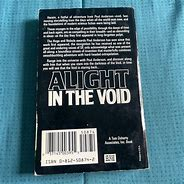
Poul Anderson's collection, Alight In The Void, also includes "The Star Beast" which we read so long ago that maybe we can now reread it with fresh eyes and a fresh mind while at the same time not repeating anything that we have posted about it before in:

blog search result for "The Star Beast"

- and for Issues In The Star Beast

- but we are not about to do any of that this evening!

The same remark applies to "Son of the Sword," which we discussed in a few posts back in July, 2013.

For now, we wish you all good night at least in this part of the world.

Friday, 26 July 2013

What Else Is In The Star Beast?


Poul Anderson's "The Star Beast" has an unexpected hero: a decadent Earthman unexpectedly performs the typically Andersonian action-adventure-fiction feat of seizing his guard's gun, knocking the guard out, escaping disguised in the guard's uniform and saving the day.

Apart from this and, of course, more importantly, the issues discussed in previous posts, a large part of this story is a vivid description of what it would be like to be, or to become, a tiger. This is similar to man becoming wolf (were-wolf) in Anderson's Operation Chaos, although that is fantasy whereas "The Star Beast" is sf. This transformation is accomplished technologically.

The tiger lacks color and perspective but sees at night, hears insects, leaves, breeze, wings and small animals' scurryings, smells grass, fungus, decay, fur and blood, feels with hairs and whiskers, lives comfortably in a damp cave, kills rabbit, deer, wild dog and hibernating bear although, crippled by his fight with the bear, he can no longer catch game and instead attacks a human being, by now beginning to forget that he had been one.

Who is the "Star Beast" of the title: the man who becomes a tiger or the fanatic who returns from the stars to sabotage the Solar utopia?

Sunday, 28 July 2013

Previous Posts

I have been reading Poul Anderson's Alight In The Void which collects:

"Terminal Quest"
"Earthman, Beware!"
"The Star Beast"
"Son of the Sword"
"Flight To Forever"

I have commented on the first four in recent posts and posted a two-part Chronology of "Flight to Forever" on June 30 and July 1, 2012. "Flight to Forever" is, appropriately, the culminating story of Anderson's time travel collection, Past Times. Therefore, when Anderson's short story collections are rationalized, it need not also appear in any other volume such as Alight In The Void.

When discussing "Earthman, Beware!," (here) I referred to an earlier post on Anderson's Brain Wave. That was "The Galactic Connection," June 15, 2012.

"The Star Beast" raises the issue of the social consequences of universally distributed abundant wealth. This and similar or related issues were discussed in earlier posts:

April, 2012
"Issues In Mirkheim"
"Something Is Rotten In Technic Culture?"
"Interstellar Wealth"
"Organic And Post-Organic"
"The Commonalty"

June, 2012
"Thulean Economics"
"Serious Issues"
"Judgment Day Economics"
"Starfarers Economics"

August, 2012
"Demetrian Economics And Ecology"
"Questions And Comments"

Thursday, 25 July 2013

Issues In The Star Beast

Poul Anderson's "The Star Beast" convinces me that, even if humanity builds a peaceful civilization on Earth or in the Solar System, it should retain some means of defense against interstellar invasion.

Such invasion does seem extremely unlikely:

do other civilizations even exist?;

if they do, surely a civilization with an advanced technology will either overcome any warmongering tendencies that it may have or, alternatively, will have destroyed itself long before it has got anywhere near to attacking anyone else?;

surely anyone capable of interstellar travel already possesses far more wealth then they can possibly hope to gain by crossing an interstellar distance and attacking someone else?

However, if interstellar travel is possible, then some human beings might colonize extra-solar planets and one of those colonies could be irrational enough to attack the home planet, which is what happens in this story. Even if we need not fear extraterrestrials, and we do not know that for sure, we might still need to fear each other - although I also remain convinced that the production and distribution of abundance will make theft and war obsolete.

But that leads to another issue which Anderson addresses here and in later works and to which I will return in a further post.

Friday, 26 July 2013

Issues In The Star Beast III

"'...I get gloomy spells where nothing seems worthwhile anymore, life is a dreadful farce...it's boredom. When you have everything without working for it, life can become horribly flat.'"

(Poul Anderson, Alight In The Void, New York, 1993, p. 82)

"'...can become...'" I agree with that.

Looking forward into an era of horror, chaos, savagery and death (death which had been prevented or at least indefinitely postponed), another character thinks:

"Maybe it was for the best...Maybe Earth had really gone into a twilight of purposeless ease. True it was that there had been none of the old striving and hoping and gallantry that had made man what he was. No art, no science, no adventure...Maybe this shock and challenge was what Earth needed..." (p. 98)

This paragraph is worth reading in full although it is longer than I want to quote here. However, it presents a false dichotomy. Why should having everything without working for it prevent art and science? Science began when a leisured, aristocratic class was freed from the necessity of physical toil. At least some of the global population would not be "bored," God forbid, but would welcome the opportunities to learn and create full time when freed from the obligation to work for a living. Types who could not adjust would die out but a new humanity would emerge, one that was sufficiently challenged by the universe, not by the shock of horror, chaos and savagery.

In other words, this is a good story but I do not agree with it.