Sunday, 27 November 2016
Megamultiverse
Similarly, St Paul saw an altar to an Unknown God. Of course, Paul drew monotheist conclusions but, in terms of mythological writing and imaginative fiction, we can envisage an anonymous deity or divine Phantom Stranger flitting between pantheons. Norse mythology names Ullr but recounts no stories about him although he appears briefly in Poul Anderson's War Of The Gods. Thus, Ullr might join our list of mysterious characters who move between universes doing important undercover work?
Saturday, 3 December 2016
James Blish And The Megamultiverse II
Prima facie, James Blish's Haertel Scholium presents a mini-multiverse, its four divergent branches dealing respectively with telepathy, energy beings, the Dirac transmitter and the planet Lithia. (The single Lithian novel is also Volume III of After Such Knowledge.) However, the Dirac transmitter "branch" denies that there are "branches of time." Its protagonists work to ensure that they continue to inhabit a single consistent timeline. So maybe the alternative future histories of the Haertel Scholium do present mutually incompatible fictional narratives?
Sunday, 21 September 2025
Megamultiverse Revisited
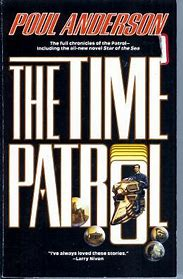
In the case of Poul Anderson's first two time travel volumes, Guardians Of Time and The Corridors Of Time, Guardians... was, at that time, the complete Time Patrol series whereas The Corridors... is not only not part of that series but also fundamentally contradicts it in their basic premises. However, some readers' minds would like to fit everything together if that was somehow possible.
Many universes make one multiverse. An even bigger dimensional framework, a megamultiverse, would be necessary to incorporate not only different timelines but also different kinds of timelines in which:
Friday, 2 December 2016
James Blish And The Megamultiverse
comparison of Poul Anderson with James Blish;
the idea of the incorporation of many fictional universes into a single megamultiverse.
Blish, like Anderson, wrote hard sf, fantasy and historical fiction but with a much smaller output. Blish's main bodies of work are:
Cities In Flight;
The Seedling Stars;
the Haertel Scholium;
After Such Knowledge.
These comprise:
two linear future histories;
one sequence of branching future histories;
one trilogy set in the past, present and future.
It will be seen that the future predominates. In fact, Blish's single volume of historical fiction and single volume of fantasy are Volumes I and II of After Such Knowledge. The branching future histories might provide material for a multiverse? Adolph Haertel, who supersedes Einstein, is referred to in more than one future - but so is Einstein. The planet Lithia exists in more than one future - but so do Earth and Mars.
When "Beep" was lengthened/novelized, it was incorporated into the Haertel Scholium. In the original "Beep," one character explicitly states:
"'I was going to do all those things. There were no alternatives, no fanciful "branches of time," no decision-points that might be altered to make the future change. My future, like yours, Dr. Wald's, and everyone else's, was fixed.'"
-James Blish, "Beep" IN Blish, Galactic Cluster (London, 1963), pp. 93-128 AT p. 116.
Although this piece of dialogue remains unchanged in the lengthened The Quincunx Of Time (New York, 1983), p. 75, the characters think their way around it. Maybe some of the Dirac beep messages come from different futures? Maybe, forewarned and forearmed, they themselves can choose between futures? - although they wisely decide against such an act of hubris.
Three characters discussing the implications of the Dirac transmitter are Blish's nearest approach to Anderson's Old Phoenix clientele and the Service that they found parallels Anderson's Time Patrol.
Wednesday, 5 September 2018
Question
Do the many parallel timelines of the Old Phoenix multiverse, the single mutable timeline of the Time Patrol universe and the different immutable timelines of The Corridors Of Time, There Will Be Time and other works exist in discrete zones or regions of just one megamultiverse (scroll down) which has 4N dimensions, as mentioned in "Time Patrol," and are there mysterious beings, like maybe obscure deities, who can travel through the megamultiverse, appearing in different times and places, intervening discretely in important events but never staying in one place and always just passing through?
I leave you with that until some time tomorrow.
Friday, 10 March 2017
Starkad
a legendary Norse hero (see here);
a planet visited by Dominic Flandry (see here);
a character in Hrolk Kraki's Saga (see the above link);
an immortal in The Boat Of A Million Years (see here);
mentioned on p. 284 of SM Stirling's The Protector's War (New York, 2006), Chapter Ten.
Thus, this single name links:
several sagas;
a future history by Poul Anderson;
Anderson's retelling of a saga;
a historical science fiction novel by Anderson;
an alternative history novel by Stirling.
Starkad might be one of our travelers through the megamultiverse.
Friday, 24 November 2017
Lilith II
We have found another candidate intercosmic traveler. Lilith interacts with Adam and demons, manages to keep herself (mostly) out of the Bible and yet looms large in Jewish mythology and some modern fantasy. She is mysterious and interacts with powerful beings in more than one time and place - the perfect suspect.
Saturday, 12 May 2018
Conceptual Space
turbulent ages, turning points, beginnings and endings in the Danellian and Technic Civilization timelines;
means of time travel in The Time Machine and in several different works by Poul Anderson;
alternative histories as imagined by various authors;
theories of a multiverse;
whether the many multiverses can be incorporated into one megamultiverse.
I used to think that the Time Patrol mutable timeline and the Old Phoenix multiple timelines were incompatible but it is hard to conceive how a system of 4N dimensions can exclude anything.
Tuesday, 26 November 2019
The Many (Fictional) Universes
reading Shadows Of Annihilation by SM Stirling;
watching His Dark Materials, which I might reread;
reflecting on -
Poul Anderson's Old Phoenix stories,
Neil Gaiman's Worlds' End,
the film, Last Action Hero.
As we have said before, any particular narrative may:
be set entirely within a single alternative history;
involve some knowledge of parallel realities, e.g., SM Stirling's The Peshawar Lancers;
involve travel between the parallels;
incorporate characters and events as fictional in one universe but real in another, e.g., a Lensman visits the Old Phoenix;
feature only the particular authors' characters or refer also to those of others, e.g., that Lensman, Sherlock Holmes and Huckleberry Finn in the Old Phoenix or Death from The Seventh Seal in Last Action Hero.
Does a single megamultiverse incorporate every possibility, including even scenarios explicitly denying a multiplicity of realities?
There will be more posts on this issue as well as on Anderson's Rogue Sword and his The People Of The Wind.
Thursday, 2 October 2025
Then And Back Again
What Saunders sees after the universe begins to reform:
a long journey futureward to avoid being pulled into the point-source
a molten planet
rain on naked rocks
under seas
strange jungles
glacial ages
the familiar Moon
"...low forested hills and a river shining in the distance...." (p. 286)
the village of Hudson, New York
a tear-off calendar and a wall clock in a bank
June 17, 1936, 1:30 P.M.
return to 1973 when the time projector, moved in the future, is now outside the house
After all that time, home at last. A sufficiently long space-time journey returns the traveller to his starting point. The Time Traveller had to turn back whereas Saunders continues forward.
Friday, 25 November 2016
Dimensions
The Time Patrol universe also has at least five dimensions because it has a second temporal dimension. We are told that it has 4N dimensions and that N is how many particles there are. In that case, the Old Phoenix multiverse and the Time Patrol universe can coexist in different parts of the 4N-dimensioned megamultiverse. It might be possible to travel between the Time Patrol and Old Phoenix realms along a sixth dimension.
However, we saw that three other universes have only four dimensions each. This implies that they exist outside the 4N-dimensioned framework and that there would be no way to enter them from outside unless someone can imagine a different means of transport? Like magic?
Sunday, 4 October 2020
1995
The young hero's physicist uncle says:
"'Never mind the physics of it...'" (p. 143)
Such an introduction would usually indicate that we are about to read a brief scientific rationale for "...temporal relativistics..." (p. 144) and "'...time projection...'" (ibid.)
All that we get, however, is:
"'Come back when you know tensor calculus, and I'll explain about n-dimensional forces and the warping of world lines.'" (ibid.)
Is that "n" the same as the "N" in "Time Patrol" where a Time Patrol Academy instructor refers to:
Saturday, 8 March 2025
Change, Actions And Information
Starfarers, 42.
"'You cannot go back into the past and change what happened, no matter what you do. But your actions can be part of what did happen." (p. 398)
The quantum intelligences called holonts form and stabilize gigantic nuclei which are deformed and spun by electromagnetic forces, thus causing spatiotemporal warps through which energetic gamma-ray photons, modulated to convey information, can pass.
Nothing shows more clearly that Poul Anderson addresses every option:
in the Time Patrol universe, you can go back into the past and change what happened;
in The Corridors Of Time, There Will Be Time and The Dancer From Atlantis, your actions are part of what did happen;
in Starfarers, only messages can be sent.
It is difficult to conceive of a multiverse that can incorporate all these universes although we have also speculated about a megamultiverse.
Friday, 25 November 2016
Moving Between Universes
Is it conceivable that fictional universes created by Anderson and others coexist in a single megamultiverse?
Could there be a narrative in which a single character moves between all these universes?
Are any characters in existing literature potential candidates for such a role?
The prospects suggested so far are Wells' Silent Man and man in grey, the Phantom Stranger and a young man in Mark's Gospel. Sean Brooks has referred to another mysterious Biblical passage: John 21. 20-23. Might the beloved disciple still be around? Also Moses and Elijah? If so, then where have they been and what have they been doing all this time?
In Anderson's own works, Holger Danske moves between universes and the narrator of the Old Phoenix short stories might take a wrong turn coming out of the Inn? This can happen to travelers who have stayed in that other free house owing allegiance to no realm, Neil Gaiman's Inn of the Worlds' End.
Here are some other characters who appear, influence events, then disappear:
the mendicant who inspired the Buddha;
the Good Samaritan (I know that it is a parable but let us suppose otherwise);
the man on the road to Emmaus - he was not recognized as Jesus and slipped away when he realized that the disciples were latching onto his scriptural interpretations but he played a pivotal role in making them believe that Jesus was risen and Messiah.
There is another mystery about the multiverse. In the Old Phoenix:
"The Taverners are as merciful as their charter, or whatever it is that was once granted them by some power unknown, allows them to be."
-Poul Anderson, "Losers' Night" IN Anderson, All One Universe (New York, 1997), pp. 105-123 AT p. 108.
Elsewhere:
"...there are some powers that no one, not even the Endless, seeks to inquire into too deeply."
-Neil Gaiman, The Sandman: The Wake (New York, 1997), p. 17.
The Endless, seven anthropomorphic personifications of aspects of consciousness, include Destiny and Death yet there are unknown powers beyond them.
Tuesday, 1 January 2019
Happy New Year
To any new readers:
welcome to Poul Anderson Appreciation;
typically, I read or reread a work by Anderson or a related author and publish short posts about the text or the issues that it raises;
currently, I am rereading Anderson's The High Crusade and Julian May's Intervention but am interrupted by new books received as Christmas or birthday (today) presents;
there are Anderson-May Parallels;
the blog recognizes SM Stirling as a worthy colleague and successor of Poul Anderson;
in particular, Stirling has surpassed Anderson in the sf sub-genre of alternative history;
I will therefore read and post about Stirling's concluding Change novel (see image);
the Change premise is that technology, including crucially electricity and gunpowder, stops working;
many people die but some in succeeding generations lead adventurous and fulfilled lives;
two questions are "How does society adapt?" and "What has caused the Change?";
there is an eventual explanation and also a curious crossover with a completely dissimilar work, The King In Yellow;
notionally, characters from all alternative histories and parallel universes can meet in Anderson's Old Phoenix Inn;
in practice, each author creates his own fictional multiverse although I have speculated about a megamultiverse.
Friday, 2 June 2017
Mysterious Characters
ERB's John Carter;
Michael Moorcock's Eternal Champion;
Donovan's Universal Soldier.
These are characters who can appear in different times and places and might travel through the megamultiverse.
Holger Danske is Poul Anderson's version of such a character. The speculation about such characters was inspired by Anderson's inter-universal inn, the Old Phoenix, and by the 4N dimensions in his Time Patrol universe.
Any warrior in an old heroic fantasy might be an earlier phase of John Carter.
Tuesday, 22 June 2021
Versions
Unlike Holmes, James Bond receives minimal treatment in Poul Anderson's works. He is mentioned just once as a fictional character in The Corridors Of Time although this would not prevent him from showing up in the Old Phoenix.
In other reading, I have discovered that there are not two but at least three versions of Bond:
the Bond of novels by Ian Fleming, Anthony Horowitz and maybe one or two others;
the Bond of the films plus some film novelizations;
the Bond of other additional novels that are more akin to the films.
I recommend Horowitz.
Friday, 25 November 2016
An Ultimate Novel
Who are the mysterious characters of literature? Why did the Time Traveler's dinner guests include the Silent Man? Who was the man in grey that bought the Crystal Egg? Who was the young man that followed Jesus when he was arrested but ran away naked leaving his linen cloth behind?
DC Comics has a sort of supernatural Lone Ranger called the Phantom Stranger (see here) who appears when needed but disappears as quickly. He is an immortal, a neutral angel, the Wandering Jew, an immortal time traveler...speculative origins. The Stranger, if no one else, would be able to access Poul Anderson's immutable timelines.
Thursday, 30 November 2023
Dominic Flandry And Time Travel
I do not think that the Time Patrol has access to the inter-universal inn, the Old Phoenix. The Time Patrol series presupposes a single mutable timeline whereas the Old Phoenix stories presuppose many parallel timelines. On the face of it, these two metaphysical systems are incompatible although maybe there can be a megamultiverse where a few beings are able to enter any universe but most space-time travellers operate by a single set of laws that excludes other such sets. Thus, in Anderson's There Will Be Time, Jack Havig's experience is confined within a single immutable timeline. All these worlds exist in Poul Anderson's imagination.
Friday, 18 February 2022
Discontinuities
There Will Be Time, V.
When Jack Havig tells Robert Anderson that:
"'Mathematically speaking, world lines are allowed to have finite, if not infinite discontinuities, and to be multi-valued functions. In many ways, time travel is equivalent to faster-than-light travel, which the physicists also declare is impossible.'" (V, p. 47)
- he echoes the language used in Time Patrol training. There Will Be Time and the Time Patrol series presuppose diametrically opposed premises regarding time travel. However, all works of fiction by a single author have a common source in their author's mind and I postulate a megamultiverse with deterministic universes in parallel timelines and a mutable timeline in a sixth dimension.
Each universe has three spatial dimensions and one temporal dimension. Immutable timelines would parallel each other along a fifth dimension. Therefore, the mutable timeline would have to exist in a sixth dimension.