Thursday, 7 July 2016
Wind, World's Edge And Time
-copied from here.
"'I hear hoofbeats,' [Gora] said low. 'I hear hoofs galloping out on the edge of the world. It is Time riding forth, and snow falls from his horse's mane and lightning crashes from its hoofs, and when Time has ridden by like a wind in the night, there are only withered leaves left blowing in the gale of his passage. He rides nearer, I hear worlds sunder before him -'"
-Poul Anderson, The Broken Sword (London, 1977), Chapter XVII, p. 116.
"Now and then on that planet, Jong Errifrans thought he heard the distant blowing of a horn...
"'Some trick of the wind, off in the cliffs yonder,' Mons Rainart suggested."
-Poul Anderson, "The Horn of Time the Hunter" IN Anderson, The Horn Of Time (New York, 1968), pp. 11-26 AT p. 11.
"...the horn of a hunter..." (p. 26)
Once at night, Hadding sees the light elves bounding to the horizon and hears their horn (here).
Dagobert is the son of a time traveler who is believed to be Wodan.
Gora is the daughter of the troll king.
Jong is a space traveler.
Hadding is an incarnation of the god, Njord.
A wind calls from the edge of the world.
Time rides like a wind at the edge of the world.
Time the hunter blows a distant horn - or it is a trick of the wind.
The elves' horn is heard from the horizon.
A knight of ghosts and shadows summons from beyond the world's end. (See here.)
Wind and Time are almost personified. Distance joins them in these evocative passages.
Thursday, 12 December 2013
The Horn Of Time
The front cover states:
"They were savage primitives of a strange future - a harrowing chronicle of the millennium after the end of the world!"
The back cover states:
"THE 20TH CENTURY PLAYED A GAME OF NUCLEAR RUSSIAN ROULETTE. AND LOST. Man must escape his own dead world, raid hostile planets, subdue his human nature to survive in a strange cosmos.
"Science-fiction master Poul Anderson explores the future in a bloodchilling narrative that spins from Earth to distant galaxies as he foretells the ultimate destiny of mankind in THE HORN OF TIME."
The book is six narratives, not one. There is no escape from a dead Earth and there are no distant galaxies. One story is about time travel from the twentieth century to the Viking period. The title story, "The Horn of Time the Hunter," features a spaceship returning from a relativistic journey to the galactic center and "The High Ones," which I have yet to read, also features interstellar travel but everything else is set on Earth. At least three of the stories do refer back to a nuclear war but with different outcomes.
The title, "A Man To My Wounding," looked familiar and the story is in fact in the collection Conflicts but I do not seem to have read it. Like "License" in Conquests, it features legalized assassination. Keeping track of collections and of short stories with related themes gets complicated.
I will post about "A Man To My Wounding" and "The High Ones" and might revisit the haunting "The Horn of Time the Hunter." Then, back to The Makeshift Rocket and Star Prince Charlie.
Monday, 16 December 2013
The Horn Of Time The Hunter And Other Matters
One previously unread story, "The High Ones," addressing major issues and evoking other stories not only by Anderson but even also by Wells, merited considerable discussion.
The story that was to be reread, "The Horn of Time the Hunter," is, like the other works mentioned here, hard sf but one of its several interesting features is psychological, mysterious or even, potentially, fantasy: an unexplained sound like a hunter's horn, heard by only one of the characters, on a briefly visited planet. Was it just the wind? The story was originally entitled "Homo Aquaticus" but that gives away the surprise discovery that the sea-dwelling inhabitants of the visited planet are descended from human colonists. The second title is far superior and extremely evocative.
When the interstellar traders called the Kith were persecuted in the Star Empire, they scattered and fled. One of their ships now returns from a twenty thousand year relativistic round trip towards the galactic center. This ship's crew did not find the Elder Race that they sought and do not yet know whether the Empire, the Kith or even humanity still exist. They find that one human colony has undergone a sea change. One of their number is killed by the aquatics and another hears the horn of time blowing on the wind...
Sunday, 23 October 2016
Significant Dates
1926 birth of Poul Anderson
1929 cosmic expansion discovered
1938 Superman published
1947 "Tomorrow's Children" by Poul Anderson and F.N. Waldrop
1947 "Chain of Logic" by Poul Anderson
1949 my birth
1951 "Tiger By The Tail" by Poul Anderson
1951 "Honorable Enemies" by Poul Anderson
1951 "Sargasso of Lost Starships" by Poul Anderson
1952 Vault Of The Ages by Poul Anderson
1952 "The Star Plunderer" by Poul Anderson
1953 Three Hearts And Three Lions by Poul Anderson
1954 Brain Wave by Poul Anderson
1954 The Broken Sword by Poul Anderson
1954 "Ghetto" by Poul Anderson
1954 "The Warriors from Nowhere" by Poul Anderson
1954 Question And Answer by Poul Anderson
1954 "The Sensitive Man" by Poul Anderson
1955 "Time Patrol" by Poul Anderson
1955 "Delenda Est" by Poul Anderson
1955 No World Of Their Own by Poul Anderson
1956 "Margin of Profit" by Poul Anderson
1956 Star Ways by Poul Anderson
1957 Earthman's Burden by Poul Anderson and Gordon R. Dickson
1957 "Memory" by Poul Anderson
1957 "Brake" by Poul Anderson
1958 The Snows Of Ganymede by Poul Anderson
1958 "The Man Who Counts" by Poul Anderson
1958 War Of The Wing-Men by Poul Anderson
1958 "The Game of Glory" by Poul Anderson
1959 Virgin Planet by Poul Anderson
1959 "Brave To Be A King" by Poul Anderson
1959 "The Sky People" by Poul Anderson
1959 "Hunters of the Sky Cave" by Poul Anderson
1959 "A Message in Secret" by Poul Anderson
1959 The Enemy Stars by Poul Anderson
1959 Perish By The Sword by Poul Anderson
1959 The War Of Two Worlds by Poul Anderson
1960 "The Only Game In Town" by Poul Anderson
1960 Guardians Of Time by Poul Anderson
1960 "The Plague of Masters" by Poul Anderson
1960 "A Twelvemonth And A Day" by Poul Anderson
1960 The High Crusade by Poul Anderson
1960 Murder In Black Letter by Poul Anderson
1960 The Golden Slave by Poul Anderson
1960 Rogue Sword by Poul Anderson
1961 "Progress" by Poul Anderson
1961 "Children of Fortune" by Poul Anderson
1961 "Epilogue" by Poul Anderson
1961 Twilight World by Poul Anderson
1961 Strangers From Earth by Poul Anderson
1961 Orbit Unlimited by Poul Anderson
1961 "Hiding Place" by Poul Anderson
1962 Un-Man And Other Novellas by Poul Anderson
1962 After Doomsday by Poul Anderson
1962 The Makeshift Rocket by Poul Anderson
1962 Murder Bound by Poul Anderson
1963 "Territory" by Poul Anderson
1963 Shield by Poul Anderson
1963 Is There Life On Other Worlds? by Poul Anderson
1964 Three Worlds To Conquer by Poul Anderson
1965 The Corridors Of Time by Poul Anderson
1965 The Star Fox by Poul Anderson
1963 Let The Spacemen Beware by Poul Anderson
1963 "The Three-Cornered Wheel" by Poul Anderson
1963 "Homo Aquaticus" by Poul Anderson
1964 "The Master Key" by Poul Anderson
1964 Three Worlds To Conquer by Poul Anderson
1965 "Trader Team" by Poul Anderson
1965 The Corridors Of Time by Poul Anderson
1966 Ensign Flandry by Poul Anderson
1966 "A Sun Invisible" by Poul Anderson
1966 "Plus Ca Change, Plus C'est Le Meme Chose" by Poul Anderson
1966 "Home" by Poul Anderson
1966 "The Moonrakers" by Poul Anderson
1966 The Fox, The Dog And The Griffin by Poul Anderson
1967 "Outpost of Empire" by Poul Anderson
1967 "Starfog" by Poul Anderson
1967 "Day of Burning" by Poul Anderson
1967 "A Tragedy of Errors" by Poul Anderson
1967 World Without Stars by Poul Anderson
1967 "To Outlive Eternity" by Poul Anderson
1968 "The Sharing of Flesh" by Poul Anderson
1969 The Rebel Worlds by Poul Anderson
1969 The Infinite Voyage by Poul Anderson
1969 Seven Conquests by Poul Anderson
1970 Tales Of The Flying Mountains by Poul Anderson
1970 "Esau" by Poul Anderson
1970 A Circus Of Hells by Poul Anderson
1970 Tau Zero by Poul Anderson
1971 "A Little Knowledge" by Poul Anderson
1971 "The Queen Of Air And Darkness" by Poul Anderson
1971 The Byworlder by Poul Anderson
1971 Operation Chaos by Poul Anderson
1971 The Broken Sword revised
1972 The Dancer From Atlantis by Poul Anderson
1972 "Wings of Victory" by Poul Anderson
1972 The Day The Sun Stood Still by Poul Anderson, Gordon R. Dickson and Robert Silverberg
1973 There Will Be Time by Poul Anderson
1973 "The Season of Forgiveness" by Poul Anderson
1973 "Wingless" by Poul Anderson
1973 The People Of The Wind by Poul Anderson
1973 "The Problem of Pain" by Poul Anderson
1973 "Rescue on Avalon" by Poul Anderson
1973 "Lodestar" by Poul Anderson
1973 The Day Of Their Return by Poul Anderson
1973 "Windmill" by Poul Anderson
1973 Hrolf Kraki's Saga by Poul Anderson
1974 "How To Be Ethnic In One Easy Lesson" by Poul Anderson
1974 A Knight Of Ghosts And Shadows by Poul Anderson
1974 "My Own, My Native Land" by Poul Anderson
1974 "Passing The Love Of Women" by Poul Anderson
1974 "A Fair Exchange" by Poul Anderson
1974 Fire Time by Poul Anderson
1974 A Midsummer Tempest by Poul Anderson
1974 The Many Worlds Of Poul Anderson, ed. Roger Elwood
1975 "To Promote The General Welfare" by Poul Anderson
1975 The Winter Of The World by Poul Anderson
1975 Homeward And Beyond by Poul Anderson
1975 Star Prince Charlie by Poul Anderson and Gordon R. Dickson
1976 The Best Of Poul Anderson
1977 A World Named Cleopatra
1978 The Avatar by Poul Anderson
1979 The Merman's Children by Poul Anderson
1979 The Demon Of Scattery by Poul Anderson and Mildred Downey Broxon
1979 A Stone In Heaven by Poul Anderson
1980 Conan The Rebel by Poul Anderson
1980 The Devil's Game by Poul Anderson
1980 The Golden Horn by Poul Anderson
1980 The Road of the Sea Horse by Poul Anderson
1980 The Sign Of The Raven by Poul Anderson
1981 Fantasy by Poul Anderson
1981 Explorations by Poul Anderson
1981 The Dark Between The Stars by Poul Anderson
1981 The Psychotechnic League by Poul Anderson
1981 "The Saturn Game" by Poul Anderson
1982 Cold Victory by Poul Anderson
1982 Starship by Poul Anderson
1982 New America by Poul Anderson
1982 The Gods Laughed by Poul Anderson
1983 Conflict by Poul Anderson
1983 "Ivory, And Apes, And Peacocks" by Poul Anderson
1983 "The Sorrow of Odin the Goth" by Poul Anderson
1983 Hoka! by Poul Anderson and Gordon R. Dickson
1983 Orion Shall Rise by Poul Anderson
1984 Past Times by Poul Anderson
1984 The Unicorn Trade by Poul and Karen Anderson
1985 Dialogue With Darkness by Poul Anderson
1985 The Game Of Empire by Poul Anderson
1985 "Pride" by Poul Anderson
1986 Roma Mater by Poul and Karen Anderson
1987 Gallicenae by Poul and Karen Anderson
1987 Dahut by Poul and Karen Anderson
1988 The Dog And The Wolf by Poul and Karen Anderson
1988 The Year Of The Ransom by Poul Anderson
1989 The Boat Of A Million Years by Poul Anderson
1990 The Shield Of Time by Poul Anderson
1991 "Star of the Sea" by Poul Anderson
1991 "Inconstant Star" by Poul Anderson
1991 The Time Patrol by Poul Anderson
Stop! This is not a complete list and was never intended to be such a long list. I have stopped temporarily only because I am not, at this time of night, finding any title that was published in 1992. The list so far shows:
(i) the dates of two important discoveries that underlie all subsequent sf;
(ii) the date of Superman who started as sf although he initiated a new genre (his alien menagerie is comparable to the one in Anderson's "Hiding Place" (1961));
(iii) for comparison, the year of my birth (blog readers can add theirs);
(iv) an unbroken record of Poul Anderson publications from 1951 until 1991 - and there was more after that.
Saturday, 21 April 2012
A Missing Ancient Race
(ii) In the Green Lantern comics, the Oans became the Guardians of the Universe who organize the Green Lantern Corps against the Qwardians.
(iii) In Julian May's Galactic Milieu Trilogy, the Lylmik organize the Galactic Milieu.
(iv) In Poul Anderson's Time Patrol series, humanity will evolve into the Danellians who will organize the Time Patrol against Neldorians, Exaltationists and chaos.
(v) Isaac Asimov's humans only galaxy did not allow for any older race but the mentally powerful Second Foundation usurped its functions, guiding history to a greater goal.
(vi) In Poul Anderson's History of Technic Civilization, many believe that the Ancients Went Beyond and Will Return.
" I think we've earned that right." (2)
(2) Poul Anderson, Tau Zero, London, 1973, p. 186.
Tuesday, 19 November 2013
The Horn Of Time
"The Horn Of Time The Hunter" (Kith future history);
"A Man To My Wounding";
"The High Ones";
"The Man Who Came Early" (time travel);
"Marius" (Psychotechnic future history);
"Progress" (Maurai future history).
The future history stories should be, and have been, collected in their respective series. The time travel story should be included in a revised edition of the time travel collection, Past Times.
That leaves two stories. "A Man To My Wounding" sounds familiar although I can't place it. Regular correspondent Sean recommends "The High Ones" which sounds unfamiliar to me so I will order a copy of The Horn Of Time.
"Time" is always an evocative word in a fiction title. In sf and in Poul Anderson, it can mean time travel although not here.
Tracking down second hand copies of all Anderson collections is one way to acquire some previously unread stories but what we really need is a multi-volume Complete Short Stories.
Tuesday, 2 August 2016
Titles
"Time" is a frequent word in sf titles, and not necessarily in time travel fiction, e.g., Anderson's "The Horn of Time the Hunter." (And see here.) Anderson's The Corridors Of Time is appropriate and evocative and not only because there are literal corridors through time in the novel. See here. Does remembering your childhood feel like peering down a long corridor?
Andre Norton's The Crossroads Of Time evokes choices, decisions and historical turning points and implies the question: could there be a literal junction in the temporal dimension? Time is abstract but we like to compare it to a medium like water. Thus, I am currently reading Volume I of SM Stirling's time travel/alternative history trilogy:
Island In the Sea Of Time
Against The Tide Of Years
On The Oceans Of Eternity
"Against the tide of years" sounds like growing old. "On the oceans of eternity" sounds like realizing that a single life is short compared with everything before and after it.
Gregory Benford's Galactic Center Saga comprises "universe as water" titles:
- In the Ocean of Night (1977)
- Across the Sea of Suns (1984)
- Great Sky River (1987)
- Tides of Light (1989)
- Furious Gulf (1994)
- Sailing Bright Eternity (1996)
Tuesday, 3 September 2013
The Horn Of Time The Hunter
So far, four series have been represented:
the Technic Civilization History;
the Psychotechnic History;
the Time Patrol;
the Kith -
- although the first two were not acknowledged. Anderson's comments merely focused on the individual stories.
Regarding the Kith, in "The Horn of Time...," Anderson explains his thinking: time dilated space travelers would develop their own culture and might sometimes be ostracized on Earth? Good thinking, Anderson.
I have said that this story should be published as an appendix to Starfarers, which does incorporate the two other Kith stories. Anderson explains:
"I was going to incorporate "The Horn of Time the Hunter" as well, but Karen convinced me that it was too dark." (p. 137)
I respectfully disagree.
Friday, 29 May 2015
Two Volumes?
a collection of all three stories in their original forms;
the novel.
These two volumes would constitute alternative versions of the Kith History. Both versions culminate with a ship returning from an unusually long exploratory voyage, either five or ten thousand years/light years. But they are different ships with different missions.
In the short story, "The Horn of Time the Hunter," the exiled Kith ship, the Golden Flyer, has explored the fringes of the galactic nucleus. We are not told what her crew found there except that it was neither wisdom nor the Elder Race. The story ends before they reach the Solar System but, en route, they have found, on an extrasolar planet, human colonists who have adapted to living in water. As in Anderson's Technic History, enough time has elapsed for human beings to adapt to different planetary environments.
This story also summarizes some future history that diverges in detail from the course of events presented in Starfarers. In the novel, a political regime called the Dominancy persecutes the Kith with exorbitant taxes whereas in "The Horn of Time...," a regime called the Star Empire physically attacks the Kith so that those who are not captured flee from the Solar System and meet in council at Tau Ceti, a rendezvous point in both versions of the History.
This mention of the Star Empire reads like a reference to an earlier installment of the series and, of course, even if such an installment did not exist at the time when "The Horn..." was written, Anderson could have added such a "prequel" later.
The viewpoint character of "The Horn..." is Jong Errifrans of the Golden Flyer and in "Ghetto," incorporated into Starfarers, Kenri Shaun recalls his friend, Jong Errifrans of the Golden Flyer.
Sunday, 27 June 2021
The Horn II
The second time Jong hears the horn, he is running to help one of his companions on the beach. The sound is louder than before so it seems that it is real. On the other hand, Jong remembers where he has heard it before. On a frontier planet, mounted huntsmen pursued a wounded, weeping animal and their leader blew just such a call from a bugle so how can Jong be hearing it again on another planet? The islands have no large animals to be hunted. Four male natives have come ashore to check that the breeding ground is in order but they are in front of Jong killing Mons Rainart, not beyond the cliffs where the sound seems to come from. Is the hearing of the horn how Jong's prescience operates, warning him of danger? It sounded faint when the natives were approaching the island and louder when their scouts were killing Mons.
Finally, as the spaceboat leaves the planet:
"I wonder what that sound was, [Jong] thought vaguely. A wind noise, no doubt, as Mons said. But I'll never be sure. For a moment it seemed to him that he heard it again, in the thrum of energy and metal, in the beat of his own blood, the horn of a hunter pursuing a quarry that wept as it ran." (p. 26)
OK. A sound heard in energy, metal and blood in a spaceboat is not a horn blown on the planet. Only the story's title connects the horn with time but that is sufficient explanation. The horn is time and we are its weeping quarry.
Friday, 10 April 2015
Very Short Future Histories
(i) Two very short unrelated "future histories," Maurai (three stories) and Kith (two stories), short enough to fit into a single collection.
(ii) The Maurai history acquires a long novel, Orion Shall Rise, and is incorporated into the time travel novel, There Will Be Time.
(iii) Kith acquires one new story, "The Tale of the Cat," which would fit between the existing stories, "Ghetto" and "The Horn of Time the Hunter."
(iv) A future historical novel, Starfarers, incorporates "Ghetto" and "The Tale of the Cat" though not "The Horn of Time the Hunter."
Observations
The Maurai are one period in a time travel history as the Kith are one period in the Starfarers history.
As a tidying up and gathering together exercise, the Maurai and Kith collection should become just a Maurai collection and "The Horn of Time the Hunter" should be included as an appendix in Starfarers.
There would then be four volumes where there were previously just five short stories.
"Ghetto" is a harrowing story of class conflict destroying a personal relationship and I am not sure that I want to reread it.
However, I will reread "The Tale of the Cat" and maybe some other chapters of Starfarers for discussion on this blog.
Tuesday, 25 February 2025
"Ghetto" And "The Horn..."
Starfarers incorporates "Ghetto" and one other Kith story, not "The Horn...," and adds some more so that the Kith History exists in two versions. We are used to different versions of single stories but not of future histories.
We encounter Time the Hunter in one Kith story and God the Hunter in several Technic History stories. Such experiences reverberate across the timelines.
The Maurai, "The People of the Sea," encounter a group called "The Sky People," whereas the Kith, "The People of the Stars," encounter a human population that has returned to the sea.
I will be out of town for most of Friday this week so probably will not post then.
Thursday, 27 February 2020
Time
See:
The Horn Of Time
Time the Destroyer and Regenerator
Lion-Headed Time (Scroll down)
There Will Be Time
The Corridors Of Time
Time Patrol
The Shield Of Time
No one can possibly read or reread all that! But my point is the importance of time as shown in some of Poul Anderson's titles and in a few powerful phrases like "the horn of time" and "Lion-Headed Time."
OK. It is late and I am thinking about time.
Thursday, 5 September 2013
Beginning To End
"Gypsy," 1950;
"Sam Hall,"1953;
"The Master Key," 1954;
"Journeys End," 1957;
Three Hearts And Three Lions (extract), 1961;
"Epilogue," 1962;
"The Horn of Time the Hunter," 1963;
"Dead Phone," 1964;
"The Queen of Air and Darkness," 1971;
"Goat Song," 1972;
"The Problem of Pain," 1973;
"Windmill," 1973;
A Midsummer Tempest (extract), 1974;
"The Saturn Game," 1981;
"Quest," 1983;
"Death and the Knight," 1995;
"Kyrie," 1996;
"The Shrine for Lost Children," 1999 -
- and that is fifty years.The acknowledgements list informs us that "The Horn of Time the Hunter" was originally "Homo Aquaticus" and we are grateful for the change.
Some Anderson titles might be confused with each other:
"Quest" and "Terminal Quest" are different kinds of stories;
"Windmill" and "Quixote and the Windmill" are installments of different series.
In 1999, Poul and Karen Anderson attended a meeting in Japan for which they designed an inhabited planet close enough to the Solar System for radio communication. Poul comments that he "...may yet get a novel out of it." (p. 360) Clearly, there was no idea of retiring after half a century of writing.
His story for the fiftieth anniversary issue of The Magazine of Fantasy and Science Fiction in 1999 was "The Shrine for Lost Children," described as a tribute to Japan. (p. 361)
The story's thirteen pages are divided into nine sections each headed by a place name:
KAMAKURA
BERKELEY
KAMAKURA
PHOENIX
KAMAKURA
NORTHFIELD
KAMAKURA
MINNEAPOLIS
KAMAKURA
I found this narrative rather disjointed. The story is fantasy if its protagonist really is internally haunted by her still-born twin sister and psychological fiction if the internal dialogue was caused by the mother's obsessive insistence on naming and continually referring to her lost daughter. In either case, the dead sister is laid to rest when the protagonist makes an offering to "...Jizo, patron of travelers and the savior of children." (p. 372)
And then there is "...Understanding...":
"It was not only Jenny who clung to me. I would not let go. Here I have freed myself from myself." (p. 374)
The last two stories, chronologically speaking, both feature a woman inwardly haunted by her dead in a religious context.
Wednesday, 15 July 2020
Life And Time
The opening sentence of Anderson's Genesis promises that the story is of a man, a woman and a world and that ghosts, gods and mysterious time pass through it. Does the novel keep its promise about time?
First, it covers cosmological periods of time:
many galactic orbits;
enough time for a slower than light intergalactic crossing;
long enough for humanity to become extinct and to be re-created.
"'I made the first of them about fifty thousand years ago.'"
-PART TWO, XII, p. 243.
Secondly, it informs us of different timescales. See Days And Eons.
Thirdly, the node of the galactic brain that recreates humanity also emulates (consciously simulates) alternative timelines.
Fourthly, when asked why she has recreated human beings, the node Gaia replies:
"'That humankind might live once more.' A sigh as of time itself blowing past."
-ibid.
And there indeed time passes through the narrative.
Sunday, 8 November 2020
Metaphors For Time
Since we cannot see time but are continually affected by it, how do we describe it? Poul Anderson's titles include "The Horn of Time the Hunter." And Time rides forth like a wind in the night. See Wind, World's Edge And Time.
Indeed, the wind is always with us:
Wednesday, 26 February 2025
Parallel Authors
Culminations
In "The Chapter Ends," psychotechnicians lead Galactic civilization.
In "Starfog," a new period of unprecedented wealth begins in post-Technic civilization.
In "The Horn...," a Kith ship returns from a twenty thousand year round trip to the fringes of the galactic nucleus and its crew will soon learn what has become of the Kith and mankind.
"The Horn..." is such a climax that it will seem like an anti-climax to return to Starfarers or even to its remaining Kith story.
James Blish's works include several future historical culminations:
in The Triumph Of Time, two universes end but several are created;
in "Watershed," Adapted Men recolonize Earth;
in Mission To The Heart Stars, the star dwelling energy beings called Angels will join Earthmen, dolphins, beadmungen and Aaa against the Heart Stars hegemony;
in "This Earth of Hours," survivors of a space battle begin a long journey back to Earth to warn of the threat from the Central Empire.
At the very end of "This Earth...," the viewpoint character sees that the galactic night is as black as death - a threat like the horn heard again at the end of "The Horn..."
Tuesday, 13 October 2020
Poul Anderson's Collections
"The Man Who Came Early" is not in Past Times but is in another Anderson collection. See above. Of the six stories in this other collection, The Horn Of Time, three are installments of different series:
Saturday, 30 May 2015
Two Volumes? II
But then, thinking this through again - and please tell me if I get anything wrong -, that tax-hungry Dominancy is presented in Chapter 21 of Starfarers which is the altered form of "Ghetto." It becomes necessary to compare the texts of "Ghetto," collected in Maurai And Kith, and of Starfarers, Chapter 21. We find several textual alterations including this one: the regime that is called "the Dominancy" in Starfarers had been called "the Star Empire" in the original version. That explains why members of its highest caste are called the Star-Free.
Thus, in the original version of the History, it was to be understood that the increased taxation introduced in "Ghetto" had preceded the physical suppression that was later referred back to in "The Horn of Time the Hunter." Did that suppression occur during the long period when Envoy was away from Earth in Starfarers?
Poul Anderson wrote:
"...I made "Ghetto," much revised, a part of my novel Starfarers. I was going to incorporate "The Horn of Time the Hunter" as well, but Karen convinced me that it was too dark."
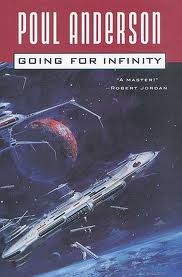
-Poul Anderson, Going For Infinity (New York, 2002), p. 137.
I think that:
the several stories that Anderson revised for later republication should be preserved in both versions;
the way to do this with the Kith stories is to publish both a three-story collection and the later novel;
thus, in the original History, the Star Empire oppressively taxes and later physically suppresses the Kith, whereas, in the Starfarers future history, the Dominancy oppressively taxes the Kith but is later superseded by the Governance and other regimes.