Showing posts sorted by relevance for query Escape. Sort by date Show all posts

Wednesday, 21 October 2020

Escape In Time

There Will Be Time, XIII.

Jack Havig, his Eyrie captors and his rescuer, Leonce, can all time travel by an act of will so how do they restrain him and how does she effect a rescue?

His ankle is chained to the wall in a room in a tower. First, Leonce spends some days in the Eyrie after Jack's escape so that she will not seem to have been involved with it. She sees the confusion and plants the idea that Jack had been helped by a time traveler that he had met in the past. She already knows that the escape will not be reported to the younger Wallis on his next inspection visit years later presumably because there had been no bad consequences in the meantime.

Next, she travels downtime to when the room was empty and uptime to the night of Jack's imprisonment. She has a pencil flashlight and a hacksaw. Freed, Havig jumps ahead to the beginning of sunrise and waits, still apparently tethered to the wall, until a guard brings his breakfast and leaves it with him. After gulping coffee, he returns to the previous night, arriving in the dark just before his younger self jumps ahead to the beginning of sunrise. Holding hands to stay together, they travel downtime until a night when the room is empty and unlocked. Still time traveling, they walk downstairs, across the courtyard and through the gates, left open in this period of peaceful Eyrie reign. They stop for air in the dark. They do not immediately time travel to before the castle was built because there were too many hunters in the forest back then. The escape is successful.

Friday, 1 March 2013

Escape!

It is a convention of action-adventure fiction that our hero and his friends are often captured by their enemies but always escape. The classic example is James Bond held at gun-point by Donovan Grant, Chief Executioner of SMERSH. Grant, pointing his gun at Bond's heart, will fire as soon as the Orient Express enters a tunnel. Meanwhile, he talks...

Somewhere earlier on this blog, I listed perhaps three occasions when one of Poul Anderson's heroes escaped from enemy territory by surreptitiously holding one of those enemies at gun- or sword-point. After Doomsday (St Albans, Herts, 1975) presents a further example. Human prisoners of the Kandemirians have been constructing new equipment for their captors. The Kandemirian physicist arrives with armed guards to escort some of the Earthmen from their cell to a laboratory to test the equipment. Suddenly the human leader pulls a gun, that should not be in his possession, and orders the physicist to conduct all of them out of there. Of course, after some violence, the men escape. The novel would have been chopped off at its mid-point if they had failed.

Anderson excelled at such action heroics but fortunately his novels offer us a lot more than this. And there is some ingenuity in how the Earthmen faked the gun. They had persuaded their captors to allow them to practise together on a piece of experimental equipment in their cell. They then constructed parts of the chassis in such a way that they could later remove a hollow cyclinder, a scrap of metal and other parts and quickly reassemble these into a mock-up of a rifle. So, while enjoying the exciting escape sequence, we can also appreciate the intelligence with which the author had constructed it.

Thursday, 16 March 2017

Argens Escapes

(Dutch cover.)

Poul Anderson can seamlessly combine speculative fiction, cosmological science fiction and action-and-adventure fiction into a single narrative. I have several times remarked how often an Anderson hero, captured by his enemies, knocks out his guard, grabs the guard's sword or gun and runs. See:

An Escape
An Occupied Planet
Escape!
Escape!
Circularity In The Corridors Of Time

It happens in World Without Stars. When Argens stumbles and his guard nudges, he is enraged enough to grab the guard's knife, slash and run. The guard pursues but collapses from the knife wound. Others pursue but are killed by the watching Pack - Argens' potential allies. A neat escape, one of many.

Saturday, 21 June 2014

An Occupied Planet

This post continues a line of thought started here.

Dan Dare: The Reign Of The Robots;

Doctor Who: Dalek Invasion

and Poul Anderson's "Hunters of the Sky Cave" -

- all recall World War II:

occupation;
street patrols;
underground resistance.

In Anderson's story, the Ardazirho have invaded and occupied the human extrasolar colony planet, Vixen. Unlike Dare's Treens and the Doctor's Daleks, the Ardazirho are not continuing villains. However, Aycharaych is behind them.

After landing covertly on Vixen and joining the resistance, Dominic Flandry reflects that a local man's hunting skills are transferable to resistance fighting. But surely such skills are also part of Intelligence work? In a Frederick Forsyth novel, a British secret agent organizing resistance in Iraqi-occupied Kuwait remains hidden and motionless but alert for eight hours while watching a possibly compromised dead letter drop before concluding that it is safe to approach it. Sure, his life depends on it. Nevertheless, this is admirable. To remain motionless and alert for eight hours is not only a day's work but a skilled day's work, and the skill is transferable to meditation, in particular to zazen. I try unsuccessfully to remain focused for half an hour.

How is Intelligence gathered? Flandry allows himself to be captured in order to learn the enemy's language, then escape. The easiness of escape is implausible. Of course, escape from capture by armed enemies is a familiar routine in action-adventure fiction and Anderson always writes his escape scenes well although their frequency diminishes their plausibility.

Friday, 5 March 2021

A Space Yacht's Auxiliary's Auxiliary

Ensign Flandry.

"The Dronning Margrete was not of a size to land safely on a planet. Her auxiliaries were small spaceships in their own right."
-CHAPTER NINE, p. 81.
 
So, in the absence of Star Trek transportation beams, the auxiliaries are used for planetary landings? They must be, but also:
 
"'Is my information correct that the auxiliaries of his Lordship's so impressive vessel possess hyperdrives in addition to gravitics?'
"'They do, distinguished colleague. But the two largest carry an airboat apiece as their own auxiliaries.'"
-CHAPTER TEN, p. 101.
 
This sounds like "Even my escape craft has an escape craft!" which I find that I have already quoted in this connection here. (See also The Big One Gets Away.) Auxiliaries with hyperdrives can be used for more than orbit to surface transport. In fact, Flandry can use an auxiliary with hyperdrive to escape into interstellar space and can later launch the auxiliary's auxiliary as a missile from what is supposed to be an unarmed craft. Poul Anderson has carefully pre-prepared both Flandry's escape and his evasion of pursuit.

Flandry flies far.

Saturday, 21 June 2014

An Escape

How does this grab you as an escape sequence? By an elaborate deception, Flandry has wangled permission for himself and his fellow prisoner, Kit, to see inside a small Ardazirho (see link) spaceship while its engines have been disconnected. Four armed guards accompany them into the ship though not into the control room. Alone with Kit, Flandry gives her a pre-arranged signal.

Returning down the companionway, Kit passes the guards while Flandry distracts them. Kit grabs a guard's knife, stabs him, grabs his rifle and shoots another. Two down, just like that. Flandry, prepared, dodges a shot aimed at him, knocks that gun aside and strikes the fourth guard, who has turned towards Kit, on the back of the head. That leaves standing only the third guard who, while springing back to get room for a shot, is blasted by Kit. Finally, Flandry kicks the stabbed guard who is down but reaching for a rifle.

All neatly choreographed so that an unarmed Terran and an unarmed Vixenite can neutralize four heavily armed Ardazihiro. One or two Ardazihiro should have watched Kit as she walked past them despite any distraction from Flandry. And how easy can it be for Flandry to dodge a point-blank shot and to knock that gun aside before a second shot is fired?

Flandry and Kit instantly escape in the ship's lifeboat. Flandry can handle the controls even though the wolves squat instead of sitting and have their thumbs on the other side of their hands and, also, he has to look for the release switch. But, nevertheless, the lifeboat controls are sufficiently similar to the spaceship controls that he has just taken time to study.

It is far more likely that such an escape attempt will either not get off the ground or end in two quick deaths.

Sunday, 5 March 2023

Escape?

The War Of Two Worlds, IV-V.

Andersonian heroes take action, solve problems and, when necessary, escape. An Andersonian hero, arrested or detained by several armed beings, is often able to attack one of his captors, seize a weapon, use it, evade the others and make his escape under cover of the confusion that he has caused. It looks as if that is about to happen again. Arnfeld and Catherine, surrounded by armed Martians, have reason to believe that a high-ranking Martian, Dzuga, and his human liaison officer, Hale, are not what they seem, might even be unknown beings equally hostile to both Martians and Terrestrials, so Arnfeld, adopting a pleading whine, steps forward, seizes a floor lamp and rams it like a spear into the face of the seated Dzuga while shouting for Catherine to escape through a window. In fact, neither of them makes it through a window but that doesn't matter. Dzuga is a metamorph and the blow to his face has not only rendered him unconscious but also penetrated his Martian disguise. He now appears as thicker, shorter and pale skinned with a crested head! - which reminds us readers of Intelligence Prime in the introduction. That sounds like my worst nightmare: a Martian invader, when attacked, morphing into a crested monster. At that stage, I would be struggling to wake up.

Friday, 14 August 2026

Future Freedoms

Interstellar travel is the ultimate symbol of freedom in American sf and, in several cases, is accompanied by escape from tyranny back on Earth. I could list titles but I think that we have been through them before:

Robert Heinlein's Howard Families escape persecution by hijacking a generation ship;

when SM Stirling's Draka conquer the Solar System, some Americans escape to found an extra-solar colony;

Poul Anderson's Technic History features the "Breakup" and, in another series, his extrasolar planet, Rustum, is colonized by ideological refugees;

the opening instalments of both of James Blish's future history series, Okies and pantropy, end with political refugees fleeing from the Solar System.

Six examples from four major sf authors. But this is wishful thinking. The bulk of humanity has to resist encroachments on its freedom here on Earth.

In a future history series, the opening instalment is a story complete in itself and the second story begins in a different time and place:

in the Technic History, the action moves from a Saturnian moon to an extrasolar planet;

Volume I of Blish's Cities In Flight ends with Senator Wagoner in his cell on the last day whereas Volume II opens centuries later with Crispin deFord waiting to watch the city of Scranton leave Earth (and, if we have read this series in publication order, then we already know deFord's fate);

Book One of Blish's The Seedling Stars ends with Sweeney on Ganymede whereas Book Two opens in a completely different milieu with Honath the Purse-Maker...

As James Blish once said, we grew up with science fiction...

Monday, 21 October 2024

Escape And Survival

"The Snows of Ganymede."

After the recent action scene: the captured rocket, also described as a boat, has wheels. It moves down a corridor and up an airlock ramp, then takes off. Again, the escape goes more smoothly than it might have done. We are told that:

"It was useful, having enemies indoctrinated out of all initiative." (VI, p. 189)

Why is this? It turns out that:

"No one had thought to cut off the automatically opening valves." (ibid.)

Poul Anderson's narrative imperative is to get the Engineers out of the city as quickly as possible so there is a plausible explanation for each comparatively easy stage in their escape. His next imperative is to have the rocket shot down and most of the Engineers killed. Thus, we return to the opening scene where three, then only two, survivors trekked across Ganymede. Everything since the end of Chapter I has been a flashback. Now, at the beginning of VII, we have returned to our starting point. So what happens next? We read on but I take another break from rereading. Anderson's heroes endure - those of them that survive, of course. I think that human resilience is his most consistent message.

Wednesday, 21 May 2025

The Big One

At the end of a story, the main villain attempts to escape and may or may not succeed, depending on whether the author wants him to remain or become a recurring villain. (Dan Dare's antagonist, the Mekon, says, "Even my escape craft has an escape craft!")

The Union Corse confronts SPECTRE on top of an Alp but Bond sees that "The Big One," Blofeld, is getting away. Blofeld does get away, with tragic results for Bond, but is apprehended and strangled in the sequel. Two volumes later, Scaramanga is seen to be getting away but, in this case, is apprehended and shot before the end of the novel.

At the climax of "Hunters of the Sky Cave," Dominic Flandry sees that Aycharaych is getting away. Flandry pursues and captures his enemy alive but the Merseians insist on a full prisoner exchange! Laying to rest the threat of Aycharaych turns out to be a much more difficult task although it is eventually accomplished at the end of the last Captain Flandry instalment.

The nature of this kind of fiction is that a hero will always have a villain.

Friday, 13 September 2013

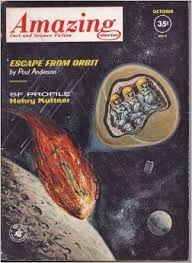
Escape From Orbit

As its title suggests, Poul Anderson's "Escape from Orbit" (Time And Stars, London, 1970) is hard sf, in fact about a spaceship in lunar orbit. However, it begins with a dream. Dreams are universally experienced so it makes sense that they be described in fiction. This dream includes fantasy: a horse leaps off the Earth. Anderson readers must be alert to which genre they are reading. It is not always clear in an opening paragraph. Magic can work in a dream in a hard sf story.

The dream is interrupted and the viewpoint character, Wister, woken by a phone call in the middle of the night. He had dreamed of the "...tinge of Julie's hair..." but wakes beside Florence. (p. 81) The ringing cuts through the dream like a saw. This reminded me of a peculiar experience: I needed to make a phone call and was surrounded by half a dozen public phones not enclosed but displayed on shelves or pedestals but they were just out of reach and far too big to be picked up - an Alice in Wonderland scenario.

Then I awoke in our attic in the middle of the night to hear the phone ringing two floors below. An acquaintance, dealing with what she regarded as an emergency, had rung at that time and had kept ringing until I answered. My sleeping brain had reversed the facts: in the dream, I was not being rung but needed to ring; I was not hearing one persistent phone but seeing several giant phones. That memory has endured.

At a residential College, someone spoke of hearing an owl during the night. Deciding to describe my giant phones, I began, "Talking about noises heard at night...," then saw the looks of horror on the faces of the guy in the next room and his girlfriend - but, instead of breaking off, I continued with the story, I suppose to their relief.

OK, the point is to read "Escape from Orbit" and to stay with the plot next time.

Monday, 15 October 2012

Escape!

Quite often in Poul Anderson's fiction, our hero escapes from his enemies and spends quite a lot of time pursued and avoiding recapture. One way to make an initial escape is with a hostage. A high-ranking opponent, surreptitiously held at sword-point or at gun-point, can be forced to accompany the hero and his companion(s), thus concealing from the hostage's subordinates that an escape is occurring.

This sort of things happens in Ensign Flandry and The Golden Slave. In the latter novel, three escaping slaves, helped by a lot of good luck, force their owner to hire a ship and to accompany them on board. Inevitably, he escapes from them and alerts the crew that his three companions are mutineers. The three retaliate by freeing and arming the slaves who are the ship's cargo. Now there is a more even fight that will result in slaughtering the crew and capturing the ship. We are back to a more plausible sequence of events.

Escapes, pursuits and fights are necessary to the plots of action-adventure fiction which, moreover, Anderson wrote very well. However, it is several other features of his writing - the well-realised historical and speculative future periods, descriptive passages, characterisation and re-told myths and legends - that make us read and reread his works.

Thursday, 4 October 2018

Three Questions

How do people survive/eat/earn a buck/make a living? (Economics.)

How should society be organized? (Politics.)

What should we believe about life and the world? (Religion and philosophy.)

Poul Anderson's fiction thoroughly addresses all three questions. Anderson valued cultural dynamism and diversity. Thus, many autonomous extra-solar colonies with FTL would, in one sense, be his ideal: a safety valve for Earth, an escape route for malcontents and a multiplicity of civilizations.

I think that the escape route would be important not just from Earth but also from other planets. Sometimes people confuse the second and third questions. Their composite answer becomes that all of society should be organized around the beliefs of some of its members. Any theocracy should have both a "church-state separation" movement and a wide-open escape route. 

Wednesday, 3 July 2013

The Characters In The Game Of Empire

Diana Crowfeather is the central character of Poul Anderson's The Game Of Empire (IN Flandry's Legacy, New York, 2012) but Targovi the Tigery is the real hero of the intelligence operation that exposes the rebel Olaf Magnassun's link to the Merseians. It is Targovi who asks questions, becomes suspicious, follows the trail and confirms the suspicions despite the opposition of superiors supporting the rebellion. For this reason, Targovi, with his alien senses and abilities, becomes the view point character of several long passages.

Axor in his quest for Foredweller ruins is pushed from pillar to post - from Imhotep to Daedalus, then from Lulach to Zacharia - as cover for Targovi's intelligence operation but nevertheless makes significant progress in the quest and, by his physical bulk alone, is crucial to the trio's escape, with the stolen evidence and database, from Zacharia.

Anderson had presented a straightforward and uncomplicated account of how, in order to steal the data, Targovi scaled a wall, entered a building, killed a Merseian, severed his head (as evidence), downloaded the database and exited by the same route. The escape from the island is even more straightforward. The dinosauroid Axor, carrying and sheltering the gun-wielding Diana, crashes through a fence, runs onto the space field and fights resisting Zacharians while the loping Targovi burns through the lock of a Merseian spaceship, kills its occupants and steals the ship in which the trio escape.

Earlier, I had shared Targovi's amusement when Axor - a Catholic priest, although Diana is not of his flock - had expressed "'...fear for that maiden's virtue.'" (p. 404) Surely Diana is not still a virgin? Yes, she is. She avoids dependent relationships and unplanned pregnancy and has spent much time among Tigeries. She gets close to Kukulkan Zachary but comes to regard him as an "alien" when she learns of the Zacharians' collusion with the Merseians. (p. 424)

Sunday, 7 April 2019

Rereading "Escape From Orbit"

Poul Anderson, "Escape from Orbit" IN Anderson, Time And Stars (London, 1970), pp. 81-100.

A previous reading of this story:

Escape From Orbit
Commuting

Also relevant to commuting:

Alien Superiority, Physical Or Moral?

"...the sky darkened until it was an infinitely deep Bonestell blue..." (p. 81)

I had no idea what "Bonestell" meant and am glad that I stopped to google it.

Wister has to get out of bed and go into the hall to answer the phone: no bedside phone or mobile. Wister's boss has to phone several colleagues successively instead of sending a group text.  (I know that our communications technology did not exist when this story was published in 1962. I am merely contrasting Anderson's projected future with our real one. We are now in the future with respect to 1962.)

"Make haste slowly, he told himself." (p. 82)

Anderson could have used the Latin: Festina lente.

The emergency is that three men are stuck in orbit around the Moon. This sounds like very near future sf but then we learn that these three have previously been to Mars and back, like the hero of Anderson's Shield. This story is somewhere between categories (i) and (ii) in the previous post.

Thursday, 9 January 2020

Young Flandry And Persis D'Io

"A smile crept over her mouth. 'Precisely what do you mean, sir?'
"He answered with a leer. 'That it is a long way to Starkad.'"
-Ensign Flandry, CHAPTER FOURTEEN, p. 148.

"Saxo glittered white among the myriads."
-CHAPTER FIFTEEN, p. 149.

Saxo is the sun of the planet Starkad. What does this prove?  If Poul Anderson had written in the way suggested by the cover of Young Flandry, then perhaps an intermediate chapter would have been devoted to the exploits of Flandry and Persis en route to Starkad? Instead, he and we rightly respect their privacy.

How likely is it that an interstellar spaceship's boat will have a smaller boat that Flandry can use as a missile to disable a pursuing Merseian destroyer whose captain knows that Flandry's vehicle is unarmed and therefore should be defenseless? Anderson invents the boat's boat as a solution to a problem. Flandry always finds a solution.

When Dan Dare's (see also here) opponent, the Mekon, flees in a spaceship, that ship is destroyed but we see the Mekon continuing his journey in a smaller craft with his head visible inside a transparent bubble, his escape craft. That craft is destroyed but the Mekon continues his flight in a smaller version as his speech balloon explains, "Even my escape craft has an escape craft!"

Tuesday, 1 August 2017

Escape And Aftermath

I compared a rescue mission and daring escape in SM Stirling's The Tears Of The Sun (New York, 2012) (see here) to the dramatic incident involving the death of Dominic Flandry's fiancee in Poul Anderson's A Knight Of Ghosts And Shadows. Reading on, we find that the similarity is closer than we had realized. In Chapter Sixteen, p. 483, of The Tears Of The Sun, a central character of the series lies on a pyre, having, we now learn, died in the escape. We knew that the mission was dangerous and cannot assume that all of the characters will survive till the end of the novel.

Thursday, 27 March 2014

Escape The Morning

Here, I made three comparisons between Poul Anderson and Robert Heinlein. Here is a fourth. An entire section of Heinlein's Future History features near future Lunar colonization and some of these stories are narrated from juvenile points of view, including one about a Boy Scout en route to the colony on Venus but meanwhile lost on the Moon.

Juvenile novels were a major part of Heinlein's output. To some extent, his juvenile fiction and his Future History overlap. Not only are there a handful of juvenile stories in the Future History but, further, several of the Scribner Juvenile novels share a considerable amount of background material with the History despite not being fully consistent with that series.

Anderson did not write anything like the same amount of juvenile fiction but nevertheless incorporated four juvenile short stories into his major future history series, the History of Technic Civilization, and one longer juvenile work, originally published as a single volume, into his Time Patrol series. His non-series short story, "Escape The Morning," is Heinleinian in every respect:

published in Boy's Life and copyright Boy Scouts of America;
featuring a juvenile hero who is a Lunar colonist and is called on to rescue a stranded VIP.

Returning from Anderson's time travel collection, Past Times, to his space travel collection, Space Folk, I have just begun to reread "Escape The Morning" and find that I remember none of the details so that it is almost like reading a new story.

Monday, 11 June 2018

Lengthening And Strengthening Power

To keep control of the Eyrie, Wallis uses time travel in two ways (I think).

(i) He lengthens and strengthens his power by periodically hopping forward to the following year. His loyal lieutenants also time travel forward:

"'...on a complicated pattern which always has one of them clearly in charge.'"
-Poul Anderson, There Will Be Time (New York, 1973), VIII, p. 77.

(ii) Leonce mentions "'...the earlier Wallis, on his inspection tour.'" (XIII, p. 142)

This implies that the earlier Wallis inspected later periods, then returned to the earlier period. We know that he met his very aged self at the end of Phase One, made one visit to Phase Two and had fleeting glimpses of Phase Three. Now it appears that he also made an inspection tour of Phase One.

When Leonce ingeniously rescues Havig, the current Wallis is present, having interrogated Havig and intending to interrogate him further, whereas the earlier Wallis on his inspection tour is not due for several years. Because no bad consequences have (yet) followed from Havig's unexplained escape, the Eyrie does not mention that escape to the earlier Wallis.

"'Why admit a failure?'" (ibid.)

There is another reason. The current Wallis did not know that Havig was going to escape, therefore the earlier Wallis cannot have been told. These time travelers have learned not to try to change the past.

But what would happen if a lot of time travelers did try to change the past? The premises of the novel become a bit shaky.

Thursday, 27 March 2014

Escape The Morning II

See Escape The Morning.

Anderson, Poul, "Escape The Morning" IN Anderson, Space Folk (New York, 1989), pp. 52-63.

A Lunar station is an isolated enterprise. Jordan Station mined ice but exhausted their vein and, in any case, so much water has been found that the price has gone down so they now mine copper and, when they have saved enough capital, might extract oil.

Lunar oil is "'Heterocyclic compounds formed by photochemical reactions in the original dust cloud that became the Solar System'" (p. 57), and can be used to make rocket fuel.

Mr and Mrs Jordan died two years ago in a pit collapse before it had been learned "'...that ferraloy cross-braces can change into a weaker crystalline form under Lunar conditions.'" (ibid.) Mark Jordan and his younger brother and sister now run the automated station, receive education by two-way television from Tycho Crater and entertainment broadcasts from Earth and deliver ore to Copernicus Town and Keplersburg. Next year, when Mark moves to the Tycho University dorm to take lab courses for an engineering degree, Tom, who is two years younger, will run the station and hire an assistant.

Thus, Anderson briefly sketches economic, educational and social features of life on the Moon and underlines, for his younger readers, that:

"'Pioneers have always had to grow up fast...'" (p. 58)