Two passages in SM Stirling's The Sky People (New York, 2007) led, first, to a reflection on relevant works by Poul Anderson and, secondly, to a more general reflection on science fiction which, appropriately, takes us back to HG Wells.
Sf writers can write about:
technological advances on Earth;
interplanetary travel;
interstellar travel;
time travel.
Thus, HG Wells wrote:
"The Land Ironclads" (tanks);
"In The Abyss" (an undersea vehicle);
The War in The Air (world war with aircraft);
The World Set Free (nuclear weapons);
The Invisible Man (invisibility);
The Food Of The Gods (giants);
Men Like Gods (the discovery of parallel Earths);
The First Men In The Moon (interplanetary travel);
A Modern Utopia (interstellar travel);
The Time Machine (time travel).
(A Modern Utopia is not a novel about interstellar travel but a discussion of a modern utopia. However, for the purpose of this discussion, Wells imagines that he and his readers have been transported to a utopian Earth in another planetary system. Also, the narrator of The War Of The Worlds speculates as to whether Martians or Terrestrials will traverse interstellar distances.)
In The Sky People, the subject-matter of interplanetary travel has passed from sf to contemporary adventure fiction. Two responses:
Frederik Pohl will concentrate on "Extrasolar stuff..." (p. 314);
L Sprague de Camp will stick to "'...historicals and time-travel from now on and leave the solar system alone...'" (p. 315).
Thus, sf has lost interplanetary travel but retains interstellar travel and time travel. Poul Anderson's main future history, avoiding the near future of interplanetary exploration, started with interstellar exploration in the twenty second century. Only much later did Anderson add a single story of interplanetary exploration set around 2055, now only forty years away.
De Camp is surely known for "...historicals and time-travel..."? His Lest Darkness Fall, a vast improvement on Mark Twain's A Connecticut Yankee In King Arthur's Court, was one source of Anderson's Time Patrol.
In The Sky People, new arrivals on Venus bring equipment like a computer camera that is not yet marketed on Earth, thus reinforcing the hero Marc's impression that he is living inside an sf story - which he is. Metafiction.
Thursday, 4 June 2015
A Cave And Neanderthals
SM Stirling, The Sky People (New York, 2007), Chapter Two.
Marc and his companions shelter and cook in a cave, a scenario familiar from many works of adventure fiction but here written really well, with details of how the meal is prepared.
Meanwhile, the Russian pilot, Binkis, is a captive of the Neanderthals, whose sordid village life makes us appreciate by contrast the amenities of human civilization:
"...the stunning urine-feces-rotting-food-sweat fetor..." (p. 64);
"...roaches and flies were inescapable. Dozens were swarming around the scraps of his dinner in the gourd bowl by the door, consuming the last of the rancid fish-and-roots stew." (ibid.);
"...a few cripples or older males slowly starved to death." (ibid.)
We hope, first, that intelligence exists on another planet and, secondly, that it has advanced far beyond such disgusting disease and dirt.
Marc and his companions shelter and cook in a cave, a scenario familiar from many works of adventure fiction but here written really well, with details of how the meal is prepared.
Meanwhile, the Russian pilot, Binkis, is a captive of the Neanderthals, whose sordid village life makes us appreciate by contrast the amenities of human civilization:
"...the stunning urine-feces-rotting-food-sweat fetor..." (p. 64);
"...roaches and flies were inescapable. Dozens were swarming around the scraps of his dinner in the gourd bowl by the door, consuming the last of the rancid fish-and-roots stew." (ibid.);
"...a few cripples or older males slowly starved to death." (ibid.)
We hope, first, that intelligence exists on another planet and, secondly, that it has advanced far beyond such disgusting disease and dirt.
Today
Today, visiting Muncaster Castle and the coastal town of Whitehaven, both in Cumbria, we were away from home for nearly twelve hours. Hence, no posts until now. At Muncaster, the display of birds of prey reminded me of Poul Anderson's Ythrians, especially when two vultures (one called "Moriarty") and three kites swooped low over the audience to musical accompaniment and a vulture landed among us. Afterwards, I mentally catalogued Anderson's Technic History, and the Ythrian History within it, yet again.
Since, to Poul Anderson fans, past history is as important as future history, I should mention that:
Muncaster Castle, built on a Roman site, has been owned by the Pennington family since 1208 and was the home of the original "Tom Fool;"
Whitehaven, my father's birthplace and childhood home, was attacked by John Paul Jones during the American War of Independence.
We live and breathe history.
Since, to Poul Anderson fans, past history is as important as future history, I should mention that:
Muncaster Castle, built on a Roman site, has been owned by the Pennington family since 1208 and was the home of the original "Tom Fool;"
Whitehaven, my father's birthplace and childhood home, was attacked by John Paul Jones during the American War of Independence.
We live and breathe history.
Wednesday, 3 June 2015
A Hero
SM Stirling, The Sky People (New York, 2007).
I have found a few more to me unfamiliar words and phrases but, for the time being, am assuming that other readers of the novel will google any terms that are unfamiliar to them - which may differ from mine.
Lieutenant Marc Vitrac, USASF, based in Jamestown on Venus, is a Ranger, whose duties include specimen collection, liaison with natives and lighter-than-air pilot. Even the short list for Venus comprises men and women who are "...nearly Olympic caliber physically as well as qualified in two or three degree-equivalents..." (p. 11). Thus, Marc more than matches the requirements for a "hero" in terms of traditional popular fiction.
We learn two additional and surprising facts about him. First:
"...he was undoubtedly the thinly disguised hero of countless trashy novels and bad TV shows..." (p. 52) back on Earth.
Although why "thinly disguised"? We read on p. 314 that Kit Carson had read dime novels about himself.
Secondly, since two nuclear spaceships regularly pass between the US and Jamestown, you might think that Marc will have leave back home, will come to the end of his stint on Venus and will eventually retire on Earth? No:
"...barring some unlikely chance, he'd leave his bones here. You didn't ship people between worlds casually, not at fifty million a ticket each way." (pp. 52-53)
So people sign up for Venus knowing that it is a one-way trip, that they will never see Earth again? Marc is not just a Lieutenant stationed on Venus but a colonist. Well, I hear that some people are volunteering to make a one-way trip to the Mars in our Solar System - though not, of course, to our Venus!
I have found a few more to me unfamiliar words and phrases but, for the time being, am assuming that other readers of the novel will google any terms that are unfamiliar to them - which may differ from mine.
Lieutenant Marc Vitrac, USASF, based in Jamestown on Venus, is a Ranger, whose duties include specimen collection, liaison with natives and lighter-than-air pilot. Even the short list for Venus comprises men and women who are "...nearly Olympic caliber physically as well as qualified in two or three degree-equivalents..." (p. 11). Thus, Marc more than matches the requirements for a "hero" in terms of traditional popular fiction.
We learn two additional and surprising facts about him. First:
"...he was undoubtedly the thinly disguised hero of countless trashy novels and bad TV shows..." (p. 52) back on Earth.
Although why "thinly disguised"? We read on p. 314 that Kit Carson had read dime novels about himself.
Secondly, since two nuclear spaceships regularly pass between the US and Jamestown, you might think that Marc will have leave back home, will come to the end of his stint on Venus and will eventually retire on Earth? No:
"...barring some unlikely chance, he'd leave his bones here. You didn't ship people between worlds casually, not at fifty million a ticket each way." (pp. 52-53)
So people sign up for Venus knowing that it is a one-way trip, that they will never see Earth again? Marc is not just a Lieutenant stationed on Venus but a colonist. Well, I hear that some people are volunteering to make a one-way trip to the Mars in our Solar System - though not, of course, to our Venus!
Quetzas And Ythrians
SM Stirling, The Sky People (New York, 2007).
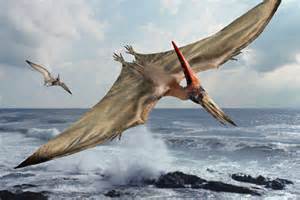
A pterodactyl with an eighty foot wingspan would not be able to fly on Earth but is able to fly on (this alternative version of) Venus because:
gravity is less;
air is thicker;
there is more oxygen.
At this point, sf readers remember:
many other fictional encounters with dinosaurs (see here);
Poul Anderson's question to John W Campbell - what comes next after fish, amphibians, reptiles and mammals?
Campbell suggested an animal that can energize its body by pumping atmospheric oxygen directly into its bloodstream. Anderson utilized this suggestion to imagine Ythrians, able both to fly under terrestroid conditions and to carry a body and brain heavy enough for intelligence.
Reading about Stirling's Quetzas and remembering Anderson's Ythrians, we next ask: do the conditions on Stirling's Venus allow for intelligent fliers?
A pterodactyl with an eighty foot wingspan would not be able to fly on Earth but is able to fly on (this alternative version of) Venus because:
gravity is less;
air is thicker;
there is more oxygen.
At this point, sf readers remember:
many other fictional encounters with dinosaurs (see here);
Poul Anderson's question to John W Campbell - what comes next after fish, amphibians, reptiles and mammals?
Campbell suggested an animal that can energize its body by pumping atmospheric oxygen directly into its bloodstream. Anderson utilized this suggestion to imagine Ythrians, able both to fly under terrestroid conditions and to carry a body and brain heavy enough for intelligence.
Reading about Stirling's Quetzas and remembering Anderson's Ythrians, we next ask: do the conditions on Stirling's Venus allow for intelligent fliers?
The Sky People, Chapter One, continued
SM Stirling, The Sky People (New York, 2007).
"'The herbivores like this one' - he kicked the ceratopsian's shield - 'are dumb as geckos.'" (p. 18)
"The stems were deep, poplin green..." (ibid.)
"A Grand Banks-style schooner..." (p. 19)
"...there were board sidewalks on the main drag..." (p. 20)
"'...frontier Deadwood...'" (ibid.)
I am learning a lot on the second reading, including this:
"...the first cargoes and personnel had come down in one-way capsules that had landed on the shallow bay...it had taken years to get the runway and orbital boosters ready for two-way traffic." (p. 19)
So the first American explorers of Venus had willingly stranded themselves on the planetary surface for several years, a detail that simply did not impinge on my brain, or at least not on my memory, on the first reading of the novel. As with Poul Anderson, there turns out to be a great deal more information in the text than we, or at least I, assimilate on a single reading. It is almost like reading another book.
"'The herbivores like this one' - he kicked the ceratopsian's shield - 'are dumb as geckos.'" (p. 18)
"The stems were deep, poplin green..." (ibid.)
"A Grand Banks-style schooner..." (p. 19)
"...there were board sidewalks on the main drag..." (p. 20)
"'...frontier Deadwood...'" (ibid.)
I am learning a lot on the second reading, including this:
"...the first cargoes and personnel had come down in one-way capsules that had landed on the shallow bay...it had taken years to get the runway and orbital boosters ready for two-way traffic." (p. 19)
So the first American explorers of Venus had willingly stranded themselves on the planetary surface for several years, a detail that simply did not impinge on my brain, or at least not on my memory, on the first reading of the novel. As with Poul Anderson, there turns out to be a great deal more information in the text than we, or at least I, assimilate on a single reading. It is almost like reading another book.
The Sky People, Chapter One
The United States Aerospace Force (USASF) has a spaceport in the Jamestown Extraterritorial Zone on the Gagarin Continent on Venus in 1988. The two nuclear USASF ships plying between Earth and Venus are the Carson and the Susan Constant. (Thus, we have referred to the historical first man in space and a fictional first man on Venus.)
A Venerian (I prefer that adjective) pterodactyl is called a Quetza.
"The winged reptile turned in a circling gyre..." (p. 17)
Is "'...Kartahown...'" (p. 12) a place name in the local language or derived from English "Carter town"?
A Venerian (I prefer that adjective) pterodactyl is called a Quetza.
"The winged reptile turned in a circling gyre..." (p. 17)
Is "'...Kartahown...'" (p. 12) a place name in the local language or derived from English "Carter town"?
The Sky People, Prologue
SM Stirling, The Sky People (New York, 2007).
The Prologue is six pages:
pp. 1-3 are headed VENUS June 14, 1962
pp. 4-6 are headed Baikonaur Cosmodrome, Kazakhstan, USSR June 14, 1962
"The morning sun was still low, casting the seven runners' shadows before them and turning the clouds to the color of raw gold." (p. 1)
"The land before the dozen-strong war party was gently rolling..." (p. 2)
"...a half-dozen figures pushed through the brush and stood staring at the probe." (p. 5)
Observations:
Knowing what we do both of space exploration in the 1960's and of Venus, we instantly recognize that this novel is set in an alternative Solar System. We do not even expect the Sun to be visible on the surface of Venus.
The number in this group seems to vary from seven to twelve to six? - although "half-dozen" could loosely mean "about six."
On pp. 5-6: the Yanki Martian probe will land next month. Thus, the sequel, In The Courts Of The Crimson Kings, will be simultaneous, not subsequent.
Words that we might need to google:
"...samovar..." (p. 4);
"...knobkerrie..." (p. 5);
"...prognathous..." (p. 5).
Any reader who does not immediately turn to Chapter One is not an sf fan.
The Prologue is six pages:
pp. 1-3 are headed VENUS June 14, 1962
pp. 4-6 are headed Baikonaur Cosmodrome, Kazakhstan, USSR June 14, 1962
"The morning sun was still low, casting the seven runners' shadows before them and turning the clouds to the color of raw gold." (p. 1)
"The land before the dozen-strong war party was gently rolling..." (p. 2)
"...a half-dozen figures pushed through the brush and stood staring at the probe." (p. 5)
Observations:
Knowing what we do both of space exploration in the 1960's and of Venus, we instantly recognize that this novel is set in an alternative Solar System. We do not even expect the Sun to be visible on the surface of Venus.
The number in this group seems to vary from seven to twelve to six? - although "half-dozen" could loosely mean "about six."
On pp. 5-6: the Yanki Martian probe will land next month. Thus, the sequel, In The Courts Of The Crimson Kings, will be simultaneous, not subsequent.
Words that we might need to google:
"...samovar..." (p. 4);
"...knobkerrie..." (p. 5);
"...prognathous..." (p. 5).
Any reader who does not immediately turn to Chapter One is not an sf fan.
Tuesday, 2 June 2015
What To Reread
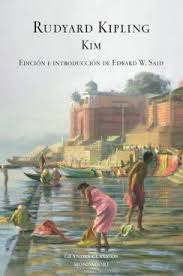
Reading Kim by Rudyard Kipling is entertaining and so far has generated five posts, including this one, so it seems worthwhile to continue, at least until SM Stirling's In The Courts Of The Crimson Kings arrives. Another option is to reread parts of Stirling's The Sky People in preparation for ...Crimson Kings. Despite having read The Sky People recently, I do not recall all of its events by any means. Most such information remains outside conscious memory, necessitating continual reference back to the relevant texts.
I think that the comparisons and connections that I make between Kipling and Poul Anderson are valid but, in any event, this is free composition where anything goes and the sky is the limit! It is good to read and discuss such works even if in the process Poul Anderson Appreciation becomes a more general literary appreciation. However, on this blog, other texts will usually be perceived insofar as they connect with or relate to Poul Anderson.
A List Description
Having frequently quoted and commended Poul Anderson's colorful and comprehensive list descriptions (scroll down) of busy street scenes, I have now found such a description in Rudyard Kipling's Kim (London, 2010) as could have been written by Anderson.
Kim and the lama enter the Kashmir Serai, a "...huge open square...surrounded with arched cloisters where the camel and horse-caravans put up on their return from Central Asia." (p. 17)
In the Serai, "...all manner of Northern folk..." (ibid.):
tend ponies and camels;
load and unload bales and bundles;
draw water;
pile grass for stallions;
cuff caravan dogs;
pay camel drivers;
engage grooms;
swear, shout, argue and chaffer.
In addition to the sounds of human voices, the well-windlasses creak and the stallions shriek. The four descriptions of conversations, "...swear..." etc, are particularly Andersonian, especially the chaffering. However, Anderson would also have listed:
the kinds of Northern folk;
more noises from animals and other sources;
the various, intermingling smells!
Kim and the lama enter the Kashmir Serai, a "...huge open square...surrounded with arched cloisters where the camel and horse-caravans put up on their return from Central Asia." (p. 17)
In the Serai, "...all manner of Northern folk..." (ibid.):
tend ponies and camels;
load and unload bales and bundles;
draw water;
pile grass for stallions;
cuff caravan dogs;
pay camel drivers;
engage grooms;
swear, shout, argue and chaffer.
In addition to the sounds of human voices, the well-windlasses creak and the stallions shriek. The four descriptions of conversations, "...swear..." etc, are particularly Andersonian, especially the chaffering. However, Anderson would also have listed:
the kinds of Northern folk;
more noises from animals and other sources;
the various, intermingling smells!
Subscribe to:
Posts (Atom)