Wednesday, 3 June 2015

The Sky People, Chapter One, continued

SM Stirling, The Sky People (New York, 2007). 

"'The herbivores like this one' - he kicked the ceratopsian's shield - 'are dumb as geckos.'" (p. 18)

"The stems were deep, poplin green..." (ibid.)

"A Grand Banks-style schooner..." (p. 19)

"...there were board sidewalks on the main drag..." (p. 20)

"'...frontier Deadwood...'" (ibid.)

I am learning a lot on the second reading, including this:

"...the first cargoes and personnel had come down in one-way capsules that had landed on the shallow bay...it had taken years to get the runway and orbital boosters ready for two-way traffic." (p. 19)

So the first American explorers of Venus had willingly stranded themselves on the planetary surface for several years, a detail that simply did not impinge on my brain, or at least not on my memory, on the first reading of the novel. As with Poul Anderson, there turns out to be a great deal more information in the text than we, or at least I, assimilate on a single reading. It is almost like reading another book.

The Sky People, Chapter One

The United States Aerospace Force (USASF) has a spaceport in the Jamestown Extraterritorial Zone on the Gagarin Continent on Venus in 1988. The two nuclear USASF ships plying between Earth and Venus are the Carson and the Susan Constant. (Thus, we have referred to the historical first man in space and a fictional first man on Venus.)

A Venerian (I prefer that adjective) pterodactyl is called a Quetza.

"The winged reptile turned in a circling gyre..." (p. 17)

Is "'...Kartahown...'" (p. 12) a place name in the local language or derived from English "Carter town"?

The Sky People, Prologue

SM Stirling, The Sky People (New York, 2007).

The Prologue is six pages:

pp. 1-3 are headed VENUS June 14, 1962
pp. 4-6 are headed Baikonaur Cosmodrome, Kazakhstan, USSR June 14, 1962

"The morning sun was still low, casting the seven runners' shadows before them and turning the clouds to the color of raw gold." (p. 1)

"The land before the dozen-strong war party was gently rolling..." (p. 2)

"...a half-dozen figures pushed through the brush and stood staring at the probe." (p. 5)

Observations:

Knowing what we do both of space exploration in the 1960's and of Venus, we instantly recognize that this novel is set in an alternative Solar System. We do not even expect the Sun to be visible on the surface of Venus.

The number in this group seems to vary from seven to twelve to six? - although "half-dozen" could loosely mean "about six."

On pp. 5-6: the Yanki Martian probe will land next month. Thus, the sequel, In The Courts Of The Crimson Kings, will be simultaneous, not subsequent.

Words that we might need to google:

"...samovar..." (p. 4);
"...knobkerrie..." (p. 5);
"...prognathous..." (p. 5).

Any reader who does not immediately turn to Chapter One is not an sf fan.

Tuesday, 2 June 2015

What To Reread

Reading Kim by Rudyard Kipling is entertaining and so far has generated five posts, including this one, so it seems worthwhile to continue, at least until SM Stirling's In The Courts Of The Crimson Kings arrives. Another option is to reread parts of Stirling's The Sky People in preparation for ...Crimson Kings. Despite having read The Sky People recently, I do not recall all of its events by any means. Most such information remains outside conscious memory, necessitating continual reference back to the relevant texts.

I think that the comparisons and connections that I make between Kipling and Poul Anderson are valid but, in any event, this is free composition where anything goes and the sky is the limit! It is good to read and discuss such works even if in the process Poul Anderson Appreciation becomes a more general literary appreciation. However, on this blog, other texts will usually be perceived insofar as they connect with or relate to Poul Anderson.

A List Description

Having frequently quoted and commended Poul Anderson's colorful and comprehensive list descriptions (scroll down) of busy street scenes, I have now found such a description in Rudyard Kipling's Kim (London, 2010) as could have been written by Anderson.

Kim and the lama enter the Kashmir Serai, a "...huge open square...surrounded with arched cloisters where the camel and horse-caravans put up on their return from Central Asia." (p. 17)

In the Serai, "...all manner of Northern folk..." (ibid.):

tend ponies and camels;
load and unload bales and bundles;
draw water;
pile grass for stallions;
cuff caravan dogs;
pay camel drivers;
engage grooms;
swear, shout, argue and chaffer.

In addition to the sounds of human voices, the well-windlasses creak and the stallions shriek. The four descriptions of conversations, "...swear..." etc, are particularly Andersonian, especially the chaffering. However, Anderson would also have listed:

the kinds of Northern folk;
more noises from animals and other sources;
the various, intermingling smells!

All The World(s) Going And Coming

Science fiction writers have sometimes based Terrestrial colonials and extraterrestrial natives on European colonials and Asian or African natives. Equally, an account, for example, of British-ruled India can seem so exotic as to remind the reader of a science fictional setting:

"'Look! Brahmins and chumars [or see], bankers and tinkers, barbers and bunnias, pilgrims and potters - all the world going and coming.'"
-Rudyard Kipling, Kim (London, 2010), p. 58.

And, on the extrasolar planet Imhotep, Diana Crowfeather sees, among the "...brawling, polyglot, multiracial population, much of it transient, drifting in and out on the tides of space..." (Poul Anderson, Flandry's Legacy, p. 195), Tigeries, a Donarrian, Irumclagians, Shalmuans and a Wodenite.

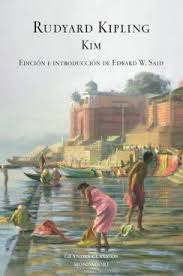
Religions on Imhotep are also as diverse as in Kipling's India. Whereas Tigeries are inchoate pagans and Diana sleeps in "...a ruinous temple..." (p. 196), the Wodenite, Francis Xavier Axor, is ordained in the Galilean Order of the Jerusalem Catholic Church. The orphan Diana guides Axor just as the orphan Kim had guided a Tibetan lama (see image).

Read Kipling, then Anderson (if you haven't already).

The Universal Quest In Kipling And Anderson

Kim's lama walks around North West India seeking his River of Enlightenment. Mad though this quest is, we are all on the same quest in different forms. My friends go to church. I sit facing a wall. None of us walks around England peering into every river or stream. But we will know Enlightenment when it finds us - or when He finds us if you are a theist. The lama and I refer to one Aryan Lord whereas my Anglican friends refer to their Hebrew Lord. The Ways transcend nation and race. (Malcolm X met white Muslims at Mecca.)

Poul Anderson's Fr Axor travels between planetary systems seeking evidence for the Universal Incarnation. Will he find it? He might, but we expect that many of his contemporaries will not accept his interpretation of the data.

The lama and Axor, clergy beings in their respective traditions, are equally sincere. However, seekers are as multifarious as the Truth is manifold.

"'Stand by. The Divine, in whatever form It manifests Itself to you, the Divine is with us.'" (Flandry's Legacy, p. 261)

Kim Again

I have read again Chapters 1 and 2 of Kim (London, 2010), with their references to the "...Peshawur brigades." (p. 38) It seems that the many faiths and castes traveling on the Indian trains are as diverse and exotic as the innumerable intelligent species in Poul Anderson's Terran Empire. Thus, Kipling's India feels very close to Anderson's extrasolar planets - and also to SM Stirling's alternative histories, especially of course to the history of the Angrezi Raj and The Peshawar Lancers.

However, since it is now past midnight and the 2nd of June, this post goes no further. I hope soon to post about Stirling's history in which explorers from Earth encounter exotic inhabitants of Mars and Venus.

Monday, 1 June 2015

Not Read Yet

Regarding Poul Anderson titles not yet read by me, Murder In Black Letter remains available but too expensive for my budget.

Since the SM Stirling novel to which I referred here was In The Courts Of The Crimson Kings, I searched the blog to see what, if anything, I had already posted about this novel. See here. There is an explicit reference to Poul Anderson but the viewpoint character of this passage is Frederik Pohl.

The fictional Pohl reflects that sf settings will have to go extrasolar as meanwhile Louis L'Amour and James Michener will fictionalize the exploits of planetary explorers, just as Kit Carson was fictionalized in his own lifetime. Carson even read dime novels about himself while he still really was fighting Indians in the Rockies. That is an interesting relationship when it occurs - between the real man and his fictional counterpart. If someone writes a novel in which Kit Carson reads a "Kit Carson" dime novel, then a fictional Carson reads about a fictional Carson or, to be more precise, a realistically fictional Carson reads about a fancifully fictional Carson.

Somewhere in Stirling's first "Lords of Creation" novel, The Sky People, an explorer on Venus reflects that people on Earth enjoy fictional accounts of the exploits of named planetary explorers. (Correction, 4 June 2015: not named. See here.) And this happens in a work of fiction that is written to celebrate earlier works of fiction written at a time when Mars and Venus really might have turned out to be inhabitable. Pretty smart stuff.

Round The Corner

(Some of us here abbreviate "tomorrow" to "tomoz" for texting purposes.)

Tomoz: Latin class and arrival of house guest.

Result: maybe less blogging.

Soon: arrival by post of an SM Stirling novel.

Result: much posting, I expect.

Poul Anderson purists might be less interested or think that the blog is going off topic? I have sometimes posted about other writers relevant to Poul Anderson and, so far, have then returned to Anderson but it remains to be seen how the blog develops in the longer term.

I think that The People Of The Wind is almost Anderson's perfect novel and would love to read through it in detail yet again but, unless a lot of time is allowed to elapse before a reread, how likely am I to find new points to post about? Page viewers are welcome to search the blog for references to this novel and to draw attention to any perspectives differing from mine. As with Mirkheim, which is a perfect political science fiction novel, the reader must assess the characters and their opinions as if dealing with a comparable situation in the real world. Watching the TV news before reading a debate or argument between Anderson's characters brings home the extent to which Anderson's imaginative fictions hold a mirror to reality.