Showing posts sorted by relevance for query Thor. Sort by date Show all posts

Thursday, 18 August 2016

Thor

Thor is a public figure, seen on cinema screens. Some readers thought that Neil Gaiman's The Sandman mocked the Marvel Comics Thor whereas instead it accurately presented the Eddic Thor. So let us trace Thor's appearances in Poul Anderson's works.

(i) "Redbeard went to the foot of the poop and shook his hammer."
-The Golden Slave (New York, 1980), 125.

"'They call me Tjorr the Sarmatian...'" (p. 128)

(ii) "His threats and foul words became too much for Thor. The storm god smote him, and a crushed skull was the wage that he got."
-War Of The Gods (New York, 1999), p. 13.

(iii) "From the north, a man in a chariot drawn by two goats. He stood burly, red-bearded, clad in helmet and ringmail, iron gloves and an iron belt. Driving with his left hand, he gripped a short-handled hammer in his right. The cloak blew behind him on mighty gales. The rumble of his car wheels went down and down the sky. He laughed, swung the hammer and threw it. Where it struck, fire blasted and the air roared; it returned to him."
-Operation Chaos (New York, 1995), p. 276.

(iv) "'Fellow name of Thor. He has a red beard, and he drives in a wagon pulled by goats...Thor has a hammer too, which he throws at trolls. I don't think those blobby characters will stand a chance.'
"I started to open my mouth. This didn't look semantically right to me."
-World Without Stars (New York, 1966), p. 14.

The man, Tjorr, becomes the storm god, Thor. Even when semantically wrong, he lives in a story.

Monday, 11 July 2016

Thor And Christ

(Scattery Island.)

The Demon Of Scattery. See here.

"...Halldor saw clasped hands and knew she was calling on her White Christ - in a whisper, but it might reach far. He touched the small silver hammer at his throat and drew Thor's sign." (pp. 12-14)

In Halldor's world-view, Thor and Christ are competing gods. Christ is not near but might hear. Thor is supposed to have challenged him. See here and here. Historical fiction presents characters with different world-views whereas historical fantasy can assume a polytheist world-view. We were told on p. 7 that the narrator of this story, Mananaaan, "...had been a god..."

Halldor is prime-signed. (p. 20)

"...by it he did not forswear his friend Thor..." (pp. 20-21)

In a far future, when a child dreams of monsters, an immortal spaceman tells her that he knows of someone "'...who can take care of that.'"

"'Fellow name of Thor.'" (Anderson, World Without Stars, Ace Books, New York, 1966, p. 14)

Thor endures although not as a literal being.

Sunday, 24 September 2023

Thor And Hugh Valland

Poul Anderson, World Without Stars (New York, 1966).

See Dream Country plus combox.

OK. I got it wrong about Thor so here's the deal. Valland tells young Wenli that:

Thor has a red beard;
goats pull his wagon;
the wheels make thunder;
Thor throws a hammer at trolls;
he will come if they ask him;
Valland helped Thor in an argument with an electrostatic generator;
Thor caught the snake that encircles the world.

Born in the twenty-first century, Valland remembers - and adds to - the myths.

Tuesday, 25 September 2012

Saxo And Starkad

In Poul Anderson's Ensign Flandry, Starkad is an inhabited planet of the star Saxo. As sf fans, we are unconcerned about the origins of these names although we are very concerned about the fates of the two intelligent Starkadian species, land-dwellers and sea-dwellers, that have become pawns of the Terran Empire and the Merseian Rhoidunate, respectively.

However, names carry rich histories if we can see it. Saxo Grammaticus is one of Anderson's sources for his heroic fantasies and in one of those fantasies, Hrolf Kraki's Saga (New York, 1973), who should appear but Starkadh:

of Jotun descent;
born six-handed;
Thor ripped off four;
Odin fostered him;
and said he should have three men's lifespans;
Thor said he must perform an unworthy deed in each;
Odin gave him the best of weapons;
Thor ordered that he would never own land;
Odin said he would always have money;
Thor that he would never have enough;
Odin that he would have victory in every battle;
Thor that he would always be wounded;
Odin made him first among skalds;
Thor made him immediately forget what he had uttered;
he fomented strife at the wedding of King Hroar's daughter. (pp. 110-111)

I neither knew that such a convoluted story existed in Norse mythology nor suspected that such a rich history lay behind the name of a planet in Ensign Flandry.

Thursday, 9 June 2016

Visual Media

OK. It is well after midnight. I want to stop reading prose and switch to a visual medium but stay with the mythological theme. Poul Anderson's heroic fantasies concentrate on Odin rather than on Thor. However, on p. 13 of War Of The Gods (Tor Books, New York, 1999):

"A giant stood and roared... His threats and foul words became too much for Thor. The storm god smote him, and a crushed skull was the wage that he got."

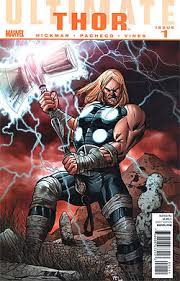
Thor is in the Marvel Movieverse and in many Marvel comics with the other Aesir although they are misnamed "Asgardians."

Odin and Thor are in Neil Gaiman's The Sandman.

Fenris Wolf is in Mike Carey's Lucifer, a sequel to The Sandman, where one of the Lilim calls Fenris "A god from a forgotten pantheon. An accidental survival." (Lucifer: Morningstar, New York, 2006), p. 79.  (What an insult!)

Here we have:

Thor in a Poul Anderson novel;
Thor in films and sequential art.

The perfect synthesis would be screen and graphic adaptations of Poul Anderson's works.

Monday, 18 May 2015

Changing Gods

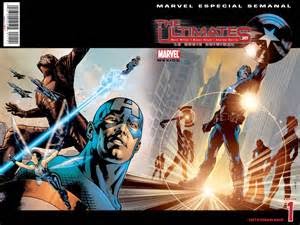
Last night, for a change from Latin verse or American English prose, I reread parts of the graphic work, The Ultimates by Mark Millar and Bryan Hitch, a superior version of the Marvel Comics superhero team, the Avengers. Of course, I found a parallel with Poul Anderson: the Ultimates include Thor.

However, this is a New Age Thor who defends anti-war demonstrators against the police and calls the US a new Roman Empire! The reference to the Roman Empire is a second parallel. But is the Ultimates Thor inauthentic? He is certainly un-Eddaic but, as I pointed out here, our gods have grown up with us. Poul Anderson, of course, shows us the process in "Star of the Sea." See in particular "The Evolving Goddess," and "Anses And Wanes."

Addendum: For authentic comic strip adaptations of Odin and Thor, see Neil Gaiman's The Sandman: Season Of Mists.

Friday, 26 January 2024

Thor And Ansa

The People Of The Wind, IV.

The Terran fleet includes:

"...the Planet-class cruisers, Thor and Ansa..." (p. 477)

Thor, of course, is a Norse god, mentioned in Poul Anderson's War Of The Gods. Ansa is a planet forcibly annexed by the Terran Empire in the previous Technic History instalment, "Sargasso of Lost Starships." However, that planet was named after:

"'...warlike, masculine sky-gods, the Anses or Aesir.'"
-Poul Anderson, "Star of the Sea" IN Anderson, Time Patrol (Riverdale, NY, December 2010), pp. 467-640 AT 11, p. 465.

And Thor was an Ansa or As. (Plurals: Anses; Aesir.)

Thus again, names encapsulate much history and, in this case, both refer back to Norse mythology. 

Monday, 13 January 2014

SF And Fantasy In A Detective Novel

In Poul Anderson's detective novel Murder Bound (New York, 1962), another sfnal (science fictional) passage:

"He had a weird sense of distortion, as if he had come back from another universe, where suns were black and cold pulsed from them and time ran uphill toward the past." (p. 163)

That could be the setting of another novel. By entering the black sun universe, somehow surviving there for a year, then returning to the home universe, a character might emerge a year in the past?

Also, two more fantasy passages. First:

"He...thought about Grettir the Strong, who had destroyed a draug in single combat. That was eight or nine hundred years ago..." (p. 168)

Grettir sounds like yet another legendary hero whom Anderson could have adapted as the hero a fantasy novel.

Secondly:

"Wednesday...Odin's day. The old one-eyed chief of the Norse gods. But he was a sinister figure, with his wolves and ravens. He made the first witchcraft in the world. Human sacrifices were given to him. At night he rode through the sky with all the dead galloping after him. He's the Wild Huntsman, you see." (p. 173)

This passage is in the past tense, except for the last sentence. Myths are simultaneously long ago and always now. The authentic Odin as described here is, of course, an active participant in several of Anderson's fantasy novels.In my teens, I read what was effectively a Christianized retelling of the Norse myths. Human sacrifice was not mentioned. Odin and Thor were presented as benign protectors of humanity from the personified hostile elements. After I have published this post, I will copy a post on Voluspa from another blog.

Murder Bound also characterizes Thor:

"Thursday comes next. Red-bearded Thor, the thunder god. He was a much pleasanter sort. The common people liked him best. That's why so many Norse names begin with 'Tor.' He gave rain to the fields. And he fought the giants and trolls. Thursday is a good day." (ibid.)

In the North of England, we live in the former "Danelaw" and still have place names incorporating "Thor."

Friday, 24 August 2018

Thor And Hugh Valland

This is the seventh post this week to have been inspired by Poul Anderson's World Without Stars, Chapter II.

Gods live in us. Hugh Valland, born about 2018 (a very significant year: see also here), is old enough to remember still earlier stories about Thor, who has been mentioned on this blog more often than I had realized.

Valland is also creative enough to compose new stories about Thor. The god will come to help Wenli if asked because he owes Valland a favor:

"'I helped him out once when he got into an argument with an electrostatic generator. Now let me tell you more about him.'" (p. 15)

Valland, a successor of the skalds, then recounts the tale of Thor and the world serpent. All of Poul Anderson's works are set in a single - multiverse.

Monday, 15 May 2017

Across The Genres And Timelines

The Golden Slave by Poul Anderson is historical fiction and its central character, Eodan, is the original of Odin.

"The Sorrow of Odin the Goth" by Poul Anderson is historical science fiction and its central character, Carl Farness, is mistaken for Odin.

Thus, The Golden Slave and "The Sorrow of Odin the Goth" could occur in earlier and later periods of a single timeline.

The Broken Sword by Poul Anderson is heroic fantasy and its characters include the god, Odin.

Thus, The Broken Sword could occur in a second timeline accesible from Anderson's inter-universal inn, the Old Phoenix.

World Without Stars by Poul Anderson is futuristic sf and its central character, Hugh Valland, refers to Thor who, we know, is a son of Odin.

However, the future of World Without Stars differs from the one described in the timeline of "The Sorrow..."

Therefore, World Without Stars is set in a third timeline.

Thus:
three genres;
one composite genre;
at least three timelines.

However, this in no way exhausts either Anderson's genres or his timelines, although all might be incorporated into a single multiverse.

Addendum: And, of course, Tjorr, original of Thor, was Eodan's companion. It is very difficult to remember all the connections.

And the god, Thor, wields his hammer in the heroic fantasy, War Of The Gods.

Thursday, 9 June 2016

From Thor To The Terran Empire

Vagnhofdi the jotun:

"...was a terrible foe who might well put a host to flight, but if too many men came at him for too long, he would die. It would happen very fast if they offered to Thor and the god chose to help them."
-Poul Anderson, War Of The Gods (Tor Books, New York, 1999), p. 19.

Will Thor intervene against a giant?
Maybe.

Will the US or UN intervene in the Middle East?
Maybe.

Will the Space Patrol intervene in the Second American Revolution?
No. It is an internal disorder.

Will the Terran Empire intervene on Starkad or on Brae?
Yes (good) and yes (bad).

Essentially the same question in a mythical narrative, in current affairs and in two future histories, beginning and ending with Poul Anderson. How neat is that?

Tuesday, 26 July 2022

Gods And Days

"The Sorrow of Odin the Goth."

"'The Romans thought Donar, whom the Scandinavians called Thor, must be the same as Jupiter, because he ruled over weather; but to the Goths, he was a son of Tiwaz. Likewise for Wodan, whom the Romans identified with Mercury.'" (p. 389)

And, in the new Thor film, Thor says that he had admired and learned from Zeus! Thursday is Jeudi in French. Wednesday is Mercredi. Tuesday is Mardi in French and De Mairt in Irish. The identification of Wodan with Mercury seems odd. However, Wodan is:

"'...the Wanderer. That's why the Romans thought he must be Mercury under a different name, same as they thought the Greek god Hermes must be.'" (p. 390)

I grew up thinking that the Greeks and Romans had different names for the same gods but apparently they had been different gods that were identified. Gods went through a process of differentiation, then reidentification.

Tuesday, 20 October 2015

Odin, Thor, Christ And The Sword

Gunnhild:

"...had learned how untrustworthy spellcraft was, how easily it could miscarry or turn on the one who wielded it."
-Poul Anderson, Mother Of Kings (New York, 2003), Book One, Chapter XV, p. 66.

Indeed. Conjured, uncontrolled demons are powerful images of economic crises, ecological catastrophes, military escalations or nuclear meltdowns. In James Blish's Black Easter, the most powerful black magician releases many major demons for a whole night to find out what they will do. He finds out. They wage and win Armageddon. The Frankenstein monster is the corresponding scientific myth.

Gunnhild's thought continues:

"Not for nothing did most Norsemen call rather on Thor than on uncanny Odin." (ibid.)

A skull-cracking hammer is powerful and also comprehensible whereas magic brought back from the other side of death is eerie and untrustworthy.

When Eirik's men approach Gunnhild:

"'We are in Finnmork, and a ghost has led us,' said Brand harshly.
"Halldor made the sign of the Cross. He had been baptized in England, together with fellow vikings who, cut off by a shire-levy, had thus saved their lives. Arni lowered at him and said, 'That god is a long way off.'
"You know I offer to Thor,' answered Halldor, 'but in this witch-land, what harm in calling on Christ as well?'
"Thorolf touched the sword hilt at his left shoulder. His voice clanged. 'I trust this the most. Trollcraft and priestcraft alike have never helped much against it.'" (pp. 73-74)

In Thorolf's experience, a man's sword is more reliable than either a distant god or a divine hammer.

Monday, 24 February 2020

Contradictions In Future Histories

Poul Anderson's Technic History is remarkably free of internal contradictions. We have found one or two. By contrast, James Blish's Cities In Flight was revised more than once in an unsuccessful attempt to remove its contradictions. I have just found one.

"The first Okie city Thor V ever saw had been an outfit which had dropped its city name and taken to calling itself the Interstellar Master Traders. By the time it had left Thor V again, it had earned itself another appellation: the Mad Dogs." (p. 246)

"'Most notorious of these recrudescences of imperialism was the reduction of Thor Five, the work of one of the earliest of the Okies, a heavily militarized city which had already earned itself the popular nickname of "the Mad Dogs." The epithet, current among Okies as well as planetary populations, of course referred primarily...'" (p. 440)

The speaker is interrupted but was about to give some other explanation of the "Mad Dogs" nickname.

Sunday, 1 November 2015

Thor-

Names Derived From "Thor"

Masculine
Thoraalf
Thorfinn
Thorgeir
Thorir
Thorleif
Thorolf
Thorstein
Thorvald

Feminine
Thora
Thordis
Thorgerd
Thorunn

In Mother Of Kings, there are:

2 Thorfinns
2 Thorirs
3 Thorolfs
3 Thorsteins

3 Thoras
3 Thorgerds

1 each of the remaining 6

Thus, 22 individuals with Thor- names, although one is a goddess or valkyrie, not a human being.

Tuesday, 5 February 2019

Old Powers

In the pagan world-view, there was no difference in meaning between the questions, "What gods exist here?" and, "Which gods are worshiped here?" although an attempt was made to reduce divine overpopulation ("All things are full of gods," Thales) by identifying, e.g., Jupiter with Zeus and Thor, and the identifications could be arbitrary, e.g., Jupiter with Thor, not with Odin, because Jupiter and Thor both wielded thunderbolts.

So, from within that pagan world-view, it becomes possible to ask, "Where are the gods now?" In Poul and Karen Anderson's The King Of Ys, Mithras, the Olympians and the Three of Ys withdraw before the new God born in the age of Augustus. I wanted to quote some relevant dialogue from Neil Gaiman's The Sandman: Dream Country. However, googling for an appropriate image, I found this very dialogue in an image (see the attached image), although I would not have quoted the old English proverb in the last speech balloon. 

Thursday, 20 September 2012

Ullr


Here is a detail that I do not remember noticing before. In Poul Anderson's War Of The Gods (New York, 1999), a character swears, "By Ull the Hunter..." (p. 128).

Summaries of Norse mythology inform us that there was an archer god called Ullr but that no stories about him survive. The Prose Edda describes him as son of Sif and stepson of Thor. He seems an ideal character to be adapted into a new series of stories.

There is another obscure archer god, the Etruscan Usil. Roy Thomas, creating Axis super villains for the DC Comics Young All-Stars, included Usil as representing Fascist Italy. Another source describes Usil as the Etruscan equivalent of Helios, the Greek god of the sun, and does not highlight his archery.

Superhero teams, kind of modern pantheons, include super-speedsters (equivalents of Mercury) and archers and even, of course, an updated Thor. Ullr - or Ull, assuming that this is the same guy, - seems a perfect character to adopt/adapt since he has little or no back story for any new version to contradict.

Meanwhile, Anderson's meticulous attention to detail is revealed yet again when, placing an oath in the mouth of a character, he revives this obscure divine name rather than just relying on the familiar Odin or Thor.

Thursday, 16 June 2016

Yule

There is a place called "Haven" both in War Of The Gods and in Hrolf Kraki's Saga but I am not yet clear whether these are the same place. In War..., Hadding rules from Haven where he leads the Yule offering. His housecarles fill horns with ale which Hadding blesses and passes to worshipers who take long to pass round. He leads them in draining the horns to Odin, Thor and the Vanir. Then he blesses soup with chunks of meat, fat and leeks which is ladled into bowls for the worshipers who feast, guesting the gods. Thus, a pagan communion ceremony with the king as priest.

"Among the heathen, the midwinter rites honor chiefly Thor, who stands between our earth and the giants of endless ice and night. Belief is that on the eve of it, all kinds of trolls and spooks run loose across the world; but next day the sun turns again homeward and hope is reborn."
-Poul Anderson, Hrolf Kraki's Saga (New York, 1973), p. 29.

People could not be sure that the sun would turn. Renewed hope was a real experience. Something stands between earth and endless ice and night. Thor is a good personification of it.

Monday, 5 December 2016

The Gods See The Spirit Supreme

"Gods" differ. I refer, of course, to superhuman beings who either are believed in and prayed to or are imagined in works of art/literature/fiction but do not necessarily exist. In fact, if any such beings do exist, then they are almost certainly completely unlike anything that has been believed or imagined.

Poul Anderson's heroic fantasies highlight the Eddaic pantheon, particularly Odin. Thor wields his hammer in Chapter I of War Of The Gods. Although these guys are inspiring to the extent that they protect mankind from hostile elements personified as Giants and Ice Trolls, their personalities, Odin's trickiness and Thor's oafishness, remain unedifying and it seems inappropriate to call them "divine."

The Vedas, like the Eddas, celebrate Aryan gods of fire, wind and thunder:

"I will declare the manly deeds of Indra, the first that he achieved, the Thunder-wielder."
(see here)

However, later scriptures, the Upanishads, promote the Vedic gods to a higher spiritual status when they see "...Brahman, the Spirit Supreme..."

They ask:

"'Who is that being that fills us with wonder?'"
-Kena Upanishad IN The Upanishads, trans. Juan Mascaro (Penguin Books, Harmondsworth, Middlesex, 1984), pp. 51-54 AT p. 52.

"'...Indra, the god of thunder, excelled all other gods for he came nearest to Brahman and he first knew he was the Spirit Supreme." (p. 53)

Thus, Indra transcends Thor.

Wednesday, 5 July 2017

Loki Bound

(Death of Balder.)

We have:

considered Odin and, to a lesser extent, Thor in the works of Poul Anderson;

looked at Thor in other media;

compared Anderson with CS Lewis -

- so here is one more detail to end tonight. CS Lewis in his youth wrote a poem, Loki Bound, with Thor as bullying villain turning Odin's mind against the tragic hero, Loki. How is that for a different perspective?

Elsewhere, I have noted this literary sequence:

Prometheus Bound by Aeschlyus;
Prometheus Unbound by Percy Shelley;
Frankenstein, or The Modern Prometheus by Mary Shelley;
Frankenstein Unbound by Brian Aldiss.

Maybe Loki Bound is a sidebar.