I have gone directly from rereading Poul Anderson's The Fleet Of Stars (1997) to rereading his Three Hearts And Three Lions (1953). The contrast could not be more complete: forty four years back through Anderson's career from late science fiction (sf) to early fantasy. Between the early fifties and the late nineties, there was an earlier period of very different sf.
The Fleet Of Stars is Volume IV of a hard sf tetralogy of imaginative speculation about the future of society, artificial intelligence, interstellar travel and the cosmos. Three Hearts And Three Lions is the first of four more loosely connected fantasy novels about parallel universes where history was different and magic works.
The Harvest Of Stars tetralogy, culminating in The Fleet Of Stars, uses the terms "chaos" and "chaotic" in their modern scientific senses whereas Three Hearts... presents a supernatural/magical cosmic conflict between Law and Chaos that is also to be found in Michael Moorcock's fantasies and, under the names of "Order" and "Chaos," in DC Comics including Neil Gaiman's The Sandman which I have previously compared to Anderson's works. (I have just found a character's name common to Three Hearts... and The Sandman: Alianora.)
Despite all the differences, the reader remains conscious of being in just another part of Anderson's imagination. We need not worry that, if we enjoy one of the genres in which he works, we will dislike others simply because they are different.
Showing posts sorted by relevance for query Three Hearts And Three Lions. Sort by date Show all posts
Tuesday, 28 August 2012
Monday, 25 May 2015
THE THREE PHASES OF POUL ANDERSON'S CAREER, by Sean M. Brooks
This article outlines and dates the three phases of Poul Anderson's career as a writer, with representative examples taken from his works. Considering how vast Anderson's output was from 1947 to his death in 2001, it will not be practical or desirable to cite more than a few of his many short stories and novels. And one weakness of this essay is how I have completely ignored his mysteries, historical novels, and non fictional works. One last point: this arbitrary carving up of a writer's career into phases is an artificial construct by critics, commentators, and fans, and should be done cautiously, with a grain of salt.
Strictly speaking, it would be correct to date Anderson's career as beginning in September 1944, when AMAZING published his first short story, "A Matter of Relativity." However, dating the beginning of the early phase of his career to the publication of "Tomorrow's Children" (ASTOUNDING, March 1947) is more realistic. Because Anderson only began to write regularly from 1947 onwards.
I argue for dating Anderson's early phase from 1947 when "Tomorrow's Children" (which became the first part of TWILIGHT WORLD) was published. And I date the end of this early phase in Anderson's career to 1958, when THE ENEMY STARS was published. This early phase was when Anderson was still learning how to write, to find his natural voice as a writer, and when he began writing about many of the ideas and themes dearest to his mind. This early period is also when we can detect a few false starts, or perhaps merely a change of mind in how he thought about and wrote his stories. The clearest example of that being the Psychotechnic stories (found in collections such as THE PSYCHOTECHNIC LEAGUE, COLD VICTORY, STARSHIP, and novels like VIRGIN PLANET and THE PEREGRINE).
One of the false starts I believe can be found in Anderson's early phase is "Genius" (ASTOUNDING SCIENCE FICTION, December 1948). I base this on comments by a critic whose name I cannot convincingly recall (it may have been Sandra Miesel) who argued this very early story contradicted the moral values and beliefs of Poul Anderson. I wish I could cite the author by name and quote the exact text. I apologize for this vague and unsatisfactory paragraph and hope I can replace it if I find the text I am incompletely remembering.
Besides hard science fiction Poul Anderson also wrote a smaller but still impressive amount of fantasies, both novels and short stories. The most significant example of that, during his early phase, being THE BROKEN SWORD (Abelard: 1954). It's interesting to note how he became dissatisfied with the original form of that novel and published a revised version 1971. Which means THE BROKEN SWORD can be found in both his early and middle periods. The following bit from Anderson's "Foreword" to the 1971 Del Rey/Ballantine Books edition of THE BROKEN SWORD gives us some understanding of why he became dissatisfied with the first version: "I would not myself write anything so headlong, so prolix, and so unrelievedly savage. My vein is more that of THREE HEARTS AND THREE LIONS."
Going back to the Psychotechnic stories, in an "Author's Note" that Anderson placed at the end of THE PSYCHOTECHNIC LEAGUE (New York, Pinnacle Books, 1981) we are given some comments about his first "future history" and why he eventually became dissatisfied with it. On page 284 Anderson wrote:
David G. Hartwell contributed a prefatory essay to the fourth volume of NESFA Press' reprinting of many of Anderson's shorter works in ADMIRALTY: THE COLLECTED SHORT WORKS OF POUL ANDERSON (2011). What he said on page 10 admirably describes qualities which can be found in the stories Anderson wrote during his middle period (in fact, in all three phases). Hartwell wrote: "Instead, again in the hard SF tradition, he most often wrote about strong men and women pitted against the challenge of survival in the face of the natural universe. Some of them die. But Anderson was optimist enough to see beyond the dark times into both a landscape, sometimes a starscape, and a future of wonders--for the survivors. Anderson's future is not for the lazy or the stay-at-homes. He was fairly gloomy about current social trends, big government, repression of the individual, so he catapulted his characters into a future of new frontiers, making them face love and death in vividly imagined and depicted environments far from home. I recall the power and beauty and pathos of his fine black hole story, "Kyrie," the wit of THE MAN WHO COUNTS (THE WAR OF THE WING MEN) the good humor of "A Bicycle Built for Brew," the enormous scope and amazing comprehension of "Memorial." His range was impressive."
(Hartwell's mentioning of "Memorial" puzzles me, I can't find it among Anderson's works. The item closest to it being "In Memoriam," which can most conveniently be found in ALL ONE UNIVERSE, published by Tor Books in 1996.)
And I would date the beginning of Anderson's middle period in his writing of fantasies to the publication of THREE HEARTS AND THREE LIONS in 1961. However, since this edition was only an expanded version of the original form of the novel first published by the MAGAZINE OF FANTASY AND SCIENCE FICTION in September/October 1953, this story belongs more to Anderson's early phase. A truer representative of Anderson's work in fantasies dating to his middle phase is A MIDSUMMER TEMPEST (Doubleday, 1974). An especially interesting thing to note about this book is how it was written almost entirely in blank verse, the form of poetry used by William Shakespeare for his plays. In other words, TEMPEST was written as an act of homage to the Bard.
I am convinced Poul Anderson was a master short story writer. In both fantasy and hard science fiction. By turns poetic and elegiac, and scrupulously faithful to known science or not too impossible extrapolations from what was known. He also excelled in describing his characters and the backgrounds of his stories.
What were some of the ideas and themes which Anderson took up with, in my opinion, magnificent success, in his later years? Immortality, artificial intelligence based on computer technology (AI, for short), the uploading of human personalities into computer networks (and their downloading into human bodies created for them via DNA engineering and cloning), nanotechnology, even raising animal species to human levels of intelligence, etc. Albeit, as of this writing, we are seeing results in the actual world only in cloning and nanotech. I am skeptical some of the themes Anderson speculated about in his later years will ever actually come to pass, such as immortality and AI.
One of the ideas which came most strongly to me as marking Anderson's late phase was how WELL he wrote during the period 1989-2001. It is my opinion that THE BOAT OF A MILLION YEARS marks both the end of his middle phase and the beginning of his late period. These years shows Anderson as not being content to rest on his laurels and rehash old ideas and themes from his earlier years. Instead, his late phase is marked by how boldly he tried out new ideas, some of them very strange to me! I refer, of course, to his four HARVEST OF STARS books, STARFARERS, GENESIS, and the posthumously published FOR LOVE AND GLORY. I ardently recommend readers to try out the HARVEST OF STARS books, despite the difficult ideas found in them (some of which, as noted above, I am skeptical will ever actually come to pass).
One of the themes which marked Anderson's later years was how he preferred to speculate about STL means of mankind reaching the stars. Mostly, of course, because that was, given our current knowledge of science, more likely than having a FTL drive. But he did use FTL for his last novel, FOR LOVE AND GLORY.
Compared to his early and middle phases, Anderson wrote fewer fantasies during his late period, 1989 to 2001. The first being "Faith" (co-authored with Karen Anderson) published in AFTER THE KING (1992). And the first of only two fantasy novels he wrote during his later years was WAR OF THE GODS (Tor: 1997). Truth to say, I consider WAR to be one of Anderson's very few weaker books. The second being OPERATION LUNA (1999), placed in the same "world" as OPERATION CHAOS.
I should also note that during his later years Anderson continue to write short stories, both hard SF and fantasy. Examples being "Death and the Knight," and the posthumously published "Pele" (set in Larry Niven's Man/Kzin wars series) and "The Lady of the Winds" (set in the Thieves World fantasy series).
Strictly speaking, it would be correct to date Anderson's career as beginning in September 1944, when AMAZING published his first short story, "A Matter of Relativity." However, dating the beginning of the early phase of his career to the publication of "Tomorrow's Children" (ASTOUNDING, March 1947) is more realistic. Because Anderson only began to write regularly from 1947 onwards.
I argue for dating Anderson's early phase from 1947 when "Tomorrow's Children" (which became the first part of TWILIGHT WORLD) was published. And I date the end of this early phase in Anderson's career to 1958, when THE ENEMY STARS was published. This early phase was when Anderson was still learning how to write, to find his natural voice as a writer, and when he began writing about many of the ideas and themes dearest to his mind. This early period is also when we can detect a few false starts, or perhaps merely a change of mind in how he thought about and wrote his stories. The clearest example of that being the Psychotechnic stories (found in collections such as THE PSYCHOTECHNIC LEAGUE, COLD VICTORY, STARSHIP, and novels like VIRGIN PLANET and THE PEREGRINE).
One of the false starts I believe can be found in Anderson's early phase is "Genius" (ASTOUNDING SCIENCE FICTION, December 1948). I base this on comments by a critic whose name I cannot convincingly recall (it may have been Sandra Miesel) who argued this very early story contradicted the moral values and beliefs of Poul Anderson. I wish I could cite the author by name and quote the exact text. I apologize for this vague and unsatisfactory paragraph and hope I can replace it if I find the text I am incompletely remembering.
Besides hard science fiction Poul Anderson also wrote a smaller but still impressive amount of fantasies, both novels and short stories. The most significant example of that, during his early phase, being THE BROKEN SWORD (Abelard: 1954). It's interesting to note how he became dissatisfied with the original form of that novel and published a revised version 1971. Which means THE BROKEN SWORD can be found in both his early and middle periods. The following bit from Anderson's "Foreword" to the 1971 Del Rey/Ballantine Books edition of THE BROKEN SWORD gives us some understanding of why he became dissatisfied with the first version: "I would not myself write anything so headlong, so prolix, and so unrelievedly savage. My vein is more that of THREE HEARTS AND THREE LIONS."
Going back to the Psychotechnic stories, in an "Author's Note" that Anderson placed at the end of THE PSYCHOTECHNIC LEAGUE (New York, Pinnacle Books, 1981) we are given some comments about his first "future history" and why he eventually became dissatisfied with it. On page 284 Anderson wrote:
A good reason for this abandonment was that the real world had, predictably, not been behaving as described. For example, World War Three remains ahead of us, rather than behind. No doubt I could have fudged my dates a bit. However, I could not explain away important scientific discoveries and technological advances which I had failed to foresee.I date Anderson's middle period as beginning with the publication of WE CLAIM THESE STARS! (Ace, 1959). This middle period is marked by the confidence and strength with which Anderson wrote. Two of his most prominent series of stories which began in his early phase, the stories featuring the Polesotechnic League/Terran Empire and the Time Patrol, reached their full maturity in this middle phase (although Anderson wrote one last Time Patrol story late, in 1995). I would date the end of this middle period to 1989, when THE BOAT OF A MILLION YEARS was published. BOAT shows both definite similarities with Anderson's earlier works and touches on the ideas and themes which would dominate the works he wrote during the last twelve years of his life.
People and institutions had also changed profoundly, as had my view of them. Once I was a flaming liberal, a fact which is probably most obvious in "Un-Man." Nowadays I consider the United Nations a dangerous farce on which we ought to ring down the curtain. (In justice to it and myself, though, please remember that when I wrote this novella the U.N. had quite a different character from that it has since acquired, and looked improvable.)
David G. Hartwell contributed a prefatory essay to the fourth volume of NESFA Press' reprinting of many of Anderson's shorter works in ADMIRALTY: THE COLLECTED SHORT WORKS OF POUL ANDERSON (2011). What he said on page 10 admirably describes qualities which can be found in the stories Anderson wrote during his middle period (in fact, in all three phases). Hartwell wrote: "Instead, again in the hard SF tradition, he most often wrote about strong men and women pitted against the challenge of survival in the face of the natural universe. Some of them die. But Anderson was optimist enough to see beyond the dark times into both a landscape, sometimes a starscape, and a future of wonders--for the survivors. Anderson's future is not for the lazy or the stay-at-homes. He was fairly gloomy about current social trends, big government, repression of the individual, so he catapulted his characters into a future of new frontiers, making them face love and death in vividly imagined and depicted environments far from home. I recall the power and beauty and pathos of his fine black hole story, "Kyrie," the wit of THE MAN WHO COUNTS (THE WAR OF THE WING MEN) the good humor of "A Bicycle Built for Brew," the enormous scope and amazing comprehension of "Memorial." His range was impressive."
(Hartwell's mentioning of "Memorial" puzzles me, I can't find it among Anderson's works. The item closest to it being "In Memoriam," which can most conveniently be found in ALL ONE UNIVERSE, published by Tor Books in 1996.)
And I would date the beginning of Anderson's middle period in his writing of fantasies to the publication of THREE HEARTS AND THREE LIONS in 1961. However, since this edition was only an expanded version of the original form of the novel first published by the MAGAZINE OF FANTASY AND SCIENCE FICTION in September/October 1953, this story belongs more to Anderson's early phase. A truer representative of Anderson's work in fantasies dating to his middle phase is A MIDSUMMER TEMPEST (Doubleday, 1974). An especially interesting thing to note about this book is how it was written almost entirely in blank verse, the form of poetry used by William Shakespeare for his plays. In other words, TEMPEST was written as an act of homage to the Bard.
I am convinced Poul Anderson was a master short story writer. In both fantasy and hard science fiction. By turns poetic and elegiac, and scrupulously faithful to known science or not too impossible extrapolations from what was known. He also excelled in describing his characters and the backgrounds of his stories.
What were some of the ideas and themes which Anderson took up with, in my opinion, magnificent success, in his later years? Immortality, artificial intelligence based on computer technology (AI, for short), the uploading of human personalities into computer networks (and their downloading into human bodies created for them via DNA engineering and cloning), nanotechnology, even raising animal species to human levels of intelligence, etc. Albeit, as of this writing, we are seeing results in the actual world only in cloning and nanotech. I am skeptical some of the themes Anderson speculated about in his later years will ever actually come to pass, such as immortality and AI.
One of the ideas which came most strongly to me as marking Anderson's late phase was how WELL he wrote during the period 1989-2001. It is my opinion that THE BOAT OF A MILLION YEARS marks both the end of his middle phase and the beginning of his late period. These years shows Anderson as not being content to rest on his laurels and rehash old ideas and themes from his earlier years. Instead, his late phase is marked by how boldly he tried out new ideas, some of them very strange to me! I refer, of course, to his four HARVEST OF STARS books, STARFARERS, GENESIS, and the posthumously published FOR LOVE AND GLORY. I ardently recommend readers to try out the HARVEST OF STARS books, despite the difficult ideas found in them (some of which, as noted above, I am skeptical will ever actually come to pass).
One of the themes which marked Anderson's later years was how he preferred to speculate about STL means of mankind reaching the stars. Mostly, of course, because that was, given our current knowledge of science, more likely than having a FTL drive. But he did use FTL for his last novel, FOR LOVE AND GLORY.
Compared to his early and middle phases, Anderson wrote fewer fantasies during his late period, 1989 to 2001. The first being "Faith" (co-authored with Karen Anderson) published in AFTER THE KING (1992). And the first of only two fantasy novels he wrote during his later years was WAR OF THE GODS (Tor: 1997). Truth to say, I consider WAR to be one of Anderson's very few weaker books. The second being OPERATION LUNA (1999), placed in the same "world" as OPERATION CHAOS.
I should also note that during his later years Anderson continue to write short stories, both hard SF and fantasy. Examples being "Death and the Knight," and the posthumously published "Pele" (set in Larry Niven's Man/Kzin wars series) and "The Lady of the Winds" (set in the Thieves World fantasy series).
Saturday, 25 August 2012
Andersonian Fantasy by Sean M. Brooks
The late Poul Anderson was best known as a writer of "hard" science fiction. But, he also wrote a smaller, but significant body of fantasy. I listed the most important of these works below.
THE BROKEN SWORD (1954, rev. ed. 1971)
THREE HEARTS AND THREE LIONS (1961)
OPERATION CHAOS (1971)
OPERATION LUNA (1999)
HROLF KRAKI'S SAGA (1973)
A MIDSUMMER TEMPEST (1974)
THE MERMAN'S CHILDREN (1979)
THE DEMON OF SCATTERY, with Mildred D. Broxon (1979)
CONAN THE REBEL (1980)
THE DEVIL'S GAME (1980)
FANTASY (1981)
WAR OF THE GODS (1997), regretfully, I think this was a weak, for Anderson, book.
I hesitate at including THE KING OF YS in this list because this four volume novel is best thought of as a historical novel. It does contain some very slight fantasy elements. One of the longest and most argumentative of my letters to Poul Anderson was a discussion of THE KING OF YS.
Except for the regrettably weak WAR OF THE GODS, Anderson's fantasies are of such high quality that I find it difficult to name the two or three I admire most. But THREE HEARTS AND THREE LIONS is definitely one of them. And A MIDSUMMER TEMPEST is unusual in being written almost entirely in blank verse. TEMPEST was written as a homage to William Shakespeare and his plays.
The stories I listed below are found in the collection called, with regrettable unoriginality, FANTASY. The collection includes two non fiction articles by Poul Anderson and an "Afterword" by Sandra Miesel
"House Rule"
"The Tale of Hauk"
"Of Pigs and Men"
"A Logical Conclusion"
"The Valor of Cappen Varra"
"The Gate of the Flying Knives"
"The Barbarian"
"On Thud and Blunder"
"Interloper"
"Pact"
"Superstition"
"Fantasy in the Age of Science"
"The Visitor"
"Bullwinch's Mythology"
"Afterword: An Invitation to Elfland," by Sandra Miesel
Truthfully, the list I gave above includes stories which are at least borderline hard science fiction. Examples being "House Rule" and "Superstition." I especially admire the rigorous logic Poul Anderson uses in developing ideas most of us would call fantasies. Two examples of that being "The Tale of Hauk" and "Pact."
Before he died in 2001, Poul Anderson arranged to have several of his books and stories posthumously published. The last of his fantasy stories, "The Lady of the Winds," was published by FANTASY AND SCIENCE FICTION in the Oct/Nov 2001 issue.
I am convinced Poul Anderson was a master short story writer. In both fantasy and hard science fiction. By turns poetic and elegiac, and scrupulously faithful to known science or not too impossible extrapolations from what was known. He also excelled in describing his characters and the backgrounds of his stories.
THE BROKEN SWORD (1954, rev. ed. 1971)
THREE HEARTS AND THREE LIONS (1961)
OPERATION CHAOS (1971)
OPERATION LUNA (1999)
HROLF KRAKI'S SAGA (1973)
A MIDSUMMER TEMPEST (1974)
THE MERMAN'S CHILDREN (1979)
THE DEMON OF SCATTERY, with Mildred D. Broxon (1979)
CONAN THE REBEL (1980)
THE DEVIL'S GAME (1980)
FANTASY (1981)
WAR OF THE GODS (1997), regretfully, I think this was a weak, for Anderson, book.
I hesitate at including THE KING OF YS in this list because this four volume novel is best thought of as a historical novel. It does contain some very slight fantasy elements. One of the longest and most argumentative of my letters to Poul Anderson was a discussion of THE KING OF YS.
Except for the regrettably weak WAR OF THE GODS, Anderson's fantasies are of such high quality that I find it difficult to name the two or three I admire most. But THREE HEARTS AND THREE LIONS is definitely one of them. And A MIDSUMMER TEMPEST is unusual in being written almost entirely in blank verse. TEMPEST was written as a homage to William Shakespeare and his plays.
The stories I listed below are found in the collection called, with regrettable unoriginality, FANTASY. The collection includes two non fiction articles by Poul Anderson and an "Afterword" by Sandra Miesel
"House Rule"
"The Tale of Hauk"
"Of Pigs and Men"
"A Logical Conclusion"
"The Valor of Cappen Varra"
"The Gate of the Flying Knives"
"The Barbarian"
"On Thud and Blunder"
"Interloper"
"Pact"
"Superstition"
"Fantasy in the Age of Science"
"The Visitor"
"Bullwinch's Mythology"
"Afterword: An Invitation to Elfland," by Sandra Miesel
Truthfully, the list I gave above includes stories which are at least borderline hard science fiction. Examples being "House Rule" and "Superstition." I especially admire the rigorous logic Poul Anderson uses in developing ideas most of us would call fantasies. Two examples of that being "The Tale of Hauk" and "Pact."
Before he died in 2001, Poul Anderson arranged to have several of his books and stories posthumously published. The last of his fantasy stories, "The Lady of the Winds," was published by FANTASY AND SCIENCE FICTION in the Oct/Nov 2001 issue.
I am convinced Poul Anderson was a master short story writer. In both fantasy and hard science fiction. By turns poetic and elegiac, and scrupulously faithful to known science or not too impossible extrapolations from what was known. He also excelled in describing his characters and the backgrounds of his stories.
Friday, 22 May 2026
Absent Heroes And Unwritten Sequels
Poul Anderson's The Broken Sword and his Three Hearts And Three Lions have in common that:
each implies a sequel that remains unwritten;
however, their main characters do appear briefly in later volumes, Skafloc and Mananaan in The Demon Of Scattery and Holger Danske in A Midsummer Tempest.
Three Hearts... concludes:
"...meanwhile new storms are rising. It may be that we shall need Holger Danske again."
-Poul Anderson, Three Hearts And Three Lions (London, 1977), NOTE, p. 156.
A fantasy novel can comment on the real world by highlighting the absence of a hero when one is needed. John Brunner was quoted as saying that Grendel is loose and there is no Beowulf.
Fantasy or sf - CS Lewis' Ransom Trilogy is both - can hint that its fantastic content relates to real life:
"What neither of us foresaw was the rapid march of events which was to render the book out of date before it was published. These events have already made it rather a prologue to our story than the story itself. But we must let it go as it stands. For the later stages of the adventure - well, it was Aristotle, long before Kipling, who taught us the formula, 'That is another story.'"
-CS Lewis, Out Of The Silent Planet (London, 1963), XXII, p. 180.
What rapid march of events? Out Of The Silent Planet was published in 1938.
Holger had lived through World War II, and also through the parallel conflict in the Carolingian universe, but new storms were rising.
Wednesday, 5 September 2012
"Operation Salamander"
Is the magic getting a bit implausible by the time we have read as far as Chapter IX of Poul Anderson's Operation Chaos (New York, 1995)? University Physical Sciences are housed in a "...grimy little..." building and nuclear physics is to be valued only because, e.g., it makes alchemy practical by preventing the unintended production of radioactive isotopes (pp.55-56).
In "...the goetic age...," a football match is a contest not of physical prowess but of the "...essentially intellectual..." Art (p. 58). Footballers levitate, change form - one even into a greased pig -, cast spells and counterspells, wear Tarnkappes and toss thunderbolts. One accidentally steps on a blown scorecard, piercing several of his opponents' names.
Clearly, this is not a football match. Fantasy and sf fans praise what we see as clever and logical implications deduced by the author from his initial premise. A guy I knew would have dismissed many of these implications as "tricks." Obviously, the fantasy of Operation Chaos is very different from that of the same author's Three Hearts And Three Lions or his A Midsummer Tempest. Three premises:
the Carolingian myths were true;
Shakespeare's plays were true;
magic works.
The first involves a very basic conflict between orderly civilization and a primordial destructiveness.
The second involves the modern conflict between immemorial forests and industrial factories.
The third involves "tricks"?
In fact, something else is going on beneath the surface of Operation Chaos but it is very abstract. In the untitled opening passage, Steve Matuchek refers to the trans-cosmic war between Law and Chaos, which we recognize from the Carolingian universe of Three Hearts And Three Lions. This is a "...strife...older than creation..." (p. 3)
Also, in Chapter IV, which was maybe added to the book version, Steve, rendered unconscious to the outside world, enters a void where he overhears a malevolent message or monologue. In Chapter XI, again rendered unconscious, he does not overhear but is addressed by "...absolute hate..." (p. 76). So there is an ultimate opponent of some sort but this is all very vague as yet.
In "...the goetic age...," a football match is a contest not of physical prowess but of the "...essentially intellectual..." Art (p. 58). Footballers levitate, change form - one even into a greased pig -, cast spells and counterspells, wear Tarnkappes and toss thunderbolts. One accidentally steps on a blown scorecard, piercing several of his opponents' names.
Clearly, this is not a football match. Fantasy and sf fans praise what we see as clever and logical implications deduced by the author from his initial premise. A guy I knew would have dismissed many of these implications as "tricks." Obviously, the fantasy of Operation Chaos is very different from that of the same author's Three Hearts And Three Lions or his A Midsummer Tempest. Three premises:
the Carolingian myths were true;
Shakespeare's plays were true;
magic works.
The first involves a very basic conflict between orderly civilization and a primordial destructiveness.
The second involves the modern conflict between immemorial forests and industrial factories.
The third involves "tricks"?
In fact, something else is going on beneath the surface of Operation Chaos but it is very abstract. In the untitled opening passage, Steve Matuchek refers to the trans-cosmic war between Law and Chaos, which we recognize from the Carolingian universe of Three Hearts And Three Lions. This is a "...strife...older than creation..." (p. 3)
Also, in Chapter IV, which was maybe added to the book version, Steve, rendered unconscious to the outside world, enters a void where he overhears a malevolent message or monologue. In Chapter XI, again rendered unconscious, he does not overhear but is addressed by "...absolute hate..." (p. 76). So there is an ultimate opponent of some sort but this is all very vague as yet.
Friday, 11 July 2014
Multiverse: Hard SF And Fantasy
Greg Bear and Gardner Dozois, Editors, Multiverse: Exploring Poul Anderson's Worlds (Burton, MI, 2014).
The preceding two posts, about a Three Hearts And Three Lions sequel and an AI/STL story, demonstrate that Multiverse rightly celebrates the yin and yang of Poul Anderson's versatile creative imagination, both his ingenious "hard fantasy" and his speculative hard sf. Tad Williams highlights this literary polarity in the afterword to his "Three Lilies and Three Leopards (And a Participation Ribbon in Science)":
Three Hearts - "...trying to figure out how [a magical world] actually WORKED" (p. 393);
Tau Zero -"...fictional science...as exciting as magic..." (ibid.).
Inspired by Anderson, Williams is a "...'hard fantasy' writer..." who also pursues ideas irrespective of "...genre boundaries." (ibid.) Anderson showed him that "...facts make fantasy more believable..." (ibid.)
Earlier on this blog, I used used the term "hard fantasy" to categorize:
Magic Inc by Robert Heinlein, about magic as technology;
Anderson's Operation... series, developing Heinlein's premise further;
Black Easter/The Day After Judgment by James Blish, about demons but stylistically indistinguishable from hard sf;
The Anubis Gates by Tim Powers, combining gods and magic with scientifically rationalized time travel.
Harry Turtledove and Tad Williams write Three Hearts... sequels that move in completely different directions. I was unable to cope with the complexities of "Three Lilies..." when reading and blogging late at night. That will have to be another post.
The preceding two posts, about a Three Hearts And Three Lions sequel and an AI/STL story, demonstrate that Multiverse rightly celebrates the yin and yang of Poul Anderson's versatile creative imagination, both his ingenious "hard fantasy" and his speculative hard sf. Tad Williams highlights this literary polarity in the afterword to his "Three Lilies and Three Leopards (And a Participation Ribbon in Science)":
Three Hearts - "...trying to figure out how [a magical world] actually WORKED" (p. 393);
Tau Zero -"...fictional science...as exciting as magic..." (ibid.).
Inspired by Anderson, Williams is a "...'hard fantasy' writer..." who also pursues ideas irrespective of "...genre boundaries." (ibid.) Anderson showed him that "...facts make fantasy more believable..." (ibid.)
Earlier on this blog, I used used the term "hard fantasy" to categorize:
Magic Inc by Robert Heinlein, about magic as technology;
Anderson's Operation... series, developing Heinlein's premise further;
Black Easter/The Day After Judgment by James Blish, about demons but stylistically indistinguishable from hard sf;
The Anubis Gates by Tim Powers, combining gods and magic with scientifically rationalized time travel.
Harry Turtledove and Tad Williams write Three Hearts... sequels that move in completely different directions. I was unable to cope with the complexities of "Three Lilies..." when reading and blogging late at night. That will have to be another post.
Sunday, 5 July 2015
Poul, Anderson and Poul Anderson
In the Lords of Creation timeline, a gathering of sf writers at the World Science Fiction Convention in Chicago, 1962, includes "Poul," who brings a case of Tuborg, likes boats and comments on a television transmission from Mars.
In the FirstSide timeline, Tom Christiansen and Adrienne Rolfe both like a number of writers, including "Anderson." In the New Virginia timeline, Adrienne's library includes Three Hearts And Three Lions and A Midsummer Tempest. Tom recognizes the titles so we know that they were imported from FirstSide.
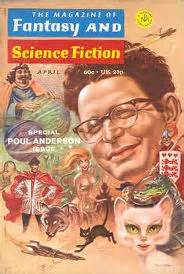
In our timeline, Poul Anderson (see image) wrote Three Hearts And Three Lions and A Midsummer Tempest.
Thus, here are three timelines containing respectively a Poul (presumably Anderson), a (presumably Poul) Anderson and a Poul Anderson but they are not exactly the same guy. The Poul of the Lords of Creation timeline lives in a detectably different Solar System whose history diverges drastically from ours after 1962. The Anderson of the FirstSide timeline lives on an Earth whose history diverges minimally from ours after 1617 and might diverge further later. I don't know yet.
But other activities call so that is the end of posting until this evening or maybe tomorrow.
In the FirstSide timeline, Tom Christiansen and Adrienne Rolfe both like a number of writers, including "Anderson." In the New Virginia timeline, Adrienne's library includes Three Hearts And Three Lions and A Midsummer Tempest. Tom recognizes the titles so we know that they were imported from FirstSide.
In our timeline, Poul Anderson (see image) wrote Three Hearts And Three Lions and A Midsummer Tempest.
Thus, here are three timelines containing respectively a Poul (presumably Anderson), a (presumably Poul) Anderson and a Poul Anderson but they are not exactly the same guy. The Poul of the Lords of Creation timeline lives in a detectably different Solar System whose history diverges drastically from ours after 1962. The Anderson of the FirstSide timeline lives on an Earth whose history diverges minimally from ours after 1617 and might diverge further later. I don't know yet.
But other activities call so that is the end of posting until this evening or maybe tomorrow.
Wednesday, 29 August 2012
Conflicts
Poul Anderson's fantasy novel Three Hearts And Three Lions (London, 1977) has a unique flavour that I missed on first reading. It is more than a string of well-presented cliches. Things and signs are not what they seem. In particular, Faerie is not neutral.
In childhood, I was pleased to read the theory that fairies had been angels who remained neutral during the War in Heaven. That seemed to explain their status as a third class of supernatural being inhabiting neither Heaven nor Hell but Nature. It was always satisfying when one mythology explained another. A second example is the Greek mythological explanation of pharaonic zoomorphism: attacked on Olympus, the gods fled and hid in Egypt, disguised as animals.
In Three Hearts And Three Lions, in the parallel world to which Holger Carlsen has been transported, Faerie supports Chaos against Law. For this reason, Holger as guest in the castle of Duke Alfric, lord of Faerie, recalls (to me) not other visits to Faerie, as in "The Land of Summer's Twilight" in Neil Gaiman's The Books Of Magic, but the hospitality received by the damned soul Christopher Rudd in the castle of a Lord of Hell in Mike Carey's Lucifer, a sequel to Gaiman's The Sandman.
There seem to be four realms: Heaven, Earth, Hell and the Middle World, the last comprising Faerie, Trollheim, Giants etc. (Why "Middle"? In some reckonings, Earth, Midgard, is in the middle.) A woods dwarf tells Holger that the Faerie folk:
"...live in wilderness, which is why they be o' the dark Chaos side in the war." (p. 27)
Alianora adds that they:
"...canna endure broad daylight, so 'tis forever twilit in their realm." (p. 37)
This sounds like Gaiman's "Summer's Twilight."
Alianora speculates:
"If Chaos wins, mayhap yon dusk will be laid on the whole world, and no more o' bricht sunshine and green leaves and blossoms...And yet does Faerie have an eldritch beauty..." (p. 37)
Is this getting a little confused? I do not expect the Fair Folk to oppose sunshine and blossoms. And a victory for Chaos and/or Hell surely mean universal darkness, not the eldritch beauty of Faerie twilight?
In childhood, I was pleased to read the theory that fairies had been angels who remained neutral during the War in Heaven. That seemed to explain their status as a third class of supernatural being inhabiting neither Heaven nor Hell but Nature. It was always satisfying when one mythology explained another. A second example is the Greek mythological explanation of pharaonic zoomorphism: attacked on Olympus, the gods fled and hid in Egypt, disguised as animals.
In Three Hearts And Three Lions, in the parallel world to which Holger Carlsen has been transported, Faerie supports Chaos against Law. For this reason, Holger as guest in the castle of Duke Alfric, lord of Faerie, recalls (to me) not other visits to Faerie, as in "The Land of Summer's Twilight" in Neil Gaiman's The Books Of Magic, but the hospitality received by the damned soul Christopher Rudd in the castle of a Lord of Hell in Mike Carey's Lucifer, a sequel to Gaiman's The Sandman.
There seem to be four realms: Heaven, Earth, Hell and the Middle World, the last comprising Faerie, Trollheim, Giants etc. (Why "Middle"? In some reckonings, Earth, Midgard, is in the middle.) A woods dwarf tells Holger that the Faerie folk:
"...live in wilderness, which is why they be o' the dark Chaos side in the war." (p. 27)
Alianora adds that they:
"...canna endure broad daylight, so 'tis forever twilit in their realm." (p. 37)
This sounds like Gaiman's "Summer's Twilight."
Alianora speculates:
"If Chaos wins, mayhap yon dusk will be laid on the whole world, and no more o' bricht sunshine and green leaves and blossoms...And yet does Faerie have an eldritch beauty..." (p. 37)
Is this getting a little confused? I do not expect the Fair Folk to oppose sunshine and blossoms. And a victory for Chaos and/or Hell surely mean universal darkness, not the eldritch beauty of Faerie twilight?
Thursday, 25 June 2020
Rules, Riddles And Radioactivity
Three Hearts And Three Lions, CHAPTER TWELVE.
Different works of fantasy can have different rules of magic. I think that it is standard that trolls emerge only at night because sunlight would transform them into stone whereas this is not usually the case with giants although it is what happens to the giant Balamorg in Three Hearts And Three Lions where all Middle Worlders are vulnerable to sunlight - and dwarfs are not Middle Worlders. We learn the precise rules in each new narrative.
In a riddling contest with Balamorg, Holger invents an excellent alternative answer to "'Why does a chicken cross the road?'" (p. 76) (There was also a riddle contest in Poul Anderson's and Gordon R Dickson's Star Prince Charlie.)
Fairy gold becomes dead leaves in sunlight. Gold from the petrified Balamorg's pouch becomes radioactive because the transformation of his carbon into silicon has generated a radioactive isotope. There is "...a curse on the plunderer of a sun-stricken giant..." (p. 80) The spine of my Three Hearts... says SF. Do these scientific rationalizations transform fantasy into sf?
Different works of fantasy can have different rules of magic. I think that it is standard that trolls emerge only at night because sunlight would transform them into stone whereas this is not usually the case with giants although it is what happens to the giant Balamorg in Three Hearts And Three Lions where all Middle Worlders are vulnerable to sunlight - and dwarfs are not Middle Worlders. We learn the precise rules in each new narrative.
In a riddling contest with Balamorg, Holger invents an excellent alternative answer to "'Why does a chicken cross the road?'" (p. 76) (There was also a riddle contest in Poul Anderson's and Gordon R Dickson's Star Prince Charlie.)
Fairy gold becomes dead leaves in sunlight. Gold from the petrified Balamorg's pouch becomes radioactive because the transformation of his carbon into silicon has generated a radioactive isotope. There is "...a curse on the plunderer of a sun-stricken giant..." (p. 80) The spine of my Three Hearts... says SF. Do these scientific rationalizations transform fantasy into sf?
Thursday, 13 September 2012
The Valeria Matuchek Trilogy
It is almost a trilogy.
Volume I
In Poul Anderson's Operation Chaos, Valeria's parents meet and marry. Valeria is born and grows to the age of three. A demon kidnaps her but her parents rescue her from Hell.
Volume II
In Anderson's Operation Luna, Valeria turns fifteen and is the first human being on the Moon in her timeline.
Volume III
In his A Midsummer Tempest, Valeria, now a graduate student travelling between timelines, advises other travellers, including Holger Danske from Three Hearts And Three Lions, whom she meets in the inter-cosmic inn.
Epilogues
In "House Rule," we meet a regular of the inter-cosmic inn.
In "Losers' Night," the regular lists spectacular women including Moll Flanders, Sojourner Truth and Valeria Matuchek.
The writing order of the Volumes was I, III, II so Anderson filled in an account of Valeria's teenage years after he had included the adult Valeria as a supporting character in A Midsummer Tempest.
Maybe her flight to the Moon qualified her as a spectacular woman or perhaps there was more later? We would like to know the rest of her career but, as far as it goes, this trilogy, or tetralogy if we include Three Hearts And Three Lions, and its Epilogues is already a comprehensive, and not merely linear, narrative sequence.
Volume I
In Poul Anderson's Operation Chaos, Valeria's parents meet and marry. Valeria is born and grows to the age of three. A demon kidnaps her but her parents rescue her from Hell.
Volume II
In Anderson's Operation Luna, Valeria turns fifteen and is the first human being on the Moon in her timeline.
Volume III
In his A Midsummer Tempest, Valeria, now a graduate student travelling between timelines, advises other travellers, including Holger Danske from Three Hearts And Three Lions, whom she meets in the inter-cosmic inn.
Epilogues
In "House Rule," we meet a regular of the inter-cosmic inn.
In "Losers' Night," the regular lists spectacular women including Moll Flanders, Sojourner Truth and Valeria Matuchek.
The writing order of the Volumes was I, III, II so Anderson filled in an account of Valeria's teenage years after he had included the adult Valeria as a supporting character in A Midsummer Tempest.
Maybe her flight to the Moon qualified her as a spectacular woman or perhaps there was more later? We would like to know the rest of her career but, as far as it goes, this trilogy, or tetralogy if we include Three Hearts And Three Lions, and its Epilogues is already a comprehensive, and not merely linear, narrative sequence.
Tuesday, 30 August 2016
Percheron Etc
"The animal was gigantic, a stallion the size of a Percheron but with more graceful build, sleek and black as polished midnight. It was not tethered, though an elaborate fringed pair of reins hung from a headstall chased with silver and arabesques. On its back was a saddle, high in pommel and cantle..." (p. 14)
Having googled "Percheron," I now understand the significance of a stallion the size of one.
Holger dons the armor and rides the horse. He seeks hospitality from an old woman called Gerd who sounds like a fairy tale witch. They speak in a language that he does not recognize but nevertheless understands. She claims to live "...by the edge of the world." (p. 18) That might be literally true.
If this is a flat Earth, then how did it come into existence? Cosmos-forming processes would have to be entirely different. The flat earth of Narnia was directly created, sung into existence, by Aslan. There are some parallels between Three Hearts And Three Lions and The Lion, the Witch And The Wardrobe - apart from a leonine element in both titles, which I have only just noticed. Tolkien elaborately explains how the directly created flat Middle Earth became our round Earth. I suppose that a flat Earth has a place in our collective imagination. In Anderson's The Broken Sword, a ship leaves Midgard and enters Jotunheim by sailing North.
Tuesday, 15 August 2017
War In Art And Life
Art reflects life in different ways.
Art
In Stieg Larsson's The Girl With The Dragon Tattoo, some members of the Vanger family were Nazis during the War.
In Harry Turtledove's Worldwar series, aliens invaded Earth during World War II.
In Poul Anderson's Three Hearts And Three Lions:
"'Those two worlds - and many more, for all I know - are in some way the same. The same fight was being waged, here the Nazis and there the Middle World; but, in both cases, Chaos against Law, something old and wild and blind against man and the works of man.'"
-Poul Anderson, Three Hearts and Three Lions (London, 1977), NOTE, p. 155.
In Anderson's "Time Patrol," a time traveller prevents his fiancee's death in a London air raid.
Life
World War II casts its shadow over succeeding decades.
Nazis march now.
Art
In Stieg Larsson's The Girl With The Dragon Tattoo, some members of the Vanger family were Nazis during the War.
In Harry Turtledove's Worldwar series, aliens invaded Earth during World War II.
In Poul Anderson's Three Hearts And Three Lions:
"'Those two worlds - and many more, for all I know - are in some way the same. The same fight was being waged, here the Nazis and there the Middle World; but, in both cases, Chaos against Law, something old and wild and blind against man and the works of man.'"
-Poul Anderson, Three Hearts and Three Lions (London, 1977), NOTE, p. 155.
In Anderson's "Time Patrol," a time traveller prevents his fiancee's death in a London air raid.
Life
World War II casts its shadow over succeeding decades.
Nazis march now.
Tuesday, 12 May 2020
Interconnections
In 1940 And The 1960s, we listed a sequence of six fantasy works by Poul Anderson.
In Guardians Of Time And The Pact, we saw that the first two of these works:
Three Hearts And Three Lions
Operation Chaos
- are linked by an inter-universal war between Law and Chaos.
In Three Hearts And Three Lions, Holger Danske begins to wander between universes;
in Operation Chaos, Valeria Matuchek is born in another universe;
in Operation Luna, she is a teenager;
in A Midsummer Tempest, she advises Holger and meets Rupert of the Rhine in the inter-universal inn, the Old Phoenix;
In "House Rule," Nicholas van Rijn from the Technic History is in the Old Phoenix;
"Losers' Night," set in the Old Phoenix, mentions Valeria, Holger, Rupert and Rhysling from Heinlein's Future History.
And, when I get tired of all these interconnections, then I will stop posting about them.
In Guardians Of Time And The Pact, we saw that the first two of these works:
Three Hearts And Three Lions
Operation Chaos
- are linked by an inter-universal war between Law and Chaos.
In Three Hearts And Three Lions, Holger Danske begins to wander between universes;
in Operation Chaos, Valeria Matuchek is born in another universe;
in Operation Luna, she is a teenager;
in A Midsummer Tempest, she advises Holger and meets Rupert of the Rhine in the inter-universal inn, the Old Phoenix;
In "House Rule," Nicholas van Rijn from the Technic History is in the Old Phoenix;
"Losers' Night," set in the Old Phoenix, mentions Valeria, Holger, Rupert and Rhysling from Heinlein's Future History.
And, when I get tired of all these interconnections, then I will stop posting about them.
Friday, 7 September 2012
The Wealth Of Anderson's Works
The more we reread of Poul Anderson's texts, the more there is to be found in them. So far, these posts about the "Old Phoenix Sequence" have covered:
the nature of Hell in Operation Chaos;
clever implications of fantasy premises in Operation Chaos;
scientific rationales for fantasy ideas in Three Hearts And Three Lions;
the use of language and Shakespearean allusions in A Midsummer Tempest;
an ingenious sequel to The Tempest;
the physical environment of the Old Phoenix;
contrasts between the Time Patrol series and the Old Phoenix;
Valeria Matuchek's life and career;
Nicholas van Rijn's antics in the old Phoenix;
the basic conflicts underlying Three Hearts And Three Lions and A Midsummer Tempest;
the issue of religious intolerance as shown in A Midsummer Tempest;
the political demands of the Johannines;
connections with Robert Heinlein, James Blish and Neil Gaiman;
the plausibility or otherwise of different imagined alternative histories;
clever uses of real history as shown by the inclusion of d'Artagnan;
literary references to Oscar Wilde and The Wind In The Willows.
the nature of Hell in Operation Chaos;
clever implications of fantasy premises in Operation Chaos;
scientific rationales for fantasy ideas in Three Hearts And Three Lions;
the use of language and Shakespearean allusions in A Midsummer Tempest;
an ingenious sequel to The Tempest;
the physical environment of the Old Phoenix;
contrasts between the Time Patrol series and the Old Phoenix;
Valeria Matuchek's life and career;
Nicholas van Rijn's antics in the old Phoenix;
the basic conflicts underlying Three Hearts And Three Lions and A Midsummer Tempest;
the issue of religious intolerance as shown in A Midsummer Tempest;
the political demands of the Johannines;
connections with Robert Heinlein, James Blish and Neil Gaiman;
the plausibility or otherwise of different imagined alternative histories;
clever uses of real history as shown by the inclusion of d'Artagnan;
literary references to Oscar Wilde and The Wind In The Willows.
Monday, 2 December 2013
Tanni On Toka
Now this is neat. The third story in the second Hoka collection, Hoka (New York, 1985), by Poul Anderson and Gordon R Dickson, tells us how Tanni Jones copes back home on Toka while Alex Jones is on Earth in the second story. Alex Jr with his copy of Kipling's Jungle Books accompanies Tanni into a jungle area where the Hokas cast him as Mowgli and themselves as Mowgli's animal companions.
Tanni must follow her husband's advice and find a way to manage the Hokas by turning their own logic against them. Thus, when she wants to stop them interfering, she reminds them that, by the Law of the Jungle, the wolves should be asleep during the day...
The texts describe Tanni as blonde and beautiful so she is drawn thus in the illustrations which could easily be extended into a comic strip or animation. The Joneses have been on Toka for twelve years so the timeline has not been advanced.
The fourth story, which I have yet to read in full, also starts with Tanni coping while Alex Sr is away, whether on the same trip or another. An illustration of a Tokan street scene shows a Childe Cycles shop advertising bicycles built for brew and a Three Hearts and Three Lions Tavern:
The Childe Cycle is an unfinished series by Dickson;
"A Bicycle Built For Brew" is a story by Anderson;
Three Hearts And Three Lions is a novel by Anderson.
Thus, this illustration is similar to Kevin O'Neil's panels in the Alan Moore-scripted The League Of Extraordinary Gentlemen (see here): backgrounds must be studied for literary references. There is another sf reference on an earlier page of Hoka:
"...here is the race that shall rule the sevagram!" (p. 47)
Tanni must follow her husband's advice and find a way to manage the Hokas by turning their own logic against them. Thus, when she wants to stop them interfering, she reminds them that, by the Law of the Jungle, the wolves should be asleep during the day...
The texts describe Tanni as blonde and beautiful so she is drawn thus in the illustrations which could easily be extended into a comic strip or animation. The Joneses have been on Toka for twelve years so the timeline has not been advanced.
The fourth story, which I have yet to read in full, also starts with Tanni coping while Alex Sr is away, whether on the same trip or another. An illustration of a Tokan street scene shows a Childe Cycles shop advertising bicycles built for brew and a Three Hearts and Three Lions Tavern:
The Childe Cycle is an unfinished series by Dickson;
"A Bicycle Built For Brew" is a story by Anderson;
Three Hearts And Three Lions is a novel by Anderson.
Thus, this illustration is similar to Kevin O'Neil's panels in the Alan Moore-scripted The League Of Extraordinary Gentlemen (see here): backgrounds must be studied for literary references. There is another sf reference on an earlier page of Hoka:
"...here is the race that shall rule the sevagram!" (p. 47)
Thursday, 1 September 2016
Fiction And Reality
If what is real in one universe is myth or fiction in another universe, then life could get complicated. Who lives where? Arnold Shwarzenneger tackled the idea in Last Action Hero.
In Poul Anderson's Three Hearts And Three Lions, Alfric, Duke of Alfarland in the Kingdom of Faerie, speculates that another Earth exists that is:
"'...the source of myths and legends, such as those told of Frederik Barbarossa or the great epical chansons about the Emperor Napoleon and his heroes.'" (Chapter Seven, p. 47)
Is Alfric's king Oberon? Alfric's Earth does contain:
"'Avalon...far, far in the western ocean...'" (Chapter Eight, p. 51) and:
"...Morgan le Fay...sister to Arthur, the last great king o' the Britons...'" (ibid.)
It may be that Morgan healed Arthur and keeps him till his time of return. King Arthur does not appear in any of Anderson's works but hovers on the borders of at least four:
The King Of Ys (with Karen Anderson)
The Boat Of A Million Years
A Midsummer Tempest
Three Hearts And Three Lions
Correction, 21 June 2020: Arthur does appear but only to lead his army out of Glastonbury Tor at the climax of A Midsummer Tempest.
In Poul Anderson's Three Hearts And Three Lions, Alfric, Duke of Alfarland in the Kingdom of Faerie, speculates that another Earth exists that is:
"'...the source of myths and legends, such as those told of Frederik Barbarossa or the great epical chansons about the Emperor Napoleon and his heroes.'" (Chapter Seven, p. 47)
Is Alfric's king Oberon? Alfric's Earth does contain:
"'Avalon...far, far in the western ocean...'" (Chapter Eight, p. 51) and:
"...Morgan le Fay...sister to Arthur, the last great king o' the Britons...'" (ibid.)
It may be that Morgan healed Arthur and keeps him till his time of return. King Arthur does not appear in any of Anderson's works but hovers on the borders of at least four:
The King Of Ys (with Karen Anderson)
The Boat Of A Million Years
A Midsummer Tempest
Three Hearts And Three Lions
Correction, 21 June 2020: Arthur does appear but only to lead his army out of Glastonbury Tor at the climax of A Midsummer Tempest.
Monday, 3 September 2012
Operation Chaos
Poul Anderson's Operation Chaos starts with an alternative World War II and ends with an alternative 1960's. There is an Introduction by the author, then an untitled opening passage before Chapter I. The opening passage makes two connections between this work and the same author's Three Hearts And Three Lions by referring to:
(i) alternative timelines where historical events and/or natural laws differ;
(ii) a war between Law and Chaos occurring in every timeline.
Operation Chaos is a collection of four "Operation..." stories. Thus, the entire sequence of interconnected works comprises nine items:
Three Hearts And Three Lions
"Operation Afreet"
"Operation Salamander"
"Operation Incubus"
"Operation Changeling"
Operation Luna
A Midsummer Tempest
"House Rule"
"Losers' Night"
I think that this sequence would look good if presented in five uniform volumes, the fifth being a collection to be called The Old Phoenix. Admittedly, only two short stories, the last two titles in the above list, are set in this inter-universal inn. However, two other alternative timeline stories, "Eutopia" and "The House of Sorrows," could fit in the same volume. "Eutopia" was collected in Past Times, which is almost entirely time travel stories, so I think that "The Man Who Came Early" should replace "Eutopia" in a revised Past Times.
In "Eutopia," Alexander does not die in Babylon. In "The House of Sorrows," the Jews do not return from Babylon. So these stories are complementary.
(i) alternative timelines where historical events and/or natural laws differ;
(ii) a war between Law and Chaos occurring in every timeline.
Operation Chaos is a collection of four "Operation..." stories. Thus, the entire sequence of interconnected works comprises nine items:
Three Hearts And Three Lions
"Operation Afreet"
"Operation Salamander"
"Operation Incubus"
"Operation Changeling"
Operation Luna
A Midsummer Tempest
"House Rule"
"Losers' Night"
I think that this sequence would look good if presented in five uniform volumes, the fifth being a collection to be called The Old Phoenix. Admittedly, only two short stories, the last two titles in the above list, are set in this inter-universal inn. However, two other alternative timeline stories, "Eutopia" and "The House of Sorrows," could fit in the same volume. "Eutopia" was collected in Past Times, which is almost entirely time travel stories, so I think that "The Man Who Came Early" should replace "Eutopia" in a revised Past Times.
In "Eutopia," Alexander does not die in Babylon. In "The House of Sorrows," the Jews do not return from Babylon. So these stories are complementary.
Saturday, 3 September 2016
Ariel
Poul Anderson, Three Hearts and Three Lions (London, 1977), Chapter Seventeen.
I have nearly finished blogging for today. However, I must mark the reappearance of an old acquaintance:
Ariel is a character in William Shakespeare's The Tempest;
therefore Ariel also appears in Poul Anderson's A Midsummer Tempest;
and this spirit is also mentioned in Anderson's Three Hearts And Three Lions -
"'I raised the fleet spirits of the air, even called in Ariel as consultant, and they were still able to find where Cortana lies buried.'" (p. 109)
Thus:
Holger will soon complete his Quest - the sword is not far;
here is yet another cross-reference, binding Anderson's fantasies to Shakespeare and to each other.
Holger was found in Elsinore, Hamlet's home town. In A Midsummer Tempest, England, Scotland and Denmark have been friendly since the days of Hamlet.
I have nearly finished blogging for today. However, I must mark the reappearance of an old acquaintance:
Ariel is a character in William Shakespeare's The Tempest;
therefore Ariel also appears in Poul Anderson's A Midsummer Tempest;
and this spirit is also mentioned in Anderson's Three Hearts And Three Lions -
"'I raised the fleet spirits of the air, even called in Ariel as consultant, and they were still able to find where Cortana lies buried.'" (p. 109)
Thus:
Holger will soon complete his Quest - the sword is not far;
here is yet another cross-reference, binding Anderson's fantasies to Shakespeare and to each other.
Holger was found in Elsinore, Hamlet's home town. In A Midsummer Tempest, England, Scotland and Denmark have been friendly since the days of Hamlet.
Wednesday, 24 June 2020
Chaos And Continuity
Three Hearts And Three Lions, CHAPTER TWELVE.
Operation Chaos works as a sequel to Three Hearts And Three Lions. It begins as Steve Matuchek telepathically broadcasts to other possible universes and states that the conflict between Law and Chaos must occur in every universe. Several times throughout the book, he comes face to face with that "...final One..." (p. 72) postulated by Holger Carlsen as outranking every other agent of Chaos.
Holger wonders whether Chaos is a more animistic expression of the second law of thermodynamics, the tendency toward disorder and level entropy, then whether Nazism is a resurgence of such animistic entropy in his world. But Chaos is not entropy. The Middle World agents of Chaos want the order of Law to be ended but not their own bodies or environments to become disordered or to wind down to total quiescence.
In our universe, that quiescence is apparently inevitable although, in Anderson's later hard sf, some high tech AIs think that they might somehow remain conscious even at full entropy. So they are Law against Chaos? As is the Time Patrol when it counteracts temporal chaos at the end of The Shield Of Time.
Extrablogular activities rule at present as you might guess from the fewness of posts.
Operation Chaos works as a sequel to Three Hearts And Three Lions. It begins as Steve Matuchek telepathically broadcasts to other possible universes and states that the conflict between Law and Chaos must occur in every universe. Several times throughout the book, he comes face to face with that "...final One..." (p. 72) postulated by Holger Carlsen as outranking every other agent of Chaos.
Holger wonders whether Chaos is a more animistic expression of the second law of thermodynamics, the tendency toward disorder and level entropy, then whether Nazism is a resurgence of such animistic entropy in his world. But Chaos is not entropy. The Middle World agents of Chaos want the order of Law to be ended but not their own bodies or environments to become disordered or to wind down to total quiescence.
In our universe, that quiescence is apparently inevitable although, in Anderson's later hard sf, some high tech AIs think that they might somehow remain conscious even at full entropy. So they are Law against Chaos? As is the Time Patrol when it counteracts temporal chaos at the end of The Shield Of Time.
Extrablogular activities rule at present as you might guess from the fewness of posts.
Tuesday, 28 August 2012
Framing Devices
When an author tells us a fantastic story, he can also tell us how the story came to him. He can add that it is not necessarily true or that he has changed details like the protagonist's name. Framing devices are an art form. In a series, they can either become an ongoing story in their own right or can be abandoned as the reader becomes familiar with the scenario.
Poul Anderson's fantasy novel, Three Hearts And Three Lions (1953), and his science fiction novel, There Will Be Time (1973), have essentially the same framing device although in the latter it has become more complicated. The former begins as it ends with a "Note" by an unnamed first person narrator, an engineer who had been a colleague of the protagonist Holger Carlsen over twenty years previously in the period 1938-'41. Between the Notes, in Chapters One to Twenty-Four, Holger's story is narrated in the third person.
The first Note had told us that there was no proof that the story was true. In the concluding Note, Holger tells his colleague the story, then searches through grimoires for a way to return to the Carolingian world where he had adventured and from which, it seems, he had originally come - he was found on a doorstep in our world. Finally, he disappears, the perfect lead in to a sequel. Anderson deploys classic ingredients but does it well. In fact, regular Anderson readers do meet Holger once more not in a continuation of his own story but lost between worlds in another alternative reality novel.
The first person narrator of the Foreword in There Will Be Time (New York, 1973), assuring us of course that he does not pretend that the story is true and even referring to such a claim as a "...literary convention..." (p. 5), is none other than the author, Poul Anderson. But he received the story from the fictitious but plausible Dr Robert Anderson, first person narrator of the Chapters I-XVI, and that second Anderson tells us the story of the time traveller Jack Havig in the third person. Dr Anderson interacts with the main protagonist throughout the novel, unlike Holger's engineering colleague.
Thus, twenty years after Three Hearts And Three Lions, Poul Anderson uses the same kind of framing device but with increased subtlety.
Poul Anderson's fantasy novel, Three Hearts And Three Lions (1953), and his science fiction novel, There Will Be Time (1973), have essentially the same framing device although in the latter it has become more complicated. The former begins as it ends with a "Note" by an unnamed first person narrator, an engineer who had been a colleague of the protagonist Holger Carlsen over twenty years previously in the period 1938-'41. Between the Notes, in Chapters One to Twenty-Four, Holger's story is narrated in the third person.
The first Note had told us that there was no proof that the story was true. In the concluding Note, Holger tells his colleague the story, then searches through grimoires for a way to return to the Carolingian world where he had adventured and from which, it seems, he had originally come - he was found on a doorstep in our world. Finally, he disappears, the perfect lead in to a sequel. Anderson deploys classic ingredients but does it well. In fact, regular Anderson readers do meet Holger once more not in a continuation of his own story but lost between worlds in another alternative reality novel.
The first person narrator of the Foreword in There Will Be Time (New York, 1973), assuring us of course that he does not pretend that the story is true and even referring to such a claim as a "...literary convention..." (p. 5), is none other than the author, Poul Anderson. But he received the story from the fictitious but plausible Dr Robert Anderson, first person narrator of the Chapters I-XVI, and that second Anderson tells us the story of the time traveller Jack Havig in the third person. Dr Anderson interacts with the main protagonist throughout the novel, unlike Holger's engineering colleague.
Thus, twenty years after Three Hearts And Three Lions, Poul Anderson uses the same kind of framing device but with increased subtlety.
Subscribe to:
Posts (Atom)