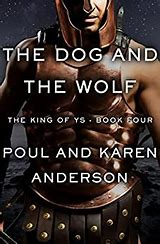
Wednesday, 20 April 2016
The Dog And The Wolf
"...between the Dog and the Wolf there is only the Law."
-Poul and Karen Anderson, The King Of Ys: The Dog And The Wolf (London, 1989), p. 504.
In Prince Of Sparta by Jerry Pournelle and SM Stirling, when Colonel Peter Owensford of Falkenberg's Legion sees the rebel leader, Skida Thibodeau, he thinks:
"The dog and the wolf..."
-Jerry Pournelle and SM Stirling, The Prince (New York, 2002), p. 967.
The Legion observes the Laws of War whereas the rebels attack civilians and kill prisoners. The Legion is a guard dog whereas the rebels are wolves. Thibodeau talks about "Revolution" but meanwhile thinks about interstellar expansion:
"...when the Democratic Republic started building up its navy." (p. 965)
"Revolution" means a society where no one builds navies or it means nothing. But I meant to focus on the significance of "the dog and the wolf," not to return us to the meaning of "Revolution." Having just returned from the monthly gathering of our modest sf group, I must now read Pournelle's and Stirling's account of the meeting between leaders of the two sides in the Spartan civil war.
Sunday, 23 October 2016
Significant Dates
1926 birth of Poul Anderson
1929 cosmic expansion discovered
1938 Superman published
1947 "Tomorrow's Children" by Poul Anderson and F.N. Waldrop
1947 "Chain of Logic" by Poul Anderson
1949 my birth
1951 "Tiger By The Tail" by Poul Anderson
1951 "Honorable Enemies" by Poul Anderson
1951 "Sargasso of Lost Starships" by Poul Anderson
1952 Vault Of The Ages by Poul Anderson
1952 "The Star Plunderer" by Poul Anderson
1953 Three Hearts And Three Lions by Poul Anderson
1954 Brain Wave by Poul Anderson
1954 The Broken Sword by Poul Anderson
1954 "Ghetto" by Poul Anderson
1954 "The Warriors from Nowhere" by Poul Anderson
1954 Question And Answer by Poul Anderson
1954 "The Sensitive Man" by Poul Anderson
1955 "Time Patrol" by Poul Anderson
1955 "Delenda Est" by Poul Anderson
1955 No World Of Their Own by Poul Anderson
1956 "Margin of Profit" by Poul Anderson
1956 Star Ways by Poul Anderson
1957 Earthman's Burden by Poul Anderson and Gordon R. Dickson
1957 "Memory" by Poul Anderson
1957 "Brake" by Poul Anderson
1958 The Snows Of Ganymede by Poul Anderson
1958 "The Man Who Counts" by Poul Anderson
1958 War Of The Wing-Men by Poul Anderson
1958 "The Game of Glory" by Poul Anderson
1959 Virgin Planet by Poul Anderson
1959 "Brave To Be A King" by Poul Anderson
1959 "The Sky People" by Poul Anderson
1959 "Hunters of the Sky Cave" by Poul Anderson
1959 "A Message in Secret" by Poul Anderson
1959 The Enemy Stars by Poul Anderson
1959 Perish By The Sword by Poul Anderson
1959 The War Of Two Worlds by Poul Anderson
1960 "The Only Game In Town" by Poul Anderson
1960 Guardians Of Time by Poul Anderson
1960 "The Plague of Masters" by Poul Anderson
1960 "A Twelvemonth And A Day" by Poul Anderson
1960 The High Crusade by Poul Anderson
1960 Murder In Black Letter by Poul Anderson
1960 The Golden Slave by Poul Anderson
1960 Rogue Sword by Poul Anderson
1961 "Progress" by Poul Anderson
1961 "Children of Fortune" by Poul Anderson
1961 "Epilogue" by Poul Anderson
1961 Twilight World by Poul Anderson
1961 Strangers From Earth by Poul Anderson
1961 Orbit Unlimited by Poul Anderson
1961 "Hiding Place" by Poul Anderson
1962 Un-Man And Other Novellas by Poul Anderson
1962 After Doomsday by Poul Anderson
1962 The Makeshift Rocket by Poul Anderson
1962 Murder Bound by Poul Anderson
1963 "Territory" by Poul Anderson
1963 Shield by Poul Anderson
1963 Is There Life On Other Worlds? by Poul Anderson
1964 Three Worlds To Conquer by Poul Anderson
1965 The Corridors Of Time by Poul Anderson
1965 The Star Fox by Poul Anderson
1963 Let The Spacemen Beware by Poul Anderson
1963 "The Three-Cornered Wheel" by Poul Anderson
1963 "Homo Aquaticus" by Poul Anderson
1964 "The Master Key" by Poul Anderson
1964 Three Worlds To Conquer by Poul Anderson
1965 "Trader Team" by Poul Anderson
1965 The Corridors Of Time by Poul Anderson
1966 Ensign Flandry by Poul Anderson
1966 "A Sun Invisible" by Poul Anderson
1966 "Plus Ca Change, Plus C'est Le Meme Chose" by Poul Anderson
1966 "Home" by Poul Anderson
1966 "The Moonrakers" by Poul Anderson
1966 The Fox, The Dog And The Griffin by Poul Anderson
1967 "Outpost of Empire" by Poul Anderson
1967 "Starfog" by Poul Anderson
1967 "Day of Burning" by Poul Anderson
1967 "A Tragedy of Errors" by Poul Anderson
1967 World Without Stars by Poul Anderson
1967 "To Outlive Eternity" by Poul Anderson
1968 "The Sharing of Flesh" by Poul Anderson
1969 The Rebel Worlds by Poul Anderson
1969 The Infinite Voyage by Poul Anderson
1969 Seven Conquests by Poul Anderson
1970 Tales Of The Flying Mountains by Poul Anderson
1970 "Esau" by Poul Anderson
1970 A Circus Of Hells by Poul Anderson
1970 Tau Zero by Poul Anderson
1971 "A Little Knowledge" by Poul Anderson
1971 "The Queen Of Air And Darkness" by Poul Anderson
1971 The Byworlder by Poul Anderson
1971 Operation Chaos by Poul Anderson
1971 The Broken Sword revised
1972 The Dancer From Atlantis by Poul Anderson
1972 "Wings of Victory" by Poul Anderson
1972 The Day The Sun Stood Still by Poul Anderson, Gordon R. Dickson and Robert Silverberg
1973 There Will Be Time by Poul Anderson
1973 "The Season of Forgiveness" by Poul Anderson
1973 "Wingless" by Poul Anderson
1973 The People Of The Wind by Poul Anderson
1973 "The Problem of Pain" by Poul Anderson
1973 "Rescue on Avalon" by Poul Anderson
1973 "Lodestar" by Poul Anderson
1973 The Day Of Their Return by Poul Anderson
1973 "Windmill" by Poul Anderson
1973 Hrolf Kraki's Saga by Poul Anderson
1974 "How To Be Ethnic In One Easy Lesson" by Poul Anderson
1974 A Knight Of Ghosts And Shadows by Poul Anderson
1974 "My Own, My Native Land" by Poul Anderson
1974 "Passing The Love Of Women" by Poul Anderson
1974 "A Fair Exchange" by Poul Anderson
1974 Fire Time by Poul Anderson
1974 A Midsummer Tempest by Poul Anderson
1974 The Many Worlds Of Poul Anderson, ed. Roger Elwood
1975 "To Promote The General Welfare" by Poul Anderson
1975 The Winter Of The World by Poul Anderson
1975 Homeward And Beyond by Poul Anderson
1975 Star Prince Charlie by Poul Anderson and Gordon R. Dickson
1976 The Best Of Poul Anderson
1977 A World Named Cleopatra
1978 The Avatar by Poul Anderson
1979 The Merman's Children by Poul Anderson
1979 The Demon Of Scattery by Poul Anderson and Mildred Downey Broxon
1979 A Stone In Heaven by Poul Anderson
1980 Conan The Rebel by Poul Anderson
1980 The Devil's Game by Poul Anderson
1980 The Golden Horn by Poul Anderson
1980 The Road of the Sea Horse by Poul Anderson
1980 The Sign Of The Raven by Poul Anderson
1981 Fantasy by Poul Anderson
1981 Explorations by Poul Anderson
1981 The Dark Between The Stars by Poul Anderson
1981 The Psychotechnic League by Poul Anderson
1981 "The Saturn Game" by Poul Anderson
1982 Cold Victory by Poul Anderson
1982 Starship by Poul Anderson
1982 New America by Poul Anderson
1982 The Gods Laughed by Poul Anderson
1983 Conflict by Poul Anderson
1983 "Ivory, And Apes, And Peacocks" by Poul Anderson
1983 "The Sorrow of Odin the Goth" by Poul Anderson
1983 Hoka! by Poul Anderson and Gordon R. Dickson
1983 Orion Shall Rise by Poul Anderson
1984 Past Times by Poul Anderson
1984 The Unicorn Trade by Poul and Karen Anderson
1985 Dialogue With Darkness by Poul Anderson
1985 The Game Of Empire by Poul Anderson
1985 "Pride" by Poul Anderson
1986 Roma Mater by Poul and Karen Anderson
1987 Gallicenae by Poul and Karen Anderson
1987 Dahut by Poul and Karen Anderson
1988 The Dog And The Wolf by Poul and Karen Anderson
1988 The Year Of The Ransom by Poul Anderson
1989 The Boat Of A Million Years by Poul Anderson
1990 The Shield Of Time by Poul Anderson
1991 "Star of the Sea" by Poul Anderson
1991 "Inconstant Star" by Poul Anderson
1991 The Time Patrol by Poul Anderson
Stop! This is not a complete list and was never intended to be such a long list. I have stopped temporarily only because I am not, at this time of night, finding any title that was published in 1992. The list so far shows:
(i) the dates of two important discoveries that underlie all subsequent sf;
(ii) the date of Superman who started as sf although he initiated a new genre (his alien menagerie is comparable to the one in Anderson's "Hiding Place" (1961));
(iii) for comparison, the year of my birth (blog readers can add theirs);
(iv) an unbroken record of Poul Anderson publications from 1951 until 1991 - and there was more after that.
Wednesday, 26 July 2023
The Years After Ys
The Dog And The Wolf.
For a final time, we follow the passage of the seasons in a volume of The King of Ys.
"Most fruit trees were done with blooming, but a new loveliness dwelt in Liguria." (III, 2, p. 67)
"That was a chilly year, but towards midsummer a spell of heat set in and lasted a while." (VI, 1, p. 113)
"Mons Ferruginus and the woods beyond the Odita blazed with autumn, red, russet, yellow under the earliest sun-rays." (VII, 2, p. 137)
"...To this place came Bishop Martinus at the beginning of winter's pastoral rounds." (VII, 3, p. 145)
"The new year might be more hopeful than the last. Weather grew springlike well before the vernal equinox." (VIII, 2, p. 153)
"Easter Eve was clear." (VIII, 4, p. 163)
"On Easter morning..." (VIII, 5, p. 166)
"Immediately after Easter..." (IX, 1, p. 170)
"The feast of St Johannes had taken unto itself the ancient rites of Midsummer, but otherwise they had changed little." (IX, 3, p. 182)
"That summer was cruel to sandy Audiarna." (X, 2, p. 192)
"...Noontide brimmed with sun, warmth, and harvest odours. Bees buzzed in clover. The view over the Odita was of men, women, and animals busy across the fields, children following to glean." (X, 6, p. 205)
"Autumn blew grey from the north. Wind bit." (X, 7, p. 207)
"Midwinter's early darkness had fallen..." (XI, 1, p. 210)
"Spring cast green over the low land around Deva. Trees budded and bloomed..." (XI, 2, p. 216)
"Winter heaven hung featureless grey." (XIII, 1, p. 250)
"A light snow fell." (XIII, 4, p. 260)
"Willows had leaved, oak and chestnut were beginning to, plum trees bedecked themselves in blossom... Migratory birds were coming home." (XIII, 5, p. 262)
"The galleys dropped anchor. They had grounded on many a strand this springtime..." (XIV, 2, p. 268)
"Rain fell in serried silver. Wind dashed it against walls and windowpanes. The first breath of autumn was in it. Gloom and chill filled the bishop's house..." (XV, 5, p. 296)
"In the dark of the moon before winter solstice, Confluentes burned." (XV, 8, p. 305)
"Springtime dusk. The air was soft, odours of greening and blossoming not yet cooled out of it." (XVI, 1, p. 311)
"The men from the currach reached holy Temir a few days after Beltene." (XVI, 2, p. 317)
"Harvest brought wholeness." (XVI, 5, p. 328)
"That year Beltene in Mide was the greatest and most magnificent ever heard of since the Children of Danu held Eriu." (XVII, 3, p. 337)
"On a day in autumn when the wind went loud and sharp..." (XVIII, 3, p. 362)
"The Black Months need not be dark." (XVIII, 4, p. 365)
"Spring returned, made green the graves of winter and strewed them with flowers. Days grew longer than night. Migratory birds trekked home." (XIX, 1, p. 372)
"Autumn weather came earliest to the high midland of Armorica. First the birches grew sallow and their leaves departed on chilly winds, then red and brown and yellow rustled all over the hills." (XX, 2, p. 391)
"A sharp summer was followed by a hard winter. Snowfalls, rarely seen in Armorica, warmed air a little for a short while, then soon a ringing frost would set in." (XX, 3, p. 397)
"As the year spun down to solstice, cold deepened. The Odita and Stegir lay frozen between banks where the snow glittered rock-hard. Icicles hung from naked boughs, eaves, battlements, like spears turned downward." (XX, 4, p. 401)
"Skies hung heavy, low above old snow and skeleton trees, a world of greys and whites." (XXI, 2, p. 411)
"The sun drew nigh to midsummer. This was a beautiful year, as if to make up for last. Croplands burgeoned..." (XXI, 7, p. 427)
"...Summer brooded in majesty on ripening grain and fragrance-heavy forests. There often the only sounds were bees at work in clover and the call of a cuckoo." (XXII, 1, p. 431)
"The long day of Armorican summer wore on." (XXII, 2, p. 435)
"Rain came, not cruelly slashing as in last year but a mildness that swelled the crops to full ripening." (XXII, 4, p. 443)
"That year they kept the Feast of Lug in Armorica without their chiefs." (XXII, 6, p. 448)
"Harvest was done, the last sheaf consecrated to the Maiden, the wether chosen as Wolf of the Fold sacrificed, a branch hung with ears of grain brought into house or barn." (XXIII, 1, p. 451)
"The storks had long since departed, and now skies were full of other wings trekking south." (XXIV, 2, p. 472)
"...The first fallen leaves scrittled across the land." (XXIV, 3, p. 475)
"Equinox almost a month behind them, nights drew in fast." (XXIV, 5, p. 484)
"The day before solstice hung still and murky." (XXV, 1, p. 490)
"Snow began to fall..." (XXV, 2, p. 495)
"Midwinter nights fell early and dwelt late in Armorica, day hardly more than a glimmer between them, but this one was ice-clear." (XXV, 3, p. 497)
Fast-forwarding through the volume for these seasonal references, we notice also how much time passes for the characters. Gratillonius marries and starts a family.
Saturday, 25 May 2024
The Dog And The Wolf II
Saturday, 28 May 2016
Versions
"Things which mortal sailors only glimpsed or dreamed were plain to the cloudy slant elf-eyes and to Skafloc: the sea maidens tumbling in the foam and singing, the drowned tower of Ys, a brief gleam of white and gold and a hawk-scream of challenge overhead - Valkyries rushing to some battle in the east."
-Poul Anderson, The Broken Sword (London, 1973), Chapter V, p. 31.
All that I wanted to quote from The Broken Sword was "...the drowned tower of Ys..." but, of course, when I reread the passage, I had to include in the quotation the sailors' glimpses and dreams, the mermaids and the Valkyries. However, my point here is that we have two versions of Ys: many toppled towers; one drowned tower.
I think of Poul Anderson's many works set in the past as a single long chronological sequence:
BC;
Ys;
Vikings;
The Last Viking;
the fourteenth century
etc -
- and they do contain many cross-references. However, they are not a single series, comprising not only different genres but also, at least in this case, two different versions of a single legend.
In their Afterword to The King Of Ys, Volume IV, the Andersons summarize the legend of Ys while noting that it comprises different and disagreeing tales. King Grallon ruled Cornouaille from Quimper and built Ys of the hundred towers for his daughter, Dahut, who took a different lover every night, then had him cast into the sea! Under her, Ys became evil with the rich oppressing the poor. The Andersons give Ys four centuries of history before Grallon, their Dahut is not that evil, Ysan society under Grallon is just and Quimper is founded after Ys is destroyed.
There are also different versions of Christianity. A barbarian sacking the Ysan ruins says:
"'The high are brought low and the low are brought high, like Christ promised. We're here to claim our share.'"
-Poul and Karen Anderson, The Dog And The Wolf, Chapter VII, section 1, p. 132.
Does Christianity mean a social revolution? The Church as an institution acquired property, accumulated wealth and taught that any social reversal must be delayed until the hereafter.
Wednesday, 14 November 2012
Seasons
"This early in the year, the surrounding forest stood mostly bare to the blue overhead." (The Dog And The Wolf (London, 1989), p. 24)
"Most fruit trees were done with blooming..." (p. 67)
"Beneath wolf-grey heaven, wrack flew. The north wind drove it, clamouring shrill, fanged with cold." (p. 84)
"That was a chilly year, but towards midsummer a spell of heat..." (p. 113)
"...the woods beyond the Odita blazed with autumn, red, russet, yellow under the earliest sun-rays." (p. 137)
"...harvest was ended, weather still mild..." (p. 145)
"The new year might be more hopeful than the last. Weather grew springlike well before the vernal equinox." (p. 153)
"Easter Eve was clear...leaves were bursting forth..." (p. 163)
"Trees groaned in the wind..." (p. 174)
"The feast of St Johannes had taken unto itself the ancient rites of Midsummer..." (p. 182)
"That summer was cruel..." (p. 192)
"...sun, warmth, and harvest odours. Bees buzzed..." (p. 205)
"Autumn blew grey from the north. Wind bit." (p. 207)
"Midwinter's early darkness had fallen..." (p. 210)
"It was the Birthday of Mithras." (p. 216)
"Spring cast green over the low land..." (p. 216)
"Summer weighed heavily on the land. Rainfall the day before..." (p. 230)
"Wind hooted and dashed rain across roof tiles." (p. 235)
"Winter heaven hung featureless grey." (p. 250)
" 'These endless winter nights drive everybody a bit crazy...' " (p. 254)
"...this was around midwinter." (p. 255)
"A light snow fell." (p. 260)
"Willows had leaved...Migratory birds were coming home." (p. 262)
"The first breath of autumn..." (p. 296)
"In the dark of the moon before winter solstice..." (p. 305)
"Springtime dusk." (p. 311)
"Harvest brought wholeness." (p. 328)
"Winter's rain brawled on the roof and sluiced down window glass." (p. 332)
"That year Beltene in Mide..." (p. 337)
"Clouds drifted low, heavy with rain." (p. 355)
"...their first, excellent harvest." (p. 358)
"On a day in autumn when the wind went loud and sharp..." (p. 362)
"The Black Months need not be dark." (p. 365)
"Spring returned..." (p. 372)
"Summer was then well along, a bleak one this year, chill rains and fleeting pale sunshine." (p. 378)
"Thunder rolled down the sky." (p. 380)
"The storm passed over." (p. 386)
"Autumn weather came..." (p. 391)
" 'Winter draws nigh.' " (p. 393)
"A sharp summer was followed by a hard winter." (p. 397)
"As the year spun down to solstice, cold deepened." (p. 401)
"Skies hung heavy, low above old snow and skeleton trees..." (p. 411)
"The sun drew nigh to midsummer. This was a beautiful year, as if to atone for the last." (p. 427)
"Summer brooded in majesty on ripening grain..." (p. 431)
"The long day of Armorican summer wore on." (p. 435)
"Rain came..." (p. 443)
"That year they kept the Feast of Lug in Armorica without their chiefs." (p. 448)
"Harvest was done..." (p. 451)
"The storks had long since departed..." (p. 472)
"Equinox almost a month behind them, nights drew in fast...Autumn colours in the woods..." (p. 484)
"The day before solstice hung still and murky." (p. 490)
"Snow began to fall..." (p. 495)
" 'Today is the Birthday of Mithras...it began that selfsame day, five-and twenty years ago. I stood on guard on the Wall...' " (p. 497)
"Midwinter nights fell early and dwelt late..." (p. 497)
Thus, by the end of the novel, we have not only witnessed great events among human beings but have also followed the circle of the year several times.
Wednesday, 10 May 2017
The Hour Between The Dog And The Wolf
The Dog And The Wolf
and see also:
Lawfulness And Drunkenness
Safety And Predictability
- but what is meant by "...the hour between the dog and the wolf..."?
-SM Stirling, The Sunrise Lands (New York, 2008), Chapter Seventeen, p. 389.
Stirling's text identifies this hour as sunset. For a book with this title, see here.
The twins, camouflaged and unmoving, demonstrate scouting skills. They spy on enemy scouts but cannot be sure whether those scouts have spotted them. The plot thickens.
Tuesday, 7 June 2016
Changes II
The harvest season is immemorial and celebrated with customs that also become immemorial. In Armorica:
the last sheaf is consecrated as the Maiden;
a wether is chosen as Wolf of the Fold and sacrificed;
"...a branch hung with ears of grain [is] brought into house or barn."
-Poul and Karen Anderson, The Dog And The Wolf, Chapter XXIII, section 1, p. 451.
And the Church of England still celebrates Harvests. (Incidentally, there is a St Martin of Tours Church in Morecambe.)
Perhaps it is appropriate that, after the Harvest Festival in Armorica in 407, men harvest what they have sown politically. The locals expel the Romans. When Duke Gratillonius receives two Imperial delegates, Procurator Bacca and Bishop Bricius, the first two of these characters are fictional whereas the third is historical. In fact, four saints appear in The Dog And The Wolf:
Bishop Martinus, St Martin;
Martinus' kinsman, Sucat, St Patrick;
Martinus' successor, Bricius, St Brice;
Martinus' appointee to the ministry in Ys, Corentinus, St Corentin.
Of these, we respect all except the portly, expensively dressed Bricius, who puffs indignantly:
"'I will not demean my sacred office by squatting down like a savage.'" (p. 452)
Here is another change, and in a single generation, from the ascetic, unwashed Martinus to the lordly, self-important Bricius. The latter says that the Church is neutral in the civil war but that:
"'God will give victory to the righteous.'" (p. 453)
He will not or, at least, not necessarily - unless Bricius just means that he will prudently proclaim as righteous whoever wins? He also consigns Gratillonius to eternal torment instead of simply discussing the rights or wrongs of Gratillonius' case.
The characters act as they do because, like the Ysan leaders before the inundation or like James Blish's magicians after Black Easter, they know that they are living in changed times. In this case, Rome can no longer protect or compel so the Armoricans must take the initiative.
Sunday, 20 May 2012
A Note on Anderson's Use of the Bible by Sean M Brooks
A MIDSUMMER TEMPEST, pg. 1, Joshua 22.22
Thursday, 15 November 2012
The Dog And The Wolf
"Now and then an abandoned dog howled on a farmstead. It sounded much like a wolf." (Poul and Karen Anderson, The Dog And The Wolf (London, 1989), p. 420)
And so it should:
"For between the Dog and the Wolf there is only the Law." (p. 504)
- which is the point of the volume's title.
When Gratillonius had fought the Scoti, his wife Verania, wanting to understand the difference between civilised and barbarian and knowing that it was not in the blood - we would say "genes" -, wrote a verse, really written by Karen Anderson, that lists possible differences, various bodily features, but ends by identifying only the Law.
When the Germani attacked:
"They were mostly big, fair men with long moustaches and braided hair." (p. 415)
- so these antagonists can be easily identified by their physical features and some members of Gratillonius' army might then identify barbarism with such features but this is a mistake, breeding xenophobia and racism.
Saturday, 28 May 2016
Grallon And Arthur
"THE KING OF YS"
Poul and Karen Anderson, The King Of Ys: The Dog And The Wolf (Grafton Books, London, 1989), back cover.
Arthurian legend would have been an appropriate theme for a novel by Poul Anderson and we should compare Arthur with Grallon, King of Ys. However, Anderson did not write about Arthur so we must instead consult Sir Thomas Malory and his successor, CS Lewis.
Perhaps we should make a three-fold distinction between:
legendary figures;
fictional characters;
legendary figures who become fictional characters.
Usually, a fictional character is still alive and active at the end of the last volume of a series. Think of Anderson's Everard, van Rijn, Falkayn, Flandry - and Gratillonius who becomes Grallon. Hardrada died at Stamford Bridge in 1066 but he was historical.
Often, a legendary figure has a life that is, to quote Aycharaych, "complete," which means that he has died:
Odin and Thor, Ragnarok;
King Arthur, a last battle;
Robin Hood, the shooting of the last arrow;
Davy Crockett, the Alamo.
(Odin and Thor will die but, in the Prose Edda, the story is complete.)
What happened to Arthur and how might Anderson have written it?
"Yet some men say in many parts of England that King Arthur is not dead, but had by the will of our Lord Jesu into another place; and men say that he shall come again, and he shall win the holy cross. I will not say that it shall be so, but rather I will say, here in this world he changed his life. But many men say that there is written upon his tomb this verse: HIC IACET ARTHURUS, REX QUONDAM REXQUE FUTURUS."
-Sir Thomas Malory, The Death of King Arthur (Penguin, London, 1995), p. 27.
And blow me down if CS Lewis doesn't identify that "other place," telling us exactly where Arthur is now:
"'The ring of the King,' said Ransom, 'is on Arthur's finger where he sits in the House of Kings in the cup-shaped land of Abhalljin, beyond the seas of Lur in Perelandra. For Arthur did not die; but Our Lord took him, to be in the body till the end of time and the shattering of Sulva, with Enoch and Elias and Moses and Melchisedec the King. Melchisedec is he in whose hall the steep-stoned ring sparkles on the forefinger of the Pendragon.'"
-CS Lewis, The Cosmic Trilogy (Pan Books, London, 1990), p. 635.
Sulva and Perelandra are the Solar names for the Moon and Venus, respectively - very far removed from the scientifically accurate Moon and Venus of Anderson's hard sf. However, Anderson could have matched Lewis' fantasy about Arthur. Parallel universes where magic works are also encompassed in Anderson's canon.
Wednesday, 19 December 2018
Some Anderson-May Parallels II
See Leaves Overhead.
Then read this sentence:
"In the night outside the little room in Rogatien Remillard's third-floor flat, the wolf wind was wailing in the doorways, the snow drifted deep along the road, the ice gnomes were marching from their Norways, and the Great White Cold walked abroad."
-Julian May, Magnificat (London, 1996), Epilogue, p. 559.
Some textual rearrangement gives us:
"The wolf wind was wailing in the doorways,
"The snow drifted deep along the road,
"The ice gnomes were marching from their Norways,
"And the Great White Cold walked abroad."
The Dog And The Wolf
"It was twilight - entre chien et loup, as we used to say."
-Julian May, Intervention (London, 1988), 3, p. 29.
Is the dog the day and the wolf the night?
May's Intervention and Galactic Milieu Trilogy cover the period from 1945 to 2113 so they are a future history although Rogi, born in 1945, is still alive in 2113. In this respect, he resembles Robert Heinlein's Lazarus Long and Poul Anderson's Hanno.
Sunday, 11 November 2012
Where Did The Gods Go?
Whether the Gods have ceased to respond is an experimental question. The vestal Nemeta tries to invoke them but is unsure of the result:
"Something stirred in the forest, unless it was a trick of the wearily climbing moon." (Poul and Karen Anderson, The Dog And The Wolf (London, 1989), p. 46)
Gods used to manifest through forests and moonlight but maybe now there is only a forest and the moon?
Again, this time in a dream:
" 'I know not...Did I see Him, antlered and male, two snakes in his grasp? Were there thunders? I woke cold...' " (pp. 47-58)
Is this a vision of the God or has it now become just a dream with mythological content? And has the nymph fled or is she dead?
Meanwhile, something else is happening. The older, wiser vestal Runa warns Nemeta to be discrete with her invocations because the political balance of power has shifted in favour of the Christians. Here we see the beginning of the Dark Ages and the seeds of the Middle Ages, centuries of enforced uniformity and oppression from which the world has thankfully emerged. Poul Anderson's The Shield Of Time shows the medieval church-state conflict ending indecisively, thus allowing freedom and science instead of either theocracy or autocracy.
Who destroyed Ys? Niall when he opened the sea gates. Lir when he let the sea pour in through the opened gates. Could Lir have held the sea back when the gates had been opened? No, but the Gods, including Lir, had marked Dahut as their next chosen Queen, knowing what must result. Rejected, as she saw it, by her father, Dahut would join forces with Niall whose own Gods had told him to seek the "Queen without a King."
The sign stops appearing on vestals when Ys has been destroyed. The Gods have at least withdrawn if not died.
Niall's morality is childish. He had intended no harm to Ys so Ysans should not have harmed him? He had intended to harm others in Armorica and Ys was part of the Armorican defence system. It is he who is responsible for the loss of his invasion fleet and his eldest son.
Wednesday, 25 May 2016
Gods Dead Or Withdrawn?
-Poul and Karen Anderson, The Dog And The Wolf (London, 1989), Chapter I, section 2, pp. 30-31.
I thought that they had merely ended their Pact and withdrawn. After all, Taranis is in the sky and Lir is in the sea. Neither was in the city. However, in this kind of context, people say different things and whatever makes sense to them. For Alan Moore's and Neil Gaiman's fictional accounts of what happens to former deities, see here.
Is there any practical difference between a God dying and merely withdrawing? James Blish's Satan says that God is dead:
"'Indeed our God is dead; or dead to us.'"
-James Blish, After Such Knowledge (London, 1991), p. 518.
- or maybe withdrawn:
"'Perhaps indeed Jehovah is not dead,
"'But mere retir'd, withdrawn or otherwise
"'Contracted hath, as Zohar subtle saith,
"'His Essence Infinite...'" (p. 519)
Satan has to quote a human document!
Wherever the Gods have gone, Corentinus says:
"'...we have come to the end of an Age, and everything is changed, and naught have we to cling to in this world unless it be our duty towards our fellow mortals.'"
-The Dog And The Wolf, p. 29.
Blish's white magicians face their new Age. Father Vance says:
"'Little that is in the New Testament, the teachings of the Church or the Arcana seems very relevant to the present situation.'"
-After Such Knowledge, p. 467.
They must abandon their monastic isolation, return to the world to work and witness and do it in the name of Christ even if hope is now all that they have. Father Boucher says:
"'I think it is all we ever had.'" (p. 468)
Wednesday, 2 August 2023
A Man And A Myth
The Dog And The Wolf, XV, 5.
Gratillonius to Corentinus:
"'You tell me Christ walked the earth as a man... I've been thinking what manhood was His, to die on the Cross when He could have called the legions of Heaven down to save and avenge Him.'" (p. 296)
That is the myth. My interpretation of the texts is almost the exact opposite:
that Jesus, like the Baptist, began by proclaiming the imminence of God's kingdom on Earth;
that the popularity generated by his preaching and healing made him wonder about his own role in the kingdom;
that he allowed the impulsive Peter to persuade him that he was the Messiah;
that he interpreted the Messiah not as a conquering Davidic monarch but as the Suffering Servant;
that he deliberately provoked the authorities, expecting to be rescued by the legions of Heaven;
that he died realizing that this approach had failed;
that his disciples coped with this setback by reinterpreting scriptures as prophesying suffering, death and resurrection as the way to Messiahship;
that the man on the road to Emmaus, if he existed, was a stranger who inspired two disciples by confirming the Suffering Servant Messiahship and who slipped away when he realized that they were latching onto what he was saying and that he had nothing else to say to them;
that Peter and Paul had traumatic visionary experiences;
that crucifixion victims were thrown into mass graves but the pious story of a decent burial in an unused tomb could easily have grown in the oral tradition before the Gospels were written;
that neither Peter's Pentecost sermon nor Paul's letters mentions a tomb burial;
that Paul describes a physical body going into the earth like a seed and a different kind of spiritual body emerging like a plant (different from a resuscitated corpse);
that Mark, writing later and elsewhere, introduced the empty tomb story and wrote that the women told no one in order to explain why this story had not been heard before;
that the other Evangelists got the empty tomb story from Mark and introduced the tangible resurrected body.
Saturday, 22 July 2023
How To Hold The Readers' Attention
Saturday, 4 June 2016
The God Of The Romans
"'...make sacrifice or give pledge to the God of the Romans.'"
-Poul and Karen Anderson, The Dog And The Wolf, Chapter XVII, section 3, p. 339.
Conual is troubled by the idea of any ruler binding his future self in this way. In fact, no sovereign power can bind its future self. An Act of the British Parliament laid down (I think) that the Church of England would be established by law for evermore. This would mean that no future Parliament had the power to disestablish the Church. However, since in the British Constitution Parliament is supreme, it can repeal any previous law even including one that tried to bind it.
Who is the God of the Romans? People used to think that the gods in the next valley were a different set of gods. Thales said, "All things are full of gods." However, people also seek unity underlying multiplicity and one way to do this is to reduce the number of gods. Thus, the Romans identified Jupiter with Zeus, then with Thor. When they had a world empire, they wanted one God for it. Displaced slaves wanted to believe that their God was omnipresent and that they had not left Him back home. Meanwhile, the Hebrew tribal federation, surviving on the crossroads of Empires, rejected imperial pantheons and made a covenant with a single god under Moses. They came to regard all other gods as powerless before theirs and, since gods are power, this meant that the others did not exist. The prophets formulated a monotheism that became acceptable to the Romans but, in their cosmopolitan empire, they did not want dietary laws, circumcision or repeated animal sacrifices so Christianity gave them freedom from the Law and one perfect sacrifice efficacious for all time. Christ triumphed over Mithras by accepting women and by claiming a basis in recent history, not in remote myth.
Thus, Ysan and Hivernian pagans face the one God of the Romans.
Thursday, 27 July 2023
Dramatis Personae
The Dog And The Wolf.
When a long novel presents a large cast of characters, we enjoy each change of scene because it transitions to another interesting set of characters. At present, I am reading the Railton Family Trilogy by John Gardner and rereading the Millennium Trilogy by Stieg Larsson and the The King of Ys Tetralogy by Poul and Karen Anderson. The list of Dramatis Personae at the end of The King of Ys, Volume IV, The Dog And The Wolf, covers five pages, from Aebell to Vortivir, Flavius.
Survivors of Ys include:
Friday, 2 September 2016
Safety And Predictability
"In this universe the wild folk of the Middle World might be trying...to restore some primeval state where anything could happen. Decent humanity would, on the other hand, always want to strengthen and extend Law, safety, predictability." (p. 66)
To Anderson's heroes, Nicholas van Rijn and Anson Guthrie, safety and predictability are death - although:
"...between the Dog and the Wolf there is only the Law."
-Poul and Karen Anderson, The King Of Ys: The Dog And The Wolf (London, 1989), p. 504.
-copied from here.
Poul Anderson covers every possibility.
Morgan le Fay tries to win Holger to the side of Chaos:
"'you're but bulwarking loutish peasants and fat-gutted burghers...'" (p. 68)
I am sure that the peasants are not all louts and that the burghers are not all fat. But, more importantly, is the Carolingian Earth static? Will peasants and burghers never become merchants, explorers, inventors, scientists or free workers? Are cosmic or social stasis possible? Must this world forever be as described in the myths? The myths assume social stasis so this is probably meant to be the case.
Monday, 30 May 2016
After Ys
Ys is gone. Time passes. Seasons turn. Ysans adjust - in different ways. Gratillonius reorganizes and rebuilds. His enemies plot. Rufinus spies. Corentinus evangelizes. The Empire recedes. Barbarians return. Nemeta lives by witchcraft. Midsummer rites become the feast of St John. Drusus, retired soldier, farmer and Christian, employs Tera, former Ysan inlander, because she is a good worker who knows the landwights. Inlanders had called on the local Gods, not on the Three.
Tera:
is reputed to be the daughter of a God but is really the daughter of an unknown human father;
knew a few spells but no longer uses them;
sees signs in wind, water or stars;
has seen Cernunnos three times;
moves in with Maeloch, the fisher captain, in Confluentes;
delivers Gratillonius' grandson;
accepts that her children will go to Christ;
says, "'They're ghosts of what They were, the Gods are.'"
-Poul and Karen Anderson, The Dog And The Wolf, Chapter VIII, section 5, p. 169.
Ghosts of Gods! The awesome reduced to the eerie. Neil Gaiman, who is surely an authority on such matters, describes five phases in the life-cycle of a God:
the Dreaming;
the land;
back to the Dreaming;
the realm of Dream's older sister, Death;
complete non-existence.
Tera's Gods have entered the third stage or maybe the fourth. Maeloch no longer serves the Three but will not forsake the spirits in the sea. He will remember Dahilis and kindle a torch on Hunter's Moon eve. Corentinus' duty:
"...was to purge the observances of their openly pagan elements." (Chapter IX, section 3, p. 182)
I can only decry this. If there is to be monotheism, then I would prefer that it be an inclusive one on the Hindu model.