Showing posts with label The Dog and the Wolf. Show all posts

Sunday, 25 November 2012

British Mythology


Shakespeare mentions Robin Hood in As You Like It. Why do Shakespeare's Histories or Comedies not include a Robin Hood play? That would have lifted the outlaw out of doggerel - "Rimes of Robin Hood" - into literature. He did make it into Ivanhoe as "Locksley." Thus, Hood is mentioned in a play by William Shakespeare and appears in a novel by Walter Scott.

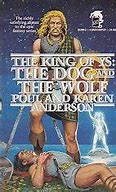
Poul Anderson mentions King Arthur in The Boat Of A Million Years, in The Merman's Children and in the Notes to The Dog And The Wolf (co-written by Karen Anderson) but Anderson's heroic fantasies and historical fictions do not include a King Arthur novel because Anderson was busy writing about many other characters, whether legendary or invented. However, the Andersons indirectly link Arthur, King of Britain, to (their version of) Grallon, King of Ys. In their King of Ys tetralogy, the Romans withdraw from Britain. The Romano-British Gratillonius, no longer King of the now inundated city of Ys but still a popular leader (Dux/Duke) in Brittany, expels the Romans and organizes local defense against barbarian incursions. Meanwhile, the British defense effort generates the Arthurian legend. Thus, the blurb on my The King Of Ys rightly says, "Before King Arthur, there was the King of Ys..."

Arthur and Robin prefigured two later social policies -

Arthur: the Round Table = equality.
Robin: robbing from the rich to give to the poor = redistribution of wealth.                                                         

Saturday, 17 November 2012

From Legend To Fiction


Poul and Karen Anderson's The King Of Ys Tetralogy combines four legends:

(i) the fabulous city, Ys of the hundred towers, protected from the sea by a wall with a gate opened to admit ships but locked against storms and high tides;

(ii) nine Witch-Queens, the Gallicenae;

(iii) a king who wins and defends his crown in mortal combat;

(iv) Ferriers of the Dead, fishermen whose sacred duty is to conduct not bodies but souls across water to their judgement or next incarnation.

Thus, the hero of the Tetralogy kills and becomes the King of Ys, husband of nine Queens, while Ysan fishermen ferry the dead.

In the legend, Grallon or Gradlon, ruling Cornouaille from Quimper, which he had founded, built Ys for his daughter, Dahut or Ahes, whose lover, the Devil disguised as a young man, got her to steal the key from her father as a sign of her affection although he really wanted it to open the gate. In the Tetralogy, Gratillonius, name later shortened to "Grallon" or "Gradlon," ruling Ys, later founds Quimper for Ysan survivors after Dahut's lover, Niall of the Nine Hostages, had got her to steal the key with the same result. Ys gains history and substance by pre-existing Gratillonius for several centuries.

In both versions, Dahut's mother had died in childbirth although her identity is different. The Andersons improve the story.

The Three Are Within


All gods are within us so the Three of Ys must be there as well although they come to be reviled by most of the characters in Poul and Karen Anderson's King of Ys tetralogy. No god has just one meaning. Therefore -

Lir:
the elements;
the sea from which life came;
pre-human life.

Belisama:
sexual motivation;
aspects of femaleness.

Taranis:
the male response;
control.

We contain:

effects of the elements;
pre-human motivations;
(at least attempted) control.

It makes sense to personify these aspects of life as gods. Our ancestors worshiped them. We begin to understand them. In Buddhist mythology, the Buddha is a teacher of gods and men. Distractions from meditation are natural, not demonic. The Goddess, not the Devil, is within.

Change But Not All At Once

In The Dog And The Wolf (London, 1989) by Poul and Karen Anderson, worldviews change but gradually, sometimes imperceptibly, as they do in real life. Nemeta, who had been the last worshiper of the Three of Ys, became a Christian but then Dahut, agent of the Three, killed Nemeta's husband, Evirion, as she had already killed another woman, Tera's, husband, Maeloch.

Knowing that this is forbidden to Christians but doing it anyway, Nemeta joins with Tera to invoke "'...the old Gods...Cernunnos, Epona, Teutatis...,'" curse the Three and summon "...the Old Folk from their dolmens." (pp. 486-487) Receiving intelligence on Dahut from Cernunnos, Nemeta relays it to Bishop Corentinus who, in turn, speaks to Dahut's father, Gratillonius.

Gratillonius, converted but not yet baptized, therefore not ringing any alarm bells in Dahut's preternatural sensory apparatus, is able to lure Dahut into the open where Corentinus, emerging from concealment, can exorcise her. Thus, an extraordinary heathen-baptised-unbaptised-episcopal alliance neutralizes the last expression of the power of the Three. (This is at last the end of the Three that I had been looking for when rereading the tetralogy.)

As I am sure any Bishop would tell us, they would not be able to do it that way these days.    

From Start To Finish

The action of Poul and Karen Anderson's King of Ys tetralogy takes twenty five years. For seventeen of those years, Gratillonius is King of Ys. The fourth volume describes the remaining eight years. Gratillonius, remarried with two young children, is still active, now as the Duke of Armorica but unofficially described as "King."

Almost everything changes:

the sea destroys Ys;
civil war divides the Empire;
no usurper succeeds in restoring central control;
one usurper withdraws troops from Britannia;
Armorica, then neighboring regions, expel Imperials;
the Pagan Gods dwindle or withdraw;
the new God's power grows;
Paganism becomes persecuted witchcraft;
Gratillonius converts from Mithraism to Christianity;
Bishop Corentinus (St Corentin) exorcises the mermaid who had been the last vengeance of the Ysan Triad;
barbarians advance even into Italy;
feudal dependence of serfs on landholders or monasteries begins.

The world changed then as now.

Friday, 16 November 2012

Who To Call On?


In Poul and Karen Anderson's The Dog And The Wolf (London, 1989), the religious changes continue. The fisherman Catto:

living on Ysan territory, had invoked the Three of Ys;
but, embittered at them after the city had foundered, learned to call on Christ;
but then, thinking that God would have "'...no ear for the likes of us...,'" instead asked "holy Martinus," St Martin, to bring them in safe (p. 469);
then, in desperation, offered " '...the Powers whatever they want for our lives...' " (p. 469);
but, thinking that this might have been an unlucky invocation, fumbled for a better one;
then said " 'Christ ha' mercy...,' " while his companion Surach mouthed spells over a seal bone amulet, when it seemed that they would be wrecked (p. 469);
finally, thanked holy Martinus, although Surach muttered, " 'If 'twas him,' " when they seemed to be safe;
and avoided shelter that might be haunted;
but then encountered Dahut who still spoke for the Three.

The basic worldview has not changed. The One God is remote. Other Powers, helpful or hostile, are nearer. Catto had asked Martinus not to intercede with God - the Christian formula - but to intervene in events - the Pagan formula. Thus, he treats St Martin more like a god than a saint.

Thursday, 15 November 2012

The End Of The Three Of Ys


We seem to have tracked these Gods to their last stand. Nemeta becomes a Christian.

"'And the Gods of Ys lost Their last worshipper,' said Gratillonius in a rush of savage glee." (Poul and Karen Anderson, The Dog And The Wolf (London, 1989), p. 445)

Other former Ysans still invoke Them but perhaps this is not the same as worship? Their agent Dahut is still at large but will be exorcised at the end of the novel.

The transfigured Dahut's mode of consciousness is extraordinary:

she hears Niall's name on the wind, on gulls' wings, in "...the secret rivers of Ocean, and the whispering of dead men in the deeps" (p. 343);

she follows it and finds him;

she gives him good weather, guides him past rocks and wrecks his enemies' ships;

she leads the Scoti to attack Gratillonius' home when he is not there to defend it.

Indeed, the world is a better place when she has been exorcised.

Times Change


The Ysans had known that their Age of Brennilis was ending and that Dahut would initiate a new Age. They just did not know what form the new Age would take: an Age of Ys as legend.

We now live in times of change as they did at the end of the Roman Empire. Enlargement and beautification of a place of worship over generations:

"...had been an idea strange to Gratillonius; but the world was moving into a different age." (Poul and Karen Anderson, The Dog And The Wolf (London, 1989), p. 359)

When Drusus says that the local defence force will never be a legion, Gratillonius replies:

" 'No...The time for that is past. We don't live in the same world any more.' " (p. 421)

- but he has the determination and foresight to lead his people into a new age and a different world.

He tells the procurator, " 'Times change, sir.' " (p. 425)

- to which the disgruntled procurator replies, " 'You're right, times do change.' " (p. 425)

Later, that same procurator says hopefully, " 'A new Constantinus, come from Britannia...A new age?' " (p. 428)

It is a new age but not one that he likes. This usurper called Constantine pulls the Romans out of Britain and Gratillonius, now popularly appointed Duke, expels them from Armorica.

Battle

Chapter XXI, section 2, of
The Dog And The Wolf (London, 1989) by Poul and Karen Anderson presents an excellent description of a battle to repel barbarian invaders. Although I have read the entire King of Ys tetralogy two or three times, I have no memory of this battle and might as well be reading it for the first time. I will remember it better after blogging.

The former centurion, Gratillonius, leads a makeshift army of local "brotherhoods" whose standards include tree, fish, horse, Cross, evergreens and auroch horns. His own banner, black on gold with a red border, shows the Roman She-Wolf that fed the Founder of the City. His brother-in-law, Salomon, training for leadership, has a gold cross on a blue shield, a precursor of medieval chivalry.

Gratillonius addresses his men, a mixed bunch:

" 'In Christ's name, by Lug and Epona and Cernunnos and Hercules, we go!' " (p. 418)

"Hercules" had been a favourite oath of Gratillonius when he was a Mithraist.

He instructs Salomon as the enemy advance. They observe that the Germani lope forward with spaced standards, forming their customary wedge but lacking finer coordination. Their petty king has combined shrewdness and boldness with leadership skills to bring them this far.

Some horses, not trained for combat, bolt but Gratillonius' pedigree animal Favonius fights with hoofs and teeth and must be kept away from friends. The minimal military organisation that the former centurion has been able to impose holds. The enemy are slaughtered or flee.

The Dog And The Wolf


After the battle:

"Now and then an abandoned dog howled on a farmstead. It sounded much like a wolf." (Poul and Karen Anderson, The Dog And The Wolf (London, 1989), p. 420)

And so it should:

"For between the Dog and the Wolf there is only the Law." (p. 504)

- which is the point of the volume's title.

When Gratillonius had fought the Scoti, his wife Verania, wanting to understand the difference between civilised and barbarian and knowing that it was not in the blood - we would say "genes" -, wrote a verse, really written by Karen Anderson, that lists possible differences, various bodily features, but ends by identifying only the Law.

When the Germani attacked:

"They were mostly big, fair men with long moustaches and braided hair." (p. 415)

- so these antagonists can be easily identified by their physical features and some members of Gratillonius' army might then identify barbarism with such features but this is a mistake, breeding xenophobia and racism.

Not Yet Fifty


Several years after the destruction of legendary Ys, Gratillonius, the former Roman Centurion from Britannia who had unexpectedly become King of that fabulous, Christ-cursed city, is not yet fifty years of age yet now leads a completely different life as a tribune in Armorica where he finds it necessary to organize a local defense force against barbarian attacks without any Imperial support and has remarried to a younger woman with whom he has started a family after losing most members of his extended Ysan family in the inundation of their city.

His reign there had lasted seventeen years, a considerable period although less than half of his life to date. He has outlived a lot of close friends and several sworn enemies but many of the issues in his career remain unresolved. "The King of Ys" is now merely an honorary title but it is how he is still known by many Ysan survivors.

One moral of this story is that none of us is any one thing. We can identify a man with the most prominent or spectacular part of his career but there is always more to him than that especially when we take into account unrealized potentialities, e.g., in this case that, had events gone differently, then "King Grallon," as he was known to the Ysans, would have led their colonization of North America.

Into The Dark

"God, how he missed Rufinus, and Maeloch, and Amreth, and more and more gone down before him into the dark!" (Poul and Karen Anderson, The Dog And The Wolf (London, 1989), p. 413)

Gratillonius is not thinking like a Christian yet. According to his belief, he and his co-religionists will go up and those who go down will not go to mere oblivion which is what "the dark" means here.

A curate in the South of Ireland said that people in his parish simultaneously entertained three mutually incompatible ideas of death:

what the Church teaches;
oblivion;
the pre-Christian idea that the dead persist in an underworld, resent the living and can return to harm us.

The pre-Christian idea was logical. In dreams, we seem to leave our bodies and to enter a realm where we can meet the dead. Death would be the mere absence of life, not a positive state.

Many people who do not question their received beliefs accept that there is a hereafter but do they really believe it? Are they as confident that they will still exist after death as they are that they will arrive in New York if they fly across the Atlantic? The mind seems to have different layers of belief. I like Alan Moore's description of religions as "higher fictions" - stories that people live inside of while still knowing that they are stories?

Wittgenstein questioned whether someone really believed in a Day of Judgement if he was not bothered about it. Is it so far in the future that it is thought of as more like a remote future event in the history of humanity rather than as a future experience of each individual? In a letter to a friend, Wittgenstein wrote, "I am afraid that the Devil will come to take me away." I thought, "This is Wittgenstein. He does not mean that literally." The very next sentence was "I mean this quite literally!"

Life After Ys II


Pursued by a combination of malice and Christianity, Nemeta must stop practising witchcraft. Hiding in the woods, she no longer even chants to the Three because:

"That could have disturbed the inhabitants, who sacrificed to spirits of wood and water and to whom Ys was a tale of doom." (Poul and Karen Anderson, The Dog And The Wolf (London, 1989), p. 394)

I am trying if possible to find the moment at which the Three cease to be worshiped and also to ascertain Who else is being worshiped then. There is Christ but there are also "...spirits of wood and water..."

So far - by page 394 of 504 -, neither Nemeta's father, former centurion, prefect, King and curial, now tribune, nor any other Roman authority knows that she has committed infanticide. That would be a more substantial charge against her and would also make it more difficult for Gratillonius to defend her. For the reader, she has become a more sympathetic character despite the horror of the child sacrifice.

Proto-Feudalism

Gratillonius, tribune of Confluentes, and Rullus, curial of Geoscribate, discuss military defence in the event that the Empire becomes unable to send reinforcements. Gratillonius proposes local lines of communication, including beacons and runners. My thought was that, since he is starting to talk about military organisation in Europe after the Fall of the Roman Empire, he is preparing the way for feudalism.

Sure enough, Rullus replies that, when free men have been wiped out by exorbitant Imperial taxation, it will be:

" 'Better to seek some great landholder's protection. Not that I'd make a serf he'd want; but the monks at Turonum may take me in...' " (Poul and Karen Anderson, The Dog And The Wolf (London, 1989), p. 399)

Rullus has here summarized all the features of feudalism:

great landholders;
protection;
serfs;
monasteries as also landholders.

The landholder does not own the land in the modern sense. He can neither sell it nor develop it as he sees fit. Fortunately, cities and trade grew up alongside feudalism and eventually overthrew it.

I think that the Mafia ethos of protection, violence, religious observance and personal loyalty to individual leaders as against the rule of law is a modern survival of feudal social relationships.

In The High Crusade, Poul Anderson imagined European feudalism succeeding on an interstellar scale but this was a joke, I hope.

Wednesday, 14 November 2012

Nemeta


After Dahut has taken Rufinus, Nemeta speaks plainly:

Dahut, not a demon in her shape, haunts Ys;

she drowned but the Three would not let her stay dead (thus, what is seen, heard and even felt is her transfigured body, not her ghost);

she is the vengeance of the Three on their city;

Nemeta knows this from dreams, wands, a pool and the smoke of a sacrificial fire;

Nemeta still worships the Three because they give her powers whereas Epona etc have become sprites or phantoms, Wotan and his warriors are aliens and Christ would deny her freedom;

Dahut now chiefly exists to avenge Niall;

having helped Rufinus, Nemeta must stay away from the sea and from any river that Dahut could swim up;

Nemeta lives in the woods with cats like the witch that she has become.

Poul and Karen Anderson, The Dog And The Wolf (London, 1989), pp. 356-358).

The Fate Of Niall


"They dared not open their hearts to each other about it. Thus nobody knew how widely and deeply the cold current ran." (Poul and Karen Anderson, The Dog And The Wolf (London, 1989), p. 341)

If nobody knew it, then how can we be told about it? Maybe they realized afterwards? Maybe. However, this passage is narrated neither by nor from the point of view of anyone who was present. The omniscient narrator addresses the reader.

The preceding page had described actions by Niall and conversation between Uail and Cathual but not from the point of view of any of these three. We are told that Cathual "...winced..." and "...seemed unable to speak his meaning..." but this could have been observed by a third party. (p. 340) We do not perceive the conversation from Cathual's perspective.

The narrator informs us of Cathual that:

"He was not alone in his forebodings." (p. 340)

- then briefly summarizes months of bad omens to Scoti, including old wives and druids.

Earlier in the novel, a conversation between Gratillonius and his prospective son-in-law, Cadoc, seems to be recounted as if seen from outside by the omniscient narrator. However, one paragraph when "...they took each other's measure...," shifts between their points of view:

"Cadoc saw a burly man, plainly clad..." (p. 183)

"Gratillonius noticed features also darkened by the sun..." (p. 183)

The Andersons control point of view well and occasional shifts of viewpoint within a single passage are rare.

Seasons


As earlier in the King of Ys tetralogy, Poul and Karen Anderson locate the narrative of Volume Four against the passage of the seasons:

"This early in the year, the surrounding forest stood mostly bare to the blue overhead." (The Dog And The Wolf (London, 1989), p. 24)

"Most fruit trees were done with blooming..." (p. 67)

"Beneath wolf-grey heaven, wrack flew. The north wind drove it, clamouring shrill, fanged with cold." (p. 84)

"That was a chilly year, but towards midsummer a spell of heat..." (p. 113)

"...the woods beyond the Odita blazed with autumn, red, russet, yellow under the earliest sun-rays." (p. 137)

"...harvest was ended, weather still mild..." (p. 145)

"The new year might be more hopeful than the last. Weather grew springlike well before the vernal equinox." (p. 153)

"Easter Eve was clear...leaves were bursting forth..." (p. 163)

"Trees groaned in the wind..." (p. 174)

"The feast of St Johannes had taken unto itself the ancient rites of Midsummer..." (p. 182)

"That summer was cruel..." (p. 192)

"...sun, warmth, and harvest odours. Bees buzzed..." (p. 205)

"Autumn blew grey from the north. Wind bit." (p. 207)

"Midwinter's early darkness had fallen..." (p. 210)

"It was the Birthday of Mithras." (p. 216)

"Spring cast green over the low land..." (p. 216)

"Summer weighed heavily on the land. Rainfall the day before..." (p. 230)

"Wind hooted and dashed rain across roof tiles." (p. 235)

"Winter heaven hung featureless grey." (p. 250)

" 'These endless winter nights drive everybody a bit crazy...' " (p. 254)

"...this was around midwinter." (p. 255)

"A light snow fell." (p. 260)

"Willows had leaved...Migratory birds were coming home." (p. 262)

"The first breath of autumn..." (p. 296)

"In the dark of the moon before winter solstice..." (p. 305)

"Springtime dusk." (p. 311)

"Harvest brought wholeness." (p. 328)

"Winter's rain brawled on the roof and sluiced down window glass." (p. 332)

"That year Beltene in Mide..." (p. 337)

"Clouds drifted low, heavy with rain." (p. 355)

"...their first, excellent harvest." (p. 358)

"On a day in autumn when the wind went loud and sharp..." (p. 362)

"The Black Months need not be dark." (p. 365)

"Spring returned..." (p. 372)

"Summer was then well along, a bleak one this year, chill rains and fleeting pale sunshine." (p. 378)

"Thunder rolled down the sky." (p. 380)

"The storm passed over." (p. 386)

"Autumn weather came..." (p. 391)

" 'Winter draws nigh.' " (p. 393)

"A sharp summer was followed by a hard winter." (p. 397)

"As the year spun down to solstice, cold deepened." (p. 401)

"Skies hung heavy, low above old snow and skeleton trees..." (p. 411)

"The sun drew nigh to midsummer. This was a beautiful year, as if to atone for the last." (p. 427)

"Summer brooded in majesty on ripening grain..." (p. 431)

"The long day of Armorican summer wore on." (p. 435)

"Rain came..." (p. 443)

"That year they kept the Feast of Lug in Armorica without their chiefs." (p. 448)

"Harvest was done..." (p. 451)

"The storks had long since departed..." (p. 472)

"Equinox almost a month behind them, nights drew in fast...Autumn colours in the woods..." (p. 484)

"The day before solstice hung still and murky." (p. 490)

"Snow began to fall..." (p. 495)

" 'Today is the Birthday of Mithras...it began that selfsame day, five-and twenty years ago. I stood on guard on the Wall...' " (p. 497)

"Midwinter nights fell early and dwelt late..." (p. 497)

Thus, by the end of the novel, we have not only witnessed great events among human beings but have also followed the circle of the year several times. 

The Fate Of Niall II


In Poul and Karen Anderson's The Dog And The Wolf (London, 1989), the death, we would say "assassination," of Niall of the Nine Hostages is very sudden, easy and unexpected. Rufinus does not shoot the arrow but it was he that made it possible. However, Wikipedia confirms that, according to the sources, Eochaid killed Niall outside Ireland and, in at least one account, with an arrow.

Earlier in the Andersons' King of Ys tetralogy, Niall had forbidden that the destruction of Ys be listed among his achievements or indeed that his and Ys' names be in any way associated with one another. Thus, the Andersons are able to place Niall at the center of the story of Ys and yet can also account for his absence from that legend.

All of the Scotian forebodings about Niall are now fulfilled. En route to his death, he has an extraordinary dialogue with the mermaid Dahut. The words of the exchange are printed without inverted commas, showing that they are not spoken aloud. Yet they are many and quite specific.

"In a way unknown to him he heard: I have said that never will my love let go of you, nor will it ever, Niall, my Niall." (p. 343)

He replies in the same way. They converse and she confirms that she is the vengeance of the Gods. Why does she not hate him for his betrayal? Are her emotions locked at the point where they were before her death - if it was death? She says that to love him is her doom. She controls the elements in his favor, wishes him a long life and does not (seem to) know of his imminent death.

The Andersons endow Eochaid with the ability to invent imaginative curses:

" 'May the winds of winter toss his homeless soul for a thousand years.' " (p. 347)

There are others. In fact, Eochaid condemns Niall to be reborn and die as a stag, a salmon and a child and Uail laments Niall by comparing him to a stag, a salmon and a child.

A sound as of winter wind though in unmoving air is a keening at sea. The invasion fleet that had been led by Niall turns back so I am bound to say that his assassination was a good thing.

Gratillonius The Hero


Far from being an anticlimax, Volume Four of Poul and Karen Anderson's King of Ys tetralogy, The Dog And The Wolf (London, 1989), is crucial to the story of the tetralogy's title character. Never has Gratillonius been such a hero than after the loss of his city and kingship.

When his political opponents have paid arsonists to destroy his colony of wooden buildings, he quickly organises the rebuilding of the colony, this time as a stone-built city to be funded by retrieving stolen wealth that Scotian pirates had secreted on the Channel Islands. The (ex-)King of Ys remains a formidable opponent to the Scotian King Niall long after Niall had destroyed Ys. Gratillonius not only fights and wins battles but also rebuilds civilisation and we see him do it - leading, working, organising.

As expected, the fire in the colony destroys the notes for a history of Ys:

"...The Veil of Brennilis, the revenge of the Gods, whatever it is, casts its shadow yet, and always shall, until Ys is wholly forgotten. We'll never find time to write that chronicle, nor will anyone else. The story of Ys will die with those of us who lived the last days of it; and our city will glimmer away into legend." (p. 308)

- legend on which fictions will be based.

Not Yet The End


Despite her claim, Nemeta was not the last worshiper of the Three. When Gratillonius mobilizes fishermen to fight the Scoti, one of them prays:

" 'Lir, I promise You the best of my every catch for a year...' " (Poul and Karen Anderson, The Dog And The Wolf (London, 1989), p. 271).

Such prayers will continue to be uttered at least until the last Ysan survivor who does not convert to Christianity dies but maybe no longer than that. Meanwhile, Nemeta, wanting to help her father, prays not to the Gods but to her dead mother and receives her mother's power to leave her human body and to fare forth in the form of an eagle owl. Dahut the mermaid and Nemeta the owl intervene in the battle between Gratillonius' irregular army and Niall's Scoti.

Meanwhile, another issue awaits resolution. As noted before, Poul Anderson wrote detective fiction and sometimes incorporated elements of such fiction into other works. Nemeta had sacrificed her son and, when the remains were found, had maliciously diverted suspicion onto Gratillonius' son-in-law. Gratillonius, charged by the Bishop to "'...search out the true guilty party...,' " has so far cleared his son-in-law but has not yet sought out any clues to the murderer's identity. (p. 254) Can we expect him to do this? Having read the book at least twice before, I do not remember. Instead, I find that many details are read with surprise as if for the first time. But this time I will indeed notice and remember what becomes of Nemeta.