Wednesday, 17 August 2016
Precosmic Chaos
In the myths and doctrines about divine creation of the universe, does God create something from nothing or impose order on chaos? Did nothing or chaos precede creation?
In Genesis, chaos came first: shapeless, empty, dark and deep. The deep was water. God, in the Genesis account, did not create the water but did impose order on it. He separated the water above from the water below and moved the water below to one side so that the dry land appeared. Thus, he created a world with a sky, sea and land which he could then populate. The Flood was the temporary undoing of creation. The Norse imagined a Void but then hypothesized dialectical opposites located at the poles interacting to generate life at the center.
When Milton's Satan looked through the Gate of Hell, he saw:
"The secrets of the hoarie deep, a dark
"Illimitable Ocean without bound,
"Without dimension, where length, breadth, and highth,
"And time and place are lost; where eldest Night
"And Chaos, Ancestors of Nature, hold
"Eternal Anarchie, amidst the noise
"Of endless warrs, and by confusion stand,
"For hot, cold, moist, and dry, four Champions fierce
"Strive here for Maistrie, and to Battel bring
"Their embryon Atoms; they around the flag
"Of each his faction, in thir several Clanns,
"Light-arm'd or heavy, sharp, smooth, swift or slow,
"Swarm populous, unnumber'd as the Sands
"Of Barca or Cyrene's torrid soil,
"Levied to side with warring Winds, and poise
"Thir lighter wings. To whom these most adhere,
"Hee rules a moment, Chaos Umpire sits,
"And by decision more imbroiles the fray
"By which he Reigns; next him high Arbiter
"Chance governs all. Into this wilde Abyss,
"The Womb of nature and perhaps her Grave,
"Of neither Sea, nor Shore, nor Air, nor Fire,
"But all these in their pregnant causes mixt
"Confus'dly, and which thus must ever fight,
"Unless the Almighty Maker them ordain
"His dark materials to create more Worlds,
"Into this wilde Abyss the warie fiend
"Stood on the brink of Hell and look'd a while,
"Pondering his Voyage; for no narrow frith
"He had to cross. Nor was his eare less peal'd
"With noises loud and ruinous (to compare
"Great things with small) then when Bellona storms,
"With all her battering Engines bent to rase
"Some Capital City, or less then if this frame
"Of Heav'n were falling, and these Elements
"In mutinie had from her Axle torn
"The stedfast Earth. At last his Sail-broad Vannes
"He spreads for flight, and in the surging smoak
"uplifted spurns the ground, thence many a League
"As in a cloudy Chair ascending rides
"Audacious, but that seat soon failing, meets
"A vast vacuitie: all unawares
"Fluttring his pennons vain plumb down he drops
"Ten thousand fadom deep, and to this hour
"Down had been falling, had not by ill chance
"The strong rebuff of som tumultuous cloud
"Instinct with Fire and Nitre hurried him
"As many miles aloft: that furie stay'd,
"Quencht in a Boggie Syrtis, neither Sea,
"Nor good dry Land: nigh foundered on he fares,
"Treading the crude consistence, half on foot,
"Half flying; behoves him now both Oare and Saile.
"As when a Gryphon through the Wilderness
"With winged course ore Hill or moarie Dale,
"Pursues the Arimaspian, who by stelth
"Had from his wakeful custody purloind
"The guarded Gold: So eagerly the fiend
"Ore bog or steep, through strait, rough, dense, or rare,
"With head, hands, wings, or feet pursues his way,
"And swims or sinks, or wades, or creeps, or flyes:
"At length a universal hubbub wilde
"Of stunning sounds and voices all confus'd
"Born through the hollow dark assaults his eare
"With loudest vehemence: thither he plyes,
"Undaunted to meet there what ever power
"Or spirit of the nethermost Abyss
"Might in that noise reside, of whom to ask
"Which way the neeresr coast of darkness lyes
"Bordering on light; when strait behold the Throne
"Of Chaos, and his dark Pavilion spread
"Wide on the wasteful Deep; with him Enthron'd
"Sat Sable-vested Night, eldest of things,
"The Consort of his Reign; and by them stood
"Orcus and Ades, and the dreaded name
"Of Demogorgon; Rumour next and Chance,
"And Tumult and Confusion all imbroild,
"And Discord with a thousand various mouths."
-John Milton, Paradise Lost, Book II, lines 891-967.
Compare Milton's account of Chaos with Anderson's account of Hell:
"I'd lose contact with Ginny and wander off again; or a lurch would nearly make us collide; or the intense gravitational field where space was sharply warped hurled our sticks groundward and tried to yank out guts and eyeballs; or a quick drop in weight sent us spinning; or we shot through folds in space instead of going around and were immediately elsewhere; or we passed into volumes where hyperspace was so flat that our broomspells didn't work and we must go through on momentum and aerodynamics - I don't recall every incident. I was too busy to notice a lot of them.
"We traveled, though, and faster than we'd hoped, once Bolyai discovered what tricks we could play when the time dimension was buckled. The deafening racket and disgusting illusions plagued us less as we got the hang of passing smoothly from metric to metric." (Operation Chaos, pp. 257-258)
Alan Moore partly follows Milton:
the endless seething chaoplasm is beyond Hell;
the Original Darkness, when conjured, arises from Chaos, advances through Hell, fomenting demonic civil war, and approaches the Light...
Wednesday, 24 June 2020
Chaos And Continuity
Operation Chaos works as a sequel to Three Hearts And Three Lions. It begins as Steve Matuchek telepathically broadcasts to other possible universes and states that the conflict between Law and Chaos must occur in every universe. Several times throughout the book, he comes face to face with that "...final One..." (p. 72) postulated by Holger Carlsen as outranking every other agent of Chaos.
Holger wonders whether Chaos is a more animistic expression of the second law of thermodynamics, the tendency toward disorder and level entropy, then whether Nazism is a resurgence of such animistic entropy in his world. But Chaos is not entropy. The Middle World agents of Chaos want the order of Law to be ended but not their own bodies or environments to become disordered or to wind down to total quiescence.
In our universe, that quiescence is apparently inevitable although, in Anderson's later hard sf, some high tech AIs think that they might somehow remain conscious even at full entropy. So they are Law against Chaos? As is the Time Patrol when it counteracts temporal chaos at the end of The Shield Of Time.
Extrablogular activities rule at present as you might guess from the fewness of posts.
Monday, 12 January 2026
The Chaos
Poul Anderson, "The Saturn Game" IN Anderson, Explorations (New York, 1981), pp. 12-81.
The "Chaos," an early period in Poul Anderson's Technic History, is mentioned in a single sentence:
"The Chaos ended those activities." (p. 36)
Is it mentioned anywhere else?
The activities that the Chaos ended were "...war and fantasy games..." (ibid.) "...during the middle twentieth century..." (p. 35) which were probably a reaction against:
"...the inactive entertainment, notably television, which had come to dominate recreation." (p. 36)
The quoted report which informs us that the Chaos had ended war and fantasy games but which also adds that those activities had been revived "...in recent times..." (ibid.) is dated 2057. Thus, the Chaos, whatever it was, is bracketed some time between the middle twentieth century and a date some time before 2057.
A regular blog correspondent, Sean Brooks, suggested that the "Chaos" in our timeline began in 1914 and is still happening and I think that this makes sense. However, in the Technic History timeline, the term has a more time-specific application and they should be getting out of it by now. That Chaos is the dividing line between the decades in which Poul Anderson was writing his Technic History and the times that he was writing about.
Although "The Saturn Game" is primarily about a small team of explorers experiencing difficulties on the surface of a Saturnian moon, some of its scenes are flashbacks to conversations inside the comfortable living quarters and shared spaces within the light sail ship, the Chronos. All of this adds to the richness of the Technic History which had originally started in the Polesotechnic League period until some chronologically earlier instalments were added. In the finished product, human beings explore the Solar System, then interact with Ythrians, first on Ythri, then on Gray/Avalon, before the League and Earth in the Solar Commonwealth are introduced in the contemporaneous fourth and fifth instalments.
"The Saturn Game" reads like a possible near future for us even if we remain skeptical of later developments like the quantum hyperdrive and interstellar civilizations. This single story is the Technic History equivalent of the The Green Hills Of Earth period of Robert Heinlein's Future History, a series that we should always remember while we read or reread Anderson's several alternative future histories.
Monday, 26 August 2024
Freedom And Chaos
"...the outlaw darkness, the last despairing return to primeval chaos..." (p. 426)
We find a vast consistency.
Friday, 9 May 2025
Chaos
Mirkheim, XI.
Falkayn thinks that Garver thinks that League independents "...represent Chaos." (p. 168)
See:
The latter post includes a link to a blog search result for Law And Chaos.
The Time Patrol learn that their ultimate antagonist is temporal chaos.
See also:
Well, that is enough about Chaos already. It is so far-reaching that it can be regarded as good, bad or neutral and there are at least two versions of it. It is either destructive disorder (bad) or freedom (good) denounced by bureaucrats.
Wednesday, 13 May 2020
An Ally Against Chaos
"Chaos and old Night."
This is the time of the evening when I:
stop reading Poul Anderson;
read something else;
find something appropriate for blogging anyway.
In "Guardians Of Time And The Pact," here, we saw that:
the Time Patrol stabilizes a reality forever liable to chaos;
the war between Law and Chaos is waged in every universe.
Now Law finds an unexpected ally. Lucifer Morningstar interrupts a conference of demons -
Lucifer Morningstar: Gentlemen. I hate to interrupt - -
Chairdemon: Lucifer Morningstar! You are most welcome, Lord! And the - - the chair belongs to you without dispute!
Lucifer Morningstar: Thanks, but I'm not staying. I just wanted to make a point. Reality hangs on a knife-edge, just at the moment. And it is in my interests that reality endures. Doubtless, you only meant to take advantage of the current disorder. But in the process you deepen it into chaos. Chaos, as I see it, is the true enemy.
-Mike Carey, Lucifer: The Wolf Beneath the Tree (New York, 2005), p. 66, panels 1-3.
Thus, the ranks against chaos are swelled. Tomorrow I expect to rejoin Steve Matuchek's anti-Chaos struggle in his part of the multiverse.
Monday, 22 June 2020
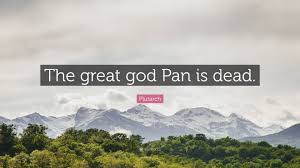
Is Pan Dead?
Law and Chaos, which are in perpetual struggle, are:
primeval forces;
modes of existence;
or a terrestrial reflection of the spiritual conflict between heaven and hell? (p. 28)
Holger's guide, Hugi, identifies four sides, Heaven, Hell, Earth and the Middle World, adding that his people, the woods dwarfs, remain neutral. Human beings are the chief agents of Law on Earth although most do not realize this and some, witches, warlocks and other evildoers, have sold out to Chaos. A few nonhuman beings support Law although on the other side is the entire Middle World comprising realms like:
Faerie;
Trollheim;
the Giants, which are a creation of Chaos.
Human wars, as between the Holy Empire and the Saracens, help Chaos. Law means peace, order and liberty but the Middle Worlders work against this and try to extend their realm. The lands of men, comprising the Empire, the southern Saracen countries and lesser kingdoms, are to the west whereas the Middle World is to the east, its closest part being Faerie. Holger has arrived in a disputed borderland.
History:
there was a literal Fall;
then nearly everything was Chaos;
Chaos has been driven back;
when the Saviour lived, the darkness could not stand;
at that time, Pan died;
however, Chaos has rallied;
it prepares to strike back.
Pan imagery has revived on our Earth. CS Lewis cited the "Piper at the Gates of Dawn" chapter of The Wind In The Willows as a literary example of awe.
"Pan has taken their souls, and they stampede."
-Poul Anderson, A Midsummer Tempest (London, 1975), xxiv, p. 221.
Wednesday, 23 October 2024
Order And Chaos
Wednesday, 31 August 2016
The History Of The Carolingian Universe
There is a perpetual struggle between two primeval forces or modes of existence, Law and Chaos. (Maybe Creation was the imposition of Law on Chaos but we are not told that.) There was a Fall and, after that, "'...everything were Chaos...'" (p. 28) but, since then, Chaos has been driven back. When the Savior was on Earth, darkness could not stand and Pan died. Thus, Chaos and darkness are linked. Now Chaos rallies and prepares to strike back.
In CS Lewis' That Hideous Strength, Hell has waited for the convergence of Atlantean magic with modern science. However, when the magician Merlin is revived, he joins forces with those who work against demonic science. In James Blish's Black Easter, Hell has waited for the meeting between Baines, who will commission the release of all the major demons, and Ware, who will be powerful enough to fulfill Baines' commission. Thus, the demons win Armageddon. In Three Hearts..., Chaos, which includes demons, prepares to strike but Holger is "...the Defender..." and it is "...as if dawn rode with him." (Chapter Twenty-Four, p. 154)
Holger speculates about the connection between the Carolingian Earth and the one he left:
"Had fleeting contact been made from time to time, castaways like himself who had returned with stories that became the stuff of legend? Had the creatures of myth a real existence here?" (Chapter Three, pp. 28-29) See here.
Friday, 27 August 2021
Dark Mathematics
The Stars Are Also Fire, 15.
Venator reflects:
Tuesday, 2 September 2014
A Multiversal Threat?
In that Introduction to Operation Chaos:
"Whatever manifold form it takes, the war of Law and Chaos surely goes on in them all.
"We have learned certain things. We ought to broadcast the lesson and the warning."
-Poul Anderson, Operation Chaos (Sutton, Surrey, 1995), p. 2.
Law and Chaos make war in Three Hearts... and in Michael Moorcock's Multiverse. Order and Chaos make war in DC Comics, including Neil Gaiman's The Sandman. So what is the warning? Will Chaos attack all the timelines simultaneously? Will characters from different Anderson works and from other fictional universes have to join forces against a common threat? Well, no. Anderson was an imaginative but also a restrained author who continued to write good novels of different genres set in different periods and universes but who did not follow up on that Introductory warning. Its sense of impending menace contributed to the particular volume but did not need to be taken any further.
Thursday, 18 August 2016
Water As Chaos
"...imagine a planet which is all water, churned by storms and not constrained by the ordinary laws of physics. At any point its surface can have any form, which won't even stay constant in time. Expand the two dimensions into three; make it four for the temporal axis, unless this requires more than one, as many philosophers believe; add the hyperspace in which paranatural forces act; put it under the rule of chaos and hatred: and you've got some analogy to the hell universe."
-Poul Anderson, Operation Chaos (New York, 1995), p. 256)
But, if Hell is that chaotic in that many dimensions, then maybe Matuchek should not see a planetary surface with stars and planets visible in the sky above?
John Milton continues the Biblical identification of water with chaos:
"In the Beginning how the Heav'ns and Earth
"Rose out of Chaos...
"Instruct me, for Thou know'st; Thou from the first
"Wast present, and with mighty wings outspread
"Dove-like satst brooding on the vast Abyss
"And mad'st it pregnant..."
-John Milton, Paradise Lost, Book I, lines 9-10; 19-22.
Christ calming a storm and walking on water exercises divine power over chaos. And the sea will be no more in the new creation. See here.
Wednesday, 15 July 2020
More Chaos
Gaia does not want her recently recreated human race to encounter her too soon.
"'What do you fear in this?'
"'Chaos. The unforeseeable, the uncontrollable.'" (p. 242)
Chaos has become a familiar but also ambiguous theme in Poul Anderson's works:
Law fights Chaos;
the Time Patrol counteracts temporal chaos;
social controllers resist chaotic freedom;
harmonious AIs oppose chaotic humanity.
How do we assess Gaia? She deceives Wayfarer and tries to destroy Brannock but champions humanity.
Chaos is also a morally neutral scientific datum, e.g.:
"Chaos and quantum uncertainties made developments incalculable in principle."
-PART TWO, V, p. 146.
Tuesday, 16 August 2016
Chaos
an alternative universe fantasy novel;
a historical fiction tetralogy with elements of fantasy;
two future history series;
two time travel novels;
a time travel series;
one volume of an alternative history trilogy, albeit by another author and mentioned parenthetically.
One emergent theme was "chaos," beginning in mythology when Chaos was personified as a Goddess and ending in science fiction when "chaos" is an impersonal principle of quantum mechanics. On every level, human beings strive to defend order and life against chaos and eventual death, the Norse Ragnarok, Dominic Flandry's Long Night.
Poul Anderson's fiction is a worthy conceptual sequel to the Sagas, the Eddas and any other literature that addresses this basic struggle. Hamlet asked, "To be or not to be?" We had no choice about coming into being but can give a good account of ourselves now that we are here.
"Chaos" is ambiguous. It can also signify the unpredictability of complete freedom that Anderson champions against the deadening order imposed by bureaucrats and dictators.
Tuesday, 2 August 2022
Agents Of Chaos
About thirty Exaltationists of both sexes are identically dressed in black, close-fitting, single-piece, silver-patterned garments, some with colourful cloaks. Only four Exaltationists will remain to be rounded up in The Shield Of Time. Raor is a minor character here but the major villainess in The Shield Of Time, PART TWO, so the same actor should appear in the part in both if these stories are filmed.
The Exaltationists are an expression of temporal chaos and, as such, cause further chaos. Thus, they stole timecycles and kidnap a Conquistador who steals a cycle from them. Raor tells Everard that they would have fought among themselves if they had succeeded in changing history. Chaos would have been unconfined.
Friday, 2 September 2016
Law, Chaos And Nazis
Holger reflects on:
"This business of Chaos versus Law..." (p. 66)
In the Carolingian universe, the Chaos-Law conflict is:
more than religious dogma;
a practical fact of existence;
perhaps a more animistic expression of entropy -
- or are the Nazis in our universe another animistic expression?
"What had he been fighting when he fought the Nazis but a resurgence of archaic horrors that civilized men had once believed were safely dead?" (ibid.)
I believe that the Nazis were partly "...a resurgence of archaic horrors..." but primarily an expression of conflicts inherent in modern civilization. A television discussion of this issue presupposed an irreconcilable antithesis between peaceful civilization and violent humanity, forgetting that it was the humanity that built the civilization and the civilization that generates violence. How could civilization have started if humanity were inherently violent?
Nazi-type regimes are what some wielders of power resort to during profound socioeconomic crises when it has become difficult to maintain order and to continue ruling in the old way. There are three options:
watch society disintegrate;
maintain order at any cost;
maybe reorganize society on a different basis.
The Nazi option is to maintain order - not Chaos or entropy! - by:
scapegoating minorities;
banning all opposition parties;
suspending democracy;
smashing all independent working class organization;
incorporating tame(d) trade unions with compulsory membership and no right to strike into the state apparatus.
Thus, I think that Nazism is an (unfortunate) potential option within advanced societies, not a resurgence of horrors from an archaic past. Of course, such a regime requires organized violence in addition to that of the police and the armed forces. Archaic horrors are cynically revived. However, storm troopers are unleashed on the victims and opponents of the regime, not on society as a whole. Chaos is controlled and channeled in the service of order. It is not allowed to destroy "law and order." The Nazis were not agents of Chaos or entropy but imposed their kind of Law, like SM Stirling's Draka.
If and when we build an inherently peaceful civilization, then it will be impossible for archaic horrors to return - just as, most of the time, ordinary human beings have no inclination to attack each other in the street.
Thursday, 14 March 2019
Other Enemies
While traveling, I remembered a few other kinds of enemies:
pre-human life;
Chaos (see also here and here);
temporal chaos;
bureaucrats or AIs regarding freedom as chaos. See here.
"Chaos" can mean either freedom, uncontrollable and unpredictable, or its antithesis, the kind of disorder that would prevent any life or freedom.
However, of these four additional "enemies," hypothetical temporal chaos need not concern us. We are born, live and die within one single timeline. Even if many such timelines chaotically succeed each other along a second temporal dimension, the inhabitants of each of the timelines remain unaffected by the chaotic relationship between their timelines. Such temporal chaos is of concern only to any time travelers who have ventured into their past and who want to ensure that they return to their remembered version of the present.
Sunday, 21 December 2014
Chaos And Order
"He loathes us because we've never either joined or toadied to the coalition of cartels, politicians, and bureaucrats. To him, we represent Chaos."
-Poul Anderson, The Rise Of The Terran Empire (New York, 2011), pp. 167-168.
How many works by Anderson present this basic conflict between freedom, "Chaos," and control, "Security"? For once, I will not try to write a complete list. In Anderson's first future history, the Psychotechnic Institute opposes not freedom miscalled chaos but real chaos: insanity; nationalism; war; totalitarianism. Totalitarian plots to impose order merely compound chaos. The Institute, if it had succeeded, would have (genuinely) reeducated, not (merely) indoctrinated.
In other works, those who value security try to eliminate those who prefer unpredictability. The earlier form of this conflict is between bureaucrats on the one side and entrepreneurs or explorers on the other. The later form is between superhuman artificial intelligences on the one side and the whole of humanity on the other. The transition occurs in Harvest Of Stars. Humanity is extinct in, ironically, Genesis.
Thursday, 20 October 2022
The Concept Of Chaos
Anderson's Time Patrol agents counteract temporal chaos.
Chaos is one of the Night Faces on the planet Gwydion in Anderson's The Night Face.
However, in some other novels by Anderson, the villains are those bureaucrats, ideologues or even artificial intelligences who regard human freedom as unpredictable and chaotic, therefore to be controlled and suppressed.
Either way, chaos is clearly a key concept or set of concepts.
Sunday, 15 August 2021
Chaos And Law And Order
In the DC Comics multiverse: Lords of Order against Lords of Chaos.
In Poul Anderson's multiverse: Law against Chaos.
In a single but mutable timeline: the Time Patrol against chaos.