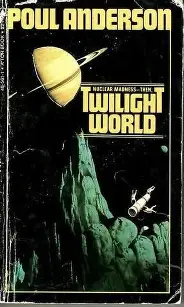
The Wikipedia Poul Anderson bibliography lists:
Tuesday, 14 April 2026
Poul Anderson's Series
Wednesday, 1 April 2026
Early Space Travel?
In Poul Anderson's Maurai future history, the War of Judgment - a version of what we call World War III - delays space travel for centuries whereas, in Anderson's Psychotechnic History, Mars and Venus are colonized in the immediate aftermath of WWIII and, in the same author's Twilight World, it is mutants resulting from the radiation of World War III that go to Mars. Thus, after all, nuclear war and space travel were not necessarily incompatible.
But what I am leading up to is: what has meanwhile happened on Earth Real? A later Anderson future history series has to acknowledge that:
Sunday, 8 February 2026
Some Short Future Histories
James Blish's The Seedling Stars is a single volume in four parts, originally five stories, about the single theme of pantropy, the science of adapting human beings to other planetary environments. It conclusion is that, when Adapted Men have filled the galaxy, Earth has changed so much that it is colonized by Adapted Men.
Twilight World and The Seedling Stars both address changes to the human form and extraterrestrial colonization.
Anderson's Maurai And Kith is a collection of only three Maurai stories and two Kith stories although later a third story was added to the Kith series and a long novel to both series. The theme of the Maurai Federation series is that, after a nuclear war, seafaring people of the Southern Hemisphere become the world power. We get a sense of Poul Anderson exploring every possibility.
James Blish's Okie series was complete as four stories in one volume. However, Blish added a prequel, a juvenile novel and a sequel. Okie culture ends in Volume III and the universe ends in Volume IV.
Larry Niven's Known Space is a long future history series with a definite ending. Because human beings are artificially selected for the inheritable psychic power of luck, Known Space and the Thousand Worlds become utopian societies of lucky people about whom Niven becomes unable to write any more stories! As Fran Cobden remarked, "...an amazing idea!"
Other short future histories:
Tuesday, 13 January 2026
The Outer Solar System
Wednesday, 17 December 2025
North American Union And Diamond Dust
"In Twilight World, the remnants of the United States and Canada merge as the North American Union..."
Both Rapid Technological Advances And Geopolitics and Alaric Wayne II refer to that same North American Union.
In North American Future History, the US and Canada amalgamate as the North American Federation.
In The Maurai Period, there is a North West Union.
In Pun And Gun, a North American Intelligence officer interrogates a rebel asterite.
In Robert Heinlein's The Star Beast, the North American Union is one part of Earth which is the leading planet in the Federated Community of Civilizations, usually referred to as the Federation.
Again, we find terminologies common to different fictional futures.
While searching for the North America in Tales Of The Flying Mountains, we find yet another description of the Milky Way:
Monday, 1 September 2025
Post-Nuclear War Futures
the majority version, spaceships;
a minority version, nuclear war aftermath.
More recently, it has been argued that an all-out nuclear exchange would generate a Nuclear Winter - with no aftermath.
Poul Anderson covers both options, i.e., spaceships and nuclear aftermath - but not Nuclear Winter.
Sunday, 20 July 2025
A Changed World
Brain Wave (originally THE ESCAPE), 12.
In every detail, Poul Anderson demonstrates that his characters live in a changed world.
Peter Corinth calculates intranuclear stresses in a faster than light drive field simultaneously with the construction of the hull, engine, armour, doors, ports and controls of the first interstellar spaceship, all designed as an unprecedented piece of precision engineering.
The Institute works nonstop because its many liberated minds now have unimaginable horizons. The future belongs to the young, strong, purposeful and balanced technicians whereas Corinth feels exhausted at thirty-three. He and Helga are now so perceptive that they cannot conceal their feelings for each other and do not try.
Thin, sharp air smells of autumn and sea. Dead leaves swirl. Frost has come. That is not new, of course, although it is standard Andersonian description, but what is new is that New York streets are half empty. Pedestrians and cars are rare. Skyscrapers are dark.
Roger's Cafe is:
"'A new night club for the new man.'" (p. 106)
Inside, there is a blue twilight. Corinth immediately deduces the new fluorescence principle used. Tables are spaced farther apart than formerly and are arranged in a spiral that minimizes distances to be walked by waiters. However, the waiter is a wheeled machine that extends slate and stylus for orders.
An orchestra including some previously famous musicians plays both old and new instruments to a now more appreciative audience. The new ability to see each other more clearly has eliminated former social distinctions. Corinth and Helga communicate with looks, gestures and very few words.
He remembers liking:
"Ah, Love, could thou and I with Fate conspire -" (p. 110)
- but now sees it as childish.
Sunday, 22 June 2025
Chronologies
Brian Aldiss' 1976 Introduction to Anderson's Brain Wave describes the work as "...this first novel..." (p. 7) However, Vault Of The Ages (1952) and Three Hearts And Three Lions (1953) preceded Brain Wave (1954). (I am assuming here that I got all these dates right when I compiled Significant Dates but I might check on that.)
Thus, we might say that Vault Of The Ages preceded Anderson's Technic History in the first kind of chronological order although not in the second kind. However, "Tiger By The Tail," (1951) "Honorable Enemies" (1951) and "Sargasso of Lost Starships" (1951) all preceded Vault Of The Ages and were later incorporated into the eventual Technic History. "Significant Dates," assuming that its dates are accurate, shows how various works and series interpenetrate in the first chronological sense. The novels and stories that separate into distinct series are parts of a single creative process.
Tuesday afternoon will be taken up with my cataract operation and the weekend after next will be spent in London in the cause of greater understanding of current conflicts.
Fair winds forever.
Monday, 21 April 2025
Since 1956
When we reread such works, especially after very long intervals, they are not the same because we are not. I used to be satisfied if the characters had travelled in spaceships through the Solar System or to other planetary systems. Now considerably more than that is necessary. Anderson conveys some sense of what it is like to be an Ythrian or a Merseian or to be a human being in regular contact with other intelligent species. Merseians, who began as space opera villains, became a credible species with diverse cultures and languages and not every single one of them a villain - obviously.
The People Of The Wind about human beings and Ythrians seems to be inexhaustible in descriptive details and characterization although we approach its climax yet again.
Wednesday, 26 March 2025
Mutations In Two Timelines
The front cover blurb proclaims:
Saturday, 1 March 2025
Some Familiar Ideas
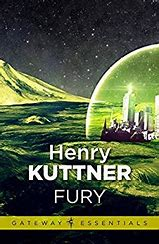
Fury.
Human beings are living on Venus because:
Monday, 24 February 2025
Future Historical Culminations And Human Changes
Thursday, 17 October 2024
White Americans And Pilgrims
The White American Church:
arose during the lunatic years in the later twentieth century;
became popular in the southern states of the former US;
was a reaction against social troubles and science;
was backed by some politicians but, unlike Robert Heinlein's Angels of the Lord, did not win political power, at least not on Earth;
colonized Ganymede and wants to pay the Planetary Engineers to terraform Ganymede and Callisto.
Terraforming Jovian moons links the White Americans to characters in Anderson's Twilight World, Heinlein's Farmer In The Sky and James Blish's The Seedling Stars.
The Pilgrim Church, which had colonized Mars in "Un-Man," is an attempt to return to an imagined past whereas the White Americans try to leap forward to an imaginary millennium. Future religions are as diverse as past ones.
On the next street to ours, an entirely black church meets on Sundays in hired premises but I have no reason to believe that they are either millennarians or supremacists. That is not the nearest place of worship to where we live because there is a mosque at the end of our street. Everything in the present is a potential seed of the future. Any current religious group might conceivably form a government or colonize Ganymede in the next century.
Tuesday, 15 October 2024
Post-Nuclear War Timelines
Monday, 20 May 2024
Futures
Some other sf, like Anderson's Psychotechnic History, Maurai History, Twilight World and Vault Of The Ages, shows a long recovery from nuclear war. We are also taking some steps in that direction! I need hardly elaborate.
In the Technic History, Ythrians of the New Faith see the shadow of God the Hunter across the future. This is, figuratively, the case for each of us as an individual but hopefully not for the planet or the species any time soon.
Wednesday, 28 June 2023
Righteous Men
Gallicenae, 11, 2.
Rufinus of the Bacaudae expounds to Gratillonius. Men meet by twilight. Wanderers preach sedition:
"The Empire had rotted to worthlessness... the fat grew fatter, the powerful grew ever more overbearing. Had not Christ Himself denounced the rich? Was not the hour overpast to humble them and take back what they had wrung from the working poor? The Last Day drew nigh, Antichrist walked the world; your sacred duty was to resist him. Righteous men had sworn themselves to a brotherhood, the Bacaudae, the Valiant..." (p. 57)
They rob the rich and are supported by some serfs and freeholders.
Yes! The Andersons allow their character to proclaim revolution convincingly although Gratillonius remains sceptical of the difference between Bacaudae and bandits.
The two men part but Rufinus has been inserted into the narrative for a reason.
(This is probably the last post until next week.)
Sunday, 11 June 2023
Important But Improbable
Sunday, 5 March 2023
Wars In Different Worlds
The War Of Two Worlds.
These Martians are humanoid, differing from Terrestrials only in details like height, colouration and number of fingers. Contrast Wells' version. It is plausible that this particular set of Andersonian Martians would be nicknamed "Marshies." (I, p. 10) Will we ever interact with extra-terrestrials in the same sort of way as we interact with each other: liking them, hating them, giving them nicknames etc? I doubt it but am prepared to be proved wrong at any time by a spaceship arriving in the Solar System.
The War Of Two Worlds, like Anderson's Psychotechnic History and Twilight World, begins among post-war ruins: two versions of World War III and the first war between worlds. Unfortunately, we currently see such ruins on TV news. That war has just passed its first anniversary. A rich world destroys thousands of lives and immense wealth.
In Manhattan, because there is no other means of transport, Arnfeld walks past gaunt buildings, empty windows, gaping doorways and shuffling pedestrians and through a raw, whimpering wind. Of course this wind whimpers.
In Anderson's Technic History, Earth avoids World War III but suffers the Chaos now and is sacked during the Troubles and again during the Long Night. We see the ruins during the Troubles. Some scenes are common to many timelines.