Niven tells us:
what Hilary Gage watches with pride and what he prefers;
then, that Hilary Gage is a computer program;
that he had volunteered for his present situation because the alternative was death by old age;
that some human planets are suspicious of advanced computers as being too similar to berserkers;
that the approaching berserker, 100101101110, has three brains and might lose one or even two without sensing any change of personality.
Thus, Niven comes down unequivocally on the side of consciousness in complicated computers, including berserkers. This is no surprise since a conscious computer plays a big role in his novel, A World Out Of Time.
100101101110 destroys the planet that Gage was terraforming, then destroys Gage himself, but not before Gage has copied himself into two of the berserker's three brains, thus gaining a majority when the brains consult - a neatly nuanced Niven notion.

When Mary in the Anderson story conversed with the berserker that she regarded as unconscious, its voice:
"...was derived from the voices of human captives taken long ago, shrill, irregular, a sonic monster pieced together out of parts of the dead, terrifying to many." (Space Folk, New York, 1989, p. 204)
That would sound terrifying especially when it was known that behind it was either a consciousness completely hostile to all organic life or an automatic system containing no consciousness.
I am not about to read any more berserker stories but Gage reflects on the different kinds of berserkers of which he has heard and I imagine that these appear in other stories:
all shapes and sizes;
time traveling;
humanly shaped but suddenly sprouting weapons.
He also reflects that:
"Machines could be destroyed, but they could never be made afraid." (p. 68)
This sentence, taken in isolation, might have suggested that the berserkers are after all not conscious. However, Gage also finds that (i. e., is conscious of the fact that):
"...he felt no fear. The glands were gone, but the habit of fear...had he lost that too?" (p. 71)
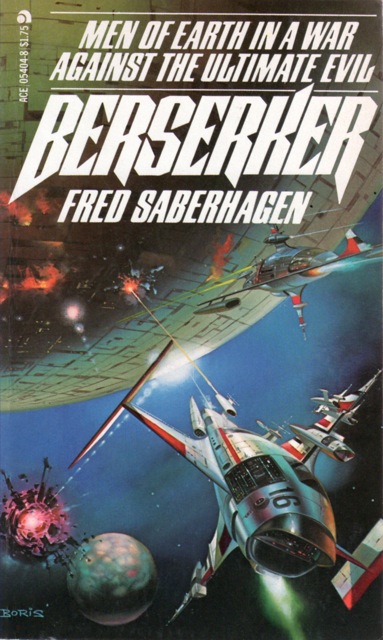
The diversity of Limits is shown by the fact that, of its two cover illustrations attached here, one is fantasy whereas the other is sf.