Showing posts with label Berserker. Show all posts

Sunday, 1 September 2013

Another Berserker

Larry Niven's berserker story, "A Teardrop Falls" (Niven, Limits, London, 1986), directly addresses the issue of artificial intelligence that I discussed here in relation to Poul Anderson's berserker story, "Deathwomb."

Niven tells us:

what Hilary Gage watches with pride and what he prefers;
then, that Hilary Gage is a computer program;
that he had volunteered for his present situation because the alternative was death by old age;
that some human planets are suspicious of advanced computers as being too similar to berserkers;
that the approaching berserker, 100101101110, has three brains and might lose one or even two without sensing any change of personality.

Thus, Niven comes down unequivocally on the side of consciousness in complicated computers, including berserkers. This is no surprise since a conscious computer plays a big role in his novel, A World Out Of Time.

100101101110 destroys the planet that Gage was terraforming, then destroys Gage himself, but not before Gage has copied himself into two of the berserker's three brains, thus gaining a majority when the brains consult - a neatly nuanced Niven notion.

Anderson's human characters capture a berserker computer by physically disabling it. Niven's character captures three by copying himself into two of them. The berserkers are the greatest possible threat to all organic life but cannot operate everywhere and, in each of these stories, we see human beings pushing them back.

When Mary in the Anderson story conversed with the berserker that she regarded as unconscious, its voice:

"...was derived from the voices of human captives taken long ago, shrill, irregular, a sonic monster pieced together out of parts of the dead, terrifying to many." (Space Folk, New York, 1989, p. 204)

That would sound terrifying especially when it was known that behind it was either a consciousness completely hostile to all organic life or an automatic system containing no consciousness.

I am not about to read any more berserker stories but Gage reflects on the different kinds of berserkers of which he has heard and I imagine that these appear in other stories:

all shapes and sizes;
time traveling;
humanly shaped but suddenly sprouting weapons.

He also reflects that:

"Machines could be destroyed, but they could never be made afraid." (p. 68)

This sentence, taken in isolation, might have suggested that the berserkers are after all not conscious. However, Gage also finds that (i. e., is conscious of the fact that):

"...he felt no fear. The glands were gone, but the habit of fear...had he lost that too?" (p. 71)

The diversity of Limits is shown by the fact that, of its two cover illustrations attached here, one is fantasy whereas the other is sf.

The 1980's

Larry Niven's Medea story, "Flare Time," and his berserker story, "A Teardrop Falls," are both in his collection, Limits, published by Ballantine Books in 1985.

Poul Anderson's Medea story, "Hunter's Moon," and his berserker story, "Deathwomb," are both in his collection, Space Folk, published by Baen Books in 1989.

The 1980's was the decade of shared universes. Niven's Introduction to Limits also mentions the James Baen-inspired sharing of Niven's own Warlock's Era series.

Fred Saberhagen, creator of the berserker series, asked half a dozen other authors each to write a human-berserker encounter story so that he would then be able to amalgamate them into a novel by deciding on the order of the stories before adding a beginning and an ending. Anderson's story is potentially a turning point for the series because, in it, human beings capture an intact berserker computer - which might enable them to design von Neumann machines programmed to kill berserkers.

If that number of "...half a dozen..." other authors to write berserker stories is accurate (Limits, p. viii), then I have read one third of this novel/sub-series.

As the berserker that is to be captured flies into the trap that has been prepared for it, it:

calculates orbits;
adjusts vectors;
receives cosmic noise;
detects human vessels scrambling from the planets that it is approaching;
tracks them;
considers withdrawal;
computes that its optimum course is to proceed because, at worst, a single unit will perish;
considers dispatching a courier back to base but calculates that the human beings would destroy it and refrains;
decides to seek engagement, to establish orbit and to begin sterilizing the inhabited planet;
sliced by an energy beam, becomes "...blind, deaf, dumb, helpless." (Space Folk, p. 232)

Can all of these calculations, considerations and decisions be unconscious computations? Some of them certainly can. A book on the philosophy of mind suggested that the test of whether an entity is conscious is whether we can fully account for its properties and behavior without attributing consciousness to it. Thus, a child can imagine a conversation between a doll, a toy soldier and a teddy bear but we can fully account for every datum about the toys without attributing consciousness to any of them whereas by far the simplest if not indeed the only way to account for the child's behavior is to assume that s/he is conscious.

So is the berserker like one of the toys or like the child? Earlier in the story there is a conversation between a human being and a berserker. At one point, the human being says:

"'Were ye human - were ye e'en alive, conscious, insultable, ye metal abomination - I'd ask ye to stop playing games wi' me.'" (p. 205)

"'Afterward think...Ah, but ye do no' really think, do ye?'" (p. 206)

- so Mary accepts that she is not conversing with a conscious being even though she speaks exactly as if she were. This strains credibility. Ability to conduct a conversation is the criterion for the Turing Test.

When she tells the berserker that "'...a red dwarf star...has a life-bearing planet...," the omniscient narrator comments:

"An organic being would have registered surprise." (p. 213)

- whereas "The machine...said merely: 'That is not believed possible.'" (ibid.)

So here we are being made aware of some difference between two kinds of conversation: that between two conscious beings and that between a conscious being and an unconscious computer.

Consistently with her remarks about the berserker's lack of consciousness and of real thought, Mary thinks of its computer as a "...pseudo-brain...," not as an artificial brain. (p. 214)

Berserkers

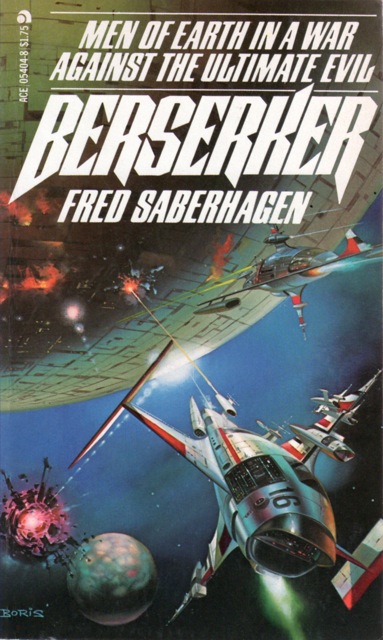
I read Larry Niven's berserker short story, "A Teardrop Falls," a long time ago but remember only the basic premise: berserkers are self-replicating machines programmed to cross interstellar space and to destroy all organic life.

"...it was nonhumans that had built the first berserkers, untold ages ago, and programmed them to destroy everything alive, as a weapon in a damned forgotten war of their own."

-Poul Anderson, "Deathwomb" (IN Anderson, Space Folk, 1989, pp. 195-238 AT p. 207).

Some organisms, called "goodlife" by the berserkers, cooperate with berserkers but I do not yet know the basis of this cooperation.

"Deathwomb" is Anderson's berserker story. The viewpoint character, Sally Jennison, thinks of:

"...the whole hollow universe as a womb engendering the agents of death, which later came back and impregnated their mother anew." (p. 220)

- this "impregnation" is by berserker auxiliaries mining planets and asteroids to make new machines programmed with the same code.

It seems that each writer of a berserker story can imagine new planets for human beings and berserkers to fight on and around. Anderson presents yet another of his astronomical oddities - a double planet at just the right distance from a red dwarf star for one of the planets to have life, their locked orbit maintaining atmospheric circulation. The inhabited planet, Ilya, has a Highroad River like Daedalus in Anderson's The Game Of Empire. As on many other fictitious planets, Anderson describes the local equivalent of grass:

"...springturf, a living recoil beneath the feet, purple studded with tiny white flowers." (p. 211)

In the opening passage, an automatic space courier carries a message from some human beings to a berserker. The omniscient narrator, having applied the words "...motivated...", "...fear..." and "...proud..." to the berserkers, then comments:

"Motivation; fear; pride - nonsense, words, when used about a set of computer-effector systems, unalive, belike unaware..." (p. 196)

"...belike unaware..."? Are they or are they not aware?

The philosopher John Searle presented two arguments -

(i) Rule-governed manipulation of symbols is not knowledge of their meanings and simulation is not duplication, therefore analog computers are not conscious. To be conscious, an artifact would have to duplicate, not merely simulate, brain functions and therefore would be an artificial brain, not an analogue computer.

(ii) However, a sufficiently complex and correctly programmed analogue computer would be able to pass the Turing Test, conversing and behaving indistinguishably from an intelligent, self-conscious being.

I accept (i) but not (ii). If (ii) were true, then how would any of us know that every other human being was not an unconscious automaton? At present, this is an academic question but, if anyone were to introduce an entity that passed the Turing Test but could then be shown to be an elaborate analog computer, then I would have a major philosophical problem.

To pass the Turing Test, an entity, on hearing an offensive joke, would have to:

laugh out loud or
merely smile or chuckle or
not get the joke or
understand the joke but not find it funny or
be very offended or
say, "That is offensive," "That is in bad taste" etc and explain why or
storm out of the room or
threaten legal action or
become offensive or even violent in return or
something else...

This at least shows that no one is yet close to constructing a computer capable of passing the Turing Test.

This is all relevant because the automatic courier and the berserker give every appearance of passing the Turing Test. They converse with questions and answers. Is it plausible either that the berserker is not conscious or that it is merely a computer?

Deathwomb

Immediately after "Hunter's Moon" in Poul Anderson's collection, Space Folk (New York, 1989), is his paradoxically entitled short story, "Deathwomb," which turns out to be his contribution to Fred Saberhagen's Berserker series. Yet again, I have had this story on a shelf for years without, as far as I can remember, ever having read it.

Thus, to reiterate some points made earlier, of the twelve items in Space Folk:

"Pride" is a prequel to Anderson's novel, Tau Zero;
"Quest" is a sequel to his The High Crusade;
"Hunter's Moon" is part of Harlan Ellison's Medea series;
"Deathwomb" is part of Saberhagen's Berserker series;
"Symmetry" has the background of Anderson's Psychotechnic future history although it is not part of that series;
"Commentary" is non-fiction.

I think that the remaining six stories are independent although at least two of them are what I call "proto-series":

"Horse Traders" could easily be the first installment of a "horse traders" series;

the very Heinleinian story, "Escape The Morning," written for the Boy Scouts of America, is about young people living, and effecting a rescue, on the Moon and could very easily initiate a series of such stories, similar to the Moon period of Heinlein's Future History.

Anderson contributed to so many other authors' series or shared universes that an entire volume of his Complete Works would be able to hold his Medea story, his Berserker story, his Robots story, his Man-Kzin Wars stories, his Isaac's Universe stories etc;
"Pride" and "Quest" should be published with their respective novels;
"Commentary" belongs in a non-fiction collection;
"Symmetry" could fit in an Appendix of the collected Psychotechnic History;
thus, Space Folk would be halved to six stories which, in turn, could be incorporated into a longer volume about space exploration.

Having said all that, I ought to get on with reading "Deathwomb."