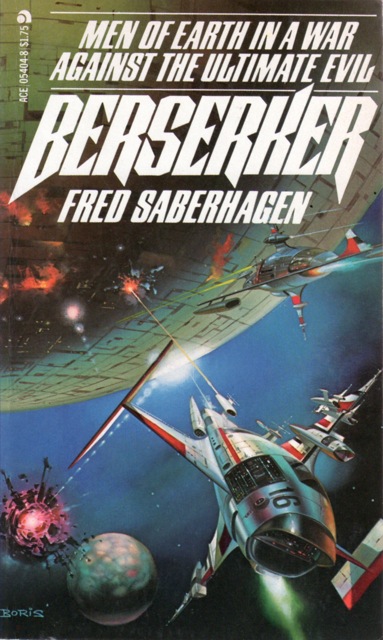
I read Larry Niven's berserker short story, "A Teardrop Falls," a long time ago but remember only the basic premise: berserkers are self-replicating machines programmed to cross interstellar space and to destroy all organic life.
"...it was nonhumans that had built the first berserkers, untold ages ago, and programmed them to destroy everything alive, as a weapon in a damned forgotten war of their own."
-Poul Anderson, "Deathwomb" (IN Anderson, Space Folk, 1989, pp. 195-238 AT p. 207).
Some organisms, called "goodlife" by the berserkers, cooperate with berserkers but I do not yet know the basis of this cooperation.
"Deathwomb" is Anderson's berserker story. The viewpoint character, Sally Jennison, thinks of:
"...the whole hollow universe as a womb engendering the agents of death, which later came back and impregnated their mother anew." (p. 220)
- this "impregnation" is by berserker auxiliaries mining planets and asteroids to make new machines programmed with the same code.
It seems that each writer of a berserker story can imagine new planets for human beings and berserkers to fight on and around. Anderson presents yet another of his astronomical oddities - a double planet at just the right distance from a red dwarf star for one of the planets to have life, their locked orbit maintaining atmospheric circulation. The inhabited planet, Ilya, has a Highroad River like Daedalus in Anderson's The Game Of Empire. As on many other fictitious planets, Anderson describes the local equivalent of grass:
"...springturf, a living recoil beneath the feet, purple studded with tiny white flowers." (p. 211)
In the opening passage, an automatic space courier carries a message from some human beings to a berserker. The omniscient narrator, having applied the words "...motivated...", "...fear..." and "...proud..." to the berserkers, then comments:
"Motivation; fear; pride - nonsense, words, when used about a set of computer-effector systems, unalive, belike unaware..." (p. 196)
"...belike unaware..."? Are they or are they not aware?
The philosopher John Searle presented two arguments -
(i) Rule-governed manipulation of symbols is not knowledge of their meanings and simulation is not duplication, therefore analog computers are not conscious. To be conscious, an artifact would have to duplicate, not merely simulate, brain functions and therefore would be an artificial brain, not an analogue computer.
(ii) However, a sufficiently complex and correctly programmed analogue computer would be able to pass the Turing Test, conversing and behaving indistinguishably from an intelligent, self-conscious being.
I accept (i) but not (ii). If (ii) were true, then how would any of us know that every other human being was not an unconscious automaton? At present, this is an academic question but, if anyone were to introduce an entity that passed the Turing Test but could then be shown to be an elaborate analog computer, then I would have a major philosophical problem.
To pass the Turing Test, an entity, on hearing an offensive joke, would have to:
laugh out loud or
merely smile or chuckle or
not get the joke or
understand the joke but not find it funny or
be very offended or
say, "That is offensive," "That is in bad taste" etc and explain why or
storm out of the room or
threaten legal action or
become offensive or even violent in return or
something else...
This at least shows that no one is yet close to constructing a computer capable of passing the Turing Test.
This is all relevant because the automatic courier and the berserker give every appearance of passing the Turing Test. They converse with questions and answers. Is it plausible either that the berserker is not conscious or that it is merely a computer?
Showing posts with label Fred Saberhagen. Show all posts
Sunday, 1 September 2013
Deathwomb
Immediately after "Hunter's Moon" in Poul Anderson's collection, Space Folk (New York, 1989), is his paradoxically entitled short story, "Deathwomb," which turns out to be his contribution to Fred Saberhagen's Berserker series. Yet again, I have had this story on a shelf for years without, as far as I can remember, ever having read it.
Thus, to reiterate some points made earlier, of the twelve items in Space Folk:
"Pride" is a prequel to Anderson's novel, Tau Zero;
"Quest" is a sequel to his The High Crusade;
"Hunter's Moon" is part of Harlan Ellison's Medea series;
"Deathwomb" is part of Saberhagen's Berserker series;
"Symmetry" has the background of Anderson's Psychotechnic future history although it is not part of that series;
"Commentary" is non-fiction.
I think that the remaining six stories are independent although at least two of them are what I call "proto-series":
"Horse Traders" could easily be the first installment of a "horse traders" series;
the very Heinleinian story, "Escape The Morning," written for the Boy Scouts of America, is about young people living, and effecting a rescue, on the Moon and could very easily initiate a series of such stories, similar to the Moon period of Heinlein's Future History.
Anderson contributed to so many other authors' series or shared universes that an entire volume of his Complete Works would be able to hold his Medea story, his Berserker story, his Robots story, his Man-Kzin Wars stories, his Isaac's Universe stories etc;
"Pride" and "Quest" should be published with their respective novels;
"Commentary" belongs in a non-fiction collection;
"Symmetry" could fit in an Appendix of the collected Psychotechnic History;
thus, Space Folk would be halved to six stories which, in turn, could be incorporated into a longer volume about space exploration.
Having said all that, I ought to get on with reading "Deathwomb."
Thus, to reiterate some points made earlier, of the twelve items in Space Folk:
"Pride" is a prequel to Anderson's novel, Tau Zero;
"Quest" is a sequel to his The High Crusade;
"Hunter's Moon" is part of Harlan Ellison's Medea series;
"Deathwomb" is part of Saberhagen's Berserker series;
"Symmetry" has the background of Anderson's Psychotechnic future history although it is not part of that series;
"Commentary" is non-fiction.
I think that the remaining six stories are independent although at least two of them are what I call "proto-series":
"Horse Traders" could easily be the first installment of a "horse traders" series;
the very Heinleinian story, "Escape The Morning," written for the Boy Scouts of America, is about young people living, and effecting a rescue, on the Moon and could very easily initiate a series of such stories, similar to the Moon period of Heinlein's Future History.
Anderson contributed to so many other authors' series or shared universes that an entire volume of his Complete Works would be able to hold his Medea story, his Berserker story, his Robots story, his Man-Kzin Wars stories, his Isaac's Universe stories etc;
"Pride" and "Quest" should be published with their respective novels;
"Commentary" belongs in a non-fiction collection;
"Symmetry" could fit in an Appendix of the collected Psychotechnic History;
thus, Space Folk would be halved to six stories which, in turn, could be incorporated into a longer volume about space exploration.
Having said all that, I ought to get on with reading "Deathwomb."
Subscribe to:
Posts (Atom)


