Showing posts sorted by relevance for query Journeys End. Sort by date Show all posts

Sunday, 29 March 2020

Journeys End

Feste:
"Journeys end in lovers meeting,
Every wise man's son doth know."
Twelfth Night (II, iii, 44-45) 
-copied from here.

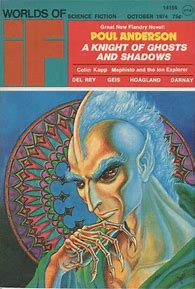
"Journeys End" by Poul Anderson. (Scroll down.)

Dialogue between the hero, heroine and villain of a novel:

"'My dear Adele,' [Mansel] said, 'I'm delighted to hear your voice.'
"'Same here,' said Adele, cheerfully.
"'Rose' Noble laughed.
"'"Journeys end in lovers meeting,'" he said."
-Dornford Yates, Perishable Goods (London, 1938), CHAPTER VI, p. 154.

Sometimes everything comes together and now this day's blogging must end.

Monday, 30 March 2020

Journeys End At World's End Or Worlds' End

Another parallel between Poul Anderson and Neil Gaiman is these two titles:

"Journeys End" by Poul Anderson; (Scroll down)
Worlds' End by Neil Gaiman.

Anderson's "End" is a verb whereas Gaiman's is a noun. "Journeys" lacks an expected apostrophe whereas Worlds' has an unusually placed apostrophe.

The more familiar phrase, "world's end," is also relevant to Anderson:

 With a host of furious fancies
Whereof I am commander,
With a burning spear and a horse of air,
To the wilderness I wander.
By a knight of ghosts and shadows
I summoned am to tourney
Ten leagues beyond the wide world's end:
Methinks it is no journey.

-copied from here.

Tuesday, 3 September 2013

Sam Hall

(Folks, the attached pictures came up as "images" for Sam Hall so please don't blame me for this.)

In Poul Anderson's capstone volume, Going For Infinity, I have reread "Gypsy" and read, for the first time ever, "Sam Hall." Every single story by Anderson raises different questions or initiates lines of inquiry in different directions. Where to start with "Sam Hall"?

Anderson bases his fiction-within-the-fiction, the faked ID of "Sam Hall," on a song that he and his friends used to sing. I have heard and prefer the earlier version of the song in which "Jack Hall" is a chimney sweep and burglar, not a murderer:

"My name it is Jack Hall,
"Chimney sweep, chimney sweep,
"My name it is Jack Hall,
"Chimney sweep.
"And I have robbed them all,
"Great and small, great and small,
"And I have robbed them all,
"Great and small.
"And my neck will pay for all,
"When I die, when I die,
"And my neck will pay for all,
"When I die."

Google discloses that the historical Jack Hall was indeed a chimney sweep turned burglar and highwayman, hanged for a burglary.

Without checking the text, I am reasonably certain that the successful revolutionaries on Earth in Anderson's Three Worlds To Conquer are called "Sam Halls" so can we (please!) call the story "Sam Hall" a prequel to that novel? Because of those "Sam Halls," I had thought that the name of Sam Hall was somehow associated with the American Revolution and had not connected it with "Jack Hall" - and I had heard the latter in a solo performance by a blind man in an Irish band so I had not realized that Jack Hall was English - but it is good when things come together.

After the successful revolution, when it is known that there had been no Sam Hall but that different revolutionaries had used this name, someone would then be able to celebrate the revolution by writing a biographical novel, a work of fiction, with Sam as viewpoint character, although he should not be the narrator. The novel should read like a historical reconstruction, leaving it open where Jack is now... He could be off Earth, since the story presupposes interplanetary travel.

I have experienced a "Sam Hall" scenario closer to home. Our National Comics Writer, the uncrowned King of Northampton, Alan Moore, created the British character, John Constantine, who was Americanized in the film Constantine, which I haven't seen. I know someone who registered for the vote as John Constantine and I posted Alan a photocopy of the voting card. Some British Anarchists, when stopped by police, have given the name "John Constantine" and one of them said, "I don't know where it comes from. It's just a name we use."

Moving on, the next stories in Going For Infinity are "Death and the Knight" and "Journeys End" which, like Finnegans Wake, is above apostrophes. (It seems that "Journeys..." is plural and "...End" is a verb, whereas Neil Gaiman's Inn of the Worlds' End has an apostrophe but in an unexpected place.)

For me, "Journeys End" is yet another difficult story. I read it before, found it emotionally unpleasant and do not want to reread it - but that is Poul Anderson's diversity for you.

(I should add that Alan Moore has seen John Constantine twice, once during a ritual when John told Alan about magic, and once in a London cafe when John nodded knowingly at him. The look on Alan's face is reproduced in Swamp Thing.
(Alan has referred to a house where apparitions of a man with a wide-brimmed hat and a cloak have been seen. Research revealed that the house had been occupied by the creator of The Shadow. So do reality and fiction overlap, as in the Old Phoenix?)

Wednesday, 23 April 2014

NESFA Collections, Vol 1, continued

I have read so many Poul Anderson short stories in diverse collections that I forget titles. Thus, more of the contents of NESFA Collected Short Works Of Poul Anderson Vol 1 are familiar than I had expected:

"Tomorrow's Children" and "Logic" are the first two parts of Twilight World;

"Journeys End," misprinted here as "Journey's End," is that story about telepaths;

"Call Me Joe," "Wildcat" and "Time Patrol" are, of course, familiar.

"The Helping Hand" is old (Astounding, 1950) but was new to me. Despite its space operatic setting, the story ends not with victory in a space battle but with the look of loss in an old man's eyes.

"The Immortal Game" (F&SF, '54), which I have only just begun to read, soon reveals itself to be an account of a chess game with conscious pieces and, unlike "The White King's War," which has robot chess pieces on a giant board, this story might present the moves in a game of chess?

I will continue to work my way through the collection. I would have preferred the short verses to be in one section at the end. It is difficult to see how many prose works we have to read. This poem is not bad:

Autumn
Slowly the moon
Slides aloft.
Keen is its edge,
Cutting the dark.
Stars and frost,
As still as the dead,
Warn of another
Waning year.

Thursday, 5 September 2013

Beginning To End

Rearranging the contents of Poul Anderson's Going For Infinity (New York, 2002) into chronological order of publication generates this list:

"Gypsy," 1950;
"Sam Hall,"1953;
"The Master Key," 1954;
"Journeys End," 1957;
Three Hearts And Three Lions (extract), 1961;
"Epilogue," 1962;
"The Horn of Time the Hunter," 1963;
"Dead Phone," 1964;
"The Queen of Air and Darkness," 1971;
"Goat Song," 1972;
"The Problem of Pain," 1973;
"Windmill," 1973;
A Midsummer Tempest (extract), 1974;
"The Saturn Game," 1981;
"Quest," 1983;
"Death and the Knight," 1995;
"Kyrie," 1996;
"The Shrine for Lost Children," 1999 -

- and that is fifty years.The acknowledgements list informs us that "The Horn of Time the Hunter" was originally "Homo Aquaticus" and we are grateful for the change.

Some Anderson titles might be confused with each other:

"Quest" and "Terminal Quest" are different kinds of stories;

"Windmill" and "Quixote and the Windmill" are installments of different series.

In 1999, Poul and Karen Anderson attended a meeting in Japan for which they designed an inhabited planet close enough to the Solar System for radio communication. Poul comments that he "...may yet get a novel out of it." (p. 360) Clearly, there was no idea of retiring after half a century of writing.

His story for the fiftieth anniversary issue of The Magazine of Fantasy and Science Fiction in 1999 was "The Shrine for Lost Children," described as a tribute to Japan. (p. 361)

The story's thirteen pages are divided into nine sections each headed by a place name:

KAMAKURA
BERKELEY
KAMAKURA
PHOENIX
KAMAKURA
NORTHFIELD
KAMAKURA
MINNEAPOLIS
KAMAKURA

I found this narrative rather disjointed. The story is fantasy if its protagonist really is internally haunted by her still-born twin sister and psychological fiction if the internal dialogue was caused by the mother's obsessive insistence on naming and continually referring to her lost daughter. In either case, the dead sister is laid to rest when the protagonist makes an offering to "...Jizo, patron of travelers and the savior of children." (p. 372)

And then there is "...Understanding...":

"It was not only Jenny who clung to me. I would not let go. Here I have freed myself from myself." (p. 374)

The last two stories, chronologically speaking, both feature a woman inwardly haunted by her dead in a religious context.

Monday, 21 May 2018

Tainted Telepathy

Telepathy is too big a topic. We are familiar with telepathy from sf even if we will never experience it. I first heard of it as "tellypathy" while at school. I mention telepathy because the human heroine of SM Stirling's A Taint In The Blood converses telepathically with the Shadowspawn hero while asleep but does not remember the conversations when awake with the result that her captor, the mind-reading Shadowspawn villainess, neither detects nor suspects the occurrence of these conversations.

In Poul Anderson's "Journeys End," some human beings are telepathic. In Anderson's Technic History, some beings can detect and interpret brain emanations but Aycharaych is the only universal telepath.

I began to compile a list of other authors who have addressed the telepathy concept but it got too long. No doubt blog readers can think of some notable names.

Saturday, 16 January 2016

Telepathy In Fiction And Reality?

What would it be like to be a telepath? or What is it like to be a telepath?

Poul Anderson addresses this question in "Journeys End."

Robert Silverberg wrote the really good Dying Inside. I heard him read part of it at a Con.

James Blish has microcosmic telepathy, which becomes the basis of an interstellar empire.

In Mike Carey's Lucifer, a schoolgirl attends her friend's funeral:

"Mona's mum was crying and her face was all red, but she wasn't thinking about anything much.
"Her dad had the same creepy crawly things in his mind that he always has. Money, and tied-up women, and all the different kinds of drugs he sells. Yeuk."
-Mike Carey, Lucifer: Devil In The Gateway (New York, 2001), p. 137.

Are there people who read our minds?

Sunday, 28 June 2015

Conquistador, Chapter One

In fantasy and sf, how many different kinds of characters move among us concealing their true identities or real natures?

vampires;
werewolves;
aliens (Poul Anderson, "Interloper;" "Details");
immortals (Anderson: The Boat Of A Million Years);
time travelers (Anderson: one series and two novels);
telepaths (Anderson: "Journeys End");
Heinlein's Howards (long-lived though not immortal, with one exception).

SM Stirling's Conquistador introduces another such group, descendants of those who colonized an alternative timeline and who retain the ability to move between the two timelines. We infer that Adrienne Rolfe is the granddaughter of John Rolfe VI and learn that she thinks of us as "FirstSiders."

We meet two sets of sympathetic characters, police investigating mysterious activities and Adrienne's group involved in those activities and trying to cover them up. The scene is set: Fish and Game Warden Tom Christiansen follows clues; we the readers are a few steps ahead of Tom; Adrienne is way ahead of us and knows the whole score. She refers to the Thirty Families, the Commission, the Commonwealth of New Virginia and Gate Security. We must read on to learn more.

Sunday, 3 June 2018

Narrative Layers

Some Examples from the Works of HG Wells, CS Lewis and (Mainly) Poul Anderson
(i) An omniscient narrator presents a third person account of a single viewpoint character's inner thoughts and outer actions. Two of many such characters in Poul Anderson's works are Dominic Flandry and Manse Everard. This kind of narrator does not (seem to) address the readers. Instead, it is as if we are given direct access to one character's point of view. However, we are of course reading words that must have been uttered or written by someone. But the author himself does not address us directly as he would in an article or an autobiography. Instead, he creates a transparent, almost invisible, narrator with unlimited access to the viewpoint character's innermost memories and thoughts, a curious fictional construct. We (usually) assume that there is no such observer in reality - nor do we assume the literal existence of such an observer in fiction although we nevertheless accept his words without, usually, reflecting on them. If the author controls point of view as, usually at least, he should, then the narrator needs to be "omniscient" about only one character - or about one character at a time since point of view can change between chapters or between passages within a chapter but not within a single paragraph or sentence. That way lies incoherence. Coherent prose should describe events that could have happened and each observer experiences events only from his single point of view. There is no point of view jumping back and forth between two or more perspectives.

The narrator might also be omniscient about cosmic events unless, by introducing a first person pronoun, he reveals that he is, after all, one of us, e.g., a novel by Anderson begins:

"Once there had been a great proud star, bright as a hundred Sols."
-Poul Anderson, Mirkheim IN Anderson, Rise Of The Terran Empire (Riverdale, NY, 2011), pp. 1-291 AT Prologue, p. 1 -

- but, further down the same page, continues:

"...we cannot now say. We simply know that..." (ibid.)

A first person narrator has appeared.

(ii) The viewpoint character is a first person narrator directly addressing his readers, e.g., Anderson's Steve Matuchek, Carl Farness or Wanda Tamberly in her first appearance. Such a character is able to tell us what s/he feels and thinks and does not need to be mediated by any omniscient narrator.

(iii) HG Wells' outer narrator directly addresses his readers by presenting first person accounts of conversations between the Time Traveler and his dinner guests, then repeats word for word the Time Traveler's first person account of his journey through time. There are two first person narrators but no omniscient narrator. At the end, the outer narrator incorporates his readers into the narrative:

"The Time Traveller vanished three years ago. And, as everybody knows now, he never returned."
-HG Wells, The Time Machine (London, 1973), 16, p. 101.

(iv) We learn that the original of CS Lewis' "Ransom" has told his story to Lewis who gives us a third person account, fictionalizing the names of the human characters. At the very end of the first Ransom novel, what had seemed to be an omniscient narrator turns out to have been a first person narrator:

"At this point, if I were guided by purely literary considerations, my story would end..."
-CS Lewis, Out Of The Silent Planet (London, 1963), XXII, p. 177.

"This is where I come into the story. I had known Dr Ransom slightly for several years and corresponded with him on literary and philological subjects, although we very seldom met." (p.178)

(v) Poul Anderson's Jack Havig had conversed with Robert Anderson who had conversed with Poul Anderson. Using notes left by Robert Anderson, Poul Anderson composed first person accounts of Robert Anderson's conversations with Havig and also third person accounts of Havig's journeys through time, fictionalizing names and some other details as Lewis had done when describing Ransom's journey through space.

Assessment
The outer narrator knew the Time Traveler and Lewis knew "Ransom" whereas Poul Anderson knew only Robert Anderson, not Jack Havig. Anderson introduces one extra layer of mediation. Any more than that would have placed too great a distance between the narrator who directly addresses us and the character whose exploits we should accept while we are reading them.

For more on points of view in Lewis' fiction, see The Ransom Trilogy.

Monday, 28 May 2018

The Light Of Day

(Today, we were at Ryelands again - in the sun.)

How is this Heracitean quotation relevant to Poul Anderson? It reminds me of three things:

(i) a passage in CS Lewis' The Great Divorce (London, 1982), where a man who leaves the grey town and approaches the mountains thinks that he must turn back because the lizard on his shoulder, whispering in his ear, gives him dreams that "'...up here...'" are "'...so damned embarrassing.'" (p. 90);

(ii) aspects of my own experience that I will not discuss here;

(iii) Poul Anderson's "Journeys End, " where telepaths are repelled by each other's private thoughts.

"'I am caught by the morning and I am a ghost.'"
-The Great Divorce, p. 117.

Tuesday, 3 September 2013

Telepathy

I did not want to reread Poul Anderson's emotionally unpleasant telepathy short story, "Journeys End" (Going For Infinity, New York, 2002), but Sean Brooks reminded of this passage in it:

"The priest's mind had been like a well, a deep well under sun-speckled trees, its surface brightened with a few gold-colored autumn leaves... ...happy...serene...with so much strength under the gentleness." (p. 130)

That contrasts with other minds in the story. In fact, imagine the opposite of what I have just quoted and you will get what I mean about emotional unpleasantness.

I am not big on telepathy although James Blish, for many years my favorite sf author, presents perhaps half a dozen rationales for it. Anderson also rationalizes telepathy, for example when writing about the telepathic spy, Aycharaych.

This is an opportunity to make a brief comparison with one other sf author. Although Robert Silverberg is prolific, I have not read many of his works. I am big on time travel (and have a Logic of Time Travel blog) but I think that Silverberg's maybe half dozen novels on this theme either do not contribute anything new or, in the case of Up The Line, get it badly wrong. However, his telepathy novel, Dying Inside, is superb. I heard Mr Silverberg read an extract at a British Con and afterwards read a copy borrowed from a Public Library. If telepathy exists, this is what it is like. And there is one old guy who is like Anderson's priest. The hero reading his mind thinks that it is pure Zen.

Definitely an sf novel to give to people who don't read sf.

Tuesday, 6 December 2016

Telepathy II

See Telepathy and Telepathy In Fiction And Reality?

We mentioned Poul Anderson's, James Blish's, Robert Silverberg's and Mike Carey's treatments of telepathy but, of course, this is a standard sf concept so there must be many examples. In fact, Asimov has some telepathic robots and Alfred Bester has a society based on telepathy. I have not read Theodore Sturgeon's More Than Human, which I understand is a major telepathy novel.

I still wish that Poul Anderson had written a Superman novel. Superman began as sf but then launched a new composite genre. Telepathy is not a Kryptonian power but Clark Kent is able to meet people with other extraordinary abilities and in fact becomes friendly with one young telepath in two episodes of Smallville. Again I wonder what it would be like to have real telepaths around. Young Ryan is so intuitive or insightful that Lex Luthor begins to suspect that he can read minds. Would concern for Ryan metamorphose into attempts to exploit his ability? Ryan is able to warn Clark to beware of Lex...

A novel about Superman by a major sf writer like Poul Anderson would probably concentrate on making the Kryptonian powers seem real and (slightly) less implausible and therefore would probably not introduce characters with yet other powers. However, Anderson presents a credible account of telepathy in "Journeys End."

Tuesday, 29 March 2022

Into Futurity


A time traveler experiences either a time-consuming journey or an instantaneous transition.

Instantaneous Transitions
(i) The timecycles and other temporal vehicles in Poul Anderson's Time Patrol series.
(ii) In James Blish's Midsummer Century, John Martels loses consciousness in 1971 and regains it in 25,000 A.D.

Time-Consuming Journeys
One example is the mutant time travelers in Poul Anderson's There Will Be Time. However, I want to focus on those who make a single long journey into a remote future:

HG Wells' Time Traveler goes to 802,701 A.D., then to the end of all life on Earth;

in Poul Anderson's "Flight to Forever," Martin Saunders in the time projector goes to the end of the universe and beyond;

in Neil Gaiman's The Books Of Magic, Volume IV, The Road To Nowhere, Mister E and Timothy Hunter magically walk through possible futures to the end of the universe.

Personified Death returns Timothy to 1991 without delay but tells E that he must walk back one step at a time. In 1991, John Constantine seems to think that E is still making his own way back... Even a writer like Neil Gaiman forgets the difference between time and space.

Friday, 21 December 2018

Secret Places And Elder Races

"The secret places. All rational beings have them and guard them - not only for their own sakes but for those of others. Who but God would love us if all the secret places of our minds lay exposed?"
-Julian May, Intervention (London, 1988), 20, p. 166.

This is the theme of Poul Anderson's "Journeys End."

In May's Galactic Milieu, one species thinks that the elder race has survived from a previous universe, as in Anderson's Tau Zero and The Avatar. Another thinks that they are angelic like CS Lewis eldila or the fallen angels in James Blish's Black Easter.

Sunday, 22 April 2018

Poul Anderson And CS Lewis

(i) Poul Anderson wrote several future histories. Future histories are one kind of fictional history. Other fictional histories include Tolkien's Middle Earth and Lewis' Narnia. The Narnia Chronicles cover the entire history of a universe with a flat earth and living stars from its creation by Aslan to its Last Battle and what happens after that. Thus, Narnia is comparable to Anderson's fantasies.

(ii) In Poul Anderson's "Journeys End," telepaths experience the problem of reading each other's distasteful thoughts. In Lewis' "The Shoddy Lands," Lewis himself enters the mental landscape of a self-absorbed woman. Being Lewis, he hears a knocking and a voice:

"'Child, child, child, let me in before the night comes.'"
-CS Lewis, "The Shoddy Lands" IN Lewis, The Dark Tower and other stories (London, 1983), pp. 104-111 AT p. 110.

(iii) Anderson is the most comprehensive writer about fictional time travel. Lewis' Ransom, Lewis, MacPhee, Orfieu and Scudamour begin "The Dark Tower" by discussing time travel just like Wells' Time Traveler and his dinner guests.

(iv) Anderson's sf is (very) "hard" whereas Lewis' is the opposite. Lacking scientific knowledge, Lewis deployed immense psychological and moral insights and knowledge of both literature and mythology.

(v) Both authors favored Norse mythology.

(vi) Anderson treated religious beliefs sympathetically whereas Lewis propagated a particular belief which he imaginatively restated three times, in the Narnia Chronicles, the Ransom Trilogy and The Great Divorce.

(vii) Anderson speculates about hereafters as about everything else whereas Lewis merely assumes survival. In The Great Divorce, ghosts are free to haunt buildings, communicate through mediums, settle in the grey town that is really Hell or catch a bus to the foothills of Heaven and stay there as long as they like. But does every individual consciousness really persist indefinitely and, if so, how?

(viii) Both authors exercised seemingly endless creative imagination.

Tuesday, 18 March 2014

Journeys

Jules Verne wrote fifty four Extraordinary Voyages. Reflecting on recent posts, I have noticed how many very different kinds of journeys Poul Anderson recounts:

the intergalactic and inter-cosmic space journey in Tau Zero;
 
Jack Havig's long return from the Pleistocene near the end of There Will Be Time;

Manson Everard's walk through medieval Sicily in The Shield Of Time;

an alternative first journey to the Moon, also a supernatural journey to Yggdrasil, in Operation Luna;

and, in The Corridors Of Time:

a car trip from Copenhagen to west Jutland in 1964 AD;

a walk through a Jutish forest in 1827 BC;

a time journey involving transfers between corridors;

another that is just in and out of opposite ends of a single gate;
 
by Warden spaceship between hemispheres, by gravity belt through an Atlantic storm, on foot and by belt through Niyorek to Brann's tower.

 And now someone will tell me what I have missed?

Sunday, 25 July 2021

STL And FTL In Future Histories

STL = Slower than light interstellar travel.
FTL = Faster etc.
 
Three Kinds Of Future Histories
(i) STL only.
(ii) STL, then FTL.
(iii) early FTL.

(i) Poul Anderson's:
Tales Of The Flying Mountains
Kith History
Rustum History
The Boat Of A Million Years
Tau Zero
Harvest Of Stars Tetralogy
Genesis
Larry Niven's A World Out Of Time
 
(ii) Robert Heinlein's Future History
Larry Niven's Known Space History
Anderson's Psychotechnic History

(iii) Anderson's Technic History
Jerry Pournelle's CoDominium History

In (i), the premise is not just that no means of FTL is ever discovered but that FTL remains theoretically impossible. The sudden invention of an FTL drive at the end of Tau Zero or Starfarers would be almost as unacceptable a deus ex machina as the sudden arrival of an alien spacecraft at the end of a mainstream novel.

Anderson's There Will Be Time is ambiguous. The main characters are mutant time travelers and:

"'Physicists talk about a mathematical equivalence between traveling into the past and flying faster than light.'"
-Poul Anderson, There Will Be Time (New York, 1973), XVI, p. 174.

- so maybe FTL will be developed but, if not, then time travelers will travel futureward to extra-solar planets in subjective minutes or hours within STL ships whose interstellar journeys last for objective centuries. These possibilities imply two alternative sequels to There Will Be Time. Another two possibilities are suggested when Leonce says:
 
"'Maybe we'll find a New Earth to raise [children] on... Or maybe we'll wander the universe till we die.'" (p. 175)
 
We want to read all these unwritten narratives.

Monday, 24 July 2017

Outer Narrators

Here is a fictional, and logically possible, scenario:

time travellers from our future are present now but disguised and concealed;

they have been active throughout history and have even influenced the course of history but again without anyone else's knowledge.

I will consider four versions of this scenario, one by Wells, three by Anderson.

The Time Machine
We begin not with time travellers from our future but with a time traveller from the author's present, i.e., from the late nineteenth century. The original "Time Traveller" presented an unconfirmed account of his journey through the future, then departed for a second time into either the past or the future but never returned. Notionally, he is invisibly present now in Richmond, London, on his outer and return journeys. He will be there until the end of life on Earth.

The Time Patrol Series
Time travelling explorers, scientists and tourists from civilizations later than 19452 AD are policed by the Time Patrol.

The Corridors Of Time
Two antithetical civilizations from two millennia in our future wage war throughout history.

There Will Be Time
Two groups of mutant time travellers contend to influence the further future after the post-nuclear Maurai Federation.

How different are Anderson's three scenarios! Now I want to address a point about narration. In all four cases, the time travel notionally occurs in our timeline although without our knowledge. If the Time Traveller had returned from his second expedition and had then initiated regular, publicized time trips, then those trips would have had to have occurred in an alternative timeline because we know perfectly well that there have been no such trips in our timeline. However, Wells "saved the appearances" by making both the Time Machine and the Cavorite sphere disappear, never to return, at the end of their respective narratives.

Similarly, Anderson's Time Patrol might really be operating in secret in our timeline? Well, no, it can't be. As a first point, Anderson subtly underlines that the Time Patrol scenario is fictional because Sherlock Holmes is a real person in that timeline. More importantly, however, our timeline is one in which the Time Patrol series by Poul Anderson has been published. A single timeline cannot accommodate both a secret Time Patrol and a published Time Patrol series. Therefore, we must in this case contemplate two timelines:

ours, in which the Time Patrol series exists;
theirs, in which the Time Patrol exists.

The same point applies to The Corridors Of Time, which begins with a third person account of its viewpoint character, Lockridge, being bailed out of gaol by a woman who turns out to be a time traveller and to need Lockridge's help. Such events cannot occur in the same timeline as a novel describing them. In any case, Lockridge winds up in the Bronze Age and there is no way that an account of that could ever have got back to the twentieth century.

However, there is a fictional convention by which, sometimes, real events are published as if they were fictional or at best ambiguously. In The Time Machine, the outer narrator tells us what was said at the Time Traveller's dinner table. It is the Time Traveller himself who is responsible for the accounts of time travelling. In There Will Be Time, Poul Anderson publishes a fictionalized acount based on notes left by Robert Anderson of his conversations with the mutant time traveller, Jack Havig. CS Lewis corresponds with the original of "Ransom" in his Ransom Trilogy. In these three cases, there is an "outer narrator" who merely informs his readers of what was said to have happened by the inner narrator...

It could have happened. This is a literary device to reinforce that "willing suspension of disbelief" which is necessary for all fiction.

Friday, 3 February 2023

The Diogenes And Dunham

"Entity" has to be set early in the second main section of Poul Anderson's Psychotechnic History because its events take place only a few decades after the invention of the faster than light interstellar drive but it also has to be set late in the History because it involves the discovery of an energy source that should have affected the technology in all subsequent instalments. "Symmetry" is set late in the History presumably because Dunham's discovery of a matter duplicator would have affected everyone and everything else thereafter. In Robert Heinlein's Future History, "'-We Also Walk Dogs'" involves the discovery of antigravity which however does not affect subsequent instalments, where spacecraft have to be rotated to generate centrifugal force.

Larry Niven described such problems in his Known Space future history:

"There were too many unlikely miracles left over from individual stories. For example, from World of Ptavvs came a stasis field so useful that every story set later in time must be examined for reasons why a stasis field would not solve the problem. From Neutron Star, where it was introduced to create an airtight problem in logic, comes an invulnerable spacecraft hull - same remarks. For the Ringworld floor material I had to come up with still another unreasonably strong material."
-Larry Niven, Afterthoughts IN Niven, Tales of Known Space (New York, 1975), pp. 221-223 AT p. 22.

In the case of the two Psychotechnic History instalments, we can imagine that the Diogenes, in "Entity," and Dunham, in "Symmetry," perished in accidents on their return journeys.

The Diogenes is described as:

"...a metal bubble floating through darkness and void for years on end..." (p. 171)

But it is not really that, is it? The spaceship is surrounded not by darkness but by the universe and the interstellar medium which the crew would observe and study throughout their voyage. The concluding sentence is optimistic:

"He went out of the building toward the Diogenes, shining under the stars." (p. 181)

Sunday, 29 November 2020

Didonian Units

Didonian Units
nogas: like rhinoceroses, stupid on their own;
 
rukas: like apes, with the largest forebrains;
 
krippos: birds.
 
Three entities, Master of Songs, Cave Discoverer and Many Thoughts, share a noga and a ruka, differing only in their krippo. Thus, killing that one krippo will end three entities.

The common noga and ruka bestow vigor and boldness. Cave Discoverer explores and adventures geographically whereas Many Thoughts journeys spiritually. Entities have descriptions, not names. A region with a large, loud waterfall is called Thunderstone. Places come closer to being named.
 
Information about Dido is highly condensed and difficult to retain.