Showing posts sorted by relevance for query Galaxies Like Grains Of Sand. Sort by date Show all posts

Saturday, 14 September 2019

Interstitial Passages

A collected future history series is enhanced by new introductions and interstitial passages. This post summarizes:

Heinlein
Asimov
Blish
Herbert
Anderson (three times)
Aldiss (twice)

Heinlein's Future History has:

an elaborate Time Chart;
a Note on Untold Stories;
a very brief fictional quotation as an introduction to "Universe."

Asimov's Foundation series quotes the Encyclopedia Galactica which is compiled by the (First) Foundation.

Three volumes of Blish's Cities In Flight are introduced by a future historian who, we eventually realize, must live in a subsequent universe.

Herbert's Dune series similarly quotes future historical texts, some by "Pander Oulson."

Sandra Miesel wrote interstitial passages for Anderson's Psychotechnic History from the point of view of a future historian.

Hloch of Stormgate Choth introduces the stories in The Earth Book Of Stormgate but not those in the rest of the History of Technic Civilization.

In six numbered "Interludes" between the seven chapters of Tales Of The Flying Mountains and also in a Prologue and an Epilogue, a group of extra-solar colonists discusses how to present their earlier history of asteroid colonization and independence from Earth to their children.

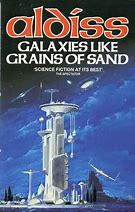
Brian Aldiss' italicized interstitial passages are a major literary feature of his Galaxies Like Grains Of Sand, e.g.:

"The trees fall year by year, the mountains tumble, the galaxies burn out like tall tallow candles. Nothing is intended to last - except time."
-Brian Aldiss, Galaxies Like Grains Of Sand (London, 1979), p. 19.

(The concluding volume of Cities In Flight is The Triumph Of Time.)

Aldiss' second italicized passage lists instinct, fear, lust and conscience as factors lying behind war-causing political issues and states that they "...stem from the long and savage past of the race...," (p. 21) thus echoing Anderson's "protean enemy" in the Psychotechnic History.

I have twice quoted with approval a beautiful three-word sentence in an italicized passage of Aldiss' later Helliconia Trilogy.

Sunday, 29 October 2017

Stars Like Sand

"...oceans of space and time...stars like grains of sand."
-SM Stirling, The Desert And The Blade (New York, 2016), Chapter Seventeen, p. 362.

Sf authors consciously write against this cosmic background even if they do not always make it explicit. See "...And Stars As Sand Or Stage" here and "Imaginary Science?" here. CS Lewis' character, Ransom, had problems with cosmic vastness but most of us welcome it. Here is an article on how many galaxies there are.

An Isaac Asimov title is The Stars Like Dust whereas a Brian Aldiss title is Galaxies Like Grains Of Sand! Four sf novels that do show us a multiplicity of galaxies, and not just in their titles, are:

Tau Zero by Poul Anderson;
World Without Stars by Poul Anderson;
The Triumph Of Time by James Blish;
Into Deepest Space by Fred Hoyle and Geoffrey Hoyle.

Let's have more cosmic sf.

Tuesday, 6 July 2021

Things Change And Remain The Same

Starfarers, 8.

Some fictional futures are recognizable projections of the past or present, e.g.:

"'The Space War had occurred, and in China the Protector was overthrown but the Council of Nine was worse...'" (p. 63)

After civil wars, international wars, World Wars, a Cold War and a War On Terror, a Space War would be a plausible next step and we are familiar with dictatorships succeeding each other in China and elsewhere.

I read but do not have The Canopy Of Time, an earlier version of Brian Aldiss's single-volume future history,  Galaxies Like Grains Of Sand. In the earlier version, some of the italicized interstitial passages began with statements to the effect that: "Again we can only say that there was change without change..." Although I was hoping for more concrete information, I nevertheless found this uninformative refrain curiously persuasive.

Also:

"This is the way Time has of fulfilling itself: while the depths of adversity are being reached, the foundation stones of future greatness are laid."
-Brian Aldiss, Galaxies Like Grains Of Sand (London, 1979), THREE, p. 50.
 
Aldiss echoes Asimov's Foundation and Anderson's Long Night. 

Thursday, 5 September 2024

We and I

"Starfog."

The use in "Starfog" of the first person plural pronoun, "we," raises the possibility, however remote, that the first person singular, "I," denoting the individual narrator, will come on-stage. Meanwhile, we might wonder: who is this unseen narrator and how does he know the inner thoughts of Daven Laure? However, most likely, we completely forget about him as we continue to read.

CS Lewis' Out Of The Silent Planet is divided into twenty two chapters and a postscript. Chapters 1-21 are a third person account of Elwin Ransom's journey to Mars. Chapter 22 opens:

"At this point, if I were guided by purely literary considerations, my story would end..."
-CS Lewis, Out Of The Silent Planet IN Lewis, The Cosmic Trilogy (London, 1990), pp. 1-144 AT 22, p. 136.

The third paragraph of this chapter begins:

"This is where I come into the story. I had known Dr Ransom slightly for several years..." (ibid.)

The postscript is extracts from a letter by Ransom to Lewis. Thus, at last, the central character, Ransom, achieves first person status!

"'Are you the prison warden,' Gerund asked, stumping into the room.
"'I am,' I said."
-Brian Aldiss, "Gene-Hive" IN Aldiss, Galaxies Like Grains Of Sand (London, 1979), pp. 116-137 AT p. 132.

This is a surprise first appearance by a first person narrator at a very late stage in a short story.

Even more surprisingly, the concluding story in Galaxies... opens with second person narration:

"You never knew the beginning..."
-Brian Aldiss, "Visiting Amoeba" IN Galaxies Like Grains Of Sand, pp. 157-188 AT p. 157.

- and ends with the first person plural:

"We who have already superseded you..." (p. 188)

I tried to follow Aldiss' example here.

Sunday, 15 September 2019

Ideas And Their Implications

In sf, an author presents an idea together with at least one plausible but preferably unexpected implication of that idea, then other authors find other implications of the same idea.

One Wellsian idea: "time traveling."

Implications
(i) In Wells' "The Chronic Argonauts," circular causality. See here.

(ii) In Wells' The Time Machine, the Time Traveler returns to 1895 with an account of the ultimate fates of civilization and of life on Earth.

(iii) In L. Sprague de Camp's Lest Darkness Fall, an unwilling time traveler deliberately changes history.

(iv) In Ward Moore's Bring The Jubilee, a time traveling historian unintentionally changes history.

(v) In Poul Anderson's Time Patrol series, the Patrol, founded by our evolutionary successors, prevents accidental or deliberate changes to history, sometimes by completing causal circles.

Thus, readers recognize old ideas but welcome new implications and, in the above list, the Time Patrol synthesizes the four earlier stages.

Brian Aldiss' Galaxies Like Grains Of Sand presents some ideas that we have encountered in different works by Poul Anderson:

people immersed in virtual realities;
time travel;
one robots story in the future history;
a robotic ecology;
a reference to a generation ship;
the ancient ape in modern man;
reality as a shadow show.

Aldiss' distinctive contribution is a particularly literary style of writing, e.g.:

"Time unrolled itself like a long carpet, down which man ambled towards extinction."
-Brian Aldiss, "All The World's Tears" IN Aldiss, Galaxies Like Grains Of Sand (London, 1979), pp. 37-49 AT p. 38.

Sunday, 17 May 2015

...And Stars As Sand Or Stage

One relevant title that I overlooked in the previous post was The Currents Of Space by Isaac Asimov. I am fairly certain that a Poul Anderson short story about interplanetary space travel includes two Asimov titles, the phrases "...the currents of space..." and "...the end of eternity...," in a single paragraph. I also thought that I had posted about the proximity of these phrases in one paragraph but have not found the post on a blog search.

Gregory Benford's Sailing Bright Eternity has now been listed both as one of several sf titles incorporating "Eternity" and as one of many sea-space comparisons. That three word title is rich in meaning and connotation.

If space is metaphorically a sea, what are the bodies occupying it? Planets are a Pebble In The Sky (Asimov) or A Stone In Heaven (Anderson). Larger heavenly bodies are The Stars Like Dust (Asimov) or Galaxies Like Grains Of Sand (Aldiss). (Just think about that for a second.)

However, the galaxy can be a "...river..." (previous post), The Stars Are Also Fire (Anderson), ...And All The Stars A Stage (Blish).

(Blish also has the phrase "...the sands of the stars...," quoted in the previous post.)

We do not usually think of titles, especially of works by different authors, as forming a sequence or as presenting alternative perspectives on the universe. In fact, book titles are often used just as labels for the works to which they refer rather than as meaningful phrases in their own right. However, sf writers often need to use cosmological terminology and also of course to avoid repetition. Thus, some interesting although unintended sequences can emerge.

Friday, 3 September 2021

Eleven Future Historians

A future history can be about human beings interacting with each other, with alien intelligences or with artificial intelligences and always with their cosmic environment. Poul Anderson's nine future histories address all these options. They, together with his time travel narratives and cosmological sf, complete a substantial literary tradition. (My opinion, of course.)

In HG Wells's The Shape Of Things To Come, mankind remakes itself with science in the twenty first and twenty second centuries whereas, in CS Lewis's That Hideous Strength, the project of mankind remaking itself through science is revealed to be literally diabolical.

Olaf Stapledon's Last And First Men recounts the entire future history of mankind, including interactions with Martians and Venerians.

Stapledon's Star Maker recounts cosmic and creational history, summarizing Last And First Men in a single sentence.

In Brian Aldiss's Galaxies Like Grains Of Sand, evolution in our galaxy ends with man and, in the next galaxy, starts with man. (Non-Darwinian evolution, obviously.)

In A Short History Of The Future by RC Churchill, Orwell's, Huxley's, Bradbury's, Vonnegut's etc dystopias are shoehorned into a single narrative. (Huxley: Ape And Essence, not Brave New World.)

In Robert Heinlein's Future History, technological progress is accompanied by social regression although there is an eventual advance toward the first mature civilization. Martians, Venerians and other Solar races are present but peripheral even though the possibility of contact with non-human intelligences had been one of the Man Who Sold The Moon's many selling points.

Isaac Asimov connected his Robots series, about human-AI interactions, with his Foundation series, about a predictive science of society.

In James Blish's Cities In Flight, cities fly with anti-gravity while human beings live indefinitely with antiagathics but cannot survive the end of the universe.

In Blish's The Seedling Stars, as in Last And First Men, human beings are adapted to extraterrestrial environments.

In Blish's The Quincunx Of Time, messages from the future help to bring about an intergalactic utopia.

In Larry Niven's Known Space future history, human beings turn out to be mutated Pak breeder colonists of a former Slaver food planet and eventually become genetically lucky while meanwhile interacting with kzinti, Puppeteers etc. (Thus, we are not who we thought we were and we become someone else in any case.)

In Jerry Pournelle's CoDominium future history, mankind exports war and imperialism to the galaxy and encounters one alien race.

Poul Anderson's Psychotechnic History is about whether mankind can remake itself with a science of the psyche and society. There are some human-alien interactions.

Anderson's Technic History is both about the cycles of human civilizations and about many human-alien interactions.

Anderson's Maurai future history is about whether mankind can survive after nearly destroying its environment.

Anderson's Kith and Flying Mountains future histories are about mankind in space. In Starfarers, the Kith novel, time dilated space travelers interact with aliens while civilizations rise and fall on Earth.

In Anderson's Rustum future history, ideological conflict on Earth leads to extra-solar exile and colonization.

In Anderson's Directorate future history, as in his Rustum history, human beings colonize extra-solar planets despite traveling between planetary systems at only sub-light speeds.

Anderson's Harvest Of Stars future history and Genesis are about human-AI interactions.

I was reminded of Anderson's first, Psychotechnic, future history when, while rereading Harvest Of Stars, Volume II, I came across:

"...purely human politics, short-sighted, ignorant, superstitious, animally impassioned, forever repeated the same ghastly mistakes."
 
The revolt of the primitive against the unnatural state of civilization is the "protean enemy," opposed by psychotechnicians. 

Tuesday, 31 March 2020

Narrative Perspectives

Writers convey most of the necessary information about their fictional worlds through individual characters' perceptions and reflections, not through lectures delivered directly to the reader by an omniscient narrator. Thus, in Poul Anderson's Technic History, many very dissimilar characters reflect, in almost identical phraseology, that this single volume of explored space at one end of a spiral arm of this galaxy is minute in relation to the entire galaxy, let alone to the "galaxies like grains of sand," to borrow a phrase from a Brian W. Aldiss title. Obviously, we accept that all these reflections are factually accurate. Already knowing that galaxies are big and many, we are now being indirectly informed of the extent of interstellar civilization at this stage of the Technic History.

I had thought that Hauksberg's put-down of the Terran Empire (see Terran Imperialism) was just another of these individual reflections meant to be understood as factually accurate. However, Hauksberg's assessment of the Merseian regime is hopelessly unrealistic so why should his assessment of Terra be any more reliable?

I think that it is fair to say that the author approves of Max Abrams' view:

"'Sure, the Empire is sick. But she's ours. She's all we've got. Son, the height of irresponsibility is to spread your love and loyalty so thin that you haven't got enough left for the few beings and the few institutions which rate it from you.'"
-Poul Anderson, Ensign Flandry IN Anderson, Young Flandry (Riverdale, NY, 2010), pp. 1-192 AT CHAPTER FIVE, p. 49. 

Sunday, 24 February 2019

Meals And POVs

I am currently rereading Poul Anderson's second Rustum volume, which takes us forwards in time, and reading SM Stirling's second Black Chamber volume, which takes us backwards and sideways in time. (Also other works but let's stay focused.)

In Theater Of Spies, look out for more lovingly described meals (of course). I will not (yet) reproduce the menus here although I have frequently done so before.

Regular readers might remember that I am a pov cop. Pov is narrative point of view. A pov cop is sensitive to any changes in pov or to any apparent breaches of the usually accepted conventions for controlling and presenting povs. We are familiar with first person pov, second person pov and omniscient narrator. The culminating story in Brian Aldiss' single-volume future history has a second person pov:

"You never knew..."
-Brian Aldiss, Galaxies Like Grains Of Sand (London, 1979), NINE, THE ULTIMATE MILLENNIA, p. 157.

- and I attempted a narrative with a second person pov on a smaller scale here.

The omniscient narrator might be appropriate to describe an event like a supernova that had happened long before there were any observers. However, in the opening passage of Mirkheim, Poul Anderson writes:

"There may have been lesser worlds and moons; we cannot now say. We simply know that the giant stars rarely have attendants..."
-Poul Anderson, Mirkheim IN Anderson, Rise Of The Terran Empire (Riverdale, NY, 2011), pp. 1-291 AT Prologue, Y minus 500,000, p. 1.

Thus, this narrator not only acknowledges that he is not omniscient but also identifies himself as one scientifically informed member of Technic civilization addressing fellow members.

The shortest unit of continuous narrative is a section either of a short story or of a chapter in a novel, e.g., Y minus 500,000 is the opening section of Prologue. The second section, Y minus 28, beginning on p. 2, is a third person narrative with Benoni Strang as its pov character.

The usual convention is that each section has a single pov. In Theater Of Spies, look out for a chapter that is narrated from Luz's third person pov but that ends with the omniscient narrator describing a third party observing both Luz and Ciara. We are not given the third party's pov but we are told that he is watching without Luz's knowledge.

For CS Lewis' extraordinary stunts with povs, see The Ransom Trilogy.

Thursday, 28 February 2013

Recruiting Nation


In Brian Aldiss' one volume future history, Galaxies Like Grains Of Sand, individual short stories set in successive future epochs are linked by italicized interstitial passages bridging the temporal gaps between the stories.

In Poul Anderson's one volume future history, Tales Of The Flying Mountains (New York, 1984), individual short stories set during successive decades and generations of the colonization of the asteroids are linked by conversational passages set inside the first interstellar spaceship. (Another good conversationally linked series is Neil Gaiman's The Sandman: Worlds' End but that is not a linear history, more of a multitemporal cosmography.)

Anderson's cosy conversations sometimes serve the same purpose as Aldiss' cosmic commentaries. One of the speakers in Interlude 6 informs us that Earth became:

" '...steadily more comfortable, as material resources flowed in from space...The average Earthling took advantage of this opportunity to relax, to enjoy more leisure and security.' " (p. 250)

That is a relief. Until now, in this volume, the picture has been of Terrestrial resources strained by unemployed masses voting for expensive social welfare, then demonstrating and rioting if their standard of living is threatened.

The seventh story, "Recruiting Nation," confirms the rosier picture of a further future and even uses the term "Utopia," which is then explained as follows:

" 'Everywhere on Earth you can enjoy economic as well as physical security, a peaceful, orderly existence. If that starts feeling too stuffy, you can move into space. There the boom guarantees you can find work at high pay...' " (p. 272)

Terraformed asteroids have even become comfortable enough to breed "'...loafers...wastrels...'" (p. 273)!

Appropriately, this last story is set on the interstellar spaceship while it is being readied for flight. The narrator of the Prologue and Interludes, Winston P. Sanders, comes to the ship to solve a technical problem that turns out to have been a human problem (parts are not failing but the chief engineer is pretending that they are so that he can steal and sell them) and stays for the flight (as the new chief engineer). He ends the story in conversation with the man who is to become president of the civil government within the ship, Amspaugh. He and Amspaugh have been in the spaceship conversation from the Prologue so the flashbacks of the stories have at last caught up with the on-going narrative of the Interludes and the last story flows easily into the Epilogue. This is a very well crafted future history.

Saturday, 14 September 2024

Milestones In SF

The previous post quoted from:

the concluding instalment of Poul Anderson's multi-volume future history series, the Technic History;

Volume I of CS Lewis' Ransom Trilogy;

two instalments of Brian Aldiss' single-volume future history, Galaxies Like Grains Of Sand, which forms a trilogy with the same author's Starswarm (an inhabited galaxy) and Non-Stop (a Heinleinian generation ship) -

- major milestones of twentieth century sf. 

Anderson and Aldiss follow Wells, Stapledon and Heinlein whereas Lewis replies to Wells and Stapledon. Both Aldiss' Galaxies... and Anderson's Genesis synthesize the Wellsian-Stapledonian and Heinleinian future history models. Both Aldiss' Frankenstein Unbound and Anderson's Genesis re-address the theme of the first modern science fiction novel, Frankenstein. Genesis, appropriately published in the concluding year of the twentieth century, is a culmination of future historical and Frankensteinian themes.

SM Stirling continues the theme of time travel for which we can again refer to all the authors already mentioned with the single exception of Mary Shelley.

(If a representative sample of Western literature were to include at least two sf titles, then I think that they would have to be Frankenstein and The Time Machine. We value these works both for themselves and for what came after them.)

Friday, 1 November 2019

Knowledge Of The Future And The Past

Copied from the Logic of Time Travel blog.

HG Wells' Time Traveler knows the general course of the future because he has traveled through it and returned to his present.

In James Blish's The Quincunx Of Time,  Service agents know of the future because they receive messages from future periods, then ensure that the events described in those messages occur.

Poul Anderson's Time Patrol agents observe unrecorded past events in order to know the course of the history that they must protect from extratemporal interference.

Anderson's contending Wardens and Rangers, living in our future, try to influence their future by controlling unrecorded details of past history.

In Anderson's There Will Be Time, two groups of mutant time travelers contend. One group changes the significance of known events.

The temporal agents in Robert Heinlein's "'- All You Zombies -'" cannot prevent events but sometimes cause them.

Heinlein's Lazarus Long visits the period of his childhood but to no good purpose.

Isaac Asimov's time traveling "Eternals" change events to maximize human happiness until they themselves are prevented from existing but I argue that Asimov's narrative is incoherent. See The Logic of Time Travel: Part II, here.

There is time travel between two periods of Brian Aldiss' future history, Galaxies Like Grains Of Sand.

Wednesday, 1 April 2020

Endings

We have discussed future histories and Latin in the works of Poul Anderson so which future history ends with a three-word phrase in Latin? No, it is not one of Anderson's. In fact, what is the appropriate way to end a future history?

"The laughter was somewhat of a victory."
-Poul Anderson, "Starfog" IN Anderson, Flandry's Legacy (Riverdale, NY, 2012), pp. 709-794 AT p. 794.

"...an aggressive order of religiously devoted men and women who will try out and establish and impose a new pattern of living upon our race.
"THE END."
-HG Wells, The Shape Of Things To Come (London, 1974), p. 493.

"For we shall make after all a fair conclusion to this brief music that is man."
-Olaf Stapledon, Last And First Men IN Stapledon, Last And First Men/Last Men In London (Harmondsworth, Middlesex, 1972), pp. 5-327 AT p. 327.

"'...the blind recollection of past light.'"
-Stapledon, Last Men In London IN op. cit., pp. 329-605 AT p. 605.

"...this brief effort of animalcules striving to win for their race some increase of lucidity before the ultimate darkness."
-Olaf Stapledon, Star Maker (Harmondsworth, Middlesex, 1972), p. 262.

"'...here's one monkey that's going to keep on climbing, and looking around him to see what he can see, as long as the tree holds out.'"
-Robert Heinlein, Methuselah's Children (London, 1966), p. 191.

"'...always Good Eating.'"
-Robert Heinlein, Orphans Of The Sky (London, 1965), p. 111.

"Creation began."
-James Blish, The Triumph Of Time IN Blish, Cities In Flight (London, 1981), pp. 467-596 AT p. 596.

"We who have already superseded you record these scenes now in your honour, as you once honoured man. REQUIESCAS IN PACE."
-Brian Aldiss, Galaxies Like Grains Of Sand (London, 1979), p. 188.

So which of these do we prefer?

Saturday, 14 September 2019

Single Volume Approaches To Futures

By "single volume," I mean to exclude omnibuses. Thus, James Blish's Cities In Flight was first published as four novels, then as one omnibus volume.

HG Wells' Time Traveler tells his dinner guests that, after he had set off earlier that day, the night, then tomorrow, then tomorrow night "...came...'" (The Time Machine, 4, p. 24) (This confirms my belief that the Time Machine does not move but stands still while effectively fast forwarding, then rewinding, everything else.)

The "future" covers all of time from tomorrow and "the day after tomorrow" until the end of the universe and sometimes beyond that, as in Poul Anderson's single-volume Tau Zero or in James Blish's Cities In Flight, Volume IV.

Nine Single Volumes
Wells' The Time Machine fast forwards history from 1895 to 802,701 A.D., then to the end of life on Earth, then rewinds.

Wells' The Shape Of Things To Come is a historical text book covering the period 1900-2050.

Stapledon's Last And First Men is a historical text covering the entire future of humanity.

In James Blish's The Quincunx Of Time, people in a relatively near future receive messages from further futures, including a distress call from a world-line cruiser traveling from 8873 to 8704 on the rim of NGC 4725, eleven million light years away.

Brian Aldiss' Galaxies Like Grains Of Sand is nine stories with interstitial material covering the entire future of humanity.

Poul Anderson's Tales of The Flying Mountains is seven stories with conversational "Interludes," covering part of a future.

Anderson's Genesis ends with the far future re-creation of extinct humanity.

Anderson's Tau Zero fast forwards time to the beginning of the next cosmic cycle.

Anderson's "Flight to Forever" fast forwards circular time from, then back to, 1973.

Always more from Anderson.

Monday, 30 January 2017

The Best Future History Omnibus Collection

A future history can be a single novel, e.g.:

The Shape Of Things To Come by HG Wells;
Last and First Men by Olaf Stapledon;
A Short History Of The Future by RC Churchill;
Genesis by Poul Anderson -

- or a single collection, e.g.:

Galaxies Like Grains Of Sand by Brian Aldiss;
The Seedling Stars by James Blish;
Tales Of The Flying Mountains by Poul Anderson -

- or a single omnibus volume, e.g.:

The Past Through Tomorrow by Robert Heinlein;
Cities In Flight by James Blish;
potentially, the Rustum History by Poul Anderson -

or may be too long to fit into a single volume, e.g.:

the Robots and Empire History by Isaac Asimov;
the Known Space History by Larry Niven;
the CoDominium History by Jerry Pournelle;
the History of Technic Civilization by Poul Anderson;
the Harvest of Stars History by Poul Anderson.

We have cited five examples by Anderson but have not yet exhausted the full list of this single author's future histories. Known Space and the Technic History each have a representative collection:

Tales Of Known Space;
The Earth Book Of Stormgate.

The Earth Book is an omnibus collection of eleven stories and one novel with new introductory passages. It introduces or incorporates many aspects of the History and even anticipates the Dominic Flandry series by introducing Merseia and mentioning the Empire. Thus, it is a remarkably comprehensive future history omnibus collection.

Thursday, 2 March 2023

A Future History Spectrum

A future history can be either a single volume of fictional historiography or a series of fictional narratives set in successive future periods. However, the two approaches interpenetrate. At one end of the spectrum, HG Wells and Olaf Stapledon each wrote a future historical text book. At the other end, Robert Heinlein's Future History comprises only short stories and two novels with no introductions or interstitial passages. However, James Blish, having written the Okie series, which included two history lessons, then added historical introductions when the series was collected. As I suggested recently, Poul Anderson's Technic History reaches a peak of historiographical verisimilitude when, between two short stories set in different periods, Hloch of Stormgate Choth concludes his Earth Book of Stormgate, then the President of the Galactic Archaeological Society introduces a memoir about the Founder of the Terran Empire. Sandra Miesel added historiographical passages to Anderson's Psychotechnic History.

Brian Aldiss' Galaxies Like Grains Of Sand collects nine stories set in successive millennia and also includes long italicized passages discussing the history that elapses between these stories. In some chapters of Anderson's Genesis, characters converse and interact as in a short story or a novel whereas, in others, the omniscient narrator summarizes cosmic events over millions of years. Thus, both a British and an American author synthesized the characteristic British and American approaches to future history.

We, editorially speaking, might take another look at Genesis but first I will have to retrieve my lent copy.

Friday, 15 June 2012

The Galactic Connection

Science fiction writers and readers are very aware that we inhabit not only a planet and a planetary system but also a galaxy. That we inhabit one of many galaxies is awesomely expressed in the Brian Aldiss title, Galaxies Like Grains Of Sand. Our galactic connection, like the God of mysticism, is within us at all times whether or not we realise it because it was stellar fusion that synthesized the elements of which we are composed. It is also possible that pre-biotic complex molecules came to Earth from elsewhere.

Fiction reflects our galactic context in different ways. Most obviously, human and other organic beings can cross interstellar distances but imaginative writers can do more. In Larry Niven's Known Space future history, terrestrial human beings are mutated Pak breeder colonists of a former Slaver food planet so neither we nor our biosphere originated on Earth.

In Poul Anderson's Brain Wave, no spacecraft arrive and none have yet been launched (but read on). Instead, life is proceeding as normal in the 1950s. However, gyromagnetic action within atomic nuclei near the galactic center had generated an electromagnetic force field radiating outward in a cone now many light years across, inhibiting electromagnetic and electrochemical processes, particularly neuronic interactions. Nervous systems adapted to the inhibiting force by becoming more efficient. Now the Solar System moves out of the field so that everyone becomes more intelligent. A small quantitative change in neuronic efficiency causes a big qualitative change in thought because the processes involved in consciousness are so sensitive.

Anderson wrote much about spaceships later but here, in his first novel, he invented an original way to show human beings interacting with the galaxy.

Sunday, 8 February 2026

Some Short Future Histories

Future histories differ in length. A long future history series is multi-themed, dealing only with whatever happens in the future, whereas a shorter series can have a single theme with a definite conclusion. Although Poul Anderson's Twilight World is not listed as one of his future histories, it is a collected series covering more than one generation and concluding in a further future. Its single theme is that World War III causes so many mutations that some are beneficial and even enable subsequent generations to colonize other planets so that the outer Solar System is inhabited after Earth has become uninhabitable. Without that War, would the race have survived?

James Blish's The Seedling Stars is a single volume in four parts, originally five stories, about the single theme of pantropy, the science of adapting human beings to other planetary environments. It conclusion is that, when Adapted Men have filled the galaxy, Earth has changed so much that it is colonized by Adapted Men.

Twilight World and The Seedling Stars both address changes to the human form and extraterrestrial colonization.

Anderson's Maurai And Kith is a collection of only three Maurai stories and two Kith stories although later a third story was added to the Kith series and a long novel to both series. The theme of the Maurai Federation series is that, after a nuclear war, seafaring people of the Southern Hemisphere become the world power. We get a sense of Poul Anderson exploring every possibility.

James Blish's Okie series was complete as four stories in one volume. However, Blish added a prequel, a juvenile novel and a sequel. Okie culture ends in Volume III and the universe ends in Volume IV.

Larry Niven's Known Space is a long future history series with a definite ending. Because human beings are artificially selected for the inheritable psychic power of luck, Known Space and the Thousand Worlds become utopian societies of lucky people about whom Niven becomes unable to write any more stories! As Fran Cobden remarked, "...an amazing idea!"

Other short future histories:

The Moon Maid by ERB (a sequel to John Carter);
City by Clifford Simak;
Galaxies Like Grains Of Sand by Brian Aldiss.

Wednesday, 1 April 2020

Outward And Inward

"Space exploration opened a new external frontier while the Psychotechnic Institute that grew out of Professor Valti's theories probed an old internal one."
-Sandra Miesel, interstitial passage IN Poul Anderson, The Complete Pschotechnic League, Volume 1, p. 19.

"...the long and savage past of the race...the adolescence of a species...
"So men fought each other instead of wrestling with themselves. The bravest sought to evade the currents of hatred by turning outward to the nearest planets in the solar system..."
-Brian Aldiss, Galaxies Like Grains Of Sand (London, 1979), ONE, p. 21.

Whereas the Psychotechnic History opens by showing a positive approach to the outer and inner frontiers, in Aldiss's future history, by contrast, inner psychological conflicts are avoided first in outer political conflicts, then in outward space exploration. (See also When Does The Future Begin?)

"Since the flaws in human society were the products of flaws in each of its members, fundamental improvement had to begin with the individual."
-Miesel IN Anderson, p.101.

This is what the Transcendental Meditators claim. For a long time, I argued the same way. Changing people changes their relationships and thus society. Now I think that the combination of meditation with political action is the optimal approach.

Saturday, 28 March 2020

When Does The Future Begin?


I thought of this question in relation to what I call the "Future History Triad":

Heinlein's Technic History;
Anderson's Psychotechnic History;
Anderson's Technic History -

- but, of course, every other future history that I have read came to mind so we wind up with a complicated list.

British
Stapledon's Last And First Men begins after "the European War";

Wells' The Shape Of Things To Come begins "today," in 1933;

CS Lewis' That Hideous Strength, not a future history but its author's reply to Stapledon and Wells, begins after World War II, with Jane Studdock remembering the words of the marriage service;

RC Churchill's A Short History Of The Future begins with a discussion of many well-known sf works on the fictional assumption that they are histories of the future;

Brian Aldiss' Galaxies Like Grains Of Sand begins with a future war and a commentary explaining that war in terms of instincts, fears and racial adolescence (Poul Anderson's "protean enemy" yet again).

OK. Maybe the Americans can have another post.