Tuesday, 2 January 2018
Fables And Fantasies
Familiar Ideas
(i) Exotic beings hide among us.
In Poul Anderson's works: aliens; "a-mortals"; futurian time travelers.
In Bill Willingham's Fables, fairy tale characters are disguised as "mundanes" in New York. A journalist who discovers this clandestine community of ageless people thinks that they are vampires.
(ii) Alternative Earths in parallel universes; what is fiction on one Earth may be real on another.
Poul Anderson: several novels and short stories.
Fables: the "Fables" are exiles from other Earths somehow based on or derived from the mundane Earth.
Friday, 19 May 2017
Connections And Parallels
Of interest in the Acknowledgments of The Sword Of The Lady:
apparently, the opening paragraph of Poul Anderson's The Broken Sword is quoted as an ancestral epic in Chapter Seventeen;
Stirling refers to the song, "Fiddler's Green," which is yet another link to Neil Gaiman's The Sandman.
Gaiman's Fiddler's Green is a place in the Dreaming but escapes and wanders the waking world as a person called "Gilbert," modelled on GK Chesterton whose Fr Brown series we have just mentioned.
From (i) works of fiction by different authors and (ii) works of fiction about alternative histories, we can wind up with (iii) stories in which different authors' fictional narratives are set in alternative histories, as shown in Poul Anderson's Old Phoenix stories. In Bill Willingham's Fables graphic novels, characters from fairy tales live in hiding in New York, having been driven out of their homelands on parallel Earths. Since the Trygve Yamamura novel that I am currently reading features Italian characters and concerns and since Pinnocchio has a big role in Fables, I find a powerful if obscure conceptual connection between this Yamamura novel and that graphic novel series. The connection is strengthened by the fact that we have just discussed parallel universes in relation to detective fiction.
As Anderson's Time Patrol finds chaos lurking behind time criminals, Stirling's Emberversers seem to find something else lurking behind their human enemies?
(Tomorrow looks like being even busier and less blog-friendly.)
Wednesday, 29 August 2018
Fables
How many mysterious beings live secretly among us - in works of fiction? In different works, Poul Anderson has time travelers, immortals and aliens. Other candidates are mutants, superheroes, werewolves, former gods etc. In Neil Gaiman's The Sandman, a former Babylonian goddess is an exotic dancer. See Temple Prostitution.
In Fables, Bill Willingham adds another group, exiled fairy tale characters living secretly in New York. And such characters could have showed up in Anderson's inter-universal inn, the Old Phoenix, where the guests include Sherlock Holmes, Huckleberry Finn, Nicholas van Rijn and Sancho Panza - all fictional to us but real to themselves.
Good night and may Morpheus send sweet dreams.
Sunday, 2 January 2022
Fictions And Fables
Alan Moore's The League Of Extraordinary Gentlemen has every literary and fictional character coexisting on a single Earth but that gets a bit crowded.
Monday, 4 September 2023
Fables And Legends
Mirkheim.
In the Polesotechnic League Tetralogy, when Coya Conyon says:
"'...when I was a youngster... I'd hear about the latest adventure of the fabulous Muddlin' Through team...'" (I, p. 33)
- we remember reading "The Trouble Twisters" and Satan's World.
When Hermetian spaceship officers focus:
"...their attention mainly on the merchant, the living legend..." (XIX, p. 254)
- we remember reading "Hiding Place," "Territory" and again Satan's World. So the fables and the legends refer to just four previous instalments. The Earth Book of Stormgare adds:
Tuesday, 4 February 2020
An Obscure Connection
(i) Ichabod Crane is a traitor to Fabletown in Bill Willingham's Fables: The Mean Seasons.
(ii) Googling Ichabod Crane, we remind ourselves that he is a Washington Irving character.
(iii) We also learn that Will Rogers played Ichabod Crane.
(iv) "[Manse Everard] wasn't a celebrity hound, but after he'd decided that roping was an art that might come in handy, he'd gone to the trouble of making acquaintance with an expert in 1910, who agreed to teach him. His hours with Will Rogers were among the pleasantest of his life."
-Poul Anderson, The Shield Of Time (New York, 1991), 209 B. C., p. 81.
Thus, through several layers of fiction, the Fables Ichabod Crane has the most tenuous possible connection with Poul Anderson's Manson Everard of the Time Patrol. Fortunately, I don't have to invent any of this stuff. I just read it.
Thursday, 11 June 2026
Caesars
Wednesday, 12 January 2022
Terminus
Lycius: Eh? Who could be greater than Jupiter the greatest and most powerful?
Wednesday, 31 August 2016
Woods Dwarfs
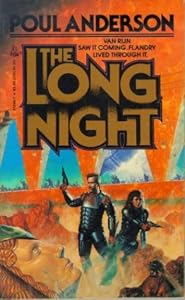
This cover shows the scene that I am rereading at present.
In the Carolingian universe, woods dwarfs:
live in the enormous forest;
eat mushrooms, nuts, rabbits and squirrels;
have no magical powers;
do not fear iron, silver or holy symbols;
unlike Narnian or Middle Earth dwarfs, do not take sides in wars between other beings -
"'We'll ha' naught to do wi' the wars in this uneasy land,' said Hugi. 'We'll bide our ain lives and let Heaven, Hell, Earth, and the Middle World fight it oot as they will. And when yon proud lairds ha' laid each the other oot, stiff and stark, we'll still be here. A pox on 'em all.'" (p. 26)
In one of Aesop's Fables, a donkey carrying military supplies is advised to flee in order to avoid capture by the advancing enemy. However, when he is told that the enemy will probably not try to make him carry any more than he is now because he is already at his limit, he replies, "I'll stay where I am!" In an sf novel by Fred and Geoffrey Hoyle, factory workers asked how they feel about the prospect of aliens conquering Earth, reply that they will still have to work in the factories. (That shocked me when I read it. Then I saw their point.)
Saturday, 4 November 2023
Augustus And Argos
Monday, 15 January 2024
End Game
Wednesday, 10 June 2026
Perspectives
In Poul Anderson's Technic History, the Fall of the Terran Empire is followed by a period of chaos called the Long Night. Pete Pinto, the second-hand bookseller, made the point that later civilizations which had grown out of that period would not refer to it as "the Long Night."
Poul Anderson imagines an sf writer in Augustan Rome who considered three possible futures:
the Empire will conquer the whole world;
in accordance with Augustan policy, the Imperial borders will remain unchanged;
the Empire will fall as barbarians move in, leaving -
Tuesday, 25 December 2018
At This Time Of Year...
(i) Neil Gaiman's Norse Mythology - relevant to both Gaiman's and Poul Anderson's works.
(ii) Julian May's The Many-Coloured Land (Pliocene Exile, Vol. I) - an author's note refers to Mananaan, the Son of Lir.
(iii) Robert Lanza's Biocentrism, which argues against mainstream cosmogony.
(iv) The next volume of Bill Willingham's Fables. (Scroll down.)
There may be more next week when it is my birthday.
Friday, 15 May 2020
Werebeasts
Where We Were-
Wolf
Parallel Reading
"Operation Afreet"
Other Authors
"There Shall Be No Darkness" by James Blish is a scientifically rationalized werewolf story, well written but badly filmed;
in Bill Willingham's Fables graphic novels, Bigby (Big Bad) Wolf is a werewolf;
Mike Carey's Lucifer features a were-tiger.
Poul Anderson
In Operation Chaos, Steve Matucheck is a werewolf. Before the War, he was a Hollywood actor, playing in Call of the Wild and Silver Chief.
"I weigh a hundred and eighty pounds, and the conservation of mass holds good like any other law of nature, so I was a pretty big wolf." (III, p. 19)
Matuchek fights a were-tiger:
"Tiger Boy stood close. In man-shape he was almost seven feet tall and monstrously fat." (V, p. 28)
"Tiger Boy" is:
"...paying the price of being a really big werebeast..." (p. 30)
By contrast, "...a fennec, the small fox of the African desert..." (ibid.)
is, in human form:
"...naturally, a dwarf barely one foot high." (ibid.)
"Poul Anderson immerses you in the future... Anderson puts you into a whole new world."
-Larry Niven, back cover blurb on Poul Anderson, Rise Of The Terran Empire (Riverdale, NY, 2011).
Anderson immerses us not only in his Technic History but also in an Earth with werebeasts.
Saturday, 25 January 2020
The Two Sides Of Empire
Whereas Poul Anderson's Dominic Flandry is the titular character of Agent of The Terran Empire:
"Entire companies of the Emperor's most diabolical soldiers - trolls, giants and worse - were tasked with [the wolf's] capture or destruction."
-Bill Willingham, Fables: Legends in Exile (New York, 2012), p. 130.
- and:
"'There's thirty, forty men with guns all coming for us. Imperial soldiers, what's more.'"
-Philip Pullman, The Subtle Knife (London, 1998), 14, p. 308.
So which side are we on? Usually, when reading fiction, on the side of our hero but which side is he on?
"'Why do you stand with Josip? You know what he is.'"
-The Rebel Worlds, CHAPTER ELEVEN, p. 475.
It is possible to appreciate Anderson's fiction while not always agreeing with his heroes. And, meanwhile, we have to take sides in real life with no author to point the way.
Saturday, 25 December 2021
New Books
There will now be an intermission while I read some books received as presents.
Although Edgar Rice Burroughs (ERB) is rarely referenced in Poul Anderson's works, this blog has had several occasions to refer to him. The following quotation is more generally relevant to all imaginative fiction:
Wednesday, 25 December 2019
Other Reading About Telepathy
Thus, we read, in a book received as a present today:
D'jinn, disguised as a slave girl: Gather all who serve Yussuf's ascendancy together tonight for an important meeting.
Sidi Nouman: Is that wise? In the past we've never congregated more than two or three at a time. Those were always Yusuf's orders.
D'jinn: No Matter. I simply needed to ascertain the fullness of the list which appeared in your mind the moment I inquired of them.
I've captured it complete, and so you are of no further use to me, Sidi Nouman, famous abuser of horses.
-Bill Willingham, Fables: Arabian Nights (And Days), (Burbank, CA, 2006), p. 59, panels 5-6.
Friday, 12 January 2024
Fantasy And Reality
It would have been very easy - all too easy? - for Poul Anderson to write a fantasy story corresponding to the role play game played by characters in his hard sf story, "The Saturn Game." This does not happen. The fantasy remains only in the minds of those characters. We happen to know that another way for denizens of the Technic History to encounter magic is to visit the inter-universal inn, the Old Phoenix, but that has no impact on the uncompromisingly scientific setting of "The Saturn Game."
It would have been even easier for the play and film, Shadowlands, to alternate between the events of CS Lewis' life and scenes from his Narnia series but that also does not happen. When one of Lewis' future stepsons enters a bedroom and looks in a wardrobe, it is only a wardrobe.
Near the end of Bill Willingham's Fables graphic series, the military forces of the mundane world enter Fabletown, previously magically concealed from their sight, where the mayor, the former King Cole, awaits them... A new and fabulous age dawns and the series unfortunately ends.
Wednesday, 1 September 2021
Marco Polo And Extratemporal Encounters In At Least Four Timelines
Poul Anderson, "The Only Game in Town" IN Anderson, Time Patrol (Riverdale, NY, 2010), pp. 129-171.
Neil Gaiman, "Soft Places" IN Gaiman, The Sandman: Fables And Reflections (New York), pp. 124-148.
Doctor Who, during the period of the first Doctor.
Section 2 of "The Only Game in Town" begins:
"Anno Domini One Thousand Two Hundred Eighty:..." (p. 133)
- then tells us what Kublai Khan, Marco Polo and several others, including two Time Patrolmen, were doing in that year.
"Soft Places" begins:
Monday, 13 July 2020
Only The Phoenix Arises...
"Only the phoenix arises and does not descend..." (see here) recalls the Old Phoenix.
Although Gaiman's The Sandman and Anderson's Time Patrol series do not apply the same concept of time, there are similarities in the way that time is described:
"Time at the edge of the dreaming is softer than elsewhere, and here in the soft places (scroll down) it loops and whorls on itself. In the soft places where the border between dreams and reality is eroded, or has not yet formed...
"Time. It's like throwing a stone into a pool. It casts ripples."
-Neil Gaiman, The Sandman: Fables & Reflections (New York, I cannot find a publication date), p. 141, panels 1-2.
"'An incipient causal loop is always dangerous, you know. It can set up a resonance, and the changes of history that that produces can multiply catastrophically.'"
-Poul Anderson, "The Sorrow of Odin the Goth" IN Anderson, Time Patrol (Riverdale, NY, 2010), pp. 333-465 AT 1935, p. 449.
"...it was all one swirl on a river that swept from the peaceful prehuman landscape where he had been to the unimaginable Danellian future."
-Poul Anderson, "Time Patrol" IN Time Patrol, pp. 1-53 AT 3, p. 17.
"History. The stream of events, great and small, running from cavemen to the Danellians. But what about the eddies, the bubbles, the insignificant little individuals and happenings that are also soon forgotten, whose being or nonbeing makes no difference to the course of the stream?"
-Poul Anderson, The Shield Of Time (New York, 1991), PART ONE, 1902 A. D., p. 120.