Showing posts sorted by relevance for query "Eutopia". Sort by date Show all posts

Monday, 3 September 2012

Operation Chaos

Poul Anderson's Operation Chaos starts with an alternative World War II and ends with an alternative 1960's. There is an Introduction by the author, then an untitled opening passage before Chapter I. The opening passage makes two connections between this work and the same author's Three Hearts And Three Lions by referring to:

(i) alternative timelines where historical events and/or natural laws differ;

(ii) a war between Law and Chaos occurring in every timeline.

Operation Chaos is a collection of four "Operation..." stories. Thus, the entire sequence of interconnected works comprises nine items:

Three Hearts And Three Lions
"Operation Afreet"
"Operation Salamander"
"Operation Incubus"
"Operation Changeling"
Operation Luna
A Midsummer Tempest
"House Rule"
"Losers' Night"

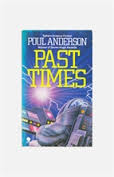
I think that this sequence would look good if presented in five uniform volumes, the fifth being a collection to be called The Old Phoenix. Admittedly, only two short stories, the last two titles in the above list, are set in this inter-universal inn. However, two other alternative timeline stories, "Eutopia" and "The House of Sorrows," could fit in the same volume. "Eutopia" was collected in Past Times, which is almost entirely time travel stories, so I think that "The Man Who Came Early" should replace "Eutopia" in a revised Past Times.

In "Eutopia," Alexander does not die in Babylon. In "The House of Sorrows," the Jews do not return from Babylon. So these stories are complementary.

Sunday, 7 February 2016

Eutopia, Westfall And America

Poul Anderson,"Eutopia" IN Anderson, Past Times (New York, 1984), pp.112-141.

Cross-time traveler Iason Philippou:

lives on a continent called "Eutopia";

is currently visiting a timeline where that continent is called "Westfall";

remembers visiting yet another timeline where it was called "America."

A region that is preserved as a wilderness for hunting on Westfall is, on Eutopia, groves, gardens, aesthetically designed villages and athletic fields. Because dielectric motors have not yet spread this far north on Westfall, Iason smells gasoline fumes and:

"He had thought that stench one of the worst abominations in America - that hogpen they called Los Angeles!..." (p. 118)

We are still rereading SM Stirling's Conquistador in which New Virginians unfavorably compare FirstSide, including LA, with their own unpolluted North American environment.

Iason mentally reviews the history of the American timeline:

Alexander the Great died from the fever that he had contracted in Babylon;

wars of succession destroyed his empire;

"Hellas and the Orient broke apart" (p. 125);

early science degenerated into metaphysics, then mysticism;

cold, cruel, uncreative Romans, claiming the Greek heritage while destroying Corinth, took over;

men despairing of life adopted a mystery cult founded by a heretical Jewish prophet;

this intolerant cult denied all but one way of seeing the God;

its priests cut down the holy groves, destroyed idols, martyred free men and kept their grip for nearly two thousand years;

after that, it became possible for science to be reborn;

however, the idea of conformity in belief remained;

hence, totalitarianism and the threat of nuclear war;

that history is filthy, wasteful, ugly, restricted, hypocritical and insane;

pretending to be an American was Iason's hardest task.

Tuesday, 6 October 2015

Comparisons

Recent posts (here and here) have compared SM Stirling's Draka History with Poul Anderson's:

History of Technic Civilization;
The Corridors Of Time;
"Eutopia";
"The House of Sorrows";
"Delenda Est";
"Amazement Of The World."

("Delenda Est" was the culmination of the original Time Patrol collection whereas "Amazement Of The World" is the culmination of the Time Patrol novel.)

(i) Technic Civilization is a fictitious future, more specifically a future history;

(ii) The Corridors Of Time, covering past, present and future, is a time travel novel set in an immutable timeline;

(iii) the Time Patrol, also covering past, present and future, is a time travel series set in a mutable timeline where divergent histories must be prevented;

(iv) "The House of Sorrows" is a short story set in a single divergent history;

(v) the Draka History is a tetralogy set in a divergent history - which I have yet to read to its conclusion;

(vi) "Eutopia" is a short story about travel between divergent histories.

Thus, six works by two authors present a conceptual sequence from future history to time travel to alternative histories to travel between alternative histories. As I have previously commented about Poul Anderson's works, there is a systematic exploration of every possibility: space, time, times and timelines.

Addendum, 6 Oct, ' 15: Including a few more works lengthens this sequence. Thus:

(vi) Stirling's Conquistador is a novel about regular travel between two divergent histories and the discovery of a third;

(vii) "Eutopia" is about regular travel between many alternative histories;

(viii) three works by Anderson feature a meeting place between alternative histories.

Again, we get the impression that the authors have ransacked every possibility.

Monday, 1 June 2020

Far And Near

Other universes are far, near or both: far - or even unreachable - in one direction but near in another. Eutopia is:

"...more than infinitely remote."
Poul Anderson, "Eutopia" IN Anderson, Past Times (New York, 1984), pp. 112-141 AT p. 124.

Nothing is more than infinite but there are different infinities. A multiverse of space-time continua is more than a single continuum which is more than an atemporal spatial volume which is more than a plane with is more than a straight line even if all five are infinite. No point is infinitely remote because any two points are separated only by a finite distance even if they are on an infinite line. It is impossible, merely by moving along a single straight line, to reach a point on a parallel straight line. However, it is possible to rotate through ninety degrees, then to move at right angles between two parallel lines, thus to cross from a point on one line to a point on the other. A Flatlander cannot reach a higher plane by moving on his native plane but some trans-planar force might lift him up.

"He could travel to the farthest of those stars which had begun twinkling forth against purple dusk - were it possible to exceed the speed of light - and not find Eutopia. It lay sundered from him by dimensions and destiny. Nothing but the warpfields of a parachronion might take him across the time lines to his own." (ibid.)

"The parachronion hummed. Energies pulsed between the universes. The gate opened and Iason stepped through." (ibid. p. 139)

Thus, the "infinitely remote" is instantly reached by stepping through a gate.

Tuesday, 4 February 2014

Poul Anderson's Time Travel II

The time travel stories by Poul Anderson that I would include in a revised Past Times are, in this order:

"Wildcat"
"The Nest"
"The Little Monster"
"The Man Who Came Early"
"Welcome"
"Time Heals"
"Flight to Forever"

The other stories in the original Past Times should, of course, be preserved elsewhere. In particular, "Eutopia" deserves to be included in another (proposed) collection:

The Old Phoenix and other Universes
"The House of Sorrows"
"Eutopia"
"House Rule"
"Losers' Night"

The seven stories in the proposed Past Times: Revised Edition span the geological past, the historical past, the near future and the ultimate cosmic future, then return to 1973 in a story published in 1950. These are independent stories, each presenting an instance of time travel in a distinct scenario.

If Anderson's "Time Patrol" (1955) had not initiated a series that spanned his career, then it would have made an appropriate concluding item for PT:RE. However, it differs from the previous seven in two respects. First, it addresses and answers the question, "Can the past be changed?" Its answer is subtle and not fully coherent in my opinion, but I have discussed this before.

Secondly, it presents not just another single, finite application of the time travel concept but a vast time traveling organization spanning and overseeing human history in its entirety. This was clearly the premise for a series and a second story, "Delenda Est", was published later that year.

"History was divided into milieus, with a head office located in a major city for a selected twenty-year period (disguised by some ostensible activity such as commerce) and various branch offices. For his time, there were three milieus: the Western world, headquarters in London; Russia, in Moscow; Asia, in Peiping; each in the easygoing years 1890-1910, when concealment was less difficult than in later decades, when there were smaller offices..."
-Time Patrol (New York, 2006), p. 13.

"...his time..." turns out to mean 1850-2000. Two decades is a very short time by comparison with a century and a half or even an expected human lifetime, let alone the indefinitely extended lifespan of a Time Patroller. Do all Patrol members receive the futuristic longevity treatment or only those who need it more because they time travel a lot? Those who do get it, which I assume is all, have to move to a different public identity in a different milieu after a few decades. We see just a little of this happening but obviously there is much more that we could be told about the Patrol.

We ordinary people work, retire and die whereas Patrollers work indefinitely and die by accident eventually so their lives are completely different from ours. A single Patroller could work for the entire twenty years in London, then Moscow, then Peiping, then somewhere/when else and so on indefinitely. The series does not begin to address such ramifications.

"Temporal, the artificial language with which Patrolmen from all ages could communicate without being understood by strangers, was a miracle of logically organized expressiveness." (p. 12)

Yet:

"'Merau Varagan, you are under arrest by the Time Patrol," [Everard] called in Temporal." (p. 278)

- so Varagan's time criminal group, the Exaltationists, must not only have stolen timecycles but also somehow learned the secret language?

The Time Patrol is time travel fans' heaven.

Friday, 22 February 2019

Theater Of Spies: Prologue

OK. A couple of observations from the Prologue won't reveal any plot developments.

Authors can use alternative history to comment on real history. Thus:

Stirling's President Theodore Roosevelt entertains the "...horrible thought..." that "...if Taft had lived Woodrow Woodenhead Wilson might be president now..."!;

in Poul Anderson's "Eutopia," a cross-time traveler contrasts his North American civilization of Eutopia with "America the Dreadful";

Alan Moore's vigilante, the Comedian, thinks that, if the Americans had lost in Vietnam, they would have gone mad as a nation...

Roosevelt also reflects that HG Wells' The War In The Air "...was starting to look horribly prophetic..." It was prophetic and has been cited on this blog as such. See here. With this reference, Stirling connects his current alternative history novel back to the Homer of sf.

The good folk at Penguin Random House sure know how to write promotional prose. In the covering letter for the Advance Reading Copy:

"Wonder Woman meets The Man in The High Castle with a splash of James Bond in this thrilling series..."

Since the 2017 Wonder Woman film is set during WWI and features General Ludendorff, this comparison is more valid than it might seem.

Monday, 8 February 2016

More On "Eutopia"

Continued from here.

"White Neathenai swept in grace and serenity down to the water."
-Poul Anderson, Past Times (New York, 1984), p. 139.

Does anyone know what "Neathenai" means?

Daimonax says of the Westfallers:

"'...they use nerves, glands, muscles more. So they know an aspect of being human which our careful world has denied itself.'" (ibid.)

However:

Eutopia has "...athletic fields..." (p. 115);
Iason himself is tall and broad and has been trained by Olympeion wreath winners.

So the Eutopians do already combine physicality with philosophy.

Of the Westfallers:

"'The family, the kingdom, the race is something to live and die for.'" (ibid.)

That is because these social units are still in dangerous conflict with each other. The human race can become something to live for, the only conflicts being with disease and with the recalcitrance of the physical environment that requires human action to satisfy human needs.

Tuesday, 4 September 2012

Eutopia And Sorrows

In the timeline of Poul Andeson's science fiction short story, "Eutopia":

Alexander the Great recovered from his fever in Babylon;

chastened by it, he spent the rest of a long life strengthening his empire;

they had a scientific revolution back then but retained religious tolerance;

thus, the world was spared the Roman Empire, Christianity and the Dark Ages.

It sounds like a good timeline although the shock ending of the story is that, in the modern period, they practice child abuse. (There is always something wrong.)

In the timeline of Anderson's "The House of Sorrows":

the Jews did not return from Babylonian Captivity;

there was no post-Exilic Judaism or Christianity;

lacking a unifying monotheist ideology, Europe centuries later remains divided between warring polytheist factions.

I don't buy that one. Yes, the Roman Empire needed a monotheism but no, they did not need to receive it from Saul of Tarsus. They could have got it from Greek philosophy. The philosophers and the priests had become monotheists surrounded by popular polytheism. Jupiter-Zeus-Thor would have become the One God. The other Olympians and other pantheons would have been demoted to lesser/angelic roles. The word "deus/god," uncapitalized, could have been retained with a changed meaning.

With inputs from Homer, the dramatists, the Mystery religions, the philosophers, Virgil and local pantheons, there might have been a European equivalent of Hinduism: academic debate between proponents of monotheistic, monistic and materialist philosophical systems co-existing with continued polytheist practice at the popular level. Socrates and Caesar are two strong candidates for a sacrificial victim role. In fact, they are complementary: Greek spiritual/philosophical as against Roman military/political. Christianity, of necessity, changed its Messianism from military to spiritual ("not of this world") but Caesarism remained militaristic.

In our history:

the Jewish scriptural canon is the Law, the Prophets and the Writings and that third section includes the Wisdom literature;

the Christian Old Testament is the Jewish canon rearranged and reinterpreted;

the New Testament is new documents, the Gospels etc;

"Homer and the poets," essentially a Pagan canon, i.e., divinely inspired authorities on theology and morality, instead became the beginning of secular literature;

Homer and the poets, i.e., the dramatists, were followed by the philosophers, "lovers of wisdom," Plato even continuing the dramatic form, and by Virgil, essentially presenting a "New Testament" about Rome as the new Troy.

In my proposed alternative history:

the "Old Testament" would be Homer, the Poets and other Writings, including "love of wisdom";
the "New Testament" would be Virgil etc.

Far out.

Strangely, Babylon plays a crucial role in both of these alternative histories imagined by Anderson. The Jews returned from Babylon in our history but not in Anderson's. Alexander returned from Babylon in Anderson's history but not in ours. 

Sunday, 7 February 2016

Relearning History

SM Stirling, Conquistador (New York, 2004).

Adrienne explains to Tom and Roy:

Alexander the Great (see image) did not die in 323 BC but lived for another forty years;

the Greeks assimilated the Jews, thus preventing Christianity;

Zoroastrianism died out;

some Scandinavians visited the American continents briefly but no one else;

Eurasia still has medieval technology;

Alexander is still worshiped as a son of Zeus.

Comments
Adrienne: "'The details don't matter.'" (p. 258)
me: They do! (But not from her practical pov.)

Adrienne: "'...our best guess is that the Industrial Revolution needed the equivalent of a toss coming up heads a thousand times in a row.'" (p. 259)
me: Is our history really that improbable?

Appendix Three: "Alexander the Great died in August of 280 B.C.E., in the summer capital of Ecbatanta..." (p. 589)
me: Is this the same as the Ecbatana visited by Time Patrolmen Manse Everard and Keith Denison?
me: When did Alexander die in Poul Anderson's "Eutopia"? Reading Stirling's alternative histories has persuaded me to reread Anderson's Old Phoenix stories and now his "Eutopia."

The History Of Westfall

Poul Anderson, "Eutopia" (see here).

The History Of Westfall
Arabs, Vikings and Magyars destroyed Christendom;
civil wars destroyed the Islamic Empire;
European barbarians developed undisturbed;
eventually, crossing the Atlantic but lacking the power to exterminate the natives, they instead came to terms with them;
lacking industry, they adapted to the forests, plains, deserts and mountains;
despite remaining divided into petty states, like Norland and Dakoty, the Westfallers have developed radio, gas engines, electric motors, aircraft and nuclear weapons;
several realms have built a lunar base and sent expeditions to Ares;
whereas the American timeline is an example of man gone wrong, the Westfallers have something to teach the complacent Eutopians who sacrifice their humanity to rationality.

Like Anderson's "Losers' Night," this is a story with a double surprise ending. See here. At the end of "Eutopia," we might be so shocked by the revelation in the last word that we forget the earlier realization that "'...Westfall is also the Good Land.'" (p. 137)

Saturday, 15 August 2015

Time Travel And Alternative Histories

Imagine a Venn diagram, comprising two overlapping circles. Circle 1 represents time travel fiction whereas Circle 2 represents alternative history fiction:

inside Circle 1 but outside the area of overlap are (among many other works) Poul Anderson's The Corridors Of Time and There Will Be Time, each describing time travel in a single consistent timeline with circular causality but no causality violation, therefore neither access to nor generation of any alternative histories;

inside Circle 2 but outside the area of overlap are (among many other works) Anderson's "The House of Sorrows," in which the twentieth century is polytheist because the Jews never returned from Babylon, and his "Eutopia," in which the twentieth century is Greek because Alexander the Great did return from Babylon;

inside the area of overlap is Anderson's Time Patrol series, describing time travel in a mutable timeline where several alternative histories are discussed and three are realized, one by extra-temporal intervention, the others by random fluctuations in space-time-energy - whereas the "House of Sorrows" history merely exists and the "Eutopia" history merely coexists with other alternative histories in parallel timelines.

However, all the alternative histories discussed so far contrast with three others presented by Anderson:

in Three Hearts And Three Lions, a man travels from our twentieth century to an Earth on which the Carolingian myths are literally true;

A Midsummer Tempest is set in the seventeenth century of a history where all of Shakespeare's plays, including those featuring supernatural beings and magic, were literally true;

in the two Operation... volumes, twentieth century technology is magical, not scientific.

Clearly, a time criminal in the Time Patrol timeline would be able to generate either the polytheist or the Greek twentieth century merely by diverting the course of history whereas it would be necessary to change the laws of physics in order to generate any of the mythical or magical histories. Let us therefore distinguish between realistic and fantastic alternative histories.

Anderson wrote four volumes of fantastic alternative histories but only two short stories (I think) about realistic alternative histories. By contrast, Anderson's successor, SM Stirling, specializes in novels and series about realistic alternative histories. I have already discussed three of Stirling's histories and will shortly begin to read Volume I of his Draka tetralogy.

Monday, 8 February 2016

Damned Ideologies

In his Afterword to "Eutopia," Poul Anderson quotes Robinson Jeffers:

"'Long live freedom and damn the ideologies.'"
-Poul Anderson, Past Times (New York, 1984), p. 141.

One meaning of "ideology" is a set of ideas that is generated by, then rationalizes, justifies and sanctifies, a status quo. Thus:

absolute monarchies generated the idea of the divine right of kings;

when James VI of Scotland became James I of England, thus uniting the kingdoms, he claimed to be restoring a lost Arthurian British unity, taking as his text Geoffrey of Monmouth's (unhistorical) History of the Kings of Britain;

the trans-Atlantic slave trade generated racism of skin color for the first time in history and with it came ideas of white superiority.

However, if by "ideologies," we mean simply theories of society, then we need them. In fact, we need several at this stage of history because we are in such disagreement. In politics as in science, theory guides practice but practice tests theory. We need not the practical instead of the theoretical but both of them and good theories instead of bad.

Wednesday, 19 August 2015

Different Histories

How many alternative courses of history are imaginable? An indefinite number. What would have been the consequences of any specific alteration to historical events? For example, would it have been good or bad for civilization if Alexander the Great had lived longer? Poul Anderson and SM Stirling present opposite answers in "Eutopia" and Conquistador, respectively.

Was monotheism necessary for the development of science and, if so, did it have to be Semitic monotheism? In "Delenda Est," Manse Everard says:

"'As Whitehead pointed out, the medieval idea of one almighty God was important to the growth of science, by inculcating the notion of lawfulness in nature.'"
-Poul Anderson, Time Patrol (New York, 2006), p. 196.

However, in Is There Life On Other Worlds?, Poul Anderson argues that science is the joining of logic and theory with data and technique. This possibly happened because Germanic barbarians, not regarding themselves as above work or trade, were confronted with the problems and labor shortage of the falling Empire. Sharp logical reasoning was provided by Christian theologians but this was because their ideology required unanimity, not necessarily because it was monotheist.

Wednesday, 19 April 2017

Cutting Edge II

Here, we listed six kinds of fiction:

mysteries;
historical fiction;
heroic fantasies;
three kinds of sf.

There is not always a convenient label for what we are talking about. The first two kinds of sf are straightforward: future histories and time travel. The third is... Hal Clement-style world-building - or speculative planetology?

In all six cases, we said, "If you read works of this type, then also read certain specified works by Poul Anderson." Next we will mention another two kinds of sf:

alternative histories fiction;
what I have here called "Cutting Edge" speculative fiction.

In these two cases, it is appropriate to mention Poul Anderson in relation to other authors. Thus:

if you have read Anderson's "The House of Sorrows" and Eutopia," then read the alternative history novels and series of Harry Turtledove and SM Stirling;

if you have read Anderson's later "Cutting Edge" sf, then read the works of several later aurhors, e.g., John C. Wright.

For a summary of Anderson's account of an AI-nanotech economy, see here. I have only just begun to read John C. Wright's The Golden Age. To write hundreds of pages of narrative set in a society with such an advanced technology is a sustained feat of the imagination. The reader must accept that everything makes sense in its context but that we do not (yet) see the entire context. Thus, we read that someone was present:

"...only as a partial-version..."
-John C. Wright, The Golden Age (New York, 2003), p. 4 -

- and we deduce from this that AI technology enables a man to be represented at a meeting or a social event by a self-conscious duplication of part of his own mind/personality/consciousness.

My initial impression is that Wright partly imagines a transformed future scenario but also partly projects features of twentieth/twenty-first society onto that scenario. Thus, crime and coercion are outmoded concepts yet some individuals and lineages are immeasurably wealthy compared with everyone else. One character reduced himself to penury by bad investments. Another is described as "...the owner of a vast entertainment empire..." (p. 33) That phrase suggests a population of individuals with incomes which they spend partly on necessities and partly on entertainment. How do they acquire their incomes? If they are employed by and work for owners of entertainment or other companies/"empires" etc, then our economy has survived unchanged whereas if instead each member of the population has a share in the vast technologically produced wealth, then why is distribution of this wealth limited in such a way that there is still a division between rich and poor?

Sunday, 8 June 2025

Duplications

Sometimes, while rereading a work by Poul Anderson, I find a passage that I would like to post about but then search the blog and find that I have already posted about it. This happens increasingly frequently, of course. At other times, I post first and search second. This can result in some duplications, e.g.:

Three Senses On Nike (21 April 2018)

Three Senses On Nike (8 June 2025)

Just over seven years between them so, of course, I had forgotten the first post. But there are some slight differences between the two posts so maybe both are worth preserving? The first post links to many others through the short story, "Eutopia," which takes us from a future history series to alternative histories. History is an important aspect of Poul Anderson's works which also include ordinary historical fiction in which, e.g., explorers into Northern waters find not Utgard or the World Serpent but icebergs. It is all one multiverse.

Thursday, 20 March 2014

Time Travel And Related Works

Over the past two months, we have surveyed the extraordinary timescapes of:

"The Little Monster" (a single time traveler);
"The Nest" (time traveling brigands);
Time Patrol and The Shield Of Time (a time travel police force);
The Corridors Of Time and There Will Be Time (two time wars).

Correspondents have been too polite to observe that I became unusually focused on Corridors.

Earlier along our own particular timeline, we also considered:

"Flight To Forever" (a journey around cosmic time);
The Dancer From Atlantis (the originals of some Greek myths).

Neither backwards nor forwards but sideways in time are:

"Eutopia" (Alexander did return from Babylon);
"The House of Sorrows" (the Jews did not return from Babylon) -

- and four of the many timelines with fleeting access to the Old Phoenix Inn:

Three Hearts And Three Lions (Carolingian mythology);
the two Operation volumes (working magic);
A Midsummer Tempest (Shakespearean history);
the History of Technic Civilization (Nicholas van Rijn).

My points are that:

Poul Anderson wrote many time travel and alternative timeline scenarios;
I have published a lot of posts about them;
but I have probably exhausted my current stock of observations on these works;
however, after the complexities of the Time Patrol, the time corridors and the Star Masters, it feels anticlimactic to return to the merely linear plots of Anderson's non-series short stories from which time travel has been an extended digression;
so I will have to find out where the blog goes next.

I usually do think of something to say - although not always at the recent rate.

Tuesday, 3 October 2017

The Rivers Of Time

Poul Anderson, Genesis (New York, 2001), Part Two, VII, 8.

When Christian and Laurinda transfer to an exotic emulation, they stand above "...a wide brown river." (p. 189) That phrase seemed familiar. Searching the blog here, I found the "great brown river" near the Time Patrol Academy and the "mighty river" near Jack Havig's main base.

Wheat and Indian corn are cultivated. Chinese navigators entered North America in the fifteenth century. The Way of the Buddha is influenced by Taoism and by local nature cults. In the twenty second century, China does not recognize North America's independence and disapproves of its miscegenation.

 All of these emulations in some way echo or parallel scenarios in other works by Anderson:

the Time Patrol prevented the Chinese from invading North America in "The Only Game In Town";
Alexander built a lasting empire in "Eutopia";
The Matuchek's visit their timeline's version of York in Operation Luna.

Thursday, 9 May 2019

Action And Ideas

Poul Anderson both wrote good action fiction and presented ideas through fiction. Occasionally, I think that the action is unnecessary, e.g., in The Boat Of A Million Years, a rescue from a hospital could have happened off-stage if it even had to happen.

A few stories have a lot of action but do present an idea at the end, e.g.:

"The Nest";
"Eutopia";
"The Master Key";
"Brake."

"Brake" works its way both to an explanation of why the characters are fighting and to the solution of a technical problem. Anderson heroes are good fighters and problem-solvers.

Sunday, 28 May 2023

Reality Branches

Poul Anderson, "The House of Sorrows" IN Anderson, All One Universe (New York, 1997), pp. 69-98.

This is the story that I think should definitely open a Poul Anderson collection. To reiterate:

Proposed title: The Old Phoenix and other universes

Proposed contents:
"The House of Sorrows"
"Eutopia"
"House Rule"
"Losers' Night"

The developing theme:
a single alternative history
travel between many histories
an inn between the histories
the culmination of the inn sequence

The inter-historical inn, the Old Phoenix, comprises a "sequence" because it also features in Anderson's A Midsummer Tempest, xi, xii and Epilogue

A Midsummer Tempest follows Anderson's Three Hearts and Three Lions and Operation Otherworld.

Operation Otherworld collects Operation Chaos and Operation Luna

Operation Chaos collects "Operation Afreet," "Operation Salamander," "Operation Incubus" and "Operation Changeling."

"House Rule," as we have repeatedly said, crosses over with Anderson's History of Technic Civilization.

To return to "The House of Sorrows" after all that seems like an anti-climax but it is an individual story by Poul Anderson and we should appreciate its reflection on history. Ancient history viewed in a distorting mirror helps us to reflect on our origins.

Tuesday, 2 December 2025

An Alternative Vision

In the combox for The (Prevented) Veleda Timeline, there is reference to an earlier comment that "Zoroastrian Persia" was becoming Christianized. That earlier comment was in the combox for The Veledan Alternative.

"The Veledan Alternative" also refers to my speculation about the possibility of a world religion differing as much from Christianity and Buddhism as they do from each other. Veleda's vision, if developed fully, might have realized that possibility:

first, feminine instead of masculine;

secondly, neither pure monotheism nor pure atheism but popular polytheism merging into a mystical monism.

Philosophers would have been able to say that the Goddess was a personification of the sea which is the source of life.

Although this religion is prevented in the Time Patrol timeline, it might exist in one of the alternative histories visited in "Eutopia" or having access to the Old Phoenix.