Sunday, 19 November 2023

In The Post-Imperial Age

In "A Tragedy of Errors," Roan Tom has settled on Kraken.

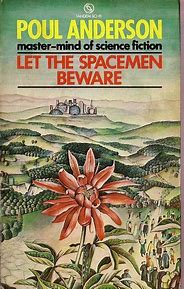
In "The Night Face," Nuevamerica has overthrown rule by Lochlann while the latter was in conflict with the Grand Alliance.

In "The Sharing of Flesh," Kraken and Nuevamerica are in the Allied Planets and there is a passing reference to Lochlann.

"Starfog" refers to events during the earlier Imperial age.

Stories set on different planets and in different periods are interconnected although each is an independent narrative and there are not enough of them.

Saturday, 18 November 2023

The Technic History Surveyed Again

If there is anyone who reads every post on this blog and remembers them, then I apologise for some repetition. Endlessly fascinated by the subtle structure of Poul Anderson's History of Technic Civilization, I keep trying to sum it up in a few words, this time focusing on three pivotal volumes.

The Earth Book of Stormgate (as I have indeed said before)...
is both the fifth Polesotechnic League volume and the second Ythrian volume;
completes the history of the League;
almost completes the history of human-Ythrian interactions;
refers to the Terran Empire although not to Dominic Flandry because he has not been born yet.

(Thus, a lot of ground already covered plus a lot more still to be covered.)

The Day Of Their Return...
follows the Young Flandry Trilogy;
at last completes recorded human-Ythrian history.

The Night Face and Other Stories...
follows the remaining five volumes of the Flandry period;
collects the four post-Imperial instalments.

As I say every time, what a future history series!

Pronouns

"...an invisible and subtle essence is the Spirit of the whole universe. That is Reality. That is Atman. THOU ART THAT."
-Chandogya Upanishad, 6.

"'Do you see God, or feel Vwi?' The last word was a pronoun; Gwydiona employed an extra gender, the universal."
-"The Night Face," III, p. 576.

"'Maybe God likes a joke now and then. But if so, Vwi has a pawky sense of humor.'" (VII, p. 602)

(I had to cross-check with a passage in an earlier instalment of the Technic History but there Dominic Flandry's sense of humour is said to be odd, not pawky.)

Gwydiona "Vwi" corresponds to the Upanishadic "THAT": a pronoun that can be applied to the ultimate reality whether that reality is regarded as personal or impersonal. As such, I can get with it. THOU ART THAT.

Outcomes

A fictional narrative can end by implying, instead of explicitly stating, a subsequent course of events. Thus, Poul Anderson's "The Night Face" ends by implying that Raven will not get out of the Holy City alive. In the absence of any sequel recounting any alternative outcome, we must assume that this is the case, that the homicidal Gwydiona kill Raven. An author always has the option of writing a sequel that contradicts the implied outcome of the previous narrative although he has to do it right. Thus, at the end of Isaac Asimov's I, Robot, the Machines, giant positronic brains, control the Terrestrial ecology and economy in what they, and no one else, judges is the best interests of mankind. No one knows what they will do. They sabotage any opposition to their schemes. But, in the sequel, they have judged that self-determination is the highest human good so they have phased themselves out! (In robotics at least, Asimov was a master of dialectical thinking although Anderson was not far behind with the unemployed robot in his Psychotechnic History.)

I think that Raven deserves to survive and I would like to read a sequel in which he does but one in which he also learns from the experience, emerging as a new Raven, a figurative death and rebirth. 

Non-Interference

There are non-interference directives (or words to that effect) in:

Star Trek
James Blish's Okie series
Poul Anderson's Psychotechnic History
Anderson's Time Patrol series

They are enforced by:

Starfleet
Earth cops
the Coordination Service
the Time Patrol

Some sf is moral stories about the need for non-interference. In Anderson's "The Night Face," the Gwydiona handle their temporary annual insanity by dancing and enacting myths. Tolteca, blundering in with good intentions but no understanding, upsets their rhythm and causes at least three deaths.

Friday, 17 November 2023

Time Travel And Hyperspace

H.G. Wells' Time Traveller arrives in 802,701 A.D. not by any kind of motion, despite Wells' use of such language, but by stationary time dilation that inexplicably makes him both invisible and intangible. Poul Anderson's characters arrive in the system of the planet Gwydion by multiple instantaneous quantum jumps. Thus, they do not traverse the distances between points in space, do not really move through space, and are understandably invisible and intangible to any observer that is not in phase with them although they also generate a hyperspace wake instantaneously detectable within a light-year. Both Wells' "time travel" and Anderson's "hyperspace" involve the danger of arriving in a space already occupied by another material object. These two modes of travel are similar in description and also in the use made of them by their authors. Both transport the protagonist(s) to an unfamiliar environment where they must deduce what is really going on: Morlocks in the Dark Nights and the Night Face of the Gwydiona.

Morlocks And Mountain Apes

In HG Wells' The Time Machine, Chapters 10 and 12 are entitled "WHEN THE NIGHT CAME" and "IN THE DARKNESS," respectively. The Eloi fear the Dark Nights when some of their number are spirited away by the small, white, ape-like Morlocks that eat them.

In Poul Anderson's "The Night Face," the Gwydiona look forward to Bale Time when they think that they become God although they acknowledge that God has "Night Faces." One Gwydiona reluctantly admits that something bad happens at Bale Time and mentions:

"'...a theory that the mountain ape is driven mad by the presence of God and comes down into the lowlands, killing and destroying.'"
-"The Night Face," VII, p. 607.

The mountain apes are omnivorous hunters that travel in flocks. See Two Fight Scenes.

The Morlocks climb up from below ground whereas the Gwydiona apes descend from the mountains. Apart from this topological difference, the two situations seem very similar - but are not.

In 802,701 A.D., mankind has divided into Morlocks and Eloi. On Gwydion, mankind has divided himself.

Thursday, 16 November 2023

The Earth Book And Watchmen

A story can be narrated, enacted or depicted. So the three story-telling media are narrative, drama and sequential art. For us, these are mainly: (prose) novels, cinema and graphic novels.

Poul Anderson's The Earth Book of Stormgate collects twelve prose narratives of different lengths, including one novel. These are twelve of the forty-three instalments of Anderson's Technic History, which is sf.

Alan Moore's and Dave Gibbons' Watchmen collects all twelve instalments of the monthly Watchmen superhero comic book series. Superheroes, an off-shoot of sf, is a hybrid genre also containing elements of action-adventure and fantasy although there is no fantasy in Watchmen.

In the Technic History, mankind survives the Chaos and Technic civilization is born. In Watchmen, mankind avoids an imminent nuclear war and a new age of peace is possibly born.

In the Earth Book, each instalment gains a new introduction and there is a single short afterword. In Watchmen, instalments I-XI were each followed by a prose piece and these are reproduced in the collection.

Some slight structural similarities between two works, each a classic in its own medium. 

Something Wrong

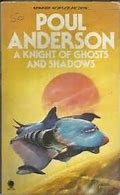
Chunderban Desai expounds a specific sophisticated cyclical historical theory to Dominic Flandry:

"'Growth until wrong decisions bring breakdown...'"
-Poul Anderson, A Knight of Ghosts and Shadows IN Anderson, Sir Dominic Flandry: The Last Knight of Terra (Riverdale, NY, March 2012), pp. 339-606 AT III, p. 388.

Desai summarizes:

growth
wrong decisions
breakdown
wars
Imperial Pax
dissolution
reconstitution
disintegration
dark age
ruins of old society
new society beginning in the ruins
growth
etc

"'Technic civilization started on that road when the Polesotechnic League changed from a mutual-aid organization to a set of cartels. Tonight we are far along the way.'" (pp. 388-389)

With metaphorical appropriateness, he says, "Tonight...," not "Today..."

Desai and Flandry live during either the initial Pax or its reconstitution, I am not sure which. Later, Flandry tells Miriam Abrams that she and he are living during the interregnum between the principate and dominate phases of the Empire. I had thought that Molitor, the usurper, represented the dominate phase and therefore the reconstitution but maybe not. Desai says that a "'...centralized divine autocracy...'" (p. 388) still lies ahead.

We have summarized all this before. My present point is that I think that Desai's exposition captures something that we might feel:

that there is something wrong in society;
that we can see many symptoms but not identify any specific cause;
that people in pivotal positions might be able to set things right if only they knew what decisions to make;
that most of us are helpless most of the time;
that a catastrophe is bearing down on us.

I describe this as a feeling, not an analysis, and maybe not everyone feels it. To me, Desai's account rings true although that is certainly not to defend all its details.

Wednesday, 15 November 2023

Caverns In Clouds

"The Night Face," VII.

"Rain cane the following afternoon, first thunderheads banked over Kolumkill like blue-black granite, lightning livid in their caverns..." (p. 602)

Where have we seen caverns in clouds before?

"Lightning blazed in [the cloud wall's] caverns."

"Lightning played through [those clouds'] caverns."
-Poul Anderson, "The Sorrow of Odin the Goth" IN Anderson, Time Patrol (Riverdale, NY, December 2010), pp. 333-465 AT 374, p. 463.

Dominic Flandry sees "...caverns beyond caverns..." in the Sky Cave nebula. See here.

In the "Starfog" of the Cloud Universe cluster, Daven Laure sees cliffs and grottoes.

There are probably more examples.