Tuesday, 16 August 2022

Ermanaricshafen

Superb intertextuality - John Wilkie refers to Rostov-on-Don, then corrects himself:

"'...Ermanaricshafen.'"
-Daggers In Darkness, CHAPTER TWO, p. 41.

The explanation follows immediately:

"There were quiet snorts and rolled eyes: Ermanaric had been...probably...a quasi-mythical Gothic king in the Ukraine in the fourth century AD, one who figured prominently in the Volsungasaga and the Niblelungenlied. The Germans were notorious for ransacking history and legend for ethnically suitable names to plaster on their vastly enlarged realm. The Ukraine was the East Gothic Marchland these days..." (ibid.)

If we were reading Daggers In Darkness on screen, then it might be appropriate for an ad to appear, saying: "Read Poul Anderson's excellent Time Patrol story, 'The Sorrow of Odin the Goth.'" Anderson's characters are East Goths, including Ermanaric, living in the Ukraine, and time travellers who refer to the Volsungasaga and the Nibelungenlied. Sometimes it feels as is if all of literature and fiction is one long series. 

Monday, 15 August 2022

A Good Leader In Another Time

This is the first in a series of occasional posts about SM Stirling's alternative history novel, Daggers In Darkness. See also here.

The edition that I have opens with:

front cover, blank inside
title page
publication information
contents
dedication
quotation
blank page
p. 1 of the text

The quotation is from Theodore Roosevelt:

"The best leader is one who has good sense enough to pick the right people to do what he wants done, and self-restraint enough to keep from meddling with them while they do it."

Poul Anderson's Nicholas van Rijn would share this sentiment. His Solar Spice & Liquors prospers because he picks people with initiative.

I googled and confirmed that Roosevelt did say this or something like it in OTL (our timeline).

An author has to convey what it would be like to live in another timeline and must sometimes show his characters reflecting on the turning points, e.g.:

"V-gas. Vernichtungsgas. Annihilation gas. Horror-gas. The devil's instrument and the devil's own luck. Without it, we would have won the Great War, beaten Germany to powder by 1918 at the latest. With it... the world we have instead. Stalemate."
-SM Stirling, Daggers In Darkness (Eric Flint's Ring of Fire Press, 2021), PROLOGUE, p. 4.

The key concepts here are the lost possibility of winning the Great War by 1918 and the phrase, "...the world we have instead." That is how life would feel to a US President in 1922(b).

Names II

The previous post lacked examples.

Merseains
Ensign Flandry meets Mei Tachwyr the Dark of the Vach Rueth and Yqan Lannawar Belgis whose naming style dates from an earlier culture.

Ythrians
Arinnian of Stormgate Choth, whose human name is Christopher Holm, marries Hrill of Highsky Choth, whose human name is Tabitha Falkayn.

Guardian of North Gate can be
Raft Farer and Woe will no longer be
Many Thoughts, Cave Discoverer and Master of Songs can no longer be
Iron Miner and Lightning Struck The House are to be

Sunday, 14 August 2022

Names

In Poul Anderson's works, we become familiar with extra-terrestrial naming systems. In After Doomsday, Ramri of Monwaing's Katkinu: Ramri, personal name; Monwaingi, species; Katkinu, the name of a Society.

In the Technic History:

a Merseian has a personal name, a nickname and a Vach;

an Ythrian has a personal name and a choth;

a tripartite Didonian is named by a phrase descriptive of his origin;

a Shalmuan seems to have a single name.

We know of two Shalmuans:

Chives, Flandry's servant;
Ch'kessa, Prime in Council of the Clan Towns of Att.

"Chives" seems to be influenced by "Jeeves." In many works, we were never told Jeeves' first name and it was as if he was above such things. However, for the revelation of his first name, read PG Wodehouse's Much Obliged, Jeeves.

Parallels

The parallels that we have been drawing between certain works by Wells, Anderson and Blish continue. Just as the Time Traveller travelled to the perpetual summer of 802,701 AD when Morlocks eat Eloi, Blish's John Martels is time-projected to the perpetual summer of circa 25,000 AD when Birds threaten men. Each spends some time in a museum - displaying items from his future. Just as the Time Traveller on his Time Machine travels farther, to the end of life on Earth, Poul Anderson's Martin Saunders in his time projector travels to the end of the universe and beyond.

We have previously listed other parallels:

sitting on the Time Machine or a timecycle;

events speeding past the Time Traveller and Poul Anderson's mutant time travellers;

time discussed as a fourth dimension in The Time Machine and in The Corridors Of Time.

Several aspects of The Time Machine parallel aspects of diverse works by Anderson.

Saturday, 13 August 2022

Futures II

Sf readers are like:

the outer narrator in The Time Machine;
Robert Anderson in Poul Anderson's There Will Be Time;
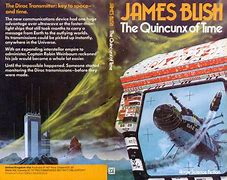
Service agents in James Blish's The Quincunx Of Time.

We receive accounts of futures that we cannot enter. Robert Heinlein's DD Harriman put mankind into space but could not go there himself until after his retirement - and then he died on the Moon.

We envy genuine time travellers who can go into the future and return but that is the most improbable of all sf speculations. We all accept that we are not going to meet anyone who has come from the future and is able to return then.

Futures

We perceive the past as fixed and the future as open. Every being that is conscious at any moment perceives earlier and later times in that way. Every moment is the present to any being that is conscious within it. There is no unique present unless we say that the eternal present intersects time at every moment - or at every conscious moment? Maybe less complex conscious organisms experience only immediate sensations with minimal memory and anticipation? However, zero memory and anticipation would entail an experience beginning and ending simultaneously, the temporal equivalent of a mathematically flat plane.

Abstractions become concrete when sf writers speculate:

mankind has devolved into Morlocks and Eloi by 802,701 AD;

mankind has evolved into Danellians a million years hence;

in 25,000 AD, birds, now called "Birds," have become intelligent and threaten to exterminate mankind.

Sources:

Wells, The Time Machine;
Anderson, Time Patrol and The Shield Of Time;
Blish, The Quincunx Of Time and Midsummer Century.

Alternative futures that might be compatible in some vaster framework. All three authors have allowed enough time for not only historical but also Darwinian processes to occur.

Differences Between The Service And The Patrol

(i) The Service guards the future whereas the Patrol guards both past and future.

(ii) The Service avoids knowing the dates of any deaths whereas the Patrol knows many such dates.

(iii) The Patrol merely polices time travel whereas the Service monopolizes the Dirac communicator although one message, from March 12, 3022, is coded:

"'But why will we be using code?' Dr. Wald wanted to know. 'It implies that we think somebody might overhear us - somebody else with a Dirac. That could be very messy.'"
-James Blish, The Quincunx Of Time (New York, 1973), CHAPTER NINE, p. 104.

(iv) The Patrol conceals the fact of time travel before its invention and the Service conceals the source of its evident prescience. However, increasing numbers of people suspect the truth and are recruited into the Service.

(v) Time travellers can explore the further future whereas the Service must wait to learn the meanings of incomprehensible future Dirac messages.

The Time Patrol And The Service II

"'...The date of a Serviceman's death must never be mentioned in a Dirac 'cast.'"
-James Blish, "Beep" IN Blish, Galactic Cluster (London, 1963), pp. 93-128 AT p. 128.

"'...The date of death of a sentient entity must never be mentioned in a Dirac 'cast.'"
-James Blish, The Quincunx Of Time (New York, 1973), p. 128.

(Coincidentally, the same page number.)

In Quincunx..., the viewpoint character, having been told that the Service is not a thought police but an Event Police, reflects that it also must not be an Assassins' Guild. The Time Patrol is an Event Police but one that might sometimes hire an Assassins' Guild.

If Manse Everard departed 1990, died in 1307 and therefore did not return to 1990, then his death and consequent failure to return would be matters of record in milieu HQ, 1890-1910. Someone would know of his death. HQ has a department that authorizes missions and a department that knows their outcomes. How does it keep these departments apart?

Friday, 12 August 2022

The Time Patrol And The Service

There are some similarities between Poul Anderson's Time Patrol and the Service in James Blish's "Beep"/The Quincunx of Time. I want to discuss these similarities as a lead-in to identifying a possible problem with Time Patrol practice. This might take a while. Tomorrow will be dominated by a family wedding.

The Time Patrol
Civilizations later than 19352 AD have space-time machines and a police force, the Patrol, whose agents ensure that recorded and unrecorded historical events happen on schedule because those events constitute the timeline in which they all live and which will lead to the post-human Danellians who will found the Patrol. However, Wanda Tamberly in 1990 cannot be sure that Manse Everard will "'...come home safe and successful...'" from a mission in 1307 because:

"The hazards of paradox and the wounds to the soul would be overmuch, did Time Patrol people go back to visit their beloved dead or forward to see what was to become of their beloved living."

Two features of the Patrol:

a mission to protect the past;
a rule against knowing when colleagues will die.

If we replace "past" with "future," then we identify the two features of the Service.

Time travel developed from an attempt to find a means of instantaneous transportation.

The Service
Late in the twenty first century, when there is already faster than light interstellar travel, Terrestrial Intelligence tries to find a means of instantaneous communication. Thor Wald invents the Dirac communicator. Any Dirac communicator simultaneously receives all messages transmitted by any other Dirac communicator. In a four dimensional continuum, this means all messages that have been, are being or will be transmitted. All the messages arrive together as a single beep but individual messages can be extracted and slowed down. 

The Intelligence Bureau that becomes the Service knows of many future events and works to bring every one of them about. Any other decision, to cause some events but prevent others - if that is even possible - would have been hubris. The consequences of this policy are increasingly utopian and the Service becomes the only interstellar government.

Blish does not explain why the consequences are utopian but I think that I can see the reason. A message reporting a massacre will be received only if such a message is transmitted. It will be transmitted only if a massacre occurs. A massacre will occur only if the Service allows or even commits it. The Service will allow or even commit a massacre only if, first, they receive a message reporting a massacre and, secondly, they are the kind of people who would insist on implementing their policy of preserving the known future even at the expense of allowing or causing a massacre. It follows that messages reporting massacres will be received only if messages reporting massacres are received (so far, a tautology) and if Service personnel are capable of massacres. Since they are not capable of this, such messages are not received. Instead, Service personnel foresee themselves implementing only, to them, morally acceptable scenarios and then have no problem about implementing such scenarios which is why only such scenarios are implemented and foreseen. Merseians, kzinti, Klingons or Draka with a Dirac transmitter would foresee themselves conquering the galaxy.

This has not got us to the point that I was aiming at but maybe it is enough for this evening.