Monday, 4 December 2023

"Lodestar" And MIRKHEIM

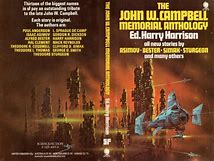
Poul Anderson's "Lodestar," which introduces the planet later called Mirkheim, was published in Astounding: The John W. Campbell Memorial Anthology, edited by Harry Harrison, in 1973. Anderson's novel, Mirkheim, was published in 1977. Thus, anyone who read these volumes as they were published read "Lodestar" before Mirkheim. However, those who read Anderson's collections and novels in their publication order find that "Lodestar" is collected in The Earth Book of Stormgate, published in 1978. It is appropriate, therefore, that, when the fictional editor, Hloch, introduces "Lodestar" in the Earth Book, he tells us that this story contains:

"...information that has long been concealed: how Nicholas van Rijn came to the world which today we know as Mirkheim."
-Poul Anderson, INTRODUCTION to "Lodestar" IN Anderson, David Falkayn: Star Trader (Riverdale, NY, March 2010), pp. 631-632 AT p. 631.

Neither Hloch's readers on Avalon nor many of Anderson's readers on Earth had read "Lodestar" before the publication of the Earth Book. Thus, this story can legitimately be introduced on a "now it can be told" basis.

Finally, in Baen Books' The Technic Civilization Saga (2009-2012), we read Anderson's entire History of Technic Civilization in chronological order of fictional events. Thus, "Lodestar" closes Volume II, David Falkayn: Star Trader (2010) whereas Mirkheim opens Volume III, Rise Of The Terran Empire (2011), although Hloch's introduction, reproduced like all other Earth Book introductions in the Saga, still refers to "...information that has long been concealed..."

I still like the idea of reading or rereading the Technic History in its original publication order.

Sunday, 3 December 2023

Individuals In History

Individuals live in historical contexts and history is made and recorded by individuals. Thus:

after the Babur War, Nicholas van Rijn and David Falkayn moved many data units from Earth to Hermes;

centuries later, Rennhi transferred the molecular patterns of these units to Avalon where they were deciphered shortly before the Terran War;

after that war, Hloch and Arinnian extracted from the data an account of the trade pioneer crew's mission to Merseia and reworked this account as a narrative that was published in The Earth Book of Stormgate.

Here, either explicitly or implicitly, are five historical events:

the Babur War, ended by van Rijn and Flandry
the League mission to Merseia, led by Flandry
the founding of Avalon by Flandry
the Terran War on Avalon
the publication of the Earth Book on Avalon

- and five individuals:

van Rijn
Falkayn
Rennhi
Hloch 
Arinnian

van Rijn and Falkayn are characters in the Polesotechnic League Tetralogy and in the Earth Book;
Arinnian is a character in The People of the Wind;
Rennhi and her son, Hloch, feature only in Hloch's Earth Book introductions.

Thus, an outstanding combo of historicity and individuality.

The Relevance Of SF

"Starfog."

Is futuristic sf relevant to the present? Yes, because it can show future consequences of present actions. The Time Machine shows the social classes of the late nineteenth century devolving into Morlocks and Eloi. 1984 shows dictatorial movements present in 1948 dominant in 1984. James Blish's and Norman L. Knight's A Torrent of Faces shows characters several centuries hence finding an obsolete artefact called an "ashtray" and attributing it to the Age of Waste. Characters in one of Asimov's Foundation novels express incredulity at the suggestion that nuclear explosions might ever have been caused deliberately as an act of war. Poul Anderson's "Starfog," includes the following dialogue. Daven Laure explains that:

Large-scale extraction of minerals from oceans would generate:

"'...so much heat that planetary temperature would be affected.'
"'That sounds farfetched.'
"'No. A simple calculation will prove it. According to historical records, Earth herself ran into the problem, and not terribly long after the industrial era began.'" (p. 790)

"According to historical records..." Thus, a future history series completed thirty-five years ago comments on Earth in 2020. The calculations, made decades ago, were ignored and are denied.
-copied from here.

Still relevant in 2023.

A Supernova And Its Place In History

By the end of "The Trouble Twisters," Nicholas van Rijn has founded his first trade pioneer crew and that crew has had its first mission. The narrative has brought together three already-established characters, van Rijn, David Falkayn and Adzel, and one Cynthian. Chee Lan had not appeared before but her home planet, Cynthia, had been mentioned twice. What happens next? The Technic History could stay with van Rijn, stay with the trader team, alternate between them or introduce new characters. Whatever else happens, the series will progress.

In The Technic Civilization Saga, Volume II, David Falkayn: Star Trader, "The Trouble Twisters" is followed by:

two pages of commentary by Hloch, editor of The Earth Book of Stormgate;

a two-and-a-half page account of a giant star that had been noted by a ship of the first Grand Survey and that goes supernova while a scoutship of the Polesotechnic League passes nearby.

Then, after all that, we join Falkayn on Merseia...

Saturday, 2 December 2023

A Pivotal Volume

Referring back to Baen Books' The Technic Civilization Saga, Volume II, David Falkayn: Star Trader, we are struck by how pivotal a volume it is -

"Territory": Nicholas van Rijn as in Volume I, The Van Rijn Method;

"The Trouble Twisters": van Rijn hands the action role over to the trader team, including David Falkayn and Adzel, both introduced in Volume I;

"Day of Burning": the trader team saves Merseia which will be important in Volumes IV-VII;

"The Master Key": what van Rijn meanwhile does back on Earth;

Satan's World: van Rijn and the trader team counteract an external threat to Technic civilization;

"A Little Knowledge": problems within that civilization;

"Lodestar": internal problems intensified cause a pivotal conflict between van Rijn and his team.

Volume III, of course, is even more pivotal, beginning with the Polesotechnic League and ending with the Terran Empire.

Stories contribute to the series but also are self-contained narratives, not episodes of a serial.

Falkayn And Laure On War

David Falkayn tells Morruchan Long-Ax, Hand of the Vach Dathyr, that the effects of a nearby supernova:

"'...will be like the aftermath of an all-out nuclear strike against a country with no civil defense. I gather you've avoided that on Merseia. But you certainly have theoretical studies of the subject, and - and I have seen planets where it did happen.'"
-Poul Anderson, "Day of Burning" IN Anderson, David Falkayn: Star Trader (Riverdale, NY, March 2010), pp. 209-272 AT p. 220.

Daven Laure tells Ozer Vandange:

"'The people of the Commonalty don't get into wars.'"
-"Starfog," p. 722.

However, when, on a planet in the Cloud Universe:

"The sun exploded.

"[Laure] was on his belly, faceplate buried in arms against the flash, before his conscious mind knew what had happened. Rangers learned about nuclear weapons. When, after a minute, no shock wave had hit him, no sound other than a rising wind, he dared sit up and look."
-ibid., p. 780.

The Rangers of the Commonalty do not experience wars but do explore the unknown and therefore go prepared, even to the extent of knowing how to respond in the case of a possible nuclear attack. That is good.

In an Anderson text, a rising wind signifies an approaching threat.

Diversity

"Starfog."

Jaccavrie reminds Laure of human diversity even:

"'...within the ambience of the Commonalty.'" (p. 775)

"'On Reith, for example, ordinary peaceful men can fall into literally murderous rages. It happens so often that violence under those circumstances is not a crime in their law.'" (p. 774)

Wasn't there a Star Trek like this? Vulcanians become irrational and violent when they are on heat. And, returning to the Technic History, we must remember what happens annually to the entire Gwydiona population.

"'A Talatto will be patient and cheerful in adversity, up to a certain point; after which he quits striving, contemplates his God, and waits to die.'" (ibid.)

On screen, we should see Reithian peacefulness followed by rage, then Talatto patience and cheerfulness followed by final contemplation. "Starfog" could become an extremely rich screen drama.

Although he has come to feel that everyone, including even Jaccavrie, is against him, Laure heeds her advice not to try to recontact Graydal until they have escaped from the stresses of their journey deeper into the Cloud Universe. He says that he does not know but clearly Jaccavrie's advice makes sense.

Moving In Different Directions

As we approach the end of "Starfog," we know that we also approach the end of Poul Anderson's Technic History and therefore will not be able to proceed any further into the future along this particular fictional timeline but we can move in other directions. "Starfog" is set at one edge of this galaxy. We can move out of the galaxy by switching to other fictional futures in Anderson's World Without Stars and Tau Zero or can move right out of this kind of universe by reverting to works of fantasy by Anderson and others. Right now, I am swamped by the works of several other writers and expect more at Christmas and also at birthday in January. We will probably extract a few more posts from the rich text of "Starfog" but right now I am finishing breakfast and preparing to walk into town for what have become some regular weekend activities. Back here later sometime.

Friday, 1 December 2023

Daven Laure's Reasons

"Starfog."

"'...you keep us on this barren search - why? For your own glory?'
"He should have explained then. But the strain and weariness snapped..." (p. 773)

He should have explained then. By discovering and exploring planets in the Cloud Universe cluster, Daven Laure establishes ownership for himself and the Kirkasanters which will mean immense wealth for them when miners of heavy metals swarm into the Cloud Universe and the miners will plant beacons that will enable the Kirkasanters to relocate their lost home planet in weeks.

Laure conceals his reasons until he has confirmed the abundance of heavy metals because he does not want to risk raising false hopes but surely the existence of heavy metals on many planets in the Cloud Universe is already assured? Poul Anderson wants to surprise his readers and wants Laure to surprise Graydal near the end of the story but surely this should have been said before then?

Similarly, we are told that Graydal should have said that she:

"...wished simply to hear his reasons. But being the descendant of hunters and soldiers, she clicked heels together and flung back at him: 'Very well, Ranger. I shall convey your words to my captain.'" (p. 774)

A human story against a cosmic background.

Interstellar Economy

"Starfog."

Daven Laure explains interstellar civilization:

"'We give a person freedom, within a loose framework of common-sense prohibitions. And then we protect his social aspect by frowning on greed, selfishness, callousness.'" (p. 770)

According to Laure, economic planning breaks down even for a single continent:

"'So we rely on the market, which operates as automatically as gravitation. Also as efficiently, as impersonally, and sometimes as ruthlessly - but we didn't make this universe. We only live in it.'" (p. 771)

Are markets efficient? They involve duplication, overproduction, waste and booms but also slumps. Defenders of markets reply: "They are more efficient than any alternative!" That still does not make them efficient. We not only live but also act in this universe. An economy is a very large number of human actions. As such, it is notoriously unpredictable, the precise opposite of mathematically predictable gravitation. Need an interstellar economy be ruthless? Technology should prevent starvation, at least.

Earlier in the Technic History, greed, selfishness and callousness, even if frowned on by governments and social institutions, wrecked the interstellar economy of the Polesotechnic League. How can the later civilizations prevent this from happening again?