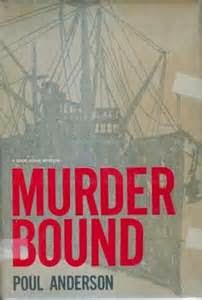
In Poul Anderson's detective novel Murder Bound (New York, 1962), another sfnal (science fictional) passage:
"He had a weird sense of distortion, as if he had come back from another universe, where suns were black and cold pulsed from them and time ran uphill toward the past." (p. 163)
That could be the setting of another novel. By entering the black sun universe, somehow surviving there for a year, then returning to the home universe, a character might emerge a year in the past?
Also, two more fantasy passages. First:
"He...thought about Grettir the Strong, who had destroyed a draug in single combat. That was eight or nine hundred years ago..." (p. 168)
Grettir sounds like yet another legendary hero whom Anderson could have adapted as the hero a fantasy novel.
Secondly:
"Wednesday...Odin's day. The old one-eyed chief of the Norse gods. But he was a sinister figure, with his wolves and ravens. He made the first witchcraft in the world. Human sacrifices were given to him. At night he rode through the sky with all the dead galloping after him. He's the Wild Huntsman, you see." (p. 173)
This passage is in the past tense, except for the last sentence. Myths are simultaneously long ago and always now. The authentic Odin as described here is, of course, an active participant in several of Anderson's fantasy novels.In my teens, I read what was effectively a Christianized retelling of the Norse myths. Human sacrifice was not mentioned. Odin and Thor were presented as benign protectors of humanity from the personified hostile elements. After I have published this post, I will copy a post on Voluspa from another blog.
Murder Bound also characterizes Thor:
"Thursday comes next. Red-bearded Thor, the thunder god. He was a much pleasanter sort. The common people liked him best. That's why so many Norse names begin with 'Tor.' He gave rain to the fields. And he fought the giants and trolls. Thursday is a good day." (ibid.)
In the North of England, we live in the former "Danelaw" and still have place names incorporating "Thor."
Monday, 13 January 2014
Friday, 10 January 2014
Environmentalism?
In Poul Anderson's Murder Bound (New York, 1962), how does the private detective, Trygve Yamamura, deduce that the Norwegian sailor, Arne Torvald, is a Communist? There are several clues. One is Torvald's "'...environmentalism...'" (p. 103) Concern for the environment? No, his belief that mental illness is caused by the environment, not by heredity (p. 79).
Interesting use of the word "environmentalism." Was it used widely in that sense before it gained its more familiar meaning of concern about ecology, pollution etc?
Yamamura, on the track of a possible murderer, has to be concerned about where Torvald sneaks off to on his shore leave. He lies, presents a cover story, changes buses, goes into a bar and out the back to shake any tails etc. If not murder, then he could be engaged in espionage or sabotage. By a process of elimination, Yamamura deduces an innocent explanation and, in the process, gives us yet another Andersonian moment of realization (when our hero has solved the problem but does not yet tell us the solution):
"The time he blew up and attacked me was -
"Yamamura slumped bonelessly. 'Good Lord!' he said aloud." (p. 144)
Then, consulting maps and memory, he works out where to look for Torvald.
Interesting use of the word "environmentalism." Was it used widely in that sense before it gained its more familiar meaning of concern about ecology, pollution etc?
Yamamura, on the track of a possible murderer, has to be concerned about where Torvald sneaks off to on his shore leave. He lies, presents a cover story, changes buses, goes into a bar and out the back to shake any tails etc. If not murder, then he could be engaged in espionage or sabotage. By a process of elimination, Yamamura deduces an innocent explanation and, in the process, gives us yet another Andersonian moment of realization (when our hero has solved the problem but does not yet tell us the solution):
"The time he blew up and attacked me was -
"Yamamura slumped bonelessly. 'Good Lord!' he said aloud." (p. 144)
Then, consulting maps and memory, he works out where to look for Torvald.
Murder Bound, Continued
One draug walks in Poul Anderson's historical fantasy short story, "The Tale of Hauk." Another seems to walk in his San Francisco-based detective novel, Murder Bound (New York, 1962). In the latter work, a Norwegian sailor imagines a drowned body clinging to the keel of a ship in the harbor and coming ashore by night... Thus, this detective novel refers both to the astronomical universe, which is the setting of much of Anderson's sf, and to Norse mythology, which is the background of several of his works of fantasy.
I was right about one of the sailors being a Communist but that was an easy deduction because his politics were obvious from his dialogue. However, this man's secret activities do not include spying. Instead, he clandestinely visits his mentally retarded daughter who, despite his atheism, he has placed in the care of a convent, concealing her very existence from his colleagues, his comrades and even his second wife. (In this respect, he fortuitously resembles "Karla," the Russian adversary of John Le Carre's Smiley.) So far, this makes him a good man, although misguided, but I do not yet know whether he will turn out to be guilty of murder or attempted murder.
Thursday, 9 January 2014
Detective Novels
that the gangster who has tried to intimidate Yamamura had been supplying homosexual prostitution to the disappeared man;
that the reticent, Russian-learning, anti-Nazi suspect will turn out to be a Communist.
But why did the disappeared man give himself away as a Nazi collaborationist just before the fracas that led to his disappearance? And why has one of the witnesses been "haunted" by an axe-wielding figure in his hotel room? I confidently expect never to answer these questions before Yamamura elucidates them in the final chapter.
Anderson conveys the sense of a mystery at sea and also something of the ethos of the sailors' country, Norway.
Cosmic And Historical Perspectives
In Poul Anderson's detective novel, Murder Bound (New York, 1962), the cosmic perspective, already noted, continues:
"So thin is the air that our unaided eyes can see a wisp at night which is a sister galaxy, two million light years remote." (p. 48)
That is the Andromeda Nebula already mentioned by name on p. 28. This time, however, Anderson, through his viewpoint character, Yamamura, goes on to present two other scientific perspectives:
"But the sea tides are ponderous enough to slow the spinning of the planet. The sea depths are eternal enough to shelter species that were ancient before the dinosaurs walked." (ibid.)
- knowledge of tidal friction and of dinosaurs. Yamamura concludes:
"...however queer a cosmos this was, you must live in it minute by minute." (ibid.)
How many fictional private detectives reflect on their place in the cosmos? This recalls Anderson's time traveling character, Manson Everard, reflecting that he does not understand the universe; he just works here.
In addition to such cosmological reflections, there is also a historical dimension. Published in 1962, the novel is set long enough ago for its characters still to have vivid memories of their World War II experiences. Pp. 38-40 present an unexpected flashback to interrogation by the Gestapo.
"So thin is the air that our unaided eyes can see a wisp at night which is a sister galaxy, two million light years remote." (p. 48)
That is the Andromeda Nebula already mentioned by name on p. 28. This time, however, Anderson, through his viewpoint character, Yamamura, goes on to present two other scientific perspectives:
"But the sea tides are ponderous enough to slow the spinning of the planet. The sea depths are eternal enough to shelter species that were ancient before the dinosaurs walked." (ibid.)
- knowledge of tidal friction and of dinosaurs. Yamamura concludes:
"...however queer a cosmos this was, you must live in it minute by minute." (ibid.)
How many fictional private detectives reflect on their place in the cosmos? This recalls Anderson's time traveling character, Manson Everard, reflecting that he does not understand the universe; he just works here.
In addition to such cosmological reflections, there is also a historical dimension. Published in 1962, the novel is set long enough ago for its characters still to have vivid memories of their World War II experiences. Pp. 38-40 present an unexpected flashback to interrogation by the Gestapo.
Wednesday, 8 January 2014
Murder Bound, Chapters I-III
In another night time scene:
"His cigarette end made a tiny red Cepheid star, waxing and waning..." (p. 2)
Some readers might have to google "Cepheid star"?
Secondly:
"A stunning photograph of the Andromeda Nebula dominated the room." (p. 28)
Many years later, artificial intelligences traveling at sub-light speeds approach the Andromeda in Anderson's late hard sf novel, Genesis, whose title expresses a new beginning long after the extinction of humanity.
In Chapter II, there is a fascinating summary of a tramp ship's round the world voyage:
from Oslo with electrical machinery and matches to Ceylon;
from Ceylon with rubber to Rangoon;
from Rangoon with rice and teak to Hong Kong;
from Hong Kong with cement to Yokohama;
from Yokohama with textiles and ceramics to San Francisco;
from San Francisco with lumbering equipment to Oslo.
Not every cargo mentioned is delivered to every destination mentioned but this is as much as I could glean from the captain's brief account to Yamamura, who is investigating a death or disappearance on the ship. Since the disappeared man, a suspected Nazi collaborator, fought three others while wielding an axe before falling overboard, it is disconcerting for one of the three when, later, he is attacked by an axe-wielding figure in his hotel room. Without going to look it up at this late hour, I remember a similar night attack scene with the missing Samurai sword in the first novel?
Onward!
OK, folks. I have:
read two Iain M Banks Culture novels and posted on the Science Fiction blog;
watched a Smallville episode and posted on the Comics Appreciation blog;
reread a volume of The League Of Extraordinary Gentlemen and posted on Comics Appreciation.
Now it is time to tackle Poul Anderson's Murder Bound (New York, 1962), a Cock Robin Mystery from MacMillan. My copy is a first printing so it is exactly fifty two years old. The text starts on page 1 and ends on p. 198. There are no blank pages between any of the XXI chapters, each chapter begins on the page where the previous chapter had ended, not on the following page, and there are no illustrations. Thus, there really are 198 pages of text to be read.
Glancing through the book, I spotted one reference to a character called van Rijn.
The blurb inside the dust jacket refers to "...natural and seemingly supernatural forces..." This is the third Trygve Yamamura novel. I have read the first Yamamura novel and can read a description of the second on the back of this dust jacket. Thus, I gather that all three novels are united not only by their central character and by their San Francisco setting but also by references to the "...seemingly supernatural..." - whereas the single Yamamura short story goes further because it involves an actual ghost telephone call.
read two Iain M Banks Culture novels and posted on the Science Fiction blog;
watched a Smallville episode and posted on the Comics Appreciation blog;
reread a volume of The League Of Extraordinary Gentlemen and posted on Comics Appreciation.
Now it is time to tackle Poul Anderson's Murder Bound (New York, 1962), a Cock Robin Mystery from MacMillan. My copy is a first printing so it is exactly fifty two years old. The text starts on page 1 and ends on p. 198. There are no blank pages between any of the XXI chapters, each chapter begins on the page where the previous chapter had ended, not on the following page, and there are no illustrations. Thus, there really are 198 pages of text to be read.
Glancing through the book, I spotted one reference to a character called van Rijn.
The blurb inside the dust jacket refers to "...natural and seemingly supernatural forces..." This is the third Trygve Yamamura novel. I have read the first Yamamura novel and can read a description of the second on the back of this dust jacket. Thus, I gather that all three novels are united not only by their central character and by their San Francisco setting but also by references to the "...seemingly supernatural..." - whereas the single Yamamura short story goes further because it involves an actual ghost telephone call.
Tuesday, 7 January 2014
Schedule
Provisional schedule
Finish reading Iain Banks' second Culture novel;
before starting the third Culture novel, start reading Poul Anderson's Star Prince Charlie or Murder Bound - having read neither before;
scan through the Poul Anderson collections in my possession for any remaining stories that I have not read or not reread recently;
hopefully get a copy of Multiverse, the anthology about Poul Anderson;
decide whether to attend the World SF Con in London this August - possible contact with other Anderson, Blish, Gaiman etc fans versus practical problems to do with staying in London for a long weekend?
As ever, any comments or suggestions would be welcome...
Finish reading Iain Banks' second Culture novel;
before starting the third Culture novel, start reading Poul Anderson's Star Prince Charlie or Murder Bound - having read neither before;
scan through the Poul Anderson collections in my possession for any remaining stories that I have not read or not reread recently;
hopefully get a copy of Multiverse, the anthology about Poul Anderson;
decide whether to attend the World SF Con in London this August - possible contact with other Anderson, Blish, Gaiman etc fans versus practical problems to do with staying in London for a long weekend?
As ever, any comments or suggestions would be welcome...
Thursday, 2 January 2014
Murder Bound And Other Works
Is this good news? Yesterday, as a birthday present, I received a second hand copy of Poul Anderson's Murder Bound (see attached image), signed by the author. This will be another of those by now rare occasions when I read a work by Anderson for the first time before blogging about it instead of rereading before blogging.
However, this will not happen immediately. Several very different books and two boxes of DVD's have arrived as Christmas or birthday presents and meanwhile I have also been diverted into reading a volume by Richard Dawkins belonging to another family member.
Back to comparing Iain Banks with Anderson:
in Banks' first Culture novel, a human species whose members can change their appearance to impersonate others was artificially generated for espionage purposes, as happened in Anderson's The War Of Two Worlds;
Anderson imagined (i) interstellar civilizations and (ii) civilizations producing abundant wealth for every individual. Banks' Culture is both (i) and (ii). Everyone has access to everything so that money and economic competition are redundant. Imperialism is an archaic form of social organization usually transcended before a species achieves faster than light travel which, of course, is necessary for any interstellar imperialism although, as we might expect, the Culture wages war against a religious imperialism in volume I and encounters another interstellar empire in the Lesser Magellanic Cloud in volume II.
It will be interesting to see how the author sustains such a series over so many volumes. Already, volumes I and II, despite their common background, present entirely dissimilar aspects of Culture society.
However, this will not happen immediately. Several very different books and two boxes of DVD's have arrived as Christmas or birthday presents and meanwhile I have also been diverted into reading a volume by Richard Dawkins belonging to another family member.
Back to comparing Iain Banks with Anderson:
in Banks' first Culture novel, a human species whose members can change their appearance to impersonate others was artificially generated for espionage purposes, as happened in Anderson's The War Of Two Worlds;
Anderson imagined (i) interstellar civilizations and (ii) civilizations producing abundant wealth for every individual. Banks' Culture is both (i) and (ii). Everyone has access to everything so that money and economic competition are redundant. Imperialism is an archaic form of social organization usually transcended before a species achieves faster than light travel which, of course, is necessary for any interstellar imperialism although, as we might expect, the Culture wages war against a religious imperialism in volume I and encounters another interstellar empire in the Lesser Magellanic Cloud in volume II.
It will be interesting to see how the author sustains such a series over so many volumes. Already, volumes I and II, despite their common background, present entirely dissimilar aspects of Culture society.
Wednesday, 1 January 2014
New Comparisons
Happy New Year, Poul Anderson fans. Thank you for continued page views during a period of blog quiescence. I have continued to post about Neil Gaiman's The Sandman on Comics Appreciation and have found three more Anderson-Gaiman parallels:
fairy gold;
Faerie withdrawal with the rise of science;
dialogue written in blank verse.
(I have just remembered one other: quotations from poems by James Elroy Flecker.)
Meanwhile, my daughter has given me the first three volumes of Iain M. Banks' Culture sf series. Previously on this blog, I have discussed:
HG Wells;
Olaf Stapledon;
CS Lewis;
Robert Heinlein;
Isaac Asimov;
James Blish;
Larry Niven
- in order to compare them with Anderson. I am less familiar with more recent sf but Banks might now join the list of comparisons.
Banks wrote contemporary novels as Iain Banks, then started his long sf series as Iain M Banks. The first Culture novel, Consider Phlebas, like James Blish's After Such Knowledge Trilogy, derives its title from a short phrase in TS Eliot's The Waste Land. Banks' interstellar society is in some ways similar to the one presented in Douglas Adams' A Hitchhiker's Guide To The Galaxy.
When Wells wrote his "fantastic and imaginative romances," many by now familiar ideas were still new:
heavier than air flight;
tanks;
heat rays;
poison gas;
world wars;
interplanetary projectiles;
antigravity;
time travel.
Since then, many later ideas have become all too familiar background material in much sf:
hyperdrives - that cannot be activated too deep in a gravity well;
artificial gravity;
interstellar civilizations - waging wars;
humanoid beings on many extrasolar planets;
telepathy;
artificial intelligence.
Banks had clearly mastered all these later ideas before starting to write Consider Phlebas. He adds the questionable idea of "human" species on many planets, apparently resulting from parallel evolution.
Anderson deploys the second list of concepts brilliantly in his History of Technic Civilization, where the quality of his writing overcomes conceptual cliches. I am currently assessing Banks by the same criteria.
fairy gold;
Faerie withdrawal with the rise of science;
dialogue written in blank verse.
(I have just remembered one other: quotations from poems by James Elroy Flecker.)
Meanwhile, my daughter has given me the first three volumes of Iain M. Banks' Culture sf series. Previously on this blog, I have discussed:
HG Wells;
Olaf Stapledon;
CS Lewis;
Robert Heinlein;
Isaac Asimov;
James Blish;
Larry Niven
- in order to compare them with Anderson. I am less familiar with more recent sf but Banks might now join the list of comparisons.
Banks wrote contemporary novels as Iain Banks, then started his long sf series as Iain M Banks. The first Culture novel, Consider Phlebas, like James Blish's After Such Knowledge Trilogy, derives its title from a short phrase in TS Eliot's The Waste Land. Banks' interstellar society is in some ways similar to the one presented in Douglas Adams' A Hitchhiker's Guide To The Galaxy.
When Wells wrote his "fantastic and imaginative romances," many by now familiar ideas were still new:
heavier than air flight;
tanks;
heat rays;
poison gas;
world wars;
interplanetary projectiles;
antigravity;
time travel.
Since then, many later ideas have become all too familiar background material in much sf:
hyperdrives - that cannot be activated too deep in a gravity well;
artificial gravity;
interstellar civilizations - waging wars;
humanoid beings on many extrasolar planets;
telepathy;
artificial intelligence.
Banks had clearly mastered all these later ideas before starting to write Consider Phlebas. He adds the questionable idea of "human" species on many planets, apparently resulting from parallel evolution.
Anderson deploys the second list of concepts brilliantly in his History of Technic Civilization, where the quality of his writing overcomes conceptual cliches. I am currently assessing Banks by the same criteria.
Subscribe to:
Posts (Atom)