Showing posts with label Trygve Yamamura. Show all posts

Monday, 1 June 2015

The Trygve Yamamura Series

Anthony Boucher persuaded sf authors to write mysteries. Poul Anderson writes:

"The result for me was three novels and several short stories. The hero of most was Trygve Yamamura..."
-Poul Anderson, Going For Infinity (New York, 2002), p. 296.

I had thought that Anderson wrote the three Yamamura novels and co-wrote with Karen Anderson just one Yamamura short story. However, Anderson's phrase "The hero of most..." seems to imply that Yamamura was the hero of more than one of the short stories? See the comment on this recent post.

So is the Trygve Yamamura series longer than some of us thought? Someone out there must know. Googling discloses this list which however confirms my earlier idea of the extent of the series.

Tuesday, 10 June 2014

Comparisons

Every writer worth reading has a distinctive style and distinctive strengths. Comparisons are inevitable because similar themes are addressed. However, comparisons also show contrasts. They do not reduce one author to a copy of another, especially when the creators in question were not necessarily aware of each others' works.

I mention this because I am able to continue a sequence of comparisons initiated in a recent post:

dead bodies walk and attack the living at night in "The Tale of Hauk" by Poul Anderson and in The Alchemist's Revenge by Peter Cakebread;

Anderson wrote a trilogy about a detective based in contemporary San Francisco whereas Cakebread has more recently written a novel about two detectives based in the Victorian seaside town of Morecambe!

My wife, Sheila, a fan of detective fiction, is reading The Morecambe Medium while I am still reading The Alchemist's Revenge (to be interrupted by attending a Latin class today). I have visited San Francisco only in works of fiction whereas Morecambe is part of Lancaster City District where Peter, Ken, Sheila and I live - I expect to visit the fictional Victorian Morecambe shortly.

So Anderson and Cakebread have in common:

historical fantasy set during the English Civil War;
detective fiction that, in both cases, happens to be set in a city by the sea.

Despite all these parallels, Anderson fans who check out Cakebread will find that he has a distinctive voice and is worth hearing in his own right.

Tuesday, 14 January 2014

Yamamura's Religion

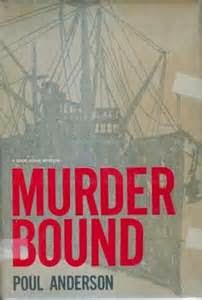
In Poul Anderson's Murder Bound (New York, 1962):

"Yamamura smiled, 'I'm a lousy Buddhist.'" (p. 100)

So he is at least nominally a Buddhist.

"...he felt evil like a physical radiation. And that shook him, for his religion did not admit the existence of absolute malignancy." (p. 158)

So he does take his religion seriously.

This gives me some empathy with the character. I am not an ordained lay Buddhist but Buddhism is the religious tradition with which I have least disagreements. Insofar as a religion is a practice, my religion is Zen because I practice zazen as taught in a local Buddhist group. I do not accept the rebirth teaching but that is a philosophical disagreement between me and the Buddha. Possibly influenced by ancient Indian materialist philosophers, he taught anatta, "no soul," and therefore amended reincarnation of souls to "rebirth" of karmic effects but I go further in disagreeing with rebirth as well. However, karma (action) and its consequences are undeniable features of life and history.

The Buddha was a man, not a god, and, mythologically, was a teacher of gods and men. His dharma is neither an academic philosophy nor a theistic religion but a practical philosophy and a contemplative religion. Here, I am on the same wavelength as Trygve Yamamura.

Wednesday, 8 January 2014

Murder Bound, Chapters I-III


In Poul Anderson's first Trygve Yamamura novel, the central character looks up at the stars, as real people and literary characters have ever done, but also thinks about the planets of those stars, thus applying a modern scientific knowledge of the universe. Anderson displays the scientific knowledge and cosmic perspective of a physics graduate and hard sf writer even more overtly twice in the opening chapters of the third Yamamura novel, Murder Bound (New York, 1962).

In another night time scene:

"His cigarette end made a tiny red Cepheid star, waxing and waning..." (p. 2)

Some readers might have to google "Cepheid star"?

Secondly:

"A stunning photograph of the Andromeda Nebula dominated the room." (p. 28)

Many years later, artificial intelligences traveling at sub-light speeds approach the Andromeda in Anderson's late hard sf novel, Genesis, whose title expresses a new beginning long after the extinction of humanity.

In Chapter II, there is a fascinating summary of a tramp ship's round the world voyage:

from Oslo with electrical machinery and matches to Ceylon;
from Ceylon with rubber to Rangoon;
from Rangoon with rice and teak to Hong Kong;
from Hong Kong with cement to Yokohama;
from Yokohama with textiles and ceramics to San Francisco;
from San Francisco with lumbering equipment to Oslo.

Not every cargo mentioned is delivered to every destination mentioned but this is as much as I could glean from the captain's brief account to Yamamura, who is investigating a death or disappearance on the ship. Since the disappeared man, a suspected Nazi collaborator, fought three others while wielding an axe before falling overboard, it is disconcerting for one of the three when, later, he is attacked by an axe-wielding figure in his hotel room. Without going to look it up at this late hour, I remember a similar night attack scene with the missing Samurai sword in the first novel?

Onward!

OK, folks. I have:

read two Iain M Banks Culture novels and posted on the Science Fiction blog;
watched a Smallville episode and posted on the Comics Appreciation blog;
reread a volume of The League Of Extraordinary Gentlemen and posted on Comics Appreciation.

Now it is time to tackle Poul Anderson's Murder Bound (New York, 1962), a Cock Robin Mystery from MacMillan. My copy is a first printing so it is exactly fifty two years old. The text starts on page 1 and ends on p. 198. There are no blank pages between any of the XXI chapters, each chapter begins on the page where the previous chapter had ended, not on the following page, and there are no illustrations. Thus, there really are 198 pages of text to be read.

Glancing through the book, I spotted one reference to a character called van Rijn.

The blurb inside the dust jacket refers to "...natural and seemingly supernatural forces..." This is the third Trygve Yamamura novel. I have read the first Yamamura novel and can read a description of the second on the back of this dust jacket. Thus, I gather that all three novels are united not only by their central character and by their San Francisco setting but also by references to the "...seemingly supernatural..." - whereas the single Yamamura short story goes further because it involves an actual ghost telephone call.