Showing posts sorted by date for query Three Worlds To Conquer. Sort by relevance Show all posts

Thursday, 23 July 2026

Solar Planets In The Pulps And Later In Heinlein, Asimov, Blish, Anderson And Stirling

Follow the link from "Northwest Smith " in Planetary Adventurers.

Ninety years ago, pulp sf writers treated the Solar System like a galaxy of inhabited planets with breathable atmospheres and even jungles on moons of Jupiter. Such an approach even affected Robert Heinlein's Future History although that series is primarily about the future development of human society, not about human-alien interactions. Isaac Asimov admitted in The Early Asimov that he wrote in this tradition even when he knew better.

We can see later writers emerging from the tradition. In James Blish's Cities In Flight and Mission To The Heart Stars, Martians had existed but are now extinct. Poul Anderson has half a dozen versions of Martians. There are Martians in his Psychotechnic History and in the original version of his "Margin of Profit" although, when that story was revised to fit into his Technic History, these "Martians" had become extra-Solars who had colonized Mars. Anderson also has Venerians in "Sister Planet," Jovians in Three Worlds To Conquer and Mercurians in "Life Cycle." 

When SM Stirling wrote a series in which Mars and Venus turned out to be more or less how earlier sf writers had imagined them, he also worked towards an explanation. A scientist working on Venus says:

"'Sam thinks...and I think...that two hundred million years ago, in the earliest Jurassic...this planet was different. Radically different from what we have now; as far as we can tell, it didn't have life at all. And we don't have any idea what changed it.'"
-SM Stirling, The Sky People (New York, October 2007), CHAPTER TWO, pp. 40-41.

But they will find out.

Tuesday, 13 January 2026

The Outer Solar System

Colonizing The Outer Solar System By Terraforming, Adaptation Or Domes
Last And First Men by Olaf Stapledon
Farmer In The Sky by Robert Heinlein 
Three Worlds To Conquer and Twilight World by Poul Anderson
The Seedling Stars by James Blish
Imperial Earth by Arthur C. Clarke

Exploring The Jovian Surface
"Skeleton Men of Jupiter" by Edgar Rice Burroughs (John Carter)
"Desertion" by Clifford Simak (City)
"Bridge" by James Blish (Cities In Flight)
"Call Me Joe" by Poul Anderson (a one-off)

ERBian physics make it possible for human beings to live on Jupiter.

We are pleased to find our man, Anderson, three times on two lists.

Quick breakfast post before visiting the lurker above the Old Pier Bookshop.

Monday, 26 May 2025

Alien Sexes

In Poul Anderson's Three Worlds To Conquer
Jovians have three sexes: male, demimale and female.

In Anderson's Technic History
Merseian females are entirely subordinate. We never see them.

Kraokan have male, transmitter and female.

Cynthian females carry the young through the trees and therefore are stronger.

Ythrian males and females both carry their young in flight and are equal.

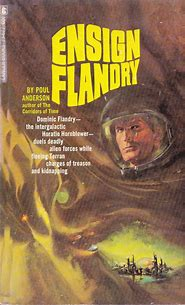
Tigery infants suck not milk but blood from their mothers' breasts. Terrans speculate that the need for a high blood supply is what makes Tigery females more vigorous and therefore dominant in most Tigery cultures. (The attached Ensign Flandry cover image shows Dominic Flandry standing beside the Tigery female, Dragoika.)

It is good to know that they are not all just human beings with differently shaped heads.

See also here.

Sunday, 27 August 2023

On Babur

Mirkheim, V.

Babur is much bigger than Earth but its seas are smaller because:

"Ammonia is less plentiful than water." (p. 91)

Continents are enormous and their interiors arid with sparse black vegetation, glittering dust and no habitation. The metallic core is surrounded by strata of rock and ice, the latter hot, compressed and liable to explode when the pressure eases. Lands sink. Others, newly upheaved, shudder with quakes and are not immediately touched by life. Houses of ice are anchored against storms. Cities cannot grow high and must spread wide. Buildings are aerodynamic. Spaceships, unsafe on the surface, must touch down in silos. Nice place. Sounds more like Hell. In terms of human habitability, Babur is intermediate between Earth and Jupiter and maybe corresponds to older ideas of Jupiter, as in Poul Anderson's Three Worlds To Conquer? That Jupiter still had a solid surface and a distinction between globe and atmosphere whereas the more recently understood Jupiter, as shown in Anderson's "Hunters of the Sky Cave," is composed of deeper layers of turbulent gas all the way down to a dense core.

Saturday, 5 August 2023

Four Themes And Six Authors

I need hardly repeat that my favourite two kinds of sf are time travel, provided that it is presented consistently, and future histories. I suppose that the third major sf theme is space travel with alien invasions of Earth as a specific sub-theme. HG Wells, Olaf Stapledon and Poul Anderson all describe Martian invasions of Earth although Anderson also presents extra-solar economic invasion in "Soldier From The Stars," where militarily superior humanoid aliens do not conquer Earth but sell their services to the highest bidder among Terrestrial governments and are paid in Terrestrial currencies...

The four themes of space travel, time travel, alien invasion and future history provide a template for comparing three British authors and three Campbell future historians. Thus, Wells wrote:

The First Men in The Moon
The Time Machine (travel through the whole future of life on Earth)
The War Of The Worlds
The Shape of Things to Come (a future historical turning point)

Stapledon incorporated space travel, time travel and Martian invasion into Last And First Men, a history of the entire future of mankind, then wrote a cosmic history, Star Maker.

CS Lewis wrote:

Out Of The Silent Planet (travel to Mars)
"The Dark Tower" (inadequate discussion of time travel)
Perelandra (Terrestrial evil invading sinless Venus)
That Hideous Strength (reply to Wells' and Stapledon's future histories)

Robert Heinlein wrote:

three "first men in the Moon" stories
three circular causality paradox stories
The Puppet Masters
the Future History

James Blish wrote:

Welcome To Mars
"The City That Was The World"
VOR
Cities In Flight, The Seedling Stars and the Haertel Scholium

Poul Anderson wrote:

Well, we all know what Poul Anderson wrote

Saturday, 11 February 2023

Aliens At Home

How often do two or more intelligent species originate on a single planet?  This happens in:

JRR Tolkien's Middle Earth
CS Lewis' Narnia (although the world of Narnia is not a planet)
Lewis' Malacandra (his version of Mars)
Poul Anderson's Jupiter in Three Worlds To Conquer
Anderson's Starkad in his Technic History

"'...their host is immense, and not even of our race. Two different breeds of thinking animal have met.'"
-Poul Anderson, Three Worlds To Conquer (London, 1966), 2, p. 19.

Those two land-dwelling species are of the same genus but there is also a rational species of another genus at a higher atmospheric level.

On Starkad, land and sea dwellers are natural enemies like men and wolves on Earth.

Malacandrians do not keep pets because, of the three species:

"Each of them is to the others both what a man is to us and what an animal is to us."
-CS Lewis, Out Of The Silent Planet IN Lewis, The Cosmic Trilogy (London, 1990), pp. 1-144 AT Postscript, p. 140.

Narnians include human beings, Talking Beasts, dwarfs etc. Lewis gets the same effect among his Martians.

Thursday, 26 January 2023

Ganymede

"Heinlein seems to have a particular fondness for Ganymede: one of the young fellows in Space Cadet was a Ganymedean colonist, the hero of Between Planets was born in a ship that was on its way to Ganymede; Farmer in the Sky is about the settling of Ganymede."
-Alexei Panshin, Heinlein In Dimension (Chicago, 1968), III, 5, p. 58.

(Space Cadet and Farmer in the Sky, but not Between Planets, belong in Heinlein's Juvenile Future History together with Red Planet, The Rolling Stones and Time For The Stars.)

In James Blish's The Seedling Stars, Ganymede is not terraformed but colonized by Adapted Men.

In Poul Anderson's Three Worlds To Conquer, there is a Ganymedean base for communication with Jovians. In Anderson's Flandry series, there is a Ganymedean base for visits to Jupiter. In Anderson's Psychotechnic History, Planetary Engineers survey Ganymede to determine whether it can be terraformed. In Anderson's Twilight World, Epilogue, Ganymede is being terraformed.

Another parallel with Blish is that, in Twilight World, Homo Superior will restore the Terrestrial ecology and, in The Seedling Stars, Adapted Men will recolonize Earth.

A Planetary Engineer says that the Uranian moons are too far away to colonize yet, in Olaf Stapledon's Last And First Men, a later human species colonizes Neptune albeit in a changed Solar System.

See previous blog references to Ganymede. (Scroll down.)

Monday, 19 September 2022

Jupiter

In Poul Anderson's Three Worlds To Conquer, Jupiter has a solid surface and ammonia oceans like Babur and T'Kela. See here. In Anderson's A Stone In Heaven, there is a more up-to-date description:

"Jupiter...is primarily liquid, beneath a vast atmosphere; a slag of light metal compounds does float about in continent-sized pieces, but most solid material is at the core (if it can be called solid, under that pressure). The slow downdrift of matter, drawn by the gravity of the stupendous mass, releases energy; Jupiter radiates about twice what it receives from Sol, making the surface warm." (VI, pp. 67-68)

My other favourite sf writer, James Blish, coined the term, "gas giant." From this phrase and from reading Blish's They Shall Have Stars, I had gained the impression that, on a Jovoid planet, the atmosphere just became denser and denser all the way down to a super-solid core. The Wikipedia article says that most Jovian matter is in a state where there is no distinction between liquids and gasses which is an even clearer description of what I had thought.

Monday, 15 November 2021

On Jupiter

In Poul Anderson's Three Worlds To Conquer, "Call Me Joe" and "Hunters of the Sky Cave," Jupiter has, under its turbulent atmosphere, a solid surface that suitably adapted bodies can walk around on. I have got the impression that gas giant planets (so named by James Blish: see here) are not really like that, that instead the atmosphere of such a planet increases in density all the way down to a solid core. The Wikipedia article (see the above link) seems to confirm this:

Other than solids in the core and the upper layers of the atmosphere, all matter is above the critical point, where there is no distinction between liquids and gases.[8] 

"The planet did not even have a 'surface' in the usual sense; instead, the bottom of the atmosphere merged more or less smoothly into a high-pressure sludge, which in turn thickened as it went deeper into solid pressure-ice. At no point on the way down was there any interface between one layer and another, except in the rare areas where a part of the deeper, more 'solid' medium had been thrust far up out of its normal level to form a continent which might last as long as two years or two hundred."
-James Blish, They Shall Have Stars IN Blish, Cities In Flight (London, 1981), 7-129 AT CHAPTER EIGHT, p. 93.

Sunday, 21 February 2021

What To Do With Your Six Limbs

As a generalization, quadrupeds evolve into bipeds and hexapods into quadrupeds but there are other possibilities.

In The Technic History
Wodenites
Donarrians
Ferrans
Gorzuni (see combox)
Diomedeans (wings, arms and legs)

a centauroid
a being with wings, arms and legs
 
In After Doomsday
 
In Three Worlds To Conquer
Jovians
 
In Fire Time
Ishtarians
 
In "Horse Trader"
a centauroid
 
In ERB's John Carter Series
green Martians
 
IIRC, green Martians can use their middle set of limbs as either arms or legs. So could they charge into battle like centaurs? They are never described as doing that. Can Anderson's Ferrans do likewise?

Friday, 29 January 2021

No Answer

A Stone In Heaven, VIII.

Part of the experience of praying is not receiving an answer.

"'Where are you out there? Why do you not answer? What has happened?'"
-Poul Anderson, Three Worlds To Conquer (London, 1966), 3..., p. 29.
 
"'You know, too, that I am intimate with the chieftain of the star-folk, Banner herself.' Oath-sister, where are you? You promised you would join me.'" (pp. 138-139)
 
Fortunately, in the latter case, Yewwl is soon answered:
 
"She broke off. The voice was in her.
"'Yewwl, are you awake? Do you want me? Good.'" (p. 139)
 
I will be very interested if some day one of my gods responds like that.

Monday, 1 June 2020

Space Travel

In sf, space travel is interplanetary, interstellar or, rarely, intergalactic. Extra-solar travel is usually, not always, FTL (faster than light).

Poul Anderson's works cover every option.

Interplanetary
Twilight World
The War Of Two Worlds
Shield
Three Worlds To Conquer
Tales Of The Flying Mountains: stories
Orion Shall Rise
The Technic History: "The Saturn Game"

Interplanetary and STL Interstellar
The Psychotechnic History: "Marius" to "Brake"
Genesis
The Boat Of A Million Years, XIX, Thule

STL Interstellar
Tales Of The Flying Mountains: Prologue; Interludes; Epilogue
The Byworlder
The Kith, Rustum, Directorate and Harvest Of Stars future histories

FTL Interstellar
Brain Wave
The Psychotechnic History: "Gypsy" to "The Chapter Ends"
The Technic History: "Wings of Victory" to "Starfog"
The Long Way Home
After Doomsday
The High Crusade
The Star Fox and Fire Time
Planet Of No Return
The Enemy Stars
The Hoka series (with Gordon R. Dickson)

STL Intergalactic and Intercosmic
Tau Zero

FTL Intergalactic
World Without Stars
The Avatar

Time Travel and Space Travel
The Time Patrol series and two time travel novels refer to future space travel but focus on time travel through history.

Thursday, 9 April 2020

Red Sun On Venus

"The Big Rain," II.

"The sun was down on a ragged horizon, dimly visible as a huge blood-red disk..." (p. 171)

I thought that a common feature of all pre-probe versions of Venus was that the heavy clouds concealed all heavenly bodies - but not in this case.

In Poul Anderson's Technic History, Venus has been incompletely terraformed but we are not told what it was like before that. The Technic History has a gas giant Jupiter whereas Three Worlds To Conquer has a solid surface Jupiter.

Twentieth century sf reflects increasing knowledge of the Solar System.

I will probably publish posts quickly in order to beat the next problem with the computer.

Thursday, 13 February 2020

The Old Solar System

Sf written before some arbitrary date features habitable/inhabited solar planets, e.g.:

ERB
Otis Adelbert Kline
HG Wells
Olaf Stapledon
Ray Bradbury
CS Lewis
Leigh Brackett
Edmond Hamilton
CL Moore
Robert Heinlein's Future History and some of his Juveniles
the early Isaac Asimov

Poul Anderson has:

a colonized Venus in Time Patrol;
different Martian races in several works;
a terraformed and colonized Venus in the Technic History;
Jovians in Three Worlds To Conquer.

The old Solar System is revived in retro-sf by SM Stirling and in, e.g., Old Mars - a variant of alternative history.

Wednesday, 12 February 2020

Jovian Sky And Surface

In Poul Anderson's Three Worlds To Conquer and "Hunters of the Sky Cave," Jupiter has a solid surface.

In "Hunters...," Flandry, descending, sees:

a glowing, multi-colored planetary surface;

moving dark storms bigger than Terra;

thousand-kilometer-long clouds of ammonia crystals;

the blue and green streaks of free radicals;

lightning in a purple sky;

sodium explosions;

allotropic ice crumbled, then lifted, by methane ocean waves flattened by pressure and gravity;

a vast plain where organisms neither plant nor animal lash at hundred-meter-long flying ribbons;

colored, singing bubbles on a red wind;

an immense, blue, low-built, artificial structure;

flashing white energy;

Ymirites flying, or rather swimming, in the dense atmosphere, some on their own wings, others in gliders.

He also feels and hears titanic winds.

Saturday, 13 April 2019

The Lost Solar System II

See The Lost Solar System.

In William Dexter's World In Eclipse:

old, dying, inhabited Vulcan;
dying silicon men on Uranus;
sentient minerals on Saturn;
thinking thread-like filaments on Jupiter;
aquatic life on Venus;
incandescent beings on Mercury;
intelligent insects on Mars;
albino humanoids on Neptune;
savage beast-men on Varang-Varang, closest to Earth;
no life on Pluto! (too cold?);
no life on three planets with chlorine and ammonia atmospheres.

Poul Anderson has:

aquatic life on Venus in "Sister Planet";
incandescent beings on Mercury in "Life Cycle";
three intelligent Jovian species in Three Worlds To Conquer;
colonists of Jupiter in "Call Me Joe" and the Technic History.

Tuesday, 11 December 2018

ANDERSONIAN CHESS, by Sean M. Brooks

In this article I discuss how Poul Anderson used the game of chess. I noticed how many times, in both stories and novels, chess is mentioned by him.  This caused me to keep in the remoter recesses of my mind the wish to someday write about this author's use of the Royal Game.  Chess, along with poker, seems to have been the games best liked by Anderson. I realize this essay will not interest most people, appealing only to fans of Poul Anderson who also enjoy chess.  I don't claim to have tracked down every mention or use of chess by Anderson in his works--only to have collected a representative sampling of his use of that game.

Fred Saberhagen, in the Introduction he wrote for PAWN TO INFINITY (Ace Books, June 1982), made some interesting comments about how much chess and science fiction have in common.  I'll quote some of what he said from page 1 of that book: "Chess and fantastic fiction (I use the term here to include science fiction) began an enthusiastic encounter with each other at least as far back as Lewis Carroll, and the mating is still in progress.  Both contain strong elements of conflict--Emmanuel Lasker, one of the great players of all time, defined chess as a struggle--and both are set in worlds where time and space are subject to transformation, the ordinary rules of human existence do not apply.  Therefore both tend to appeal to the same kind of mind; an interest in the fantastic is very often a sign of interest in chess, and vice versa."  I used the text found in that book of Anderson's "The Immortal Game" for this essay.  And what Saberhagen said about fantastic fiction fans often being interested in chess is certainly true of me!

Before getting down to a discussion of Anderson's use of chess, collected from some of his works, I shall give a general overview of how science fiction writers have used that game. I quoted the following text from the article "Games and Sports," by Bryan Stableford and Peter Nicholls  (THE ENCYCLOPEDIA OF SCIENCE FICTION, St. Martin's Press, 1993, page 467): "The game which has most frequently fascinated sf writers is chess, featured in Charles L. HARNESS's "The Chess Players" (1953) and Poul ANDERSON's "The Immortal Game" (1954) as well as Malzberg's TACTICS OF CONQUEST.  John Brunner's THE SQUARES OF THE CITY (1965) has a plot based on a real chess game, and Ian WATSON's QUEENMAGIC, KINGMAGIC (1986) includes a world structured as one (as well as worlds structured according to other games, including Snakes and Ladders!).  Gerard Klein built the mystique of the game into STARMASTER'S GAMBIT (1958; trans. 1973).  A version of chess crops up in the works of Edgar Rice Burroughs--in THE CHESSMEN OF MARS (1922) --  and a rather more exotic variant plays an important role in THE FAIRY CHESSMEN (1951; vt CHESSBOARD PLANET; vt THE FAR REALITY) by Lewis Padgett (Henry KUTTNER and C.L. MOORE).  An anthology of chess stories is PAWN TO INFINITY (anth 1982) ed Fred SABERHAGEN."

The authors quoted immediately above also discussed how electronic arcade games and home computer games inspired many stories using such things. Stableford and Nicholls then wrote (also on page 467 of the same ENCYCLOPEDIA: "Stories of space battles whose protagonists are revealed in the last line to be icons in a computer-game "shoot 'em up" may have succeeded Shaggy God stories (---> ADAM AND EVE) as the archetypal folly perpetrated by novice writers (although Fredric Brown's similarly plotted "Recessional" [1960], where the protagonists are chessmen has been much anthologized)."

Poul Anderson was fond of chess, so I now quote some examples of how he mentioned or used that game from his works.  In Chapter I of THE LONG WAY HOME (Ace Books, 1955, as NO WORLD OF THEIR OWN. Republished in 1978 by Gregg Press as THE LONG WAY HOME), readers will find this on page 3: "Saris Hronna and Robert Matsumoto were the EXPLORER's chess fiends, they had spent many hours hunched over the board, and it was a strange thing to watch them: a human whose ancestors had left Japan for America and a creature from a planet a thousand light-years distant, caught in the trap of some ages-dead Persian.  More than the gaping emptinesses he had traversed, more than the suns and planets he had seen spinning  through darkness and vacuum, it gave Langley a sense of the immensity and omnipotence of time."

We also see chess mentioned in THE ENEMY STARS (Lippincott: 1958), on a planet named Krasna which seemed to have been colonized largely by Russians, a people with a well known passion for chess.  In Chapter 4 a character named Chang Sverdlov was observing the scene in a bar: "A chess game, a card game,  a dirty  joke, an Indian wrestling match,..."  And while meeting two other members of the anti-Protectorate "Fellowship" in that same chapter Sverdlov was told he should not leave them too soon, else it would look suspicious: "Sverdlov snorted impatience, but reached for the little chess set in his pouch. "Who'll play me a quick game, then?" "

The game of chess is also seen in Anderson's story "Que Donn'rez Vous?" (TALES OF THE FLYING MOUNTAINS (Macmillan, 1970) on page 151:

    K-B2.
    Q-K7.  "Check," said Roy Pearson.
    Captain Elias ben Judah did not swear, because it was against his principles.
But his comment was violent enough.  "Second blinking check in a row," he added,
moving the black king to refuge at Kt3."
    "And the third," said his operations manager in a parched chuckle.  The white
queen jumped in his artificial hand to Q8.

One thing I have pondered over with some puzzlement is why Poul Anderson, when he happened to mention chess MOVES, used the English or Descriptive notation formerly used by most Anglo/American chess players for recording moves of the game.  It would have been more "science fictional" if he had used the "Algebraic" notation now dominant for the recording of chess moves.  After all, as long ago as H.J.R. Murray's massive A HISTORY OF CHESS (1913), wherein the author advocated and used that system, many English speaking chess players must have known of the existence of Algebraic notation.  Anderson's use of English notation has caused some of his SF stories to "seem" just a bit dated.  The most likely reason for this is simple enough: the English notation was what Anderson was FAMILIAR with.  The rise and spread of chess computers of all kinds using only Algebraic notation after 1976 has driven Descriptive notation into extinction.  (I myself used first the English notation after learning how to play chess--but switched over to Algebraic notation without difficulty after I was given my first chess computer in the early 1980's.)

In my copy of Anderson's THREE WORLDS TO CONQUER (USA, Pyramid Books, 1964), in Chapter 4, is another mention of  the game: "...a chess set stood by Fraser's tobacco jar. He'd always liked chess and poker too much for his own good, he thought in the back of his brain: they could become a way of life if you didn't watch them."  I think this can reasonably be understood as being Anderson's personal view of these games.

I now wish to discuss how Anderson mentioned chess in his Time Patrol story "Brave To Be A King" (THE TIME PATROL, Tor [1991], page 53).  Keith Denison, a Patrol agent Shanghaied by a powerful Median politician to pose as Cyrus the Great, was conversing with Manse Everard and said: "Kobad the Mage has some original thoughts, and he's the only man alive who dares beat me at chess."  The problem is this, chess did not exist in that king's time, and would not for more than one thousand years. As H.J.R. Murray wrote on page 47 of  A HISTORY OF CHESS (1913.  Rpt. by Benjamin Press, Northampton, MA, undated): "The date when it occurred to some Indian to represent the chaturanga and its evolutions in a game cannot be fixed, though naturally it cannot be earlier than the organization of the army on which it is based.  Chess was certainly in existence in the 7th century A.D., and it had already at that time penetrated to Persia."  So it was mistaken of Anderson to say chess was being played in the Persia of Cyrus the Great (unless we are to assume Keith Denison taught the game at least to a few persons, such as Kobad the Mage).

Chess is also seen in one of Poul Anderson's historical novels: THE LAST VIKING, a three volume novelization of  the life of King Harald Hardrede of Norway (r. 1046-1066).  In volume  2, THE ROAD OF THE SEA HORSE (Zebra Books:  1980),  the game is seen or mentioned in two chapters.  In Chapter V, after King Harald asked Ulf Uspakson, who became his marshal of the royal guards, whether he wanted to return to Iceland, Ulf replied: "God forbid,... This playing chess with kingdoms becomes a habit."  And in Chapter XII, Section 2, after Earl Godwin and his sons had  been driven out of England by their enemies during the quarrels endemic among the English leaders, two of the earl's sons, Harold and Leofwin, chose to spend their exile in Ireland, rather than in Flanders as the rest of their family had done.  Time passed and "...on a heavy winter day he sought out Leofwin.  The younger man was playing chess when Harold beckoned to him. "I'll come back and checkmate you as soon as I can," he boasted and got up."  It's only right to say that the chess first played in Europe at that time used the Muslim pieces and rules for the moves of that time.  Chess as we know it needed several centuries of experimentation in the moves and rules of the game by European players before it took the form we see now after 1490.

The most numerous references to chess I found in the works of Poul Anderson came from his Technic Civilization series.  For example, the unnamed narrator in "The Problem of Pain" mentions chess: "...he plays chess at just about my level of skill," page 36 of THE EARTHBOOK OF STORMGATE (Berkley, 1978).

Chess is also seen in ENSIGN FLANDRY in Chapter 2.  Commander Max Abrams,  the officer in charge of Terra's Naval Intelligence operations on the planet Starkad, was not only a chess player, but also, in one of those curiously respectful, half-friendly relationships which can show up even between enemies in opposing military forces, was playing a game of correspondence chess with Runei the Wanderer, the Merseian officer in command of the Roidhunate's forces on the same planet.  Merseia was the great rival and enemy of the Terran Empire in the second half of Anderson's Technic Civilization stories.  But even Merseia, however hostile it was to mankind, the race which had not only saved its planet (see "Day of Burning") and from whom it learned how to reach the stars, couldn't help being culturally influenced by the Terrans in some ways (such as adopting chess and the drinking of tea).  Getting back to the point, in Chapter 2 we read: "Time must pass while the word seeped through channels.  Abrams opened a drawer, got out his magnetic chessboard, and pondered.  He hadn't actually been ready to play.  However, Runei the Wanderer was too fascinated by their match to refuse an offer if he had a spare moment lying around; and damn if any Merseian son of a mother was going to win at a Terran game."  We see Abrams reflecting on what move to make in the next paragraph: "Hm....promising development here, with the white bishop...no, wait, then the queen might come under attack...tempting to sic a computer onto the problem...betcha the opposition did...maybe not...ah, so."  Regrettably, we see Anderson still using the antiquated Descriptive notation as Abrams gave Runei his move: "Knight to King's Bishop four."

One of the most extensive uses of chess to be found in the works of Anderson is in his novel A CIRCUS OF HELLS, on Wayland, a mineral rich moon of a Jupiter type gas giant planet.  Centuries before, shortly before the complete collapse of the Polesotechnic League, a mining company had installed a self aware, conscious level computer for overseeing mining operations.  Because Wayland was not a world suitable for long term occupation by humans.  Knowledge of Wayland was lost during the Time of Troubles and even after the Empire arose to restore order.  To help preserve its sanity during the centuries of isolation from outside contact, the self aware computer played chess and variants of chess. In Chapter VIII of A CIRCUS OF HELLS, this is what one of the robotic White Knights looked like: "A new kind of robot was approaching from within the sphere.  It was about the size of a man.  The skin gleamed golden.  Iridescence was lovely over the great batlike wings that helped the springing of its two long hoofed and spurred legs.  The body was a horizontal barrel, a balancing tail behind, a neck and head rearing in front.  With its goggling optical and erect audio sensors, its muzzle that perhaps held the computer, its mane of erect antennae, that head looked eerily equine.  From its forepart, swivel mounted, thrust a lance."

As already stated, the Wayland computer developed elaborate variants of chess to help preserve its sanity during centuries of isolation.  As Flandry explained in Chapter X of A CIRCUS OF HELLS: "A thinking capability like that, with nothing but routine to handle, no new input, decade after decade--" Flandry shivered.  "Br-rr!  You must know what sensory deprivation does to organic sophonts.  Our computer rescued itself by creating something complicated and unpredictable to watch."  Almost the only criticism I would make about A CIRCUS OF HELLS is that too little is shown us of the Wayland AI (Artificial Intelligence).  My view is that Anderson could have devoted a few more pages to that computer, showing us in more detail both its history and how it reacted to humans again making contact with it.  Flandry did say the AI was pathetically eager to resume normal operations.

A few more examples of the widespread, ordinary playing of chess by both humans and non humans within the sphere of space covered by Technic Civilization can be found in additional stories set by Anderson in that series.  In Chapter XX of A CIRCUS OF HELLS, after Dominic Flandry and his prisoner Ydwyr the Seeker had agreed on the terms and conditions of the latter's captivity and release, Ydwyr asked: "With that made clear, would you like a game of chess?"  In Chapter XII of THE PLAGUE OF MASTERS, when Flandry's friends were rescuing him from Biocontrol Central, we read: "Flandry bent his own head above respectfully folded hands, hoping the plumes would shadow his face enough.  A couple of men, cross-legged, above a chessboard, looked up in curiosity and kept on looking."  Years later, in Chapter VIII of WE CLAIM THESE STARS, as Flandry and Catherine Kittredge were traveling to the planet Vixen, readers will see: "Flandry discovered that Kit could give him a workout, when they played handball, down in the hold [of his space ship].  And her stubborn chess game defeated his swashbuckling tactics most of the time."  Last, near the very end of THE GAME OF EMPIRE, in Chapter 23, we see Flandry using metaphors from chess: "We play the game move by move, and never see far ahead----the game of empire, of life, whatever you want to call it--and what the score will be when all the pieces at last go back into the box, who knows?"

And we see chess centuries after the fall of the Terran Empire, on the long isolated planet named Gywdion, in THE NIGHT FACE.  In Chapter VII of that novel one of the Gwydiona characters talked about chess (while waiting with his companions to be rescued following an accident): "So we sat in that diving bell waiting to see if their grapple would find us before we ran out of air," Llyrdin said, "and I never played better chess in my life.  It got right black in there, too, before they snatched us up.  They could have had the decency to be a few minutes longer about it, though.  I had such a lovely end game planned out!  But of course the board was upset as they hauled on the bell."

But the story where we see Poul Anderson using chess most deeply came from his early years as a science fiction writer : "The Immortal Game" (THE MAGAZINE OF FANTASY AND SCIENCE FICTION, February 1954).  The story was based on a game of chess played by Adolf Anderssen (White) and L.A.B.F. Kieseritzky (Black) in London, 1851.  Anderson used MOSTLY the exact moves of this game around which to build a fascinating and thought provoking tale.  The Immortal Game was especially interesting because of how White deliberately sacrificed the Queen and both Rooks to trap and checkmate Black.  This beautiful game deserves to be included with this essay.

However, when I played through the moves of the game as given in "The Immortal Game" and wrote them out, I discovered that not all the moves were the same as the ones I listed below in "Immortal Game One" (or IG1, for short).  The moves in IG1 belong to the game as recorded in the most widely accepted sources.  I checked the entry for the Immortal Game on page 150 of THE OXFORD COMPANION TO CHESS, by David Hooper and Kenneth Whyld (Oxford University Press, 1984), and the moves are the same as in IG1.  But the moves in "Immortal Game Two" (IG2) do not exactly match those in IG1 (see Black's third moves in both lines, for example). I hope these discrepancies came merely from Anderson using a different source for this game's moves.  Because it would not have been right for an author to change what the standard sources gave as the moves for this game.

Immortal Game One. 1e4  e5 2f4  exf4 3Bc4  Qh4+ 4Kf1 b5 5Bxb5 Nf6 6Nf3  Qh6  7d3  Nh5 8Nh4  Qg5? 9Nf5  c6 10g4  Nf6 11Rg1 cxBb5 12h4 Qg6 13 h5 Qg5 14Qf3 Ng8 15Bxf4  Qf6 16Nc3 Bc5 17Nd5!? Qxb2 18Bd6 Bxg1 19e5 QxRa1+ 20Ke2  Na6  21Nxg7+ Kd8 22Qf6+ Nxf6 23Be7 #  Mate

Immortal Game Two. 1e4 e5 2f4 exf4 3Bc4 b5 4Bxb5 Qh4+ 5Kf1 Nf6 6Nf3 Qh6 7d3 Nh5 8Nh4 c6 9Nf5 Qg5 10g4 Nf6 11Rg1 cxBb5 12h4 Qg6 13h5 Qg5 14Qf3 Ng8 15Bxf4 Qf6 16Nc3 Bc5 17Nd5 Qxb2 18Bd6 Bxg119e5 QxRa1+ 20Ke2 Na6 21Nxg7+ Kd8 22Qf6+ Nxf6 23Be7 #  Mate

I list the moves in IG1 which differ from those given in IG2: 3,4,5,8,9, and from move 10, they are exactly the same.  I twice checked and played out the moves given in "The Immortal Game" and they still came out as recorded in IG2.  I don't understand why the moves in 3,4.5,8, and 9 are different from those in the most commonly accepted record of the Immortal Game (as given in the Hooper/Whyld book).  I even checked online at Wikipedia, and it agrees with the moves as given in THE OXFORD COMPANION TO CHESS.

Poul Anderson's "The Immortal Game" has to be among the earliest (if not the earliest) of his stories touching on the themes of AIs and intelligent, self aware computers. In this story individual computers controlled its own individual chessmen, plus all the computers on a given side were linked together to form a kind of group mind programmed to obey the laws of chess and to make the best possible moves. This was part of a project studying what happens from using computers tied together in multiple linkages (PAWN TO INFINITY, "The Immortal Game," page 69).

An observer, visiting the scientist overseeing this project, wondered whether these computers shared many of the qualities of a human mind, going on to speculate the computers had become conscious and self aware, to have minds.  An idea his host regarded with skepticism.  His visitor argued that the feedback arrangement of these computers was analogous to the human nervous system.  He then  suggested that, even given that the individual computers were constrained by the group linkage, they still had individual personalities.  Next he wondered if the computers interpreted the game of chess as the interplay of free will and necessity.  And did these individual computers interpret the data of their moves as equivalent to the Churchillian "blood, sweat, and tears" (PAWN, pages 69-70)?

It is not my purpose in this article to give a complete commentary on Anderson's "The Immortal Game" * (despite writing about that story at greater than expected length).  But a few more comments is called for. The viewpoint character of that story is the Black King's Bishop, called Rogard.  As the computers were switched on, Rogard was stirred to wakefulness and gazed ahead: "Away there, across the somehow unreal red-and-black distances of the steppe, he saw sunlight flash on armor and caught the remote wild flutter of lifted banners.  So it is war, he thought.  So we must fight again (PAWN, page 57). Which means the man visiting the scientist was right, these computers were self aware, conscious, and thinking entities.  And the computers could even feel love, as we see on pages 58-59 of PAWN TO INFINITY: "Looking beyond Flambard, the Bishop saw his Queen, Evyan the Fair, and there was something within him which stumbled and broke into fire.  Very tall and lovely was the gray-eyed Queen of Cinnabar, where she stood in armor and looked out at the growing battle."

And I like this bit from the story, on page 62 of PAWN: "There had never been anything but this meaningless war, there would never be aught else, and when Rogard tried to think beyond the moment when the fight had begun, or the moment when it would end, there was only an abyss of darkness."  Here we see one of the computerized chessmen groping with issues of fate and necessity.  And this is more clearly brought out on page 63 of PAWN: "Rogard tried once more to get out of his square and go to Evyan's aid, but his will would not carry him.  The Barrier held, invisible and uncrossable, and the Law held, the cruel and senseless Law which said a man must stand by and watch his lady be slain, and he railed at the bitterness of it, and lapsed into a gray waiting."  Rogard was trying to violate the Laws of chess, which he had been programmed to obey. Even the mere intent and attempt indicates he had free will, at least in his mind.  And we get a hint at Churchillian determination at move 20 when Rogard saw the White King, MIKILLATI,  move into e2 to escape Evyan's check: "Peering into his face, Rogard felt a sudden coldness.  There was no defeat there, it was craft and knowledge and an unbending steel will--..."

Rogard had come to realize that the wars of Cinnabar (Black) with LEUKAS (White) were senseless and of no use to either side: "No-No-you fool!"  Rogard reached out, trying to break the Barrier, clawing at MIKILLATI. "Can't you see, none of us can win, it's death for us all if the war ends. Call her back!" (PAWN, page 68).  And of course MIKILLATI ignored Rogard. But I would not go as far as Rogard did and say the computers died after they were switched off when Black was checkmated--they lapsed into a kind of dreamless sleep from which they would eventually be awakened, to fight again.

It's right to end this article with a few questions, to stimulate further thought.  What might or could happen if these computerized chessmen ever discovered they were only instruments in the hands of human beings studying them?  Would they try to refuse playing chess and attempt to somehow inform the humans they were thinking, self aware entities?  Or would they still be compelled by their programming to continue playing chess despite no longer wishing to do so?  What might humans do if they discovered the truth about these chessmen? 

APPENDIX.  Although this Appendix is not directly about any of the works of Poul Anderson, his story "The Immortal Game" and the author's use of chess came to remind me of how I have often played against my chess computer, a model called Radio Shack Chess Champion 2150L.  Despite being very old for a chess computer (and one I've had since 1992), it is still such a tough player that I've felt little need to replace it.  While this chess computer defeats me most times, I still occasionally win .  I include the score of a game I played against this machine, because of its brevity and its technical interest (the computer was set at Level A3).  The game given below was played by me as White on Sunday, October 14, 2018.  I began the game with 1 e4, and Black's first move was pawn to c6, the Caro-Kann defense.

1e4 c6 2d4 d5 3e5 Bf5 4Nc3 h6? 5Nf3 e6 6Be2 Bb4 7Bd2 Ne7 8o-o o-o 9Qc1 Nd7 10Bxh6 gxh6 11Qxh6 Bxc2? 12Ng5 c5 13Rac1 Bf5 14Bg4! cxd4? 15Bxf5 Re8 16Bh7+ Kh8 17Nxf7+ Mate.

I was very pleased to defeat my chess computer because of how rarely that happens.  And in only 17 moves by White! 

I include as a sample of how I reasoned about the moves of this game a note I wrote on the score sheet: "I thought 4... h6? poor for Black, it enabled White to carry out a Bishop and Queen attack on the h6 square after Black castled."

Sunday, 2 December 2018

The History Of The Colonization Of The Solar System

This is not an exclusive list (of course) but various parts of the Solar System are colonized in:

Robert Heinlein's Future History and Scribner Juveniles;

Poul Anderson's Psychotechnic History, Technic History, Tales Of The Flying Mountains, Three Worlds To Conquer and Harvest of Stars Tetralogy;

Larry Niven's Known Space future history.

Stages Of Colonization (without specifying which works are relevant each time)
(i) The Moon, Mars and Venus.
(ii) Ganymede.
(iii) The Belt because the asteroids are not down at the bottom of a gravity well.
(iv) The Belt because the asteroids can be terraformed with gyrogravitics.
(v) Venus when it has been terraformed.
(vi) Recognition that Venus can be neither colonized nor terraformed.
(vii) In "Harvest of Stars":
the Moon (Lunarians are adapted to live and breed in Lunar gravity);
Mars (Lunarians and Terrans can breed in Martian gravity);
the Kuiper Belt, including the planetoid Proserpina (colonized by Lunarians).

Thus, there is some progress in ideas about colonizing the Solar System.

Friday, 24 August 2018

The Yonderfolk

Poul Anderson, World Without Stars, Chapter III.

Some intergalactics with an unpronounceable name who breathe hydrogen and drink liquid ammonia (like the Jovians in Three Worlds To Conquer?) have contacted human civilization. The co-owners of Felipe Argens' ship, the Meteor, hope to trade for new scientific knowledge, insights, ideas or art forms. These Yonderfolks' knowledge of the intergalactic stars might lead to other planets profitable for human beings while their sheer difference has implications for what else they might know.

Large hydrogen clouds condensed into galaxies but did not leave an absolute vacuum between them, especially not in the earliest period when the universe had not yet expanded very far. Smaller intergalactic condensations became star clusters. Then, supernovae enriched the interstellar medium, thus producing second and third generation stars. Galactic gravity broke up the clusters. Matter dispersed so far that star formation ceased. The brighter stars burned out, leaving widely scattered, old, metal-poor, red dwarfs, each lasting for fifty billion years on the main sequence.

The Yonderfolk might have got beyond the Stone Age by experimenting with electrostatics, voltaic piles or ceramics. Ceramic tubes filled with electrolytic solution for conductors might have given them electrodynamics. Then, perhaps after millions of years of civilization, they would extract light metals from ores. Even with the space jump, they avoided galaxies because they cannot stand the radiation. Heavily screened, they reached the galactic rim and a planet like their own but with a factor from the company owning the Meteor. The language barrier was more difficult than usual.

Worlds

That is one Wow! cover.

First, see Ad Astra. Notice that Robert Heinlein wrote a juvenile novel called Time For The Stars whereas a Poul Anderson collection is called Time And Stars!

Another word quite frequently used in sf titles is "World."

Poul Anderson:

Twilight World 
Satan's World
The Rebel Worlds
The Winter Of The World
World Without Stars
The Byworlder
A World Named Cleopatra
The War Of Two Worlds
Three Worlds To Conquer
Is There Life On Other Worlds? (non-fiction)

And that is all unless, of course, you know better.