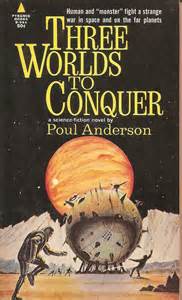
The opening pages or paragraphs of a work of futuristic science fiction set the scene by referring to unfamiliar aspects of a future society that we will come to understand as we read further. Thus, in Poul Anderson's Three Worlds To Conquer, a space battleship, the USS Vega:
"'...was on patrol near Venus when the revolution broke, and was put to searching for an orbital base the Sam Halls were believed to have somewhere in that sector.'"
-Poul Anderson, Three Worlds To Conquer (London, 1966), Chapter 1, p. 8.
OK. Sf readers catch on fast:
there is regular interplanetary travel;
the United States still exist;
there has just been a revolution;
the revolutionaries were nicknamed the "Sam Halls"?
Yes. In fact, there had been a short story about the Sam Halls' revolution (see here) although I did not learn this until many years later.
Incidentally, my copy of Three Worlds To Conquer is a "Mayflower-Dell Paperback." I am much indebted to Mayflower-Dell because the first James Blish novel that I read was their edition of Earthman, Come Home. For many years, Blish was superior to Anderson in my estimation. I have come to appreciate Anderson considerably more than I did and, of course, his output was much bigger.
Showing posts sorted by relevance for query Three Worlds To Conquer. Sort by date Show all posts
Saturday, 25 November 2017
Thursday, 23 November 2017
Jehovah And The Storm Goddess
"'ATTENTION, INSURRECTIONISTS!'"
-Poul Anderson, Three Worlds To Conquer (London, 1966), Chapter 7, p. 54.
He goes on like that. This is described as "...the Jehovah voice..." (op. cit., p. 55)
In Anderson's Starfarers, when Nivala speaks through an amplifier:
"Her voice rang as loud as the voice of some ancient storm goddess."
-Poul Anderson, Starfarers (New York, 1999), Chapter 21, p. 199.
I am certainly alone in being reminded of the Jehovah voice by the voice of the storm goddess but this coincidence has refocused my attention on Three Worlds To Conquer which might be a good book to reread. I said here that I had not found the cover of my edition on google but now I have. See image. A search of the blog shows how often I have posted about this novel before, e.g., Hardware and Echoes Of Heinlein. Or: search for the name of the Jovian character, Theor. However, there is always more to be said.
Tuesday, 19 February 2013
Hardware
In science fiction, some items of futuristic technology become taken-for-granted background cliches:
hyperdrives;
flying cars;
hand weapons called "blasters;"
force screens;
three dimensional TV called "3V;"
an interrogation device called either a "hypnoprobe" or "psychoprobe."
(I think this list should be longer but I can't think of any other examples right now.)
Asimov's Galactic Imperials use psychoprobes; Anderson's Terran Imperials use hypno-. Both devises extract the truth and can destroy the mind if misused. Either we are not told exactly how they work or the explanation is fairly low key but we get an idea of what they are from how they are referred to.
Anderson's Three Worlds To Conquer (London, 1966) is set in a nearer future and a different timeline than his Terran Empire. Nevertheless, one character says:
" 'They don't have psychoprobe equipment, or I'd never have fooled them. But they do have a couple of tough political officers who know how to, to interrogate.' " (p. 80)
Here, Anderson uses the Asimovian term. This signals to the reader that the character is referring to something much like a hypnoprobe but not in the same timeline as the Terran Empire. There is an underlying assumption that such technology will be developed in future. But, if the interrogators have not brought such equipment with them, then why mention it? Assumptions need to be challenged, especially in sf. The development of background cliches, including even the term "Terran" (not used outside sf) instead of "Terrestrial," contributed to making sf a literary ghetto with regular readers who knew the lingo and occasional or would-be readers maybe repelled by it.
Having said that, I love Anderson's Terran Empire as a fictional setting and the hypnoprobing of Dominic Flandry's son contributes to the dramatic climax of A Knight Of Ghosts And Shadows. Anderson is one writer who could usually make cliches work for instead of against him. But he did not need the reference to "psychoprobe" in Three Worlds To Conquer.
hyperdrives;
flying cars;
hand weapons called "blasters;"
force screens;
three dimensional TV called "3V;"
an interrogation device called either a "hypnoprobe" or "psychoprobe."
(I think this list should be longer but I can't think of any other examples right now.)
Asimov's Galactic Imperials use psychoprobes; Anderson's Terran Imperials use hypno-. Both devises extract the truth and can destroy the mind if misused. Either we are not told exactly how they work or the explanation is fairly low key but we get an idea of what they are from how they are referred to.
Anderson's Three Worlds To Conquer (London, 1966) is set in a nearer future and a different timeline than his Terran Empire. Nevertheless, one character says:
" 'They don't have psychoprobe equipment, or I'd never have fooled them. But they do have a couple of tough political officers who know how to, to interrogate.' " (p. 80)
Here, Anderson uses the Asimovian term. This signals to the reader that the character is referring to something much like a hypnoprobe but not in the same timeline as the Terran Empire. There is an underlying assumption that such technology will be developed in future. But, if the interrogators have not brought such equipment with them, then why mention it? Assumptions need to be challenged, especially in sf. The development of background cliches, including even the term "Terran" (not used outside sf) instead of "Terrestrial," contributed to making sf a literary ghetto with regular readers who knew the lingo and occasional or would-be readers maybe repelled by it.
Having said that, I love Anderson's Terran Empire as a fictional setting and the hypnoprobing of Dominic Flandry's son contributes to the dramatic climax of A Knight Of Ghosts And Shadows. Anderson is one writer who could usually make cliches work for instead of against him. But he did not need the reference to "psychoprobe" in Three Worlds To Conquer.
Saturday, 16 February 2013
Echoes Of Heinlein
Poul Anderson's Three Worlds To Conquer (London, 1966) features a colony on Ganymede like Robert Heinlein's Farmer In The Sky and a successful revolution against an American dictatorship like Heinlein's Revolt In 2100.After twelve years on Ganymede, Anderson's Mark Fraser considers returning to Earth but then is unsure because:
"...if Ganymede's rock and ice were hard to strike roots in, they gripped those roots all the more tightly." (pp. 8-9)
This echoes Heinlein's story, "It's Great To Be Back!" A young couple reach the end of their contracted time in the lunar colony and thankfully return to Earth only to find that they are no longer at home there so, at the end of the story, they are back on the Moon, saying, "It's great to be back!"
Having as yet reread Three Worlds To Conquer only as far as p. 11, I will now watch out for any other Heinlein parallels. Another such could be that there are Jovians, inhabitants of Jupiter, both in this Anderson novel and in Heinlein's Future History. However, Anderson's Jovians are major characters whereas the Future History Jovians are merely mentioned.
"It's Great to be Back!" and Revolt In 2100 belong to the Future History whereas Farmer In The Sky belongs to Heinlein's alternative or juvenile Future History along with Red Planet, Space Cadet, The Rolling Stones and Time For The Stars. As I remarked previously, Anderson's History of Technic Civilisation parallels the Future History but on a vaster spatiotemporal scale.
Three Worlds To Conquer
I am starting to reread Three Worlds To Conquer (London, 1966) by Poul Anderson. My copy is a Mayflower-Dell paperback that cost three shillings and six pence. I have not found its cover on the Internet.
p. 1, an extract;
p. 2, titles of two other Mayflower-Dell paperbacks by Anderson;
p. 3, title page;
p. 4, publishing details;
p. 5, dedication to Gordon Dickson;
p. 6, blank;
pp. 7-142, the novel;
pp. 143-144, other books published by Mayflower-Dell.
Page 7 establishes that the novel features interplanetary but not interstellar travel. Glimpsing the stars while approaching Ganymede, the viewpoint character thinks:
"...I'd like to know what's out yonder. But he wouldn't live that long. And it didn't matter. There was sufficient mystery in the Solar System for a lot of human lifetimes yet..." (p. 7)
It is also soon established that a dictatorship has just been overthrown back in the United States so that Anderson's characters are in a similar situation to Robert Heinlein's at the end of his Revolt In 2100. We are about to read about the effects of Terrestrial politics in the Outer Solar System. Since I have previously read this novel perhaps once decades ago, I must read on to learn more...
p. 1, an extract;
p. 2, titles of two other Mayflower-Dell paperbacks by Anderson;
p. 3, title page;
p. 4, publishing details;
p. 5, dedication to Gordon Dickson;
p. 6, blank;
pp. 7-142, the novel;
pp. 143-144, other books published by Mayflower-Dell.
Page 7 establishes that the novel features interplanetary but not interstellar travel. Glimpsing the stars while approaching Ganymede, the viewpoint character thinks:
"...I'd like to know what's out yonder. But he wouldn't live that long. And it didn't matter. There was sufficient mystery in the Solar System for a lot of human lifetimes yet..." (p. 7)
It is also soon established that a dictatorship has just been overthrown back in the United States so that Anderson's characters are in a similar situation to Robert Heinlein's at the end of his Revolt In 2100. We are about to read about the effects of Terrestrial politics in the Outer Solar System. Since I have previously read this novel perhaps once decades ago, I must read on to learn more...
Saturday, 25 November 2017
"Only For The Duration..."
Poul Anderson's Three Worlds To Conquer refers overtly to his short story, "Sam Hall" (see here), and perhaps also to another short story:
"Noble slogans were cheap, and the finest causes could go awry. Even the dictatorship had started as a movement to restore to a beaten United States her sovereignty and her pride. Then somehow one emergency after another cropped up, and those who grumbled began to have problems with the cops...."
-Poul Anderson, Three Worlds To Conquer (London, 1966), Chapter 1, p. 9.
This passage accords thematically with the conclusion of the story, "For the Duration" (see here), although I would have to reread that story to check its other details.
"Noble slogans were cheap, and the finest causes could go awry. Even the dictatorship had started as a movement to restore to a beaten United States her sovereignty and her pride. Then somehow one emergency after another cropped up, and those who grumbled began to have problems with the cops...."
-Poul Anderson, Three Worlds To Conquer (London, 1966), Chapter 1, p. 9.
This passage accords thematically with the conclusion of the story, "For the Duration" (see here), although I would have to reread that story to check its other details.
Wednesday, 2 October 2013
Non-Series Futuristic SF Novels
I am trying to list all of Poul Anderson's non-series futuristic science fiction novels. So far, I have come up with:
Brain Wave
Vault Of The Ages
The War Of Two Worlds
Shield
Planet Of No Return
Three Worlds To Conquer
The Long Way Home
Tau Zero
World Without Stars
After Doomsday
The Byworlder
The Enemy Stars
The Winter Of The World
The Avatar
For Love And Glory
Qualifications to this classification:
as noted in earlier posts, Three Worlds To Conquer and Tau Zero each have a short prequel whereas The Enemy Stars has a short sequel, so maybe these are mini-series;
The Boat Of A Million Years is a long novel with a novel-length concluding section set in an indefinite future but the earlier sections are historical science fiction with one contemporary chapter;
Starfarers is not on the list because it is, most of, the Kith History series;
Twilight World is not on the list because it is a series - in particular, its epilogue is set in a much later period;
some time travel works have passages set in the future but are mostly about the past;
Genesis is not on the list, although maybe it should be, because I classify it as a future history (a synthesis of the Stapledonian and Heinleinian models) and would therefore shelve it alongside the other shorter future histories like Flying Mountains and Rustum rather than with the more straightforward novels listed here.
Still to do:
finish reading and commenting on The Snows Of Ganymede;
discuss the lesser known (?) The War Of Two Worlds;
say (a little) more about Ace Doubles;
acquire Anderson's second and third mystery novels;
but first re-enter the realm of Morpheus;
and wonder whether discussion of Anderson's works is really, as it seems to be, endless...
Brain Wave
Vault Of The Ages
The War Of Two Worlds
Shield
Planet Of No Return
Three Worlds To Conquer
The Long Way Home
Tau Zero
World Without Stars
After Doomsday
The Byworlder
The Enemy Stars
The Winter Of The World
The Avatar
For Love And Glory
Qualifications to this classification:
as noted in earlier posts, Three Worlds To Conquer and Tau Zero each have a short prequel whereas The Enemy Stars has a short sequel, so maybe these are mini-series;
The Boat Of A Million Years is a long novel with a novel-length concluding section set in an indefinite future but the earlier sections are historical science fiction with one contemporary chapter;
Starfarers is not on the list because it is, most of, the Kith History series;
Twilight World is not on the list because it is a series - in particular, its epilogue is set in a much later period;
some time travel works have passages set in the future but are mostly about the past;
Genesis is not on the list, although maybe it should be, because I classify it as a future history (a synthesis of the Stapledonian and Heinleinian models) and would therefore shelve it alongside the other shorter future histories like Flying Mountains and Rustum rather than with the more straightforward novels listed here.
Still to do:
finish reading and commenting on The Snows Of Ganymede;
discuss the lesser known (?) The War Of Two Worlds;
say (a little) more about Ace Doubles;
acquire Anderson's second and third mystery novels;
but first re-enter the realm of Morpheus;
and wonder whether discussion of Anderson's works is really, as it seems to be, endless...
Monday, 18 February 2013
Three Worlds
I feel obliged to post again because page views today are already 80, twice as many as yesterday. However, I have not much to add at present. Today, I have revised Latin, performed chores, walked, meditated, eaten, watched a Smallville TV episode and reread to the mid point of Poul Anderson's Three Worlds To Conquer (London, 1966).
Human beings fight on Ganymede while Jovians fight on Jupiter. Anderson always describes combat well. There is one big surprise: a Jovian defensive fleet learns in battle that the invaders of a different species command large sea beasts which attack, destroy ships and slaughter those trying to swim to shore. Imagine what that would look like on screen.
The three worlds of the title must be Earth, Ganymede and Jupiter. The battle on Ganymede may settle whether a counterrevolution will succeed on Earth.
The Jovian Theor conversing with the Ganymedean Mark through a communicator hanging from his neck is like someone whose lucky charm really does give him access to another world. Theor is a Reeveling whose people are free and need not heed him. Hearing that the government on Earth had been overthrown, he asks:
" 'How could a leadership maintain itself in the first instance when not to the benefit of the people?' " (p. 39)
- and does not understand when he is told that some Terrestrials value security higher than freedom. Like Jonathan Swift, who imagined fantastic islands rather than other planets, Anderson uses an alien perspective to comment on human affairs.
Addendum, just after midnight: 85 page views yesterday and one already today. Thank you for all the interest.
12.30: 17 page views in half an hour. I need to turn in.
Human beings fight on Ganymede while Jovians fight on Jupiter. Anderson always describes combat well. There is one big surprise: a Jovian defensive fleet learns in battle that the invaders of a different species command large sea beasts which attack, destroy ships and slaughter those trying to swim to shore. Imagine what that would look like on screen.
The three worlds of the title must be Earth, Ganymede and Jupiter. The battle on Ganymede may settle whether a counterrevolution will succeed on Earth.
The Jovian Theor conversing with the Ganymedean Mark through a communicator hanging from his neck is like someone whose lucky charm really does give him access to another world. Theor is a Reeveling whose people are free and need not heed him. Hearing that the government on Earth had been overthrown, he asks:
" 'How could a leadership maintain itself in the first instance when not to the benefit of the people?' " (p. 39)
- and does not understand when he is told that some Terrestrials value security higher than freedom. Like Jonathan Swift, who imagined fantastic islands rather than other planets, Anderson uses an alien perspective to comment on human affairs.
Addendum, just after midnight: 85 page views yesterday and one already today. Thank you for all the interest.
12.30: 17 page views in half an hour. I need to turn in.
Saturday, 11 February 2023
Aliens At Home
How often do two or more intelligent species originate on a single planet? This happens in:
JRR Tolkien's Middle Earth
CS Lewis' Narnia (although the world of Narnia is not a planet)
Lewis' Malacandra (his version of Mars)
Poul Anderson's Jupiter in Three Worlds To Conquer
Anderson's Starkad in his Technic History
"'...their host is immense, and not even of our race. Two different breeds of thinking animal have met.'"
-Poul Anderson, Three Worlds To Conquer (London, 1966), 2, p. 19.
Those two land-dwelling species are of the same genus but there is also a rational species of another genus at a higher atmospheric level.
On Starkad, land and sea dwellers are natural enemies like men and wolves on Earth.
Malacandrians do not keep pets because, of the three species:
"Each of them is to the others both what a man is to us and what an animal is to us."
-CS Lewis, Out Of The Silent Planet IN Lewis, The Cosmic Trilogy (London, 1990), pp. 1-144 AT Postscript, p. 140.
Narnians include human beings, Talking Beasts, dwarfs etc. Lewis gets the same effect among his Martians.
Tuesday, 28 November 2017
Ganymede And Counterrevolution
"That's not exactly the way I heard it, just before Earth went behind the sun, Fraser thought."
-Poul Anderson, Three Worlds To Conquer (London, 1966), Chapter 6, p. 43.
Nowadays, we hear global news instantly. Imagine living so far away that Earth was sometimes on the other side of the sun. In some ways, space travel will restore earlier conditions like communication time lags. How long did it take the news of the Russian Revolution to spread around Earth? It was not instantly known about in European trenches.
Somewhere in Anderson's Psychotechnic History, extrasolar colonies are compared to colonies on Earth in previous centuries. Their cultures diverge because of the distances involved.
In the Psychotechnic History, the Humanists overthrow the Institute on Earth but some psychotechnicians plan to make a comeback from Ganymede. In Three Worlds To Conquer, the Sam Halls overthrow the Protectorate on Earth but one loyalist Admiral plans to restore American hegemony form a base on Ganymede. Ganymede's distance from Earth makes it an appropriate base for counterrevolution in more than one timeline.
I am amazed at what I learn by reading Poul Anderson.
-Poul Anderson, Three Worlds To Conquer (London, 1966), Chapter 6, p. 43.
Nowadays, we hear global news instantly. Imagine living so far away that Earth was sometimes on the other side of the sun. In some ways, space travel will restore earlier conditions like communication time lags. How long did it take the news of the Russian Revolution to spread around Earth? It was not instantly known about in European trenches.
Somewhere in Anderson's Psychotechnic History, extrasolar colonies are compared to colonies on Earth in previous centuries. Their cultures diverge because of the distances involved.
In the Psychotechnic History, the Humanists overthrow the Institute on Earth but some psychotechnicians plan to make a comeback from Ganymede. In Three Worlds To Conquer, the Sam Halls overthrow the Protectorate on Earth but one loyalist Admiral plans to restore American hegemony form a base on Ganymede. Ganymede's distance from Earth makes it an appropriate base for counterrevolution in more than one timeline.
I am amazed at what I learn by reading Poul Anderson.
Sunday, 23 October 2016
Significant Dates
1925 other galaxies recognized
1926 birth of Poul Anderson
1929 cosmic expansion discovered
1938 Superman published
1947 "Tomorrow's Children" by Poul Anderson and F.N. Waldrop
1947 "Chain of Logic" by Poul Anderson
1949 my birth
1951 "Tiger By The Tail" by Poul Anderson
1951 "Honorable Enemies" by Poul Anderson
1951 "Sargasso of Lost Starships" by Poul Anderson
1952 Vault Of The Ages by Poul Anderson
1952 "The Star Plunderer" by Poul Anderson
1953 Three Hearts And Three Lions by Poul Anderson
1954 Brain Wave by Poul Anderson
1954 The Broken Sword by Poul Anderson
1954 "Ghetto" by Poul Anderson
1954 "The Warriors from Nowhere" by Poul Anderson
1954 Question And Answer by Poul Anderson
1954 "The Sensitive Man" by Poul Anderson
1955 "Time Patrol" by Poul Anderson
1955 "Delenda Est" by Poul Anderson
1955 No World Of Their Own by Poul Anderson
1956 "Margin of Profit" by Poul Anderson
1956 Star Ways by Poul Anderson
1957 Earthman's Burden by Poul Anderson and Gordon R. Dickson
1957 "Memory" by Poul Anderson
1957 "Brake" by Poul Anderson
1958 The Snows Of Ganymede by Poul Anderson
1958 "The Man Who Counts" by Poul Anderson
1958 War Of The Wing-Men by Poul Anderson
1958 "The Game of Glory" by Poul Anderson
1959 Virgin Planet by Poul Anderson
1959 "Brave To Be A King" by Poul Anderson
1959 "The Sky People" by Poul Anderson
1959 "Hunters of the Sky Cave" by Poul Anderson
1959 "A Message in Secret" by Poul Anderson
1959 The Enemy Stars by Poul Anderson
1959 Perish By The Sword by Poul Anderson
1959 The War Of Two Worlds by Poul Anderson
1960 "The Only Game In Town" by Poul Anderson
1960 Guardians Of Time by Poul Anderson
1960 "The Plague of Masters" by Poul Anderson
1960 "A Twelvemonth And A Day" by Poul Anderson
1960 The High Crusade by Poul Anderson
1960 Murder In Black Letter by Poul Anderson
1960 The Golden Slave by Poul Anderson
1960 Rogue Sword by Poul Anderson
1961 "Progress" by Poul Anderson
1961 "Children of Fortune" by Poul Anderson
1961 "Epilogue" by Poul Anderson
1961 Twilight World by Poul Anderson
1961 Strangers From Earth by Poul Anderson
1961 Orbit Unlimited by Poul Anderson
1961 "Hiding Place" by Poul Anderson
1962 Un-Man And Other Novellas by Poul Anderson
1962 After Doomsday by Poul Anderson
1962 The Makeshift Rocket by Poul Anderson
1962 Murder Bound by Poul Anderson
1963 "Territory" by Poul Anderson
1963 Shield by Poul Anderson
1963 Is There Life On Other Worlds? by Poul Anderson
1964 Three Worlds To Conquer by Poul Anderson
1965 The Corridors Of Time by Poul Anderson
1965 The Star Fox by Poul Anderson
1963 Let The Spacemen Beware by Poul Anderson
1963 "The Three-Cornered Wheel" by Poul Anderson
1963 "Homo Aquaticus" by Poul Anderson
1964 "The Master Key" by Poul Anderson
1964 Three Worlds To Conquer by Poul Anderson
1965 "Trader Team" by Poul Anderson
1965 The Corridors Of Time by Poul Anderson
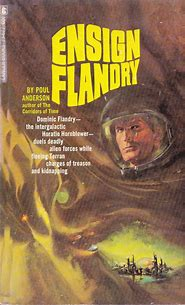
1966 Ensign Flandry by Poul Anderson
1966 "A Sun Invisible" by Poul Anderson
1966 "Plus Ca Change, Plus C'est Le Meme Chose" by Poul Anderson
1966 "Home" by Poul Anderson
1966 "The Moonrakers" by Poul Anderson
1966 The Fox, The Dog And The Griffin by Poul Anderson
1967 "Outpost of Empire" by Poul Anderson
1967 "Starfog" by Poul Anderson
1967 "Day of Burning" by Poul Anderson
1967 "A Tragedy of Errors" by Poul Anderson
1967 World Without Stars by Poul Anderson
1967 "To Outlive Eternity" by Poul Anderson
1968 "The Sharing of Flesh" by Poul Anderson
1969 The Rebel Worlds by Poul Anderson
1969 The Infinite Voyage by Poul Anderson
1969 Seven Conquests by Poul Anderson
1970 Tales Of The Flying Mountains by Poul Anderson
1970 "Esau" by Poul Anderson
1970 A Circus Of Hells by Poul Anderson
1970 Tau Zero by Poul Anderson
1971 "A Little Knowledge" by Poul Anderson
1971 "The Queen Of Air And Darkness" by Poul Anderson
1971 The Byworlder by Poul Anderson
1971 Operation Chaos by Poul Anderson
1971 The Broken Sword revised
1972 The Dancer From Atlantis by Poul Anderson
1972 "Wings of Victory" by Poul Anderson
1972 The Day The Sun Stood Still by Poul Anderson, Gordon R. Dickson and Robert Silverberg
1973 There Will Be Time by Poul Anderson
1973 "The Season of Forgiveness" by Poul Anderson
1973 "Wingless" by Poul Anderson
1973 The People Of The Wind by Poul Anderson
1973 "The Problem of Pain" by Poul Anderson
1973 "Rescue on Avalon" by Poul Anderson
1973 "Lodestar" by Poul Anderson
1973 The Day Of Their Return by Poul Anderson
1973 "Windmill" by Poul Anderson
1973 Hrolf Kraki's Saga by Poul Anderson
1974 "How To Be Ethnic In One Easy Lesson" by Poul Anderson
1974 A Knight Of Ghosts And Shadows by Poul Anderson
1974 "My Own, My Native Land" by Poul Anderson
1974 "Passing The Love Of Women" by Poul Anderson
1974 "A Fair Exchange" by Poul Anderson
1974 Fire Time by Poul Anderson
1974 A Midsummer Tempest by Poul Anderson
1974 The Many Worlds Of Poul Anderson, ed. Roger Elwood
1975 "To Promote The General Welfare" by Poul Anderson
1975 The Winter Of The World by Poul Anderson
1975 Homeward And Beyond by Poul Anderson
1975 Star Prince Charlie by Poul Anderson and Gordon R. Dickson
1976 The Best Of Poul Anderson
1977 A World Named Cleopatra
1978 The Avatar by Poul Anderson
1979 The Merman's Children by Poul Anderson
1979 The Demon Of Scattery by Poul Anderson and Mildred Downey Broxon
1979 A Stone In Heaven by Poul Anderson
1980 Conan The Rebel by Poul Anderson
1980 The Devil's Game by Poul Anderson
1980 The Golden Horn by Poul Anderson
1980 The Road of the Sea Horse by Poul Anderson
1980 The Sign Of The Raven by Poul Anderson
1981 Fantasy by Poul Anderson
1981 Explorations by Poul Anderson
1981 The Dark Between The Stars by Poul Anderson
1981 The Psychotechnic League by Poul Anderson
1981 "The Saturn Game" by Poul Anderson
1982 Cold Victory by Poul Anderson
1982 Starship by Poul Anderson
1982 New America by Poul Anderson
1982 The Gods Laughed by Poul Anderson
1983 Conflict by Poul Anderson
1983 "Ivory, And Apes, And Peacocks" by Poul Anderson
1983 "The Sorrow of Odin the Goth" by Poul Anderson
1983 Hoka! by Poul Anderson and Gordon R. Dickson
1983 Orion Shall Rise by Poul Anderson
1984 Past Times by Poul Anderson
1984 The Unicorn Trade by Poul and Karen Anderson
1985 Dialogue With Darkness by Poul Anderson
1985 The Game Of Empire by Poul Anderson
1985 "Pride" by Poul Anderson
1986 Roma Mater by Poul and Karen Anderson
1987 Gallicenae by Poul and Karen Anderson
1987 Dahut by Poul and Karen Anderson
1988 The Dog And The Wolf by Poul and Karen Anderson
1988 The Year Of The Ransom by Poul Anderson
1989 The Boat Of A Million Years by Poul Anderson
1990 The Shield Of Time by Poul Anderson
1991 "Star of the Sea" by Poul Anderson
1991 "Inconstant Star" by Poul Anderson
1991 The Time Patrol by Poul Anderson
Stop! This is not a complete list and was never intended to be such a long list. I have stopped temporarily only because I am not, at this time of night, finding any title that was published in 1992. The list so far shows:
(i) the dates of two important discoveries that underlie all subsequent sf;
(ii) the date of Superman who started as sf although he initiated a new genre (his alien menagerie is comparable to the one in Anderson's "Hiding Place" (1961));
(iii) for comparison, the year of my birth (blog readers can add theirs);
(iv) an unbroken record of Poul Anderson publications from 1951 until 1991 - and there was more after that.
1926 birth of Poul Anderson
1929 cosmic expansion discovered
1938 Superman published
1947 "Tomorrow's Children" by Poul Anderson and F.N. Waldrop
1947 "Chain of Logic" by Poul Anderson
1949 my birth
1951 "Tiger By The Tail" by Poul Anderson
1951 "Honorable Enemies" by Poul Anderson
1951 "Sargasso of Lost Starships" by Poul Anderson
1952 Vault Of The Ages by Poul Anderson
1952 "The Star Plunderer" by Poul Anderson
1953 Three Hearts And Three Lions by Poul Anderson
1954 Brain Wave by Poul Anderson
1954 The Broken Sword by Poul Anderson
1954 "Ghetto" by Poul Anderson
1954 "The Warriors from Nowhere" by Poul Anderson
1954 Question And Answer by Poul Anderson
1954 "The Sensitive Man" by Poul Anderson
1955 "Time Patrol" by Poul Anderson
1955 "Delenda Est" by Poul Anderson
1955 No World Of Their Own by Poul Anderson
1956 "Margin of Profit" by Poul Anderson
1956 Star Ways by Poul Anderson
1957 Earthman's Burden by Poul Anderson and Gordon R. Dickson
1957 "Memory" by Poul Anderson
1957 "Brake" by Poul Anderson
1958 The Snows Of Ganymede by Poul Anderson
1958 "The Man Who Counts" by Poul Anderson
1958 War Of The Wing-Men by Poul Anderson
1958 "The Game of Glory" by Poul Anderson
1959 Virgin Planet by Poul Anderson
1959 "Brave To Be A King" by Poul Anderson
1959 "The Sky People" by Poul Anderson
1959 "Hunters of the Sky Cave" by Poul Anderson
1959 "A Message in Secret" by Poul Anderson
1959 The Enemy Stars by Poul Anderson
1959 Perish By The Sword by Poul Anderson
1959 The War Of Two Worlds by Poul Anderson
1960 "The Only Game In Town" by Poul Anderson
1960 Guardians Of Time by Poul Anderson
1960 "The Plague of Masters" by Poul Anderson
1960 "A Twelvemonth And A Day" by Poul Anderson
1960 The High Crusade by Poul Anderson
1960 Murder In Black Letter by Poul Anderson
1960 The Golden Slave by Poul Anderson
1960 Rogue Sword by Poul Anderson
1961 "Progress" by Poul Anderson
1961 "Children of Fortune" by Poul Anderson
1961 "Epilogue" by Poul Anderson
1961 Twilight World by Poul Anderson
1961 Strangers From Earth by Poul Anderson
1961 Orbit Unlimited by Poul Anderson
1961 "Hiding Place" by Poul Anderson
1962 Un-Man And Other Novellas by Poul Anderson
1962 After Doomsday by Poul Anderson
1962 The Makeshift Rocket by Poul Anderson
1962 Murder Bound by Poul Anderson
1963 "Territory" by Poul Anderson
1963 Shield by Poul Anderson
1963 Is There Life On Other Worlds? by Poul Anderson
1964 Three Worlds To Conquer by Poul Anderson
1965 The Corridors Of Time by Poul Anderson
1965 The Star Fox by Poul Anderson
1963 Let The Spacemen Beware by Poul Anderson
1963 "The Three-Cornered Wheel" by Poul Anderson
1963 "Homo Aquaticus" by Poul Anderson
1964 "The Master Key" by Poul Anderson
1964 Three Worlds To Conquer by Poul Anderson
1965 "Trader Team" by Poul Anderson
1965 The Corridors Of Time by Poul Anderson
1966 Ensign Flandry by Poul Anderson
1966 "A Sun Invisible" by Poul Anderson
1966 "Plus Ca Change, Plus C'est Le Meme Chose" by Poul Anderson
1966 "Home" by Poul Anderson
1966 "The Moonrakers" by Poul Anderson
1966 The Fox, The Dog And The Griffin by Poul Anderson
1967 "Outpost of Empire" by Poul Anderson
1967 "Starfog" by Poul Anderson
1967 "Day of Burning" by Poul Anderson
1967 "A Tragedy of Errors" by Poul Anderson
1967 World Without Stars by Poul Anderson
1967 "To Outlive Eternity" by Poul Anderson
1968 "The Sharing of Flesh" by Poul Anderson
1969 The Rebel Worlds by Poul Anderson
1969 The Infinite Voyage by Poul Anderson
1969 Seven Conquests by Poul Anderson
1970 Tales Of The Flying Mountains by Poul Anderson
1970 "Esau" by Poul Anderson
1970 A Circus Of Hells by Poul Anderson
1970 Tau Zero by Poul Anderson
1971 "A Little Knowledge" by Poul Anderson
1971 "The Queen Of Air And Darkness" by Poul Anderson
1971 The Byworlder by Poul Anderson
1971 Operation Chaos by Poul Anderson
1971 The Broken Sword revised
1972 The Dancer From Atlantis by Poul Anderson
1972 "Wings of Victory" by Poul Anderson
1972 The Day The Sun Stood Still by Poul Anderson, Gordon R. Dickson and Robert Silverberg
1973 There Will Be Time by Poul Anderson
1973 "The Season of Forgiveness" by Poul Anderson
1973 "Wingless" by Poul Anderson
1973 The People Of The Wind by Poul Anderson
1973 "The Problem of Pain" by Poul Anderson
1973 "Rescue on Avalon" by Poul Anderson
1973 "Lodestar" by Poul Anderson
1973 The Day Of Their Return by Poul Anderson
1973 "Windmill" by Poul Anderson
1973 Hrolf Kraki's Saga by Poul Anderson
1974 "How To Be Ethnic In One Easy Lesson" by Poul Anderson
1974 A Knight Of Ghosts And Shadows by Poul Anderson
1974 "My Own, My Native Land" by Poul Anderson
1974 "Passing The Love Of Women" by Poul Anderson
1974 "A Fair Exchange" by Poul Anderson
1974 Fire Time by Poul Anderson
1974 A Midsummer Tempest by Poul Anderson
1974 The Many Worlds Of Poul Anderson, ed. Roger Elwood
1975 "To Promote The General Welfare" by Poul Anderson
1975 The Winter Of The World by Poul Anderson
1975 Homeward And Beyond by Poul Anderson
1975 Star Prince Charlie by Poul Anderson and Gordon R. Dickson
1976 The Best Of Poul Anderson
1977 A World Named Cleopatra
1978 The Avatar by Poul Anderson
1979 The Merman's Children by Poul Anderson
1979 The Demon Of Scattery by Poul Anderson and Mildred Downey Broxon
1979 A Stone In Heaven by Poul Anderson
1980 Conan The Rebel by Poul Anderson
1980 The Devil's Game by Poul Anderson
1980 The Golden Horn by Poul Anderson
1980 The Road of the Sea Horse by Poul Anderson
1980 The Sign Of The Raven by Poul Anderson
1981 Fantasy by Poul Anderson
1981 Explorations by Poul Anderson
1981 The Dark Between The Stars by Poul Anderson
1981 The Psychotechnic League by Poul Anderson
1981 "The Saturn Game" by Poul Anderson
1982 Cold Victory by Poul Anderson
1982 Starship by Poul Anderson
1982 New America by Poul Anderson
1982 The Gods Laughed by Poul Anderson
1983 Conflict by Poul Anderson
1983 "Ivory, And Apes, And Peacocks" by Poul Anderson
1983 "The Sorrow of Odin the Goth" by Poul Anderson
1983 Hoka! by Poul Anderson and Gordon R. Dickson
1983 Orion Shall Rise by Poul Anderson
1984 Past Times by Poul Anderson
1984 The Unicorn Trade by Poul and Karen Anderson
1985 Dialogue With Darkness by Poul Anderson
1985 The Game Of Empire by Poul Anderson
1985 "Pride" by Poul Anderson
1986 Roma Mater by Poul and Karen Anderson
1987 Gallicenae by Poul and Karen Anderson
1987 Dahut by Poul and Karen Anderson
1988 The Dog And The Wolf by Poul and Karen Anderson
1988 The Year Of The Ransom by Poul Anderson
1989 The Boat Of A Million Years by Poul Anderson
1990 The Shield Of Time by Poul Anderson
1991 "Star of the Sea" by Poul Anderson
1991 "Inconstant Star" by Poul Anderson
1991 The Time Patrol by Poul Anderson
Stop! This is not a complete list and was never intended to be such a long list. I have stopped temporarily only because I am not, at this time of night, finding any title that was published in 1992. The list so far shows:
(i) the dates of two important discoveries that underlie all subsequent sf;
(ii) the date of Superman who started as sf although he initiated a new genre (his alien menagerie is comparable to the one in Anderson's "Hiding Place" (1961));
(iii) for comparison, the year of my birth (blog readers can add theirs);
(iv) an unbroken record of Poul Anderson publications from 1951 until 1991 - and there was more after that.
Thursday, 21 May 2015
Sex And Gender
Poul Anderson, Starfarers (New York, 1999).
Tahirians copulate by kissing and both become pregnant. This is a genuinely different reproductive system, far more imaginative than the Jovian male/demi-male/female trisexuality in Anderson's Three Worlds To Conquer or the bi-species trisexuality of Larry Niven's Puppeteers.
Olaf Stapledon's Neptunian observer tells us, through Stapledon, that his species, the Last Men, have many sexes but does not elaborate. CS Lewis imagined immortal space-dwelling beings, the eldila, with no sex but seven genders. Thus, personality types or genders (masculine: active; feminine: passive; others:?) are separated from reproductive functions and then increased in number. I used to argue at school that God was not male but nevertheless masculine (active, creative) but other pupils did not understand this distinction. I still understand it but am no longer sure that I buy into it.
Lewis mysteriously refers only once to these seven genders. However, this author created something entirely unique, two very different and equally imaginative fictional restatements of Christianity: Narnia and Ransom. Although Lewis' anti-Wellsian theological sf is unique, Anderson touches on the same themes in "The Problem of Pain" and The Game Of Empire. Thus, this line of thought has taken us from Starfarers via Three Worlds To Conquer, Niven, Stapledon and Lewis to Anderson's Technic History.
Tahirians copulate by kissing and both become pregnant. This is a genuinely different reproductive system, far more imaginative than the Jovian male/demi-male/female trisexuality in Anderson's Three Worlds To Conquer or the bi-species trisexuality of Larry Niven's Puppeteers.
Olaf Stapledon's Neptunian observer tells us, through Stapledon, that his species, the Last Men, have many sexes but does not elaborate. CS Lewis imagined immortal space-dwelling beings, the eldila, with no sex but seven genders. Thus, personality types or genders (masculine: active; feminine: passive; others:?) are separated from reproductive functions and then increased in number. I used to argue at school that God was not male but nevertheless masculine (active, creative) but other pupils did not understand this distinction. I still understand it but am no longer sure that I buy into it.
Lewis mysteriously refers only once to these seven genders. However, this author created something entirely unique, two very different and equally imaginative fictional restatements of Christianity: Narnia and Ransom. Although Lewis' anti-Wellsian theological sf is unique, Anderson touches on the same themes in "The Problem of Pain" and The Game Of Empire. Thus, this line of thought has taken us from Starfarers via Three Worlds To Conquer, Niven, Stapledon and Lewis to Anderson's Technic History.
Friday, 24 November 2017
Stochasticism, Not Scholasticism
The blogging process is stochastic. I have no more idea of what is to come than anyone else. (Stochasticism is a philosophical school in James Blish's The Triumph Of Time.)
While swimming here, I got what I thought were Two Good Ideas for posts. I eventually published these two posts, Class Warriors and Self-Reference, although only after thirteen other posts about Poul Anderson's Starfarers. (And, in fact, there had been an earlier Class Warrior.)
After "Self-Reference," there were, among other posts, five more about Starfarers. The fifth, "Jehovah And The Storm Goddess" (see here), compared metaphors in Starfarers and Three Worlds To Conquer, thus leading to, so far, two posts about Three Worlds..., Ganymede and Choice. And I will probably (not definitely) reread Three Worlds..., thus generating a few more posts.
And all this goes back to swimming one morning.
While swimming here, I got what I thought were Two Good Ideas for posts. I eventually published these two posts, Class Warriors and Self-Reference, although only after thirteen other posts about Poul Anderson's Starfarers. (And, in fact, there had been an earlier Class Warrior.)
After "Self-Reference," there were, among other posts, five more about Starfarers. The fifth, "Jehovah And The Storm Goddess" (see here), compared metaphors in Starfarers and Three Worlds To Conquer, thus leading to, so far, two posts about Three Worlds..., Ganymede and Choice. And I will probably (not definitely) reread Three Worlds..., thus generating a few more posts.
And all this goes back to swimming one morning.
Sunday, 10 January 2016
Ways To Die On Jupiter
Jupiter is visited in Poul Anderson's Psychotechnic, Technic and Flying Mountains future histories and in his independent novel, Three Worlds To Conquer. (Three Worlds... has a marginal future historical element because its events occur after the "Sam Hall" revolution described in the short story of that name.)
The problem is always how to survive in the hostile Jovian environment. In "Brake," should a spaceship that needs to decelerate make braking ellipses in the Jovian atmosphere? Arguably not: in that thick and turbulent atmosphere, an already damaged ship would not have enough control to compute its exit orbit so there would be insufficient time to inform the rescue boats before the ship had reentered the atmosphere.
Crashing on the surface would be fatal because the atmosphere is hydrogen and helium at one hundred and forty degrees Absolute. But there would be no time to breathe because the ship would be "'...spattered on the surface...'" (Cold Victory, p. 272) But the ship would not even reach the surface because it would be squashed by Jupiter's tens of thousands of atmosphere's pressure.
The solution is to lighten the ship so that it can float in the lighter upper atmosphere until rescued. Because of Jupiter's massive gravity, the air thins out with height more slowly so there is a deeper layer of thin air for the braking ellipses. We realized that, didn't we?
The problem is always how to survive in the hostile Jovian environment. In "Brake," should a spaceship that needs to decelerate make braking ellipses in the Jovian atmosphere? Arguably not: in that thick and turbulent atmosphere, an already damaged ship would not have enough control to compute its exit orbit so there would be insufficient time to inform the rescue boats before the ship had reentered the atmosphere.
Crashing on the surface would be fatal because the atmosphere is hydrogen and helium at one hundred and forty degrees Absolute. But there would be no time to breathe because the ship would be "'...spattered on the surface...'" (Cold Victory, p. 272) But the ship would not even reach the surface because it would be squashed by Jupiter's tens of thousands of atmosphere's pressure.
The solution is to lighten the ship so that it can float in the lighter upper atmosphere until rescued. Because of Jupiter's massive gravity, the air thins out with height more slowly so there is a deeper layer of thin air for the braking ellipses. We realized that, didn't we?
Monday, 27 November 2017
An Andersonian Exercise
See Hexapodality and Some Quadrupeds.
The Jovians in Poul Anderson's Three Worlds To Conquer are quadrupeds as also is the artificial Jovian organism, Joe, in Anderson's "Call Me Joe." At least, I thought that Joe was quadrupedal. See the attached image.
So here is an exercise for Andersonians: compare and contrast the descriptions of the Jovians and of Joe. I will get around to it eventually but meanwhile I am very slowly rereading Three Worlds... between reading SM Stirling and rereading Stieg Larsson so this is going to take a while. We have, if not all the time in the world, then at least all the remaining time that the Norns have allotted to the current blogger.
Meanwhile, if anyone out there wants to tackle the Joe-Jovians comparison, then please either post it in the combox or email it as an article to be published on the blog provided that my technical assistant can handle the transfer from email to blog, not always easy apparently.
I am finding that appropriate subject-matter for the blog is quite literally endless.
The Jovians in Poul Anderson's Three Worlds To Conquer are quadrupeds as also is the artificial Jovian organism, Joe, in Anderson's "Call Me Joe." At least, I thought that Joe was quadrupedal. See the attached image.
So here is an exercise for Andersonians: compare and contrast the descriptions of the Jovians and of Joe. I will get around to it eventually but meanwhile I am very slowly rereading Three Worlds... between reading SM Stirling and rereading Stieg Larsson so this is going to take a while. We have, if not all the time in the world, then at least all the remaining time that the Norns have allotted to the current blogger.
Meanwhile, if anyone out there wants to tackle the Joe-Jovians comparison, then please either post it in the combox or email it as an article to be published on the blog provided that my technical assistant can handle the transfer from email to blog, not always easy apparently.
I am finding that appropriate subject-matter for the blog is quite literally endless.
Thursday, 21 February 2013
Flying Mountains II
I am trying to finish rereading Poul Anderson's Three Worlds To Conquer and to start rereading his Tales Of The Flying Mountains (New York, 1984) but am surrounded by the interruptions of life like helping a friend to move house, venturing into the cold to buy a takeaway meal for my family and watching bizarre events at home and abroad on the television news.
Flying Mountains I really have read only once maybe twenty nine years ago. Looking ahead, I note that it has an elaborate structure with perhaps three layers of narrative. It contains seven stories of which we are informed that four had previously "...appeared, in somewhat different form...in Analog..." (p. 4). This suggests that maybe the remaining three were written for the book? These seven are about asteroid colonization.
There are also a Prologue, an Epilogue and six numbered Interludes, making eight shorter passages in addition to the seven stories. In these shorter passages, extrasolar colonists discuss how to teach the history of the asteroid colonies to their children.
In Larry Niven's Known Space future history, the Asteroid Belt, called simply "the Belt," is colonized entirely with technology that could be envisaged when the stories were written, e.g., a hollowed out asteroid is spun to generate centrifugal force in place of gravity. Anderson's extrasolar colonists are still en route at sub-light speed. My point is that Flying Mountains need not have involved any technological innovations, just the application of existing space technology on a larger scale.
However, as I remember it, the asteroids are colonized by using some sort of gravity control involving the artificial generation of terrestroid gravitational fields on asteroidal surfaces. Although not FTL, gravity control is a very big premise indeed. I will reread with interest both Anderson's rationale for "...gyrogravitics..." and his colonists discussions of how to teach history as well as the seven individual stories (p. 29).
Flying Mountains I really have read only once maybe twenty nine years ago. Looking ahead, I note that it has an elaborate structure with perhaps three layers of narrative. It contains seven stories of which we are informed that four had previously "...appeared, in somewhat different form...in Analog..." (p. 4). This suggests that maybe the remaining three were written for the book? These seven are about asteroid colonization.
There are also a Prologue, an Epilogue and six numbered Interludes, making eight shorter passages in addition to the seven stories. In these shorter passages, extrasolar colonists discuss how to teach the history of the asteroid colonies to their children.
In Larry Niven's Known Space future history, the Asteroid Belt, called simply "the Belt," is colonized entirely with technology that could be envisaged when the stories were written, e.g., a hollowed out asteroid is spun to generate centrifugal force in place of gravity. Anderson's extrasolar colonists are still en route at sub-light speed. My point is that Flying Mountains need not have involved any technological innovations, just the application of existing space technology on a larger scale.
However, as I remember it, the asteroids are colonized by using some sort of gravity control involving the artificial generation of terrestroid gravitational fields on asteroidal surfaces. Although not FTL, gravity control is a very big premise indeed. I will reread with interest both Anderson's rationale for "...gyrogravitics..." and his colonists discussions of how to teach history as well as the seven individual stories (p. 29).
Friday, 22 February 2013
Neat Ending
I just finished rereading Poul Anderson's Three Worlds To Conquer (London, 1966). The ending is a neat solution to two problems. On Ganymede, a space battleship loyal to an overthrown Terrestrial dictatorship has secretly taken over the colony where its commander plans to manufacture weapons before re-attacking Earth. On Jupiter, Theor, friend of the Ganymedean colonists, leads an army that is about to be overwhelmed by invaders.
How to solve both problems? Mark Fraser, Ganymedean colonist, hijacks an as yet unflown ship designed to land on Jupiter. Chased by a missile, he descends into the Jovian atmosphere and bounces along a denser atmospheric layer that destroys the missile. Then he simply lands on the invaders.
Next, he returns to Ganymede, pretending to surrender, and exits the hijacked ship, having set the autopilot to fly the ship, its hold now full of dense and explosive Jovian atmosphere, straight at the battleship. Solution to second problem and end of novel. As I say, neat.
Ironically, Mark had thought, "Life isn't a story book...There are no happy endings. It just goes on." (p. 136) For the reader, the story does end happily. For Mark, life goes on. He returns to his wife and family while the woman with whom he has shared the Jovian adventure feels it is better that she return to Earth.
Thursday, 8 February 2018
ANDERSONIAN CHESS, by Sean M. Brooks
In
this article I will discuss how Poul Anderson used the game of chess. I
noticed how many times, in both stories and novels, chess is mentioned
by him. This caused me to keep in the remoter recesses of my mind the
wish to someday write about this author's use of the Royal Game. Chess,
along with poker, seems to have been the games best liked by Anderson. I
realize this essay will not interest most people, appealing only to
fans of Poul Anderson who also enjoy chess. I don't claim to have
tracked down every mention or use of chess by Anderson in his
works--only to have collected a representative sampling of his use of
that game.
Fred Saberhagen, in the Introduction he wrote for PAWN TO INFINITY
(Ace Books, June 1982), made some interesting comments about how much
chess and science fiction have in common. I'll quote some of what he
said from page 1 of that book: "Chess and fantastic fiction (I use the
term here to include science fiction) began an enthusiastic encounter
with each other at least as far back as Lewis Carroll, and the mating is
still in progress. Both contain strong elements of conflict--Emmanuel
Lasker, one of the great players of all time, defined chess as a
struggle--and both are set in worlds where time and space are subject to
transformation, the ordinary rules of human existence do not apply.
Therefore both tend to appeal to the same kind of mind; an interest in
the fantastic is very often a sign of interest in chess, and vice
versa." I used the text found in that book of Anderson's "The Immortal
Game" for this essay. And what Saberhagen said about fantastic fiction
fans often being interested in chess is certainly true of me!
Before
getting down to a discussion of Anderson's use of chess, collected from
some of his works, I shall give a general overview of how science
fiction writers have used that game. I quoted the following text from
the article "Games and Sports," by Bryan Stableford and Peter Nicholls
(THE ENCYCLOPEDIA OF SCIENCE FICTION, St. Martin's Press, 1993, page
467): "The game which has most frequently fascinated sf writers is
chess, featured in Charles L. HARNESS's "The Chess Players (1953) and
Poul ANDERSON's "The Immortal Game" (1954) as well as Malzberg's TACTICS
OF CONQUEST. John Brunner's THE SQUARES OF THE CITY (1965) has a plot
based on a real chess game, and Ian WATSON's QUEENMAGIC, KINGMAGIC
(1986) includes a world structured as one (as well as worlds structured
according to other games, including Snakes and Ladders!). Gerard Klein
built the mystique of the game into STARMASTER'S GAMBIT (1958; trans.
1973). A version of chess crops up in the works of Edgar Rice
Burroughs--in THE CHESSMEN OF MARS (1922) -- and a rather more exotic
variant plays an important role in THE FAIRY CHESSMEN (1951; vt
CHESSBOARD PLANET; vt THE FAR REALITY) by Lewis Padgett (Henry KUTTNER
and C.L. MOORE). An anthology of chess stories is PAWN TO INFINITY
(anth 1982) ed Fred SABERHAGEN."
The
authors quoted immediately above also discussed how electronic arcade
games and home computer games inspired many stories using such things.
Stableford and Nicholls then wrote (also on page 467 of the same
ENCYCLOPEDIA: "Stories of space battles whose protagonists are revealed
in the last line to be icons in a computer-game "shoot 'em up" may have
succeeded Shaggy God stories (---> ADAM AND EVE) as the archetypal
folly perpetrated by novice writers (although Fredric Brown's similarly
plotted "Recessional" [1960], where the protagonists are chessmen has
been much anthologized)."
Poul
Anderson was fond of chess, so I now quote some examples of how he
mentioned or used that game from his works. In Chapter I of THE LONG
WAY HOME (Ace Books, 1955, as NO WORLD OF THEIR OWN. Republished in 1978
by Gregg Press as THE LONG WAY HOME), readers will find this on page 3:
"Saris Hronna and Robert Matsumoto were the EXPLORER's chess fiends,
they had spent many hours hunched over the board, and it was a strange
thing to watch them: a human whose ancestors had left Japan for America
and a creature from a planet a thousand light-years distant, caught in
the trap of some ages-dead Persian. More than the gaping emptinesses he
had traversed, more than the suns and planets he had seen spinning
through darkness and vacuum, it gave Langley a sense of the immensity
and omnipotence of time."
The
game of chess is also seen in Anderson's story "Que Donn'rez Vous?"
(TALES OF THE FLYING MOUNTAINS (Macmillan, 1970) on page 151:
K-B2.
Q-K7. "Check," said Roy Pearson.
Captain Elias ben Judah did not swear, because it was against his principles. But his comment was violent enough. "Second blinking check in a row," he added, moving the black king to refuge at Kt3."
"And the third," said his operations manager in a parched chuckle. The white queen jumped in his artificial hand to Q8.
One thing I have pondered over with some puzzlement is why Poul
Anderson, when he happened to mention chess MOVES, used the English or
Descriptive notation formerly used by most Anglo/American chess players
for recording moves of the game. It would have been more "science
fictional" if he had used the "Algebraic" notation now dominant for the
recording of chess moves. After all, as long ago as H.J.R. Murray's
massive A HISTORY OF CHESS (1913), wherein the author advocated and used
that system, many English speaking chess players must have known of the
existence of Algebraic notation. Anderson's use of English notation has
caused some of his SF stories to "seem" just a bit dated. The most
likely reason for this is simple enough: the English notation was what
Anderson was FAMILIAR with. The rise and spread of chess computers of
all kinds using only Algebraic notation after 1976 has driven
Descriptive notation into extinction. (I myself used first the English
notation after learning how to play chess--but switched over to
Algebraic notation without difficulty after I was given my first chess
computer in the early 1980's.)
In Anderson's THREE WORLDS TO CONQUER (USA, Pyramid
Books, 1964), in Chapter 4, is another mention of the game: "...a chess
set stood by Fraser's tobacco jar. He'd always liked chess and poker
too much for his own good, he thought in the back of his brain: they
could become a way of life if you didn't watch them." I think this can
reasonably be understood as being Anderson's personal view of these
games.
The most numerous references to chess I found in the works of Poul
Anderson came from his Technic Civilization series. For example, the
unnamed narrator in "The Problem of Pain" mentions chess: "...he plays
chess at just about my level of skill," page 36 of THE EARTHBOOK OF
STORMGATE (Berkley, 1978).
I
now wish to discuss how Anderson mentioned chess in his Time Patrol
story "Brave To Be A King" (THE TIME PATROL, Tor [1991], page 53). Keith
Denison, a Patrol agent Shanghaied by a powerful Median politician to
pose as Cyrus the Great, was conversing with Manse Everard and said:
"Kobad the Mage has some original thoughts, and he's the only man alive
who dares beat me at chess." The problem is this, chess did not exist
in that king's time, and would not for more than one thousand years. As
H.J.R. Murray wrote on page 47 of A HISTORY OF CHESS (1913. Rpt. by
Benjamin Press, Northampton, MA, undated): "The date when it occurred to
some Indian to represent the chaturanga and its evolutions in a game
cannot be fixed, though naturally it cannot be earlier than the
organization of the army on which it is based. Chess was certainly in
existence in the 7th century A.D., and it had already at that time
penetrated to Persia." So it was mistaken of Anderson to say chess was
being played in the Persia of Cyrus the Great (unless we are to assume
Keith Denison taught the game at least to a few persons, such as Kobad
the Mage).
Chess is also seen in ENSIGN FLANDRY in Chapter 2. Commander Max
Abrams, the officer in charge of Terra's Naval Intelligence operations
on the planet Starkad, was not only a chess player, but also, in one of
those curiously respectful, half-friendly relationships which can show
up even between enemies in opposing military forces, was playing a game
of correspondence chess with Runei the Wanderer, the Merseian officer in
command of the Roidhunate's forces on the same planet. Merseia was the
great rival and enemy of the Terran Empire in the second half of
Anderson's Technic Civilization stories. But even Merseia, however
hostile it was to mankind, the race which had not only saved its planet
(see "Day of Burning") and from whom it learned how to reach the stars,
couldn't help being culturally influenced by the Terrans in some ways
(such as adopting chess and the drinking of tea). Getting back to the
point, in Chapter 2 we read: "Time must pass while the word seeped
through channels. Abrams opened a drawer, got out his magnetic
chessboard, and pondered. He hadn't actually been ready to play.
However, Runei the Wanderer was too fascinated by their match to refuse
an offer if he had a spare moment lying around; and damn if any
Merseian son of a mother was going to win at a Terran game." We see
Abrams reflecting on what move to make in the next paragraph:
"Hm....promising development here, with the white bishop...no, wait,
then the queen might come under attack...tempting to sic a computer onto
the problem...betcha the opposition did...maybe not...ah, so."
Regretfully, we see Anderson still using the antiquated Descriptive
notation as Abrams gave Runei his move: "Knight to King's Bishop four."
One of the most extensive uses of chess to be found in the works of
Anderson is in his novel A CIRCUS OF HELLS, on Wayland, a mineral rich
moon of a Jupiter type gas giant planet. Centuries before, shortly
before the complete collapse of the Polesotechnic League, a mining
company had installed a self aware, conscious level computer for
overseeing mining operations. Because Wayland was not a world suitable
for long term occupation by humans. Knowledge of Wayland was lost
during the Time of Troubles and even after the Empire arose to restore
order. To help preserve its sanity during the centuries of isolation
from outside contact, the self aware computer played chess and variants
of chess. In Chapter VIII of A CIRCUS OF HELLS, this is what one of the
robotic White Knights looked like: "A new kind of robot was approaching
from within the sphere. It was about the size of a man. The skin
gleamed golden. Iridescence was lovely over the great batlike wings
that helped the springing of its two long hoofed and spurred legs. The
body was a horizontal barrel, a balancing tail behind, a neck and head
rearing in front. With its goggling optical and erect audio sensors,
its muzzle that perhaps held the computer, its mane of erect antennae,
that head looked eerily equine. From its forepart, swivel mounted,
thrust a lance."
As already stated, the Wayland computer developed elaborate
variants of chess to help preserve its sanity during centuries of
isolation. As Flandry explained in Chapter X of A CIRCUS OF HELLS: "A
thinking capability like that, with nothing but routine to handle, no
new input, decade after decade--" Flandry shivered. "Br-rr! You must
know what sensory deprivation does to organic sophonts. Our computer
rescued itself by creating something complicated and unpredictable to
watch." Almost the only criticism I would make about A CIRCUS OF HELLS
is that too little is shown us of the Wayland AI (Artificial
Intelligence). My view is that Anderson could have devoted a few more
pages to that computer, showing us in more detail both its history and
how it reacted to humans again making contact with it. Flandry did say
the AI was pathetically eager to resume normal operations.
A few more examples of the widespread, ordinary playing of chess by
both humans and non humans within the sphere of space covered by
Technic Civilization can be found in additional stories set by Anderson
in that series. In Chapter XX of A CIRCUS OF HELLS, after Dominic
Flandry and his prisoner Ydwyr the Seeker had agreed on the terms and
conditions of the latter's captivity and release, Ydwyr asked: "With
that made clear, would you like a game of chess?" In Chapter XII of THE
PLAGUE OF MASTERS, after Flandry's friends had rescued him from
Biocontrol Central, we read: "Flandry bent his own head above
respectfully folded hands, hoping the plumes would shadow his face
enough. A couple of men, cross-legged, above a chessboard, looked up in
curiosity and kept on looking." Years later, in Chapter VIII of WE
CLAIM THESE STARS, as Flandry and Catherine Kittredge were traveling to
the planet Vixen, readers will see: "Flandry discovered that Kit could
give him a workout, when they played handball, down in the hold [of his
space ship]. And her stubborn chess game defeated his swashbuckling
tactics most of the time." Last, near the very end of THE GAME OF
EMPIRE, in Chapter 23, we see Flandry using metaphors from chess: "We
play the game move by move, and never see far ahead----the game of
empire, of life, whatever you want to call it--and what the score will
be when all the pieces at last go back into the box, who knows?"
But the story where we see Poul Anderson using chess most deeply
came from his early years as a science fiction writer : "The Immortal
Game" (THE MAGAZINE OF FANTASY AND SCIENCE FICTION, February 1954). The
story was based on a game of chess played by Adolf Anderssen (White)
and L.A.B.F. Kieseritzky (Black) in London, 1851. Anderson used MOSTLY
the exact moves of this game around which to build a fascinating and
thought provoking tale. The Immortal Game was especially interesting
because of how White deliberately sacrificed the Queen and both Rooks to
trap and checkmate Black. This beautiful game deserves to be included
with this essay.
However, when I played through the moves of the game as given in
"The Immortal Game" and wrote them out, I discovered that not all the
moves were the same as the ones I listed below in "Immortal Game One"
(or IG1, for short). The moves in IG1 belong to the game as recorded in
the most widely accepted sources. I checked the entry for the Immortal
Game on page 150 of THE OXFORD COMPANION TO CHESS, by David Hooper and
Kenneth Whyld (Oxford University Press, 1984), and the moves are the
same as in IG1. But the moves in "Immortal Game Two" (IG2) do not
exactly match those in IG1 (see Black's third moves in both lines, for
example). I hope these discrepancies came merely from Anderson using a
different source for this game's moves. Because it would not have been
right for an author to change what the standard sources gave as the
moves for this game.
Immortal Game One. 1e4 e5 2f4 exf4 3Bc4 Qh4+ 4Kf1 b5 5Bxb5
Nf6 6Nf3 Qh6 7d3 Nh5 8Nh4 Qg5? 9Nf5 c6 10g4 Nf6 11Rg1 cxBb5 12h4
Qg6 13 h5 Qg5 14Qf3 Ng8 15Bxf4 Qf6 16Nc3 Bc5 17Nd5!? Qxb2 18Bd6 Bxg1
19e5 QxRa1+ 20Ke2 Na6 21Nxg7+ Kd8 22Qf6+ Nxf6 23Be7 # Mate
Immortal Game Two. 1e4 e5 2f4 exf4 3Bc4 b5 4Bxb5 Qh4+ 5Kf1 Nf6 6Nf3
Qh6 7d3 Nh5 8Nh4 c6 9Nf5 Qg5 10g4 Nf6 11Rg1 cxBb5 12h4 Qg6 13h5 Qg5
14Qf3 Ng8 15Bxf4 Qf6 16Nc3 Bc5 17Nd5 Qxb2 18Bd6 Bxg1 19e5 QxRa1+ 20Ke2
Na6 21Nxg7+ Kd8 22Qf6+ Nxf6 23Be7 # Mate
I list the moves in IG1 which differ from those given in IG2:
3,4,5,8,9, and from move 10, they are exactly the same. I twice checked
and played out the moves given in "The Immortal Game" and they still
came out as recorded in IG2. I don't understand why the moves in
3,4.5,8, and 9 are different from those in the most commonly accepted
record of the Immortal Game (as given in the Hooper/Whyld book). I even
checked online at Wikipedia, and it agrees with THE OXFORD COMPANION TO
CHESS.
Poul Anderson's "The Immortal Game" has to be among the earliest
(if not the earliest) of his stories touching on the themes of AIs and
intelligent, self aware computers. In this story individual computers
controlled its own individual chessmen, plus all the computers on a
given side were linked together to form a kind of group mind programmed
to obey the laws of chess and to make the best possible moves. This was
part of a project studying what happens from using computers tied
together in multiple linkages (PAWN TO INFINITY, "The Immortal Game,"
page 69).
An observer, visiting the scientist overseeing this project,
wondered whether these computers shared many of the qualities of a human
mind, going on to speculate the computers
had become conscious and self aware, to have minds. An idea his host
regarded with skepticism. His visitor argued that the feedback
arrangement of these computers was analogous to the human nervous
system. He then suggested that, even given that the individual
computers were constrained by the group linkage, they still had
individual personalities. Next he wondered if the computers interpreted
the game of chess as the interplay of free will and necessity. And did
these individual computers interpret the data of their moves as
equivalent to the Churchillian "blood, sweat, and tears" (PAWN, pages
69-70)?
It is not my purpose in this article
to give a complete commentary on Anderson's "The Immortal Game" *
(despite writing about that story at greater than expected length). But
a few more comments is called for. The viewpoint character of that
story is the Black King's Bishop, called Rogard. As the computers were
switched on, Rogard was stirred to wakefulness and gazed ahead: "Away
there, across the somehow unreal red-and-black distances of the steppe,
he saw sunlight flash on armor and caught the remote wild flutter of
lifted banners. So it is war, he thought. So we must fight again (PAWN,
page 57). Which means the man visiting the scientist was right, these
computers were self aware, conscious, and thinking entities. And the
computers could even feel love, as we see on pages 58-59 of PAWN TO
INFINITY: "Looking beyond Flambard, the Bishop saw his Queen, Evyan the
Fair, and there was something within him which stumbled and broke into
fire. Very tall and lovely was the gray-eyed Queen of Cinnabar, where
she stood in armor and looked out at the growing battle."
And I like this bit from the story, on
page 62 of PAWN: "There had never been anything but this meaningless
war, there would never be aught else, and when Rogard tried to think
beyond the moment when the fight had begun, or the moment when it would
end, there was only an abyss of darkness." Here we see one of the
computerized chessmen groping with issues of fate and necessity. And
this is more clearly brought out on page 63 of PAWN: "Rogard tried once
more to get out of his square and go to Evyan's aid, but his will would
not carry him. The Barrier held, invisible and uncrossable, and the Law
held, the cruel and senseless Law which said a man must stand by and
watch his lady be slain, and he railed at the bitterness of it, and
lapsed into a gray waiting." Rogard was trying to violate the Laws of
chess, which he had been programmed to obey. Even the mere intent and
attempt indicates he had free will, at least in his mind. And we get a
hint at Churchillian determination at move 20 when Rogard saw the White
King, MIKILLATI, move into e2 to escape Evyan's check: "Peering into
his face, Rogard felt a sudden coldness. There was no defeat there, it
was craft and knowledge and an unbending steel will--..."
Rogard had come to realize that the
wars of Cinnabar (Black) with LEUKAS (White) were senseless and of no
use to either side: "No-No-you fool!" Rogard reached out, trying to
break the Barrier, clawing at MIKILLATI. "Can't you see, none of us can
win, it's death for us all if the war ends. Call her back!" (PAWN, page
68). And of course MIKILLATI ignored Rogard. But I would not go as far
as Rogard did and say the computers died after they were switched off
when Black was checkmated--they lapsed into a kind of dreamless sleep
from which they would eventually be awakened, to fight again.
Tuesday, 11 December 2018
ANDERSONIAN CHESS, by Sean M. Brooks
In this article I discuss how Poul
Anderson used the game of chess. I noticed how many times, in both
stories and novels, chess is mentioned by him. This caused me to keep
in the remoter recesses of my mind the wish to someday write about this
author's use of the Royal Game. Chess, along with poker, seems to have
been the games best liked by Anderson. I realize this essay will not
interest most people, appealing only to fans of Poul Anderson who also
enjoy chess. I don't claim to have tracked down every mention or use of
chess by Anderson in his works--only to have collected a representative
sampling of his use of that game.
Fred Saberhagen, in the Introduction
he wrote for PAWN TO INFINITY (Ace Books, June 1982), made some
interesting comments about how much chess and science fiction have in
common. I'll quote some of what he said from page 1 of that book:
"Chess and fantastic fiction (I use the term here to include science
fiction) began an enthusiastic encounter with each other at least as far
back as Lewis Carroll, and the mating is still in progress. Both
contain strong elements of conflict--Emmanuel Lasker, one of the great
players of all time, defined chess as a struggle--and both are set in
worlds where time and space are subject to transformation, the ordinary
rules of human existence do not apply. Therefore both tend to appeal to
the same kind of mind; an interest in the fantastic is very often a
sign of interest in chess, and vice versa." I used the text found in
that book of Anderson's "The Immortal Game" for this essay. And what
Saberhagen said about fantastic fiction fans often being interested in
chess is certainly true of me!
Before getting down to a discussion of
Anderson's use of chess, collected from some of his works, I shall give
a general overview of how science fiction writers have used that game. I
quoted the following text from the article "Games and Sports," by Bryan
Stableford and Peter Nicholls (THE ENCYCLOPEDIA OF SCIENCE FICTION,
St. Martin's Press, 1993, page 467): "The game which has most frequently
fascinated sf writers is chess, featured in Charles L. HARNESS's "The
Chess Players" (1953) and Poul ANDERSON's "The Immortal Game" (1954) as
well as Malzberg's TACTICS OF CONQUEST. John Brunner's THE SQUARES OF
THE CITY (1965) has a plot based on a real chess game, and Ian WATSON's
QUEENMAGIC, KINGMAGIC (1986) includes a world structured as one (as well
as worlds structured according to other games, including Snakes and
Ladders!). Gerard Klein built the mystique of the game into
STARMASTER'S GAMBIT (1958; trans. 1973). A version of chess crops up in
the works of Edgar Rice Burroughs--in THE CHESSMEN OF MARS (1922) --
and a rather more exotic variant plays an important role in THE FAIRY
CHESSMEN (1951; vt CHESSBOARD PLANET; vt THE FAR REALITY) by Lewis
Padgett (Henry KUTTNER and C.L. MOORE). An anthology of chess stories
is PAWN TO INFINITY (anth 1982) ed Fred SABERHAGEN."
The authors quoted immediately above
also discussed how electronic arcade games and home computer games
inspired many stories using such things. Stableford and Nicholls then
wrote (also on page 467 of the same ENCYCLOPEDIA: "Stories of space
battles whose protagonists are revealed in the last line to be icons in a
computer-game "shoot 'em up" may have succeeded Shaggy God stories
(---> ADAM AND EVE) as the archetypal folly perpetrated by novice
writers (although Fredric Brown's similarly plotted "Recessional"
[1960], where the protagonists are chessmen has been much
anthologized)."
Poul Anderson was fond of chess, so I
now quote some examples of how he mentioned or used that game from his
works. In Chapter I of THE LONG WAY HOME (Ace Books, 1955, as NO WORLD
OF THEIR OWN. Republished in 1978 by Gregg Press as THE LONG WAY HOME),
readers will find this on page 3: "Saris Hronna and Robert Matsumoto
were the EXPLORER's chess fiends, they had spent many hours hunched over
the board, and it was a strange thing to watch them: a human whose
ancestors had left Japan for America and a creature from a planet a
thousand light-years distant, caught in the trap of some ages-dead
Persian. More than the gaping emptinesses he had traversed, more than
the suns and planets he had seen spinning through darkness and vacuum,
it gave Langley a sense of the immensity and omnipotence of time."
We also see chess mentioned in THE
ENEMY STARS (Lippincott: 1958), on a planet named Krasna which seemed to
have been colonized largely by Russians, a people with a well known
passion for chess. In Chapter 4 a character named Chang Sverdlov was
observing the scene in a bar: "A chess game, a card game, a dirty
joke, an Indian wrestling match,..." And while meeting two other
members of the anti-Protectorate "Fellowship" in that same chapter
Sverdlov was told he should not leave them too soon, else it would look
suspicious: "Sverdlov snorted impatience, but reached for the little
chess set in his pouch. "Who'll play me a quick game, then?" "
The game of chess is also seen in
Anderson's story "Que Donn'rez Vous?" (TALES OF THE FLYING MOUNTAINS
(Macmillan, 1970) on page 151:
K-B2.
Q-K7. "Check," said Roy Pearson.
Captain Elias ben Judah did not swear, because it was against his principles.
But his comment was violent enough. "Second blinking check in a row," he added,
moving the black king to refuge at Kt3."
"And the third," said his operations manager in a parched chuckle. The white
queen jumped in his artificial hand to Q8.
One thing I have pondered over with
some puzzlement is why Poul Anderson, when he happened to mention chess
MOVES, used the English or Descriptive notation formerly used by most
Anglo/American chess players for recording moves of the game. It would
have been more "science fictional" if he had used the "Algebraic"
notation now dominant for the recording of chess moves. After all, as
long ago as H.J.R. Murray's massive A HISTORY OF CHESS (1913), wherein
the author advocated and used that system, many English speaking chess
players must have known of the existence of Algebraic notation.
Anderson's use of English notation has caused some of his SF stories to
"seem" just a bit dated. The most likely reason for this is simple
enough: the English notation was what Anderson was FAMILIAR with. The
rise and spread of chess computers of all kinds using only Algebraic
notation after 1976 has driven Descriptive notation into extinction. (I
myself used first the English notation after learning how to play
chess--but switched over to Algebraic notation without difficulty after I
was given my first chess computer in the early 1980's.)
In my copy of Anderson's THREE WORLDS
TO CONQUER (USA, Pyramid Books, 1964), in Chapter 4, is another mention
of the game: "...a chess set stood by Fraser's tobacco jar. He'd always
liked chess and poker too much for his own good, he thought in the back
of his brain: they could become a way of life if you didn't watch
them." I think this can reasonably be understood as being Anderson's
personal view of these games.
I now wish to discuss how Anderson mentioned chess in his Time Patrol story "Brave To Be A King" (THE TIME PATROL, Tor [1991], page 53). Keith Denison, a Patrol agent Shanghaied by a powerful Median politician to pose as Cyrus the Great, was conversing with Manse Everard and said: "Kobad the Mage has some original thoughts, and he's the only man alive who dares beat me at chess." The problem is this, chess did not exist in that king's time, and would not for more than one thousand years. As H.J.R. Murray wrote on page 47 of A HISTORY OF CHESS (1913. Rpt. by Benjamin Press, Northampton, MA, undated): "The date when it occurred to some Indian to represent the chaturanga and its evolutions in a game cannot be fixed, though naturally it cannot be earlier than the organization of the army on which it is based. Chess was certainly in existence in the 7th century A.D., and it had already at that time penetrated to Persia." So it was mistaken of Anderson to say chess was being played in the Persia of Cyrus the Great (unless we are to assume Keith Denison taught the game at least to a few persons, such as Kobad the Mage).
Chess is also seen in one of Poul
Anderson's historical novels: THE LAST VIKING, a three volume
novelization of the life of King Harald Hardrede of Norway (r.
1046-1066). In volume 2, THE ROAD OF THE SEA HORSE (Zebra Books:
1980), the game is seen or mentioned in two chapters. In Chapter V,
after King Harald asked Ulf Uspakson, who became his marshal of the
royal guards, whether he wanted to return to Iceland, Ulf replied: "God
forbid,... This playing chess with kingdoms becomes a habit." And in
Chapter XII, Section 2, after Earl Godwin and his sons had been driven
out of England by their enemies during the quarrels endemic among the
English leaders, two of the earl's sons, Harold and Leofwin, chose to
spend their exile in Ireland, rather than in Flanders as the rest of
their family had done. Time passed and "...on a heavy winter day he
sought out Leofwin. The younger man was playing chess when Harold
beckoned to him. "I'll come back and checkmate you as soon as I can," he
boasted and got up." It's only right to say that the chess first
played in Europe at that time used the Muslim pieces and rules for the
moves of that time. Chess as we know it needed several centuries of
experimentation in the moves and rules of the game by European players
before it took the form we see now after 1490.
The most numerous references to chess I
found in the works of Poul Anderson came from his Technic Civilization
series. For example, the unnamed narrator in "The Problem of Pain"
mentions chess: "...he plays chess at just about my level of skill,"
page 36 of THE EARTHBOOK OF STORMGATE (Berkley, 1978).
Chess is also seen in ENSIGN FLANDRY
in Chapter 2. Commander Max Abrams, the officer in charge of Terra's
Naval Intelligence operations on the planet Starkad, was not only a
chess player, but also, in one of those curiously respectful,
half-friendly relationships which can show up even between enemies in
opposing military forces, was playing a game of correspondence chess
with Runei the Wanderer, the Merseian officer in command of the
Roidhunate's forces on the same planet. Merseia was the great rival and
enemy of the Terran Empire in the second half of Anderson's Technic
Civilization stories. But even Merseia, however hostile it was to
mankind, the race which had not only saved its planet (see "Day of
Burning") and from whom it learned how to reach the stars, couldn't help
being culturally influenced by the Terrans in some ways (such as
adopting chess and the drinking of tea). Getting back to the point, in
Chapter 2 we read: "Time must pass while the word seeped through
channels. Abrams opened a drawer, got out his magnetic chessboard, and
pondered. He hadn't actually been ready to play. However, Runei the
Wanderer was too fascinated by their match to refuse an offer if he had a
spare moment lying around; and damn if any Merseian son of a mother was
going to win at a Terran game." We see Abrams reflecting on what move
to make in the next paragraph: "Hm....promising development here, with
the white bishop...no, wait, then the queen might come under
attack...tempting to sic a computer onto the problem...betcha the
opposition did...maybe not...ah, so." Regrettably, we see Anderson
still using the antiquated Descriptive notation as Abrams gave Runei his
move: "Knight to King's Bishop four."
One of the most extensive uses of
chess to be found in the works of Anderson is in his novel A CIRCUS OF
HELLS, on Wayland, a mineral rich moon of a Jupiter type gas giant
planet. Centuries before, shortly before the complete collapse of the
Polesotechnic League, a mining company had installed a self aware,
conscious level computer for overseeing mining operations. Because
Wayland was not a world suitable for long term occupation by humans.
Knowledge of Wayland was lost during the Time of Troubles and even
after the Empire arose to restore order. To help preserve its sanity
during the centuries of isolation from outside contact, the self aware
computer played chess and variants of chess. In Chapter VIII of A CIRCUS
OF HELLS, this is what one of the robotic White Knights looked like: "A
new kind of robot was approaching from within the sphere. It was about
the size of a man. The skin gleamed golden. Iridescence was lovely
over the great batlike wings that helped the springing of its two long
hoofed and spurred legs. The body was a horizontal barrel, a balancing
tail behind, a neck and head rearing in front. With its goggling
optical and erect audio sensors, its muzzle that perhaps held the
computer, its mane of erect antennae, that head looked eerily equine.
From its forepart, swivel mounted, thrust a lance."
As already stated, the Wayland
computer developed elaborate variants of chess to help preserve its
sanity during centuries of isolation. As Flandry explained in Chapter X
of A CIRCUS OF HELLS: "A thinking capability like that, with nothing
but routine to handle, no new input, decade after decade--" Flandry
shivered. "Br-rr! You must know what sensory deprivation does to
organic sophonts. Our computer rescued itself by creating something
complicated and unpredictable to watch." Almost the only criticism I
would make about A CIRCUS OF HELLS is that too little is shown us of the
Wayland AI (Artificial Intelligence). My view is that Anderson could
have devoted a few more pages to that computer, showing us in more
detail both its history and how it reacted to humans again making
contact with it. Flandry did say the AI was pathetically eager to
resume normal operations.
A few more examples of the widespread,
ordinary playing of chess by both humans and non humans within the
sphere of space covered by Technic Civilization can be found in
additional stories set by Anderson in that series. In Chapter XX of A
CIRCUS OF HELLS, after Dominic Flandry and his prisoner Ydwyr the Seeker
had agreed on the terms and conditions of the latter's captivity and
release, Ydwyr asked: "With that made clear, would you like a game of
chess?" In Chapter XII of THE PLAGUE OF MASTERS, when Flandry's
friends were rescuing him from Biocontrol Central, we read: "Flandry bent
his own head above respectfully folded hands, hoping the plumes would
shadow his face enough. A couple of men, cross-legged, above a
chessboard, looked up in curiosity and kept on looking." Years later,
in Chapter VIII of WE CLAIM THESE STARS, as Flandry and Catherine
Kittredge were traveling to the planet Vixen, readers will see: "Flandry
discovered that Kit could give him a workout, when they played
handball, down in the hold [of his space ship]. And her stubborn chess
game defeated his swashbuckling tactics most of the time." Last, near
the very end of THE GAME OF EMPIRE, in Chapter 23, we see Flandry using
metaphors from chess: "We play the game move by move, and never see far
ahead----the game of empire, of life, whatever you want to call it--and
what the score will be when all the pieces at last go back into the box,
who knows?"
And we see chess centuries after the
fall of the Terran Empire, on the long isolated planet named Gywdion, in
THE NIGHT FACE. In Chapter VII of that novel one of the Gwydiona
characters talked about chess (while waiting with his companions to be
rescued following an accident): "So we sat in that diving bell waiting
to see if their grapple would find us before we ran out of air," Llyrdin
said, "and I never played better chess in my life. It got right black
in there, too, before they snatched us up. They could have had the
decency to be a few minutes longer about it, though. I had such a
lovely end game planned out! But of course the board was upset as they
hauled on the bell."
But the story where we see Poul
Anderson using chess most deeply came from his early years as a science
fiction writer : "The Immortal Game" (THE MAGAZINE OF FANTASY AND
SCIENCE FICTION, February 1954). The story was based on a game of chess
played by Adolf Anderssen (White) and L.A.B.F. Kieseritzky (Black) in
London, 1851. Anderson used MOSTLY the exact moves of this game around
which to build a fascinating and thought provoking tale. The Immortal
Game was especially interesting because of how White deliberately
sacrificed the Queen and both Rooks to trap and checkmate Black. This
beautiful game deserves to be included with this essay.
However, when I played through the
moves of the game as given in "The Immortal Game" and wrote them out, I
discovered that not all the moves were the same as the ones I listed
below in "Immortal Game One" (or IG1, for short). The moves in IG1
belong to the game as recorded in the most widely accepted sources. I
checked the entry for the Immortal Game on page 150 of THE OXFORD
COMPANION TO CHESS, by David Hooper and Kenneth Whyld (Oxford University
Press, 1984), and the moves are the same as in IG1. But the moves in
"Immortal Game Two" (IG2) do not exactly match those in IG1 (see Black's
third moves in both lines, for example). I hope these discrepancies
came merely from Anderson using a different source for this game's
moves. Because it would not have been right for an author to change
what the standard sources gave as the moves for this game.
Immortal Game One. 1e4 e5 2f4 exf4
3Bc4 Qh4+ 4Kf1 b5 5Bxb5 Nf6 6Nf3 Qh6 7d3 Nh5 8Nh4 Qg5? 9Nf5 c6
10g4 Nf6 11Rg1 cxBb5 12h4 Qg6 13 h5 Qg5 14Qf3 Ng8 15Bxf4 Qf6 16Nc3 Bc5
17Nd5!? Qxb2 18Bd6 Bxg1 19e5 QxRa1+ 20Ke2 Na6 21Nxg7+ Kd8 22Qf6+ Nxf6
23Be7 # Mate
Immortal Game Two. 1e4 e5 2f4 exf4 3Bc4 b5 4Bxb5 Qh4+ 5Kf1 Nf6 6Nf3 Qh6 7d3 Nh5 8Nh4 c6 9Nf5 Qg5 10g4 Nf6 11Rg1 cxBb5 12h4 Qg6 13h5 Qg5 14Qf3 Ng8 15Bxf4 Qf6 16Nc3 Bc5 17Nd5 Qxb2 18Bd6 Bxg119e5 QxRa1+ 20Ke2 Na6 21Nxg7+ Kd8 22Qf6+ Nxf6 23Be7 # Mate
I list the moves in IG1 which differ
from those given in IG2: 3,4,5,8,9, and from move 10, they are exactly
the same. I twice checked and played out the moves given in "The
Immortal Game" and they still came out as recorded in IG2. I don't
understand why the moves in 3,4.5,8, and 9 are different from those in
the most commonly accepted record of the Immortal Game (as given in the
Hooper/Whyld book). I even checked online at Wikipedia, and it agrees
with the moves as given in THE OXFORD COMPANION TO CHESS.
Poul Anderson's "The Immortal Game"
has to be among the earliest (if not the earliest) of his stories
touching on the themes of AIs and intelligent, self aware computers. In
this story individual computers controlled its own individual chessmen,
plus all the computers on a given side were linked together to form a
kind of group mind programmed to obey the laws of chess and to make the
best possible moves. This was part of a project studying what happens
from using computers tied together in multiple linkages (PAWN TO
INFINITY, "The Immortal Game," page 69).
An observer, visiting the scientist
overseeing this project, wondered whether these computers shared many of
the qualities of a human mind, going on to speculate the
computers had become conscious and self aware, to have minds. An idea
his host regarded with skepticism. His visitor argued that the feedback
arrangement of these computers was analogous to the human nervous
system. He then suggested that, even given that the individual
computers were constrained by the group linkage, they still had
individual personalities. Next he wondered if the computers interpreted
the game of chess as the interplay of free will and necessity. And did
these individual computers interpret the data of their moves as
equivalent to the Churchillian "blood, sweat, and tears" (PAWN, pages
69-70)?
It is not my purpose in this article
to give a complete commentary on Anderson's "The Immortal Game" *
(despite writing about that story at greater than expected length). But
a few more comments is called for. The viewpoint character of that
story is the Black King's Bishop, called Rogard. As the computers were
switched on, Rogard was stirred to wakefulness and gazed ahead: "Away
there, across the somehow unreal red-and-black distances of the steppe,
he saw sunlight flash on armor and caught the remote wild flutter of
lifted banners. So it is war, he thought. So we must fight again (PAWN,
page 57). Which means the man visiting the scientist was right, these
computers were self aware, conscious, and thinking entities. And the
computers could even feel love, as we see on pages 58-59 of PAWN TO
INFINITY: "Looking beyond Flambard, the Bishop saw his Queen, Evyan the
Fair, and there was something within him which stumbled and broke into
fire. Very tall and lovely was the gray-eyed Queen of Cinnabar, where
she stood in armor and looked out at the growing battle."
And I like this bit from the story, on
page 62 of PAWN: "There had never been anything but this meaningless
war, there would never be aught else, and when Rogard tried to think
beyond the moment when the fight had begun, or the moment when it would
end, there was only an abyss of darkness." Here we see one of the
computerized chessmen groping with issues of fate and necessity. And
this is more clearly brought out on page 63 of PAWN: "Rogard tried once
more to get out of his square and go to Evyan's aid, but his will would
not carry him. The Barrier held, invisible and uncrossable, and the Law
held, the cruel and senseless Law which said a man must stand by and
watch his lady be slain, and he railed at the bitterness of it, and
lapsed into a gray waiting." Rogard was trying to violate the Laws of
chess, which he had been programmed to obey. Even the mere intent and
attempt indicates he had free will, at least in his mind. And we get a
hint at Churchillian determination at move 20 when Rogard saw the White
King, MIKILLATI, move into e2 to escape Evyan's check: "Peering into
his face, Rogard felt a sudden coldness. There was no defeat there, it
was craft and knowledge and an unbending steel will--..."
Rogard had come to realize that the
wars of Cinnabar (Black) with LEUKAS (White) were senseless and of no
use to either side: "No-No-you fool!" Rogard reached out, trying to
break the Barrier, clawing at MIKILLATI. "Can't you see, none of us can
win, it's death for us all if the war ends. Call her back!" (PAWN, page
68). And of course MIKILLATI ignored Rogard. But I would not go as far
as Rogard did and say the computers died after they were switched off
when Black was checkmated--they lapsed into a kind of dreamless sleep
from which they would eventually be awakened, to fight again.
It's right to end this article with a
few questions, to stimulate further thought. What might or could happen
if these computerized chessmen ever discovered they were only
instruments in the hands of human beings studying them? Would they try
to refuse playing chess and attempt to somehow inform the humans they
were thinking, self aware entities? Or would they still be compelled by
their programming to continue playing chess despite no longer wishing
to do so? What might humans do if they discovered the truth about these
chessmen?
APPENDIX.
Although this Appendix is not directly about any of the works of Poul
Anderson, his story "The Immortal Game" and the author's use of chess
came to remind me of how I have often played against my chess computer, a
model called Radio Shack Chess Champion 2150L. Despite being very old
for a chess computer (and one I've had since 1992), it is still such a
tough player that I've felt little need to replace it. While this chess
computer defeats me most times, I still occasionally win . I include
the score of a game I played against this machine, because of its
brevity and its technical interest (the computer was set at Level A3).
The game given below was played by me as White on Sunday, October 14,
2018. I began the game with 1 e4, and Black's first move was pawn to
c6, the Caro-Kann defense.
1e4 c6 2d4 d5 3e5 Bf5 4Nc3 h6? 5Nf3 e6
6Be2 Bb4 7Bd2 Ne7 8o-o o-o 9Qc1 Nd7 10Bxh6 gxh6 11Qxh6 Bxc2? 12Ng5 c5
13Rac1 Bf5 14Bg4! cxd4? 15Bxf5 Re8 16Bh7+ Kh8 17Nxf7+ Mate.
I was very pleased to defeat my chess computer because of how rarely that happens. And in only 17 moves by White!
I include as a sample of how I
reasoned about the moves of this game a note I wrote on the score sheet:
"I thought 4... h6? poor for Black, it enabled White to carry out a
Bishop and Queen attack on the h6 square after Black castled."
Subscribe to:
Posts (Atom)