Showing posts sorted by relevance for query "Margin of Profit". Sort by date Show all posts

Monday, 22 November 2021

"Margin of Profit"

Although Dune has been adapted to screen three times, Paul Atreides has not become as household a name as, e.g., Luke Skywalker. If Poul Anderson's Technic History is ever filmed, then we can expect Nicholas van Rijn, "memorable and popular" (see here) among sf readers, to become memorable and popular with the general public.

We are focusing on the seminal role of "Margin of Profit," quoted although not included in the first van Rijn collection, Trader To The Stars. The story required revision before it could be included in any Technic History volume. Thus, until its revision, "Margin of Profit" was paradoxically apocryphal but also authoritative.

"Margin of Profit" is the fourth work collected in The Earth Book Of Stormgate where it is preceded by "Wings of Victory," "The Problem of Pain" and "How To Be Ethnic In One Easy Lesson." It is also the fourth work collected in The Van Rijn Method where it is preceded by "The Saturn Game," "Wings of Victory" and "The Problem of Pain..." and succeeded by "How To Be Ethnic..."

"Margin of Profit," featuring van Rijn, and "How To Be Ethnic...," featuring van Rijn's future employee, Adzel, are set in different places at about the same time so it does not matter in which order they are read. However, I think that it is better if "How to Be Ethnic..." comes first, thus slightly delaying the first appearance of the dominating figure of van Rijn. The first four stories, beginning with "The Saturn Game," provide a firm foundation for a future history series, similarly to the opening four stories in Robert Heinlein's The Man Who Sold The Moon. (In that seminal case, the very first story is set in 1951 and the first four stories precede even spaceflight.)

At the end of "How To Be Ethnic...," Adzel recommends James Ching to an unnamed Master Merchant of the Polesotechnic League. "Margin of Profit" explains the League and displays the wealth of a particular named Master Merchant.

Wednesday, 11 March 2020

Okie And Technic Hardware

In the 1960s, James Blish was my "favorite" sf writer. Poul Anderson gets an Appreciation blog because of his comparable quality and also a bigger blog because of his vaster output.

Blish's Cities In Flight future history fits into a single omnibus volume whereas Anderson's Technic Civilization future history fills seven omnibus volumes. Both series explain the technological basis of their interstellar civilizations.

Volume I of the Cities In Flight Tetralogy (before the omnibus edition) recounts:

the discovery of anti-agathics (a short story incorporated into the novel);
the discovery of antigravity (a short story incorporated into the novel);
Terrestrial politics at the time (new linking passages added in the novel).

The PROLOGUE of Volume III explains that:

the Dillon-Wagoner gravitron polarity generator, or "spindizzy," is an overdrive with meteor screen and antigravity;

the overdrive plus anti-agathics make long interstellar flights possible;

the opening of the interstellar frontier drives down the price of germanium until it becomes the monetary standard for space trade.

The first six published stories in Anderson's Technic History were:

"Tiger by the Tail" (January, 1951);
"Honorable Enemies" (May, 1951);
"Sargasso of Lost Starships" (January, 1952);
"The Star Plunderer" (September, 1952);
"The Warriors from Nowhere" (Summer, 1954);
"Margin of Profit" (September, 1956) -

- although that version of "Margin of Profit" had to be revised to make it consistent with the History. After that revision, the stories rearranged themselves as follows:

"Margin of Profit," the Polesotechnic League period;
"The Star Plunderer," the Time of Troubles;
"Sargasso of Lost Starships," the early Terran Empire;
"Tiger by the Tail," Flandry in the later Terran Empire;
"Honorable Enemies," Flandry;
"The Warriors from Nowhere," Flandry.

Three later-written works are set earlier than "Margin of Profit." Nevertheless, that story retains its status as:

the first Nicholas van Rijn story;
the earliest written story set in the earlier period of the Technic History.

Like the Blish works cited above, "Margin of Profit" lists the technological and other factors underling the new period of interstellar trade:

automation and the mineral wealth of the Solar System made most manufacturing cheap;
fusion power made energy cheap;
gravitics led to the hyperdrive....

Strong Anderson-Blish parallels. 

Wednesday, 12 October 2016

Van Rijn POV

I think that Dominic Flandry is usually the viewpoint character of Flandry stories whereas Nicholas van Rijn is not usually the viewpoint character of van Rijn stories? The first van Rijn story was "Margin of Profit" (Astounding, September 1956). According to the Chronology of Technic Civilization, "Margin of Profit," introducing van Rijn, and "How To Be Ethnic In One Easy Lesson," introducing Adzel, are set in the same year although "Margin of Profit" is listed first.

In The Earth Book Of Stormgate, the first four stories are:

"Wings of Victory"
"The Problem of Pain"
"How To Be Ethnic In One Easy Lesson"
"Margin of Profit"

- whereas, in The Technic Civilization Saga: The Van Rijn Method, the first five stories are:

"The Saturn Game"
"Wings of Victory"
"The Problem of Pain"
"Margin of Profit"
"How To Be Ethnic In One Easy Lesson"

I prefer "...Ethnic..." before "...Margin..." because I like the idea of four whole stories before van Rijn appears. These opening stories form a solid foundation for the emerging future history.

In Robert Heinlein's Future History, the first flight to the Moon occurs in the fifth installment and the first slower than light interstellar expedition has been launched by the time of the twentieth installment;

Isaac Asimov's Robots and Empire future history begins with robots working on solar planets and testing an FTL drive in an early story;

James Blish's Cities in Flight future history begins with a novel in which interplanetary travel happens while observations on Jupiter and experiments on Earth lead to the discoveries that make FTL interstellar flight possible;

in Anderson's Psychotechnic History, interplanetary travel has begun by the second installment and slower than light interstellar expeditions have been launched by the ninth installment;

in Anderson's Technic History, faster than light interstellar travel has already started in "Wings of Victory" but "The Saturn Game," about interplanetary exploration, was written later;

Larry Niven's Known Space future history begins with interplanetary exploration;

Jerry Pournelle's CoDominium future history begins with faster than light interstellar travel already happening.

Thus, we observe some technological progress in future histories. I started to post about van Rijn's pov but got sidetracked onto comparing the early periods of the big seven American future histories.

Sunday, 5 January 2025

The Earlier Van Rijn Series

While without Internet access at home, I have been drafting posts for blog publication and reading interesting books by other authors while also rereading Poul Anderson who really is endlessly re-readable.

Currently utilizing Internet access at my daughter's house, I want to publish a quick version of one of the drafted posts despite maybe not having every relevant reference in place.

Trader To The Stars climaxes with "The Master Key" which refers to van Rijn's earlier exploits involving Borthu, Diomedes and t'Kela although only the t'Kela incident is included in this collection. Let us reconstruct the earliest version of the van Rijn series. "The Master Key" reads like a culmination first because it refers to three of the four earlier instalments and secondly because van Rijn seems to have stopped travelling and to have settled down on Earth where he hears the accounts of the problem on Cain, then solves the mystery by thought alone without rising from his lounger.

"Margin of Profit," about Borthu, was published in 1956.

"The Man Who Counts," about Diomedes, was serialized, then published as a novel under the title, War Of The Wing Men, in 1958.

"Hiding Place," about a space zoo, was published on 1961.

Un-Man And Other Novellas, collecting "Margin of Profit" and one instalment each from two other Anderson series, is copyright 1962.

"Territory," about t'Kela, was published in 1963.

"The Master Key," about Cain, was published in 1964.

Trader To The Stars, copyright 1964 and introduced by a new passage signed "de Matelot," collects:

"Hiding Place";

"Territory," introduced by an extract from "Margin of Profit";

"The Master Key," introduced by a verse by Shelley.

Thus, here were five van Rijn instalments published in two and one third volumes:

"Margin of Profit" in Un-Man...;

War Of The Wing Men;

Trader To The Stars.

This series was, so far, complete and not part of anything greater.

As we all know, there were two subsequent developments. First, The Earth Book Of Stormgate, published in 1978, collected twelve Technic History instalments, including:

"Margin of Profit," revised;

The Man Who Counts, its original title restored;

"Esau," about Baburites on Mogul, published in 1970;

"Lodestar," about Mirkheim and equally featuring Anderson's trader team, published in 1973.

Because the Earth Book is to be read several volumes after Trader To The Stars, that earlier collection, no longer needing to be preceded either by Un-Man... or by War Of The Wing Men, became Volume I of the Technic History with the Earth Book as at least Volume VI.

Finally, the seven-volume The Technic Civilization Saga, published 2009-2012, presents the entire Technic History in chronological order of fictional events so that the van Rijn instalments appear in their rightful places among all the others.

Addendum: For an error in this post, see here.

Saturday, 19 December 2020

Changed Reading Order

In The Earth Book Of Stormgate
"Wings of Victory"
"The Problem of Pain"
"How To Be Ethnic In One Easy Lesson"
"Margin of Profit"
"Esau"
"The Season of Forgiveness"
The Man Who Counts
"A Little Knowledge"
"Day of Burning"
"Lodestar"
"Wingless"
"Rescue on Avalon"
 
In The Technic Civilization Saga (interspersed with other works)
"Wings of Victory"
"The Problem of Pain"
"Margin of Profit"
"How To Be Ethnic In One Easy Lesson"
"The Season of Forgiveness"
The Man Who Counts
"Esau"
"Day of Burning" 
"A Little Knowledge"
"Lodestar"
"Wingless"
"Rescue on Avalon"
 
The changes are in heavy type.
 
According to Sandra Miesel's Chronology of Technic Civilization (see also here), "Margin of Profit" and "How To Be Ethnic..." are set in the same year. For what it is worth, I prefer a slightly longer delay before our first encounter with Nicholas van Rijn in "Margin of Profit."
 
Hloch's Earth Book introduction to "A Little Knowledge" informs his Avalonian readers that:
 
"Arinnian of Stormgate, whose human name is Christopher Holm and who has rendered several Ythrian works into Anglic, prepared this version for the book you hold."
-Poul Anderson, "A Little Knowledge" IN Anderson, The Earth Book Of Stormgate (New York, 1979), pp. 291-315 AT p. 291.
 
Hloch's introduction to "Day of Burning" states that:
 
"Hloch and Arinnian together have worked [a full account of what happened on Merseia] into narrative form."
-Poul Anderson, "Day of Burning" IN The Earth Book Of Stormgate, pp. 316-367 AT p. 317.
 
Thus, in The Technic Civilization Saga, the introduction that merely refers to Arinnian comes before the introduction that explains who he is.
 
"Esau" is about Emil Dalmady. Hloch's introduction to this story explains that some of Dalmady's children moved to Avalon with Falkayn and that one of them, Judith, wrote the story. Hloch's introduction to "The Season of Forgiveness" begins:
 
"The following story was also written by Judith Dalmady/Lundgren..."
-Poul Anderson, "The Season of Forgiveness" IN The Earth Book Of Stormgate, pp. 131-145 AT p. 131.

Again, the introduction assuming knowledge of Judith comes before the introduction that explains who she is.

Hloch's introduction to "A Day of Burning," mentioned above, informs readers that the story was based on an account found in records that had been kept on Falkayn's home planet, Hermes. Hloch's introduction to "Lodestar" begins:
 
"Also in the records left on Hermes..."
-Poul Anderson, "Lodestar" IN The Earth Book Of Stormgate, pp. 368-408 AT p. 368.
 
In the Earth Book, "Lodestar" immediately follows "Day of Burning" whereas, in the Saga, "The Master Key," Satan's World and "A Little Knowledge" come between them so the reader must hark back to recall the records on Hermes.

Wednesday, 26 October 2022

Introducing The Polesotechnic League

Today we lunched on a terrace above raging river rapids circling around the shop and cafe. Such consumption in such surroundings usually reminds me of the good life (for those who can afford it) in Poul Anderson's Polesotechnic League.

An early passage in Anderson's first Nicholas van Rijn story, "Margin of Profit," presents the Polesotechnic League and thus sets the scene for sixteen of the forty-three instalments of the Technic History. The passage begins:

"It is a truism that the structure of a society is basically determined by its technology."
-Poul Anderson, "Margin of Profit" IN Anderson, The Van Rijn Method (Riverdale, NY, December 2009), pp. 135-172 AT p. 145 -

- and ends:

"Nevertheless, [the League] had its troubles." (p. 146)

The Van Rijn Method is Volume I of Baen Books' seven-volume The Technic Civilization Saga, compiled by Hank Davis. In his Introduction to Volume II, David Falkayn: Star Trader, Davis informs us that the first story in this volume, "Territory," also about van Rijn, is preceded by an excerpt from "Margin of Profit," namely this same passage introducing the League. Having collected "Margin of Profit" in Volume I, Davis was uncertain whether to include the excerpt in Volume II but nevertheless list four sound reasons why he finally decided to do so. Thus, the League is properly introduced in Volumes I and II whereas Volume III begins with the concluding novel of the League period.

In the original publication order of the Technic History, "Margin of Profit" was included in the later collection, The Earth Book Of Stormgate, but the opening volume, Trader To The Stars, included "Territory." Thus, again, the League was appropriately introduced at the beginning of the series.

Monday, 22 November 2021

Van Rijn Publication Chronology

1956 "Margin of Profit"
1958 The Man Who Counts
1961 "Hiding Place"
1963 "Territory"
1966 "A Sun Invisible" (van Rijn reference)
1968 Satan's World
1970 "Birthright"
1971 "The Master Key"
1971 "Trader Team" (van Rijn cameo)
1971 "A Little Knowledge" (van Rijn reference)
1973 "Lodestar"
1977 Mirkheim
1978 The Earth Book Of Stormgate ("Margin of Profit" revised; Hloch's Introductions)
 
Observations
(i) It doesn't look a lot, does it? - but it is a major part of the Technic History.
(ii) Twenty-two years from start to finish.
(iii) The first short story and the first novel are of the 1950s.
(iv) "Territory" is introduced by an excerpt from "Margin of Profit."
(v) Trader To The Stars collected "Hiding Place," "Territory" and "The Master Key."
(vi) The Earth Book collected "Margin of Profit," The Man Who Counts, "Birthright"/"Esau," "A Little Knowledge" and "Lodestar."
(vii) The Technic Civilization Saga collects everything.
(viii) "Margin of Profit" was the earliest Polesotechnic League story.
(ix) The excerpt that introduces "Territory" provides the basis for the series and is presented separately as A HISTORICAL REFLECTION in The Technic Civilization Saga, Volume II.

Thursday, 25 January 2018

Collections And Introductions

Poul Anderson's "Hiding Place," starring Nicholas van Rijn, was first published in Analog, March 1961, and has since been collected twice:

it is the first of three van Rijn stories to be collected as Trader To The Stars;

it is the last of eleven installments of Anderson's History of Technic Civilization to be collected as The Technic Civilization Saga, Volume I (of VII), The Van Rijn Method.

Van Rijn is the title character of both these collections.

In my copy of Trader To The Stars (Frogmore, St Albans, Herts, 1975) (see image):

"Hiding Place" begins on p. 9;

p. 8 is blank;

p. 7 is a fictional quotation from "Le Matelot," beginning with an authentic quotation from Shelley -

"The world's great age begins anew..." (see here)

Thus, Le Matelot seems to introduce the volume. However, I have reason to believe that Le Matelot specifically introduces only "Hiding Place" and therefore possibly appeared with it in Analog. (Later: Le Matelot was not in Analog. See the Acknowledgments in The Van Rijn Method, pp. vi-vii.)

In my copy of Trader To The Stars, "Hiding Place" is immediately followed by an extended quotation from Anderson's first van Rijn story, "Margin of Profit" (1956):

"Hiding Place" ends near the bottom of p. 47;

the quotation from "Margin of Profit" begins at the bottom of p. 47 and continues to the top of p. 49;

p. 50 is blank;

the second story in this collection, "Territory," begins on p. 51.

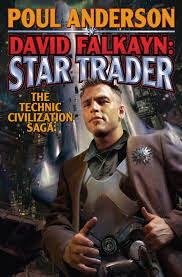
However, despite this misleading layout and pagination, the quotation from "Margin of Profit" is intended as an introduction to "Territory," not as a postscript to "Hiding Place." The compiler of The Technic Civilization Saga, Hank Davis, reproduces Le Matelot as introducing "Hiding Place" and the "Margin of Profit" quotation, now entitled "A Historical Reflection," as introducing "Territory," which is the first of seven works collected in Volume II, David Falkayn: Star Trader.

Finally, in Trader To The Stars:

"Territory" ends on p. 103;
p. 104 is blank;
p. 105 quotes a further stanza from Shelley's "Hellas" (see the above link);
p. 106 is blank;
the third story, "The Master Key," begins on p. 107.

Thus, the stanza beginning, "A loftier Argo cleaves the main...," clearly introduces "The Master Key" and is reproduced as such when this story is republished as the fourth installment in David Falkayn: Star Trader.

Monday, 22 November 2021

A Revised And Quoted Text

The trouble with physical books is that we need to have a copy to hand when we want to reread it or refer to it. This morning, I referred to Poul Anderson's David Falkayn: Star Trader when composing The Basis. Later, David Falkayn... seemed to have disappeared. In fact, it was on the shelf where it should have been but the title on the spine is so faded that I did not notice it.

I have: 

"Margin of Profit," unrevised, in Anderson's Un-Man and other novellas (New York, 1962) and, revised, in his The Earth Book Of Stormgate (New York, 1978) and The Van Rijn Method (Riverdale, NY, 2009);

"Territory" in Anderson's Trader To The Stars (St. Albans, 1975) and his David Falkayn: Star Trader (Riverdale, NY, 2010).

"Territory" quotes an explanatory passage from "Margin of Profit." In the unrevised "Margin...," that passage includes the sentence:

"Automation made manufacturing cheap, and the cost of energy nose-dived when the proton converter was invented."
-"Margin of Profit" IN Un-Man and other novellas, pp. 103-129 AT p. 110.
 
In the revised text, that sentence becomes two:
 
"Automation and the mineral wealth of the Solar System made the manufacture of most goods cheap. The cost of energy nosedived when small, clean, simple fusion units became available."
-"Margin of Profit" IN The Earth Book Of Stormgate, pp. 68-100 AT pp. 77.
 
Thus, fusion units replace proton converters. 

Of necessity, "Territory" in Trader To The Stars quotes the unrevised Margin... because that text had not been revised yet. However, "Territory" in David Falkayn... also quotes the unrevised version with proton converters instead of fusion units.
 
(And, if I am not a Poul Anderson scholar yet, then I am training to be one.)

Sunday, 20 April 2014

Back To The Future History IV

As I said a couple of posts ago, I would change the titles and slightly re-arrange the contents of the first two volumes of Baen Books' The Technic Civilization Saga by Poul Anderson. Thus, instead of:

The Van Rijn Method (collecting 11 works);
David Falkayn: Star Trader (7) -

- there would be:

Rise Of The Polesotechnic League; (9)
Decline Of The Polesotechnic League. (9)

The nine works in Vol I would comprise:

2 about Ythrians;
2 about van Rijn;
2 about Falkayn;
2 set on the planet Ivanhoe;
2 others.

That adds up to nine because one of the stories is about Falkayn on Ivanhoe!

The nine works in Vol II would comprise:

2 about van Rijn in space;
2 about van Rijn on Earth;
2 about Falkayn's trader team, working for van Rijn;
2 equally featuring van Rijn and the trader team;
1 other.

That summary gives some indication of the diversity and interconnectedness of the series. According to Sandra Miesel's Chronology of Technic Civilization, "Margin of Profit," introducing van Rijn, and "How To be Ethnic In One Easy Lesson," introducing Adzel, a later member of the trader team, occur in the same year, 2416, although that can only be a guess and an approximation.

In "How To Be Ethnic...," James Ching refers to "...the Brotherhood..." and thinks:

"If I'd been apprenticed to a Master Merchant of the Polesotechnic League..."
- The Van Rijn Method (New York, 2009), pp. 177, 178.

In "Margin of Profit," Lodgemaster Captain Rafael Torres of the Federated Brotherhood of Spacefarers tells van Rijn:

"'We assume you will be a spokesman for the master merchants of the League.'"
- David Falkayn: Star Trader (New York, 2010), p. 140.

Thus, "How To Be Ethnic..." mentions both the Brotherhood and the League, with its Master Merchants, whereas "Margin of Profit" not only explains the League but also features both a Master Merchant and a Brotherhood Lodgemaster. For these reasons, I think that the order of the stories in the collection should be reversed, with "How To Be Ethnic..." coming first. The reader should receive hints and clues about the functioning of the League before learning more of the details. The first appearance of the towering figure of van Rijn should be delayed until the fourth story in the series so that we have been introduced, as far as possible, to Technic Civilization before focusing on a particular individual within it.

Ching lives in San Francisco Integrate and, later, one of van Rijn's penthouses is on the roof of the Winged Cross in Chicago Integrate. Although most of the action and interest of the series is located off Earth, this repeated use of the term "Integrate" gives a sense of a heavily urbanized Earth providing the economic basis for van Rijn's exploits in space.

Friday, 3 November 2023

Beginnings

Nothing that has not been said before although it might bear some repetition.

"Margin of Profit" (1956) was the beginning of the Nicholas van Rijn series and thus also of the Polesotechnic League series which is part of the Technic History.

Trader To The Stars (1964) was the beginning of the Technic History book series. Introduced by Le Matelot, the volume collects three van Rijn stories, one of them introduced by a passage from "Margin of Profit."

The Van Rijn Method (2009) is the beginning of The Technic Civilization Saga which collects the entire Technic History. This volume includes "Margin of Profit," now revised and introduced by Hloch of Stormgate Choth on Avalon in the Domain of Ythri.

"Margin of Profit" has taken a strange, three-stage course but has finally been fully incorporated into the Technic History.

Another beginning is "The Saturn Game" (1981), introduced by Francis L. Minamoto of Apollo University Communications, Leyburg, Luna, which is chronologically the earliest Technic History instalment, therefore the opening story in The Van Rijn Method.

Wednesday, 23 April 2014

"Sandra Miesel's Technic Civilization Chronology," by Sean M. Brooks

Prefatory Note.  Dr. Shackley kindly published on his blog (April 26, 2012) an earlier version of this essay written by me.  Since then, I decided it needed to be revised, mostly from dating the birth of Nicholas van Rijn to 2421 instead of my earlier suggestion he was born in 2424.  And that made it necessary to revise my suggested dates for the birth of David Falkayn and many of the stories set during the Polesotechnic League. I also found it necessary to change some of the dates for the stories set in the Imperial era.

Several editions of the Technic Civilization stories of Poul Anderson (Gregg Press, Ace Books, Baen Books) have attached to them a chronology compiled by Sandra Miesel, an excellent commentator on the works of Anderson.  This chronology lists in internal chronological order all the stories and novels of the Technic Civilization series through periods like that of the Polesotechnic League and the Terran Empire.  Miesel also added many annalistic notes to her chronology.

For those who wish to read the Technic Civilization stories in chronological order, or merely to have a list of the stories in a correct temporal sequence, Sandra Miesel has done readers of Anderson's works a real favor.  However, commentators like Dr. Paul Shackley have discovered inconsistencies in some of Miesel's proposed dates which contradicts what the texts says.

For example, Miesel dates the birth of Nicholas van Rijn to AD 2376 and the crucial Polesotechnic League's Council of Hiawatha to 2400.  However, as discussed by Dr. Shackley in his note "Inconsistencies II," Nicholas van Rijn was born too late to have attended that council.  The section of Chapter IX of MIRKHEIM which discussed the Council of Hiawatha ended with "But when a century had passed--".  Nicholas van Rijn could not have attended that council because he was 80 years old at the time of the Mirkheim/Baburite crisis.  He would need to have been, implausibly, well over a century in age.

I have no objection to keeping Miesel's dating of the Council of Hiawatha to 2400, but I believe dating van Rijn's birth to 2421 is more accurate.  And since the Mirkheim/Baburite war came when van Rijn was 80 years old, that means it should be dated 2501 (not in 2456, Miesel's date).  This has the advantage of not contradicting what Chapter IX of MIRKHEIM said about "But when a century had passed."

Another error in Miesel's chronology contradicting what the texts say are her dates for "Lodestar" and MIRKHEIM.  She dates the events in "Lodestar" and MIRKHEIM to 2446 and 2456.  However, the Prologue to MIRKHIEIM clearly dates the events in that book to EIGHTEEN, not 10, years after "Lodestar."  My revision of her chronology dates those stories to 2483 and 2501.

The next major inconsistency in Miesel's chronology contradicting what the texts say came from her dating the foundation of the Terran Empire to the 28th century and the birth of Dominic Flandry to AD 3000.  These dates clash with what Chapter 10 of ENSIGN FLANDRY says, as the Merseian prime minister Brechdan Ironrede was going to the Imperial embassy for an official reception: "His destination was another offense, a compound of residences and offices in the garish bubble style of the Imperium four hundred years ago."  This indicates the Empire had existed for over four centuries by the time of ENSIGN FLANDRY (because it is reasonable to think schools of architecture needed some time after the Empire arose to become popular).

However, one problem with this dating is that we don't know how long the year of the planet Merseia was when compared to our Earth's year.  We don't know whether it was longer or shorter than the Terran year. Nonetheless it does indicate the Empire was older than the three centuries or so her chronology gives it by the time of ENSIGN FLANDRY.

Moreover, Miesel herself contradicts her chronology when she wrote in her "Introduction" for THE PEOPLE OF THE WIND (Gregg Press: 1977): "The Empire is its third century when it moves against the Domain in its first aggressive campaign against a civilized foe."  Another chronological indication can be found in Chapter 8 of Anderson's THE DAY OF THEIR RETURN, as Ivar Frederiksen briefly summarized the history of relations between the Empire and the Domain of Ythri: "Still, it [the Domain] grew.  So did Empire, Terra's, that is, till they met and clashed.  Couple centuries ago, they fought."  Now, if the Empire had existed a little over two centuries by the time of the Ythrian War and then that conflict was at least two centuries in the past by the time of THE DAY OF THEIR RETURN, that can only mean it had lasted more than four centuries by then.

Therefore, I would argue for dating the birth of Dominic Flandry to AD 3100, not 3000 (the year Miesel chose).  The later date better fits the chronological evidence I collected from the texts.  I am still puzzled how Miesel could have missed, for example, such crucial indications as the Prologue of MIRKHEIM saying the Baburite war occurred 18 years after "Lodestar."

Because of Dr. Paul Shackley's zeal and devotion to accuracy, I became aware of mistakes I made in my proposed ordering of the Dominic Flandry stories beginning with "Tiger By The Tail" and ending with WE CLAIM THESE STARS.  While working on a revision of Sandra Miesel's Chronology of Technic Civilization, I erred in too quickly accepting Miesel's listing of these stories when I should have paid attention to certain texts in THE PLAGUE OF MASTERS and WE CLAIM THESE STARS.  This time I made what I believe is a more accurate listing and "dating" of these six stories.

"Tiger By The Tail" is at the head of this listing because Dominic Flandry  was not yet a knight in that story.  That honor was conferred on him by the Emperor because of how he had nullified the Scothanian threat.  And also because we see Aline Chang-Lei saying in "Honorable Enemies," while trying to cheer up an anxious Flandry: "Dominic Flandry, the singled-handed conqueror of Scothania, brought down by that overgrown buzzard?" So I placed "Honorable Enemies second after "Tiger By The Tail."

"The Game of Glory" begins with mention of how an agent  serving Merseia escaped the Terrans from a planet named Conjumar in a spaceship so badly damaged that this agent, Aa'u, was forced to hide on another frontier world of the Empire. Then we read: "Two years went by. He was sent to Betelgeuse and discovered how to lie to a telepath," referring to "Honorable Enemies," which happened before the "Game of Glory" proper.  So we arrive at this partial listing: "Tiger By The Tail," "Honorable Enemies," and "The Game of Glory."

Next comes the problem of where to most accurately list, chronologically, "A Message in Secret" and THE PLAGUE OF MASTERS.  In Chapter II of PLAGUE we read: "The Betelgeuseans were ubiquitous throughout this sector of space.  Flandry had engaged passage on one of their tramp ships, as the quickest way to get from his completed assignment  on Altai to the big Imperial port at Spica VI." Which means "A Message in Secret " came immediately before THE PLAGUE OF MASTERS.  Last, in Chapter I of WE CLAIM THESE STARS, we see Flandry saying to Lady Diana Vinogradoff: "The Nyanza business was a trifle wearing, y' know,"  to remind her  of yet another exploit of his on yet another exotic planet.  "I came home for a rest. And the Merseians are such damnably strenuous creatures.  It makes me tired, just to look at one, let alone spar with him." And that places "The Game of Glory " not long before WE CLAIM THESE STARS.  Summing up, we get this listing: "Tiger By The Tail," "Honorable Enemies," "A Message in Secret," THE PLAGUE OF MASTERS, "The Game of Glory," and WE CLAIM THESE STARS.

 In addition, I suggested below that Josip died in 3142 rather than in 3141 (Miesel's date was 3041) because a slightly longer reign for that Emperor fitted better the background of the stories.  That is, it gives more time for the events recorded in those stories to take place without being crowded together too tightly.

If the argument I gave above is correct, then that means many, not all, of the dates given by Miesel in her chronology needs to be changed.  Mostly by proposing dates later than the ones she chose.  In the chronology given by me below, the dates I advocate are given first while Miesel's dates are given in square brackets.  For the most part I used the "Chronology of Technic Civilization" to be found in the Gregg Press edition of ENSIGN FLANDRY.  I also thought it best, for simplicity's sake, to omit many of the annalistic notes added by Sandra Miesel.  I omitted many bibliographical details for similar reasons.

In my proposed revision of Sandra Miesel's Chronology I preferred to list the stories by their first magazine or book publication dates.  To be strictly accurate I should say that Poul Anderson revised a few of these stories: "Margin of Profit," "The White King's War," "Tiger by the Tail," "Honorable Enemies," and "Warriors from Nowhere." These later versions should be considered canonical and first appeared in THE EARTHBOOK OF STORMGATE ("Margin of Profit") and in the Ace Books and Gregg Press editions of the Dominic Flandry stories ("The White King's War," GALAXY, October 1969, was incorporated in A CIRCUS OF HELLS.)

The Breakup and the Polesotechnic League

2055  "The Saturn Game," ANALOG SCIENCE FICTION (cited as ASF), February, 1981
2150  "Wings of Victory," ASF, April, 1972
24th century  "The Problem of Pain," FANTASY AND SCIENCE FICTION, February, 1973
2400  The Council of Hiawatha
2421 [2376]  Birth of Nicholas van Rijn
2451 [2406]  Birth of David Falkayn
2461 [2416]  "Margin of Profit," ASF, September, 1956
2461 [2416]  "How to be Ethnic in One Easy Lesson," FUTURE QUEST, ed. Roger Elwood, Avon Books, 1974
2468 [2416]  "The Three Cornered Wheel," ASF, October, 1963
2471 [2426]  WAR OF THE WING MEN, Ace Books, 1958
2471 [2426]  "Esau," ASF, February, 1970
2472 [2427]  "Hiding Place," ASF, March, 1961
2472 [2427]  "Territory," ASF, June, 1963
2473              "A Sun Invisible," ASF, April, 1966
2476 [2427]  "The Trouble Twisters," as "Trader Team," ASF, July-August, 1965
2478 [2433]  "Day of Burning," as "Supernova," ASF, January, 1967
3478 [2433]  "The Master Key," ASF, July, 1964
2482 [2437]  SATAN'S WORLD, Doubleday, 1969
2482 [2437]  "A Little Knowledge," ASF, August 1971
2482 [2437]  "The Season of Forgiveness," BOY'S LIFE, December, 1973
2483 [2446]  "Lodestar," ASTOUNDING: THE JOHN W. CAMBPBELL MEMORIAL ANTHOLOGY, ed. by Harry Harrison, Random House, 1973
2501 [2456]  MIRKHEIM, G.P. Putnam's Sons, 1977
Early 26th century [late 25th century], settlement of Avalon
26th century, "Wingless on Avalon," BOY'S LIFE, July, 1973
26th century, "Rescue on Avalon," in CHILDREN OF INFINITY, ed. Roger Elwood, Franklin Watts, 1973
26th  centruy, dissolution of the Polesotechnic League

The Time of Troubles and the Terran Empire

2600-2700 [27th century]  The Time of Troubles
Late 27th century, "The Star Plunderer," PLANET STORIES (cited as PS), September, 1952
2700  Manuel Argos founds the Terran Empire, Principate phase begins
28th century, "Sargasso of Lost Starships," PS, January, 1952
29th century [30th C], Covenant of Alfzar
2925 [29th century], THE PEOPLE OF THE WIND, New American Library, 1973
3100 [3000]  Birth of Dominic Flandry
3112 Battle of Mirzan, Alarri invasion crushed by the Navy.
3119 [3019]  ENSIGN FLANDRY, Chilton, 1966
3121 [3021]  A CIRCUS OF HELLS, New American Library, 1971
3122 [3022]  Josip succeeds Georgios as Emperor
3125 [3025]  THE REBEL WORLDS, New American Library,1969
3127 [3027]  "Outpost of Empire," GALAXY, December, 1967
3128 [3028]  THE DAY OF THEIR RETURN, Doubleday, 1973
3132 [3032]  "Tiger by the Tail," PS, January, 1951
3135 [3033]  "Honorable Enemies," FUTURE COMBINED WITH SCIENCE FICTION STORIES, May, 1951
3137 [3037]  "A Message in Secret," as MAYDAY ORBIT, Ace Books, 1961
3137 [3038]  "A  Plague of Masters," as EARTHMAN, GO HOME, Ace Books, 1961
3139 [3040] "The Game of Glory," VENTURE, March, 1958
3140 [3040]  WE CLAIM THESE STARS! (also HUNTERS OF THE SKY CAVE), Ace Books, 1959
3042 [3041]  Hans Molitor succeeds Josip as Emperor after brief civil war, supplants short lived Imperial relative as Emperor.
3143 [3042]  "Warriors from Nowhere," as "Ambassadors of Flesh," PS, Summer, 1954
3148 [3047]  A KNIGHT OF GHOSTS AND SHADOWS, New American Library, 1975
3155  Dietrich succeeds Hans as Emperor
3157  Gerhart succeeds Dietrich as Emperor
3162 [3061]  A STONE IN HEAVEN, Ace Books, 1979
3167 [3064]  THE GAME OF EMPIRE, Baen Books, 1985
Early fourth millennium, the Empire enters its Dominate phase
Circa AD 3500, Fall of the Terran Empire, the Long Night begins.  War, piracy, anarchy, economic collapse, and isolation devastate countless worlds.

The Long Night

3600  "A Tragedy of Errors," GALAXY, February, 1968
3900  THE NIGHT FACE, Ace Books, 1978
4000  "The Sharing of Flesh," GALAXY, December, 1968
7100  "Starfog," ASF, August, 1967

Monday, 30 March 2020

The Two Reading Orders

(Maybe my favorite Anderson cover because of what it says as well as what it shows.)

I think that every Poul Anderson reader should have copies both of The Technic Civilization Saga and of earlier editions of the Technic History novels and collections, particularly The Earth Book Of Stormgate, even though the Earth Book's entire contents are reproduced in Saga, Volumes I-III. This is a series that can be read two ways and the ways can be compared and contrasted. The Earth Book installments are presented in two different orders.

Earth Book
"Wings of Victory"
"The Problem of Pain"
"How To Be Ethnic In One Easy Lesson"
"Margin of Profit"
"Esau"
"The Season of Forgiveness"
The Man who Counts
"A Little Knowledge"
"Day of Burning"
"Lodestar"
"Wingless"
"Rescue on Avalon"

In Saga, Volume I
"Wings of Victory"
"The Problem of Pain"
"Margin of Profit"
"How To Be Ethnic In One Easy Lesson"
"The Season of Forgiveness"
The Man Who Counts
"Esau"

In Saga, Volume II

"Day of Burning"
"A Little Knowledge"
"Lodestar"

In Saga, Volume III
"Wingless"
"Rescue on Avalon"

The Chronology lists "Margin of Profit" and "How To Be Ethnic In One Easy Lesson," which have no common characters, as occurring in the same year. I prefer the Earth Book order as slightly delaying the introduction of Nicholas van Rijn. Four entire other stories can be read first.

Hloch's Earth Book introductions to the stories are reproduced in Saga without acknowledging that their reading order has been changed. Thus:

the introduction to "Esau" informs us that this story's central character, Emil Dalmady, had children who moved to Avalon with Falkayn and that one of them, Judith, wrote "Esau";

the introduction to "The Season of Forgiveness" informs us that Judith Dalmady/Lundgren also wrote this story;

the introduction to "A Little Knowledge" informs us that Arinnian of Stormgate, whose human name is Christopher Holm, wrote the story;

the introduction to "Day of Burning" merely informs us that Hloch and Arinnian collaborated on the story without, this time, telling us who Arinnian is.

Tuesday, 29 August 2017

Ideas

(I don't like this cover but it is the issue that contained Poul Anderson's "Margin of Profit.")

The previous post moved from a passage in SM Stirling's The Given Sacrifice to a discussion of philosophy. This post continues the discussion of philosophy, then moves to "Margin of Profit."

Philosophy was standing on its head because philosophers, like everyone else, thought that ideas preceded life and action. Materialist philosophers stood philosophy on its feet when they recognized that people had to eat before they could think. How we earn our livings determines how we relate to each other and therefore also determines how we think about society, social values and reality in general. When social labour had produced a (small) surplus and when the priestly elite that administered that surplus had begun to rule the majority whose labour produced the surplus, then it came to be thought that the rulers' ideas, not productive labour, were the driving force of society. This led to more refined forms of idealism, e.g., the belief that the idea of Man, preceding particular men, had existed from eternity in the mind of God or in an ideal realm.

"It is a truism that the structure of a society is basically determined by its technology. Not in an absolute sense - there may be totally different cultures using identical tools - but the tools settle the possibilities: you can't have interstellar trade without spaceships. A race limited to a single planet, possessing a high knowledge of mechanics but with its basic machines of industry and war requiring a large capital investment, will inevitably tend toward collectivism under one name or another. Free enterprise needs elbow room."
-Poul Anderson, "Margin of Profit" IN Anderson, The Van Rijn Method (Riverdale, NY, 2009), pp. 135-173 AT p. 145.

Anderson, or at least his omniscient narrator, agrees that technology basically determines social structure. I have to agree that different cultures can use identical tools. But I think that the nature of the tools limits the range of possible ideas? Anderson refers to "...collectivism under one name or another."

He goes on to list the conditions that make the "exuberent capitalism" (p. 146) of the Polesotechnic League possible:

automation and the mineral wealth of the Solar System make the manufacure of most goods cheap;
small, clean, simple fusion units make energy cheap;
gravitics leads to the hyperdrive, making interstellar exploitation and emigration possible;
interstellar distances and cultural differences prevent political union;
but there is little reason for armed conflict;
the colonies want the luxuries of home;
home wants colonial products;
older civilizations have much to exchange;
imports are cheaper than synthetics or substitutes;
companies compete but must also arbitrate and present a common front to the governments;
governments limited to a few planetary systems cannot control interstellar traders;
they are also bribed and coerced;
the League became a loose supergovernment;
QED.

Saturday, 25 May 2013

Margins Of Profit III Etc

That last post was cut short by the need to eat a meal. I meant to add not only that the concluding Flandry novels follow a period of civil war and usurpation but also that the splendid Chunderban Desai expounds a theory of "change and decay" on an imperial scale. The feeling of end times  generated in Mirkheim, set during the latter days of the Polesotechnic League, is echoed in the evocatively entitled A Knight Of Ghosts And Shadows, set during the latter days of the Terran Empire.

But Anderson does not repeat himself, at least not in this series. The later problems of imperial decadence are not the earlier problems of state/monopoly capitalism and the two periods differ considerably in tone.

Desai is a native of Ramanujan, as is van Rijn's captain in the first story of Trader To The Stars. Van Rijn's companion in the second story in that collection is from Esperance which we see in The People Of The Wind. An ensign in the third and last story in Trader To The Stars is from Nuevo Mexico, as are the Fleet Admiral and his daughter in The People Of The Wind. Many of Anderson's invented planets are re-mentioned although not always remembered until rereading reveals the interconnections between background details of different works.

The second story in Trader To The Stars, "Territory," presents an extremely elaborate, even for Anderson, explanation of its fictitious planet's environmental features and ecological problems. I will shortly summarize one character's account to van Rijn in the hope of making this clearer at least to myself.

The original version of "Margin of Profit," already discussed, is included as an appendix to the online edition of Baen Book's The Van Rijn Method. I suggest that, in any printed Complete Works, that original version should be not an appendix to the History but just another item among the Complete Short Stories, where it could be regarded as a non-series work that is set in a timeline different from although similar to that of the History.

Alternatively, since Anderson made some, lesser, revisions to the shorter Flandry works, there could be an Alternative Technic History Volume in which the original "Margin of Profit" would be followed by the original Flandry stories, one of which does refer back to van Rijn - unless, of course, that story was not among those revised.

This is a bigger issue with James Blish whose Complete Works would definitely have to include a volume of the original, shorter versions of several works.

Wednesday, 28 March 2012

Anderson’s Technic History

A Chronology of the Writing of the Technic History
Jan 51
“Tiger by the Tail”
3032
May 51
“Honorable Enemies”
3033
Jan 52
“Sargasso of Lost Starships”
28th C
Sep 52
“The Star Plunderer”
c2700
Summer 54
“The Warriors from Nowhere”
3042
Sep 56
“Margin of Profit”
2416
Feb-Apr 58
The Man Who Counts
2420s
Mar 58
“The Game of Glory”
3025
59
“Hunters of the Sky Cave”
3040
Mar 61
“Hiding Place”
2420s
61
“A Message in Secret”
3037
61
“The Plague of Masters”
3038
Jun 63
“Territory”
2430s
63
The Night Face
3900
63
“The Three-Cornered Wheel”
2423
Apr 66
“A Sun Invisible”
2420s
66
Ensign Flandry
3019
Jan 67
“Day of Burning”
2430s
Aug 67
“Starfog”
7100
Dec 67
“Outpost of Empire”
3027
Feb 68
“A Tragedy of Errors”
3600
May-Aug 68
Satan’s World
2430s
Dec 68
“The Sharing of Flesh”
4000
69
The Rebel Worlds
3025
Feb 70
“Esau”
2420s
70
A Circus of Hells
3021
Jul-Aug 71
“The Trouble Twisters”
2430s
Aug 71
“The Master Key”
2430s
Aug 71
“A Little Knowledge”
2430s
Apr 72
“Wings of Victory”
2150
Feb 73
“The Problem of Pain”
24th C
Feb-Apr 73
The People of the Wind
29th C
Jul 73
“Wingless”
26th C
73
“Rescue on Avalon”
26th C
73
“Lodestar”
2446
73
The Day of Their Return
3028
Dec 73
“The Season of Forgiveness”
2420s
74
“How To Be Ethnic In One Easy Lesson”
2416
Sep-Dec 74
A Knight of Ghosts and Shadows
3047
77
Mirkheim
2456
79
A Stone in Heaven
3061
Feb 81
“The Saturn Game”
c2055
85
The Game of Empire
3064
Sandra Miesel compiled the “Chronology [which is also a bibliography] of Technic Civilization.” (1) From this Chronology/bibliography, I have abstracted the above chronology of the writing of the Technic History from 1951 to 1985.

The History comprises two complete narrative cycles. The first begins in 2150 with human-Ythrian first contact on the planet Ythri and ends, seven centuries later, when the human-Ythrian joint colony on the planet Avalon successfully resists Terran Imperial annexation. The second cycle begins in 3019 with Dominic Flandry defending the Terran Empire and ends, four millennia later, when descendants of rebels exiled by Flandry contact a post-Imperial civilization. “The Saturn Game,” preceding the first cycle, introduces the Jerusalem Catholic Church and thus anticipates both The People of the Wind, the last volume of the first cycle, and The Game of Empire, the last volume of the Imperial period, because members of that Church play important roles in both of these works.

The Game of Empire, set in the Empire, “A Tragedy of Errors," set during the Long Night between the Empire and the Commonalty, and “Starfog,” set in the Commonalty period, are potential series. Each introduces a character who could have become central to later works but Anderson had more to write than this one series.

In “Hunters of the Sky Cave,” Flandry reveals that the Empire he has defended in “Tiger by the Tail,” “Honorable Enemies,” “The Warriors from Nowhere” and “The Game of Glory” is the same Empire that the leader of a slave rebellion, Manuel Argos, had founded in “The Star Plunderer.” In “A Plague of Masters,” Flandry reveals that Manuel’s Empire was preceded by the Polesotechnic League of Nicholas van Rijn’s period as described in “Margin of Profit” and The Man Who Counts. Since mercantile expansion was later followed by imperial decline, the combined series is about social change.

Mirkheim, a good political novel, shows how the League had declined and sympathetically treats a revolutionary character despite Anderson’s conservatism. Van Rijn, old but not pathetic and still energetic, makes an anti-cartels speech into the sunset.

“Day of Burning” reveals that the Merseians from whom Flandry defended the Empire had owed their earlier survival to van Rijn’s protégé, David Falkayn. “Lodestar” shows why inequities within the League made Falkayn break his oath of fealty to old van Rijn. When the League declines, van Rijn leads an expedition outside known space but Falkayn leads the colonization of Avalon. Works set after The Game of Empire show us what happened after the Empire fell. Flandry, an Intelligence officer, worked hard to prolong the Empire so that he could continue to enjoy its decadence while he lived. Near the end of A Stone in Heaven, the reader is led to believe that Flandry will die in space but his faithful retainer rescues him and he is last seen, in this book, in an autumnal scene. He cameos in The Game of Empire, about his daughter who is embarking on a new series of adventures.

(Added later: on re-reading A Stone in Heaven, I realize that I had misremembered one scene. Chives does not rescue Flandry. Instead, Miriam Abrams rescues both Chives and Flandry. But I prefer my memory. Flandry should have been alone when reminiscing before an expected death in space.)

I think that the elderly Flandry should have become Emperor in a palace revolution. A novel called Emperor Flandry could have book-ended the series with Ensign Flandry. Also, as the Lancaster sf book seller Peter Pinto suggested to Anderson, Flandry’s opponent Aycharaych should have returned but in an Aycharaych, not another Flandry, novel. I used dialogue between Flandry and Aycharaych on death when working as an RE Teacher. The aristocratic Flandry thinks that death is “…not quite a gentleman…” whereas the alien Aycharaych sees it as a “...completion.” (2)

Van Rijn stories are curious combinations of frivolous action-adventure fiction and serious scientific speculation. We are supposed to admire and enjoy van Rijn’s profiteering, ostentation, apparent benevolence and confounding of the bureaucrats. At the same time, the canny trader van Rijn survives, prospers and profits only if he continues to understand ever new examples of alien biology and psychology and Anderson can imagine these as genuinely alien by reasoning from the basic premises of different stellar and planetary environments. Van Rijn’s deductive processes resemble Hercules Poirot’s. He works hard at thinking out new situations even while lounging and drinking beer but is physically powerful and skilled enough to handle himself in a fight with an alien warrior if necessary. How would he have coped with a situation where he had to choose between private profit and the greater good? The moral of his stories seems to be that he can always profit from the greater good although he is persuaded to hold his peace at the end of “Lodestar” when Falkayn has become more prominent.

This article is occasioned by the fact that Baen Books are currently issuing the entire Technic series in chronological order of fictitious events for the first time ever. They are therefore having to break up earlier collections including the omnibus The Earth Book of Stormgate but they are preserving the Earth Book introductions to stories, “written by” an Avalonian Ythrian. The Earth Book about Terrans who walk the Earth is a companion volume to the Sky Book, which we do not see, about winged Ythrians.

This complete publication of the series means that many of us will read for the first time the previously uncollected “Sargasso of Lost Starships” which, I believe, has to be regarded as a slightly inconsistent account of the early Empire. A reference in “The Star Plunderer” to Manuel’s Empire as the First Empire fits with a similar reference in Anderson’s earlier, Psychotechnic, History. Thus, this represents a period in the writing when the Histories had not yet been differentiated.

Disagreeing with Anderson, I would include “Memory” (July 1957) as a post-Empire Long Night story because that is how it reads. If it were included in the Long Night section of the History, I do not think that readers would notice any discrepancy. It may be that the characters anticipate a different subsequent history than the one revealed in later stories but that is what happens in history.

(Added Feb 2012: After carefully re-reading "Memory," I now agree with Anderson that it is not set during the Long Night after the Fall of the Terran Empire.)

The Chronology of Technic Civilization
c2055
“The Saturn Game”
Feb 81
2150
“Wings of Victory”
Apr 72
24th C
“The Problem of Pain”
Feb 73
2416
“Margin of Profit”
Sep 56
2416
“How To Be Ethnic In One Easy Lesson”
74
2423
“The Three-Cornered Wheel”
63
2420s
“A Sun Invisible”
Apr 66
2420s
“The Season of Forgiveness”
Dec 73
2420s
The Man Who Counts
Feb-Apr 58
2420s
“Esau”
Feb 70
2420s
“Hiding Place”
Mar 61
2430s
“Territory”
Jun 63
2430s
“The Trouble Twisters”
Jul-Aug 71
2430s
“Day of Burning”
Jan 67
2430s
“The Master Key”
Aug 71
2430s
Satan’s World
69
2430s
“A Little Knowledge”
Aug 71
2446
“Lodestar”
73
2456
Mirkheim
77
26th C
“Wingless”
Jul 73
26th C
“Rescue on Avalon”
73
c2700
“The Star Plunderer”
Sep 52
28th C
“Sargasso of Lost Starships”
Jan 52
29th C
The People of the Wind
Feb-Apr 73
3019
Ensign Flandry
66
3021
A Circus of Hells
70
3025
The Rebel Worlds
69
3027
“Outpost of Empire”
Dec 67
3028
The Day of their Return
73
3032
“Tiger by the Tail”
Jan 51
3033
“Honorable Enemies”
May 51
3035
“The Game of Glory”
Mar 58
3037
“A Message in Secret”
61
3038
“The Plague of Masters”
61
3040
“Hunters of the Sky Cave”
Jun 59
3042
“The Warriors from Nowhere”
Summer 54
3047
A Knight of Ghosts and Shadows
Sep-Dec 74
3061
A Stone in Heaven
79
3064
The Game of Empire
85
3600
“A Tragedy of Errors”
Feb 68
3900
The Night Face
63
4000
“The Sharing of Flesh”
Dec 68
7100
“Starfog”
Aug 67
  1. Miesel, Sandra, “Chronology of Technic Civilization” IN Anderson, Poul, The Technic Civilization Saga: The Van Rijn Method, compiled by Hank Davis, 2008, Riverdale NY, pp. 445-450.
  2. Anderson, Poul, Agent of the Terran Empire, 1977, London, p. 93.