Showing posts sorted by date for query "Life Cycle". Sort by relevance Show all posts

Thursday, 23 July 2026

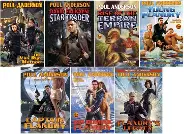
Solar Planets In The Pulps And Later In Heinlein, Asimov, Blish, Anderson And Stirling

Follow the link from "Northwest Smith " in Planetary Adventurers.

Ninety years ago, pulp sf writers treated the Solar System like a galaxy of inhabited planets with breathable atmospheres and even jungles on moons of Jupiter. Such an approach even affected Robert Heinlein's Future History although that series is primarily about the future development of human society, not about human-alien interactions. Isaac Asimov admitted in The Early Asimov that he wrote in this tradition even when he knew better.

We can see later writers emerging from the tradition. In James Blish's Cities In Flight and Mission To The Heart Stars, Martians had existed but are now extinct. Poul Anderson has half a dozen versions of Martians. There are Martians in his Psychotechnic History and in the original version of his "Margin of Profit" although, when that story was revised to fit into his Technic History, these "Martians" had become extra-Solars who had colonized Mars. Anderson also has Venerians in "Sister Planet," Jovians in Three Worlds To Conquer and Mercurians in "Life Cycle." 

When SM Stirling wrote a series in which Mars and Venus turned out to be more or less how earlier sf writers had imagined them, he also worked towards an explanation. A scientist working on Venus says:

"'Sam thinks...and I think...that two hundred million years ago, in the earliest Jurassic...this planet was different. Radically different from what we have now; as far as we can tell, it didn't have life at all. And we don't have any idea what changed it.'"
-SM Stirling, The Sky People (New York, October 2007), CHAPTER TWO, pp. 40-41.

But they will find out.

Saturday, 4 April 2026

The Technic History And Real Life

OK. We have got drawn back into Poul Anderson's Technic History (History of Technic Civilization).

Years ago, I enjoyed Wagner's Ring Cycle on TV because I was able to follow the plot thanks to sub-titles. (I would not have been carried along by the music alone.) Adzel, a Wodenite who resembles a dragon, sings Fafner when he is a student on Earth.

In The Earth Book Of Stormgate, Chinese New Year is celebrated in San Francisco Integrate and Christmas on the planet Ivanhoe. We celebrate both in Lancaster.

We recognize Sikh men by their turbans and their karas. Ensign Flandry takes orders from Commander Singh when no superior officers survive in a space battle.

Kossara Vymezal encounters an extremely unpleasant human subject of the Merseian Roidhunate named Muhammad Snell (Eriau name: Kluwych). We are more fortunate in our Muslim neighbours who share food at Eid. 

Kossara, later canonized, lies in state in St. Clement's Cathedral in Zorkagrad on Dennitza. In Lancaster, we have a Priory Church, a Cathedral of St. Peter and a Polish language Catholic Church among others.

The Terran Emperor celebrates his Birthday by following daylight around the globe. The King of England visited Lancaster where he is Duke.

Our multi-cultural society prefigures their multi-species society. 

Humanity will survive the Long Night but might not survive the Chaos.

Sayonara. 

Monday, 29 December 2025

Diomedean Social Developments

War Of The Wing-Men, IX.

How does the author's reasoning about social developments stack up?

"In many ways, the Drak'honia were closer to the human norm than the Lannachska." (p. 55)

Why?

"Their master-serf culture was a natural consequence of economics..." (ibid.)

So what were their economics?

"...given only neolithic tools, a raft big enough to support several families represented an enormous capital investment." (ibid.)

So why did the Drak'honai make that investment instead of staying with the migratory life-cycle of other Diomedeans? (The answer to this question probably is in the text. I am following through the reasoning again.)

Given life on big rafts:

"It was simply not possible for disgruntled individuals to strike out on their own; they were at the mercy of the State." (ibid.)

OK.

"In such cases, power always concentrated in the hands of aristocratic warriors and intellectual priesthoods; among the Drak'honai, those two classes had merged into one." (pp. 55-56)

In the opening sentence of Chapter I, a single individual bears five titles:

Grand Admiral;
(hereditary) Commander in Chief of the Fleet of Drak'ho;
Fisher of the Western Seas;
Leader in Sacrifice;
Oracle of the Lodestar.

Admiral and Commander are military. 
Leader in Sacrifice and Lodestar are priestly. 
"Fisher" is economic in that raft-dwellers toil to net fish.

Sunday, 27 July 2025

Technic History: Volumes And Instalments

The seven volumes of The Technic Civilization Saga, which is Baen Books' omnibus collection of Poul Anderson's History of Technic Civilization, are uniform in length but not in numbers of instalments collected in each volume because the instalments vary so much in length.

I: 11
II: 7
III: 6
IV: 3
V: 6
VI: 4
VII: 6

Volumes I-II average 9 instalments per volume whereas III-VII average 5.

Volumes I-II cover a historical cycle from interplanetary exploration in "The Saturn Game" to the beginning of the end of the Polesotechnic League in "Lodestar." III goes from League to Empire. IV-VII take a long time to get through the life of Dominic Flandry but eventually takes us into a much further future! In any case, it is all the best future history series, in my opinion.

Friday, 4 April 2025

Changing Laws And Constants

In Olaf Stapledon's Last And First Men and in Poul Anderson's "Flight to Forever," cosmic time is literally a circle. Travelling forward on the Earth's surface returns us to our starting point. Travelling futureward from 1973 eventually returns Anderson's Martin Saunders to 1973 although he passes through the end, then the beginning, of the universe en route. Stapledon's Last Men reveal that the time between the beginning and the end of the universe is only a fraction of the time between the end and the beginning although they do not know what happens in that longer inter-cosmic period. But this is imaginative fiction. What really happens with cosmic time? 

Even if the universe really oscillates as in Eastern mythologies and in Anderson's Tau Zero, the same events will not recur. It will be a new universe with a new history each time. Recent cosmological thinking was that dark energy is accelerating cosmic expansion, preventing any collapse or contraction. Now we might hear something different although, in a period like the current one, the latest findings are never going to be the final word. 

Is the dark energy weakening? If so, is it weakening enough to make a difference? Might the expanding universe collide with others, causing it to rebound and contract? 

"-Here and now, our burnt-out cosmos, expanding, fleeing from itself, has intersected another. From this union, when it is complete, will arise a whole new world of worlds. (Praised be the chance that the other plenum is old itself, that no life - we pray - will perish in the genesis!) What the next cycle will be like, we cannot foretell.
"-Already the very laws and constants of physics are changing." 
-The Avatar, XLVI, p. 381.

The Others aim to become part of something new and strange. Universes are bubbles in a hyperdimensional ocean where their substance becomes part of something new as with stars and flowers.

Wednesday, 19 March 2025

On Demeter And Earth

The Avatar, V-VI.

Some days, there is too much else going on for new blog posts.

In what is left of Chapter V, Dan and Caitlin discuss personal matters against the Demetrian backdrop summarized in recent posts.

On Demeter, there are garms. On Avalon in Poul Anderson's Technic History, there are draculas. In Larry Niven's Smoke Ring, there are large birds whose mating ritual earns them the name, "flashers." Human beings will take words to other worlds and give them new meanings.

Chapter VI, a second one-pager, is narrated by another "avatar" which has been caterpillar, pupa and moth. An insect is conscious, unlike a tree. This insect describes its sensations at each stage of its life cycle, then adds:

"...One gathered me up, taking me back into Oneness, and presently We knew what my whole life had been since I lay in the egg." (p. 55)

In this second case, the selected organism is conscious of its "Oneness" with the Others. We do not know the whole story yet although we might be starting to guess.

The human story continues in Chapter VII which is maybe where we will go tomorrow.

Monday, 17 March 2025

Remembering THE AVATAR II

Poul Anderson, The Avatar (London, 1985), I, p. 1. (II occupies pp. 2-15. There are L (50) chapters in 404 pages.)

I forgot a central point which is the reason for the title. The Elder Race observes a living planet, in this case Earth, by using particular organisms as its "avatars" through which data and experiences are somehow accessed. 

I is narrated by a birch tree which describes its life cycle in two paragraphs. Leaves drink sunlight and dance in the wind although the tree neither sees nor hears so how does it know and tell us this? It says that each cell feels secretly. So secretly that it is not really happening? The tree marks it all because it lives. Yes, a plant is affected by and bears marks of everything that happens to it but this stops short of consciousness. I thought that the tree would awaken into consciousness at the moment when it was selected as an avatar but this does not happen. I ends by stating that the tree was not aware and did not understand but nevertheless knew. Contradiction. Concluding sentence:

"I was Tree." (p. 1)

I know about the avatars because I have read the book before. On a first reading, all that we know in I is that an unconscious organism is unaccountably narrating.

Wednesday, 26 February 2025

Parallel Authors

Culminations probably indicates why I think of Poul Anderson and James Blish in parallel. "The Horn of Time the Hunter," Mission To The Heart Stars and "This Earth of Hours" all involve a spaceship returning from the direction of the galactic centre. The Technic History and Cities In Flight recount the rise and fall of interstellar civilizations. In "The Horn," Jorn reflects that:

"When you fled at almost the speed of light, time shrank for you, and in his own life he had seen the flower and the fall of an empire."
-Maurai And Kith, p. 218.

The universe ends in Tau Zero and The Triumph Of Time. The parallel extends to changes in supernatural realms in works of fantasy. Thus, in The King Of Ys (with Karen Anderson), the Olympians, the Three of Ys and Mithras all withdraw before the new God born in the reign of Augustus and the Age of Pisces while, in Black Easter/The Day After Judgement, demons win Armageddon but then Satan, now God, undoes the damage.

There is an endless cycle of destruction and renewal, it seems. 

Decades ago, Brian Aldiss ended a short story with the phrase:

"...a voice singing in a new universe."
-Brian Aldiss, "Dumb Show" IN Aldiss, Space, Time And Nathaniel (London, 1966), pp. 153-159 AT p. 159.

- and thus spoke for sf.

Friday, 14 June 2024

New Beginning

Fire Time, XIV.

Arnanak applies his religious philosophy to current events:

"...let him go boldly forward. The Three would dance out his fate: in the mighty rhythms of Sun and Ember Star, and in that chaos the Rover brought, from which free will might snatch a chance to begin a new cycle of destinies." (pp. 153-154)

Sun and Ember Star are the cycle of life and death. The Rover is the possibility of a new beginning. Arnanak must act freely when the possibility is near. But it is unfortunate that the only possibility that he sees is military conquest.

I know some astrologers, including one who has written a specialist book on the subject. The ancient belief in the might rhythms of the stars is still with us.

Thursday, 13 June 2024

Two Kinds Of Time

This morning, I realized that Ishtarian Triadism addresses two kinds of time. Life and change are cyclical whereas chaos is disruptive although, on Ishtar, even periodic disruption has become a longer term cycle.

See three previous posts:

Lost Texts And Change

Kinds Of Change

Changes

When I asked a pagan who practised seasonal rituals, how he responded to linear, historical change, he replied, "I don't."

I suggest a tripartite approach:

celebrate the seasons;
meditate;
prepare for social change (which is unavoidably controversial).

Tuesday, 4 June 2024

Captain Dejerine And Jill Conway

Fire Time, VII.

Chapter VII breaks a cycle because it stays with a human point of view. Captain Dejerine is delighted when his guide for a day on Ishtar is to be Jill Conway so Dejerine is the viewpoint character and the third character through whose viewpoint we will see Jill. However, later in this chapter, she regrets a remark so the pov (point of view) has shifted to her and stays there. 

They discuss life on Ishtar. Some of the information is in earlier posts on this blog and more might go on. To Dejerine's surprise, Jill argues that:

"'...the Ishtarians are a more advanced form of life than us.'" (p. 75)

Post-mammalian Ythrians pump oxygen directly into their veins. Ishtarians have beneficent symbiotes. 


Wednesday, 27 March 2024

Pacifism And Future Weapons

The Long Way Home, CHAPTER FOUR.

Blausten, one of the Explorer crew, had been what he calls "'...a pacifist...'" (p. 40) That word can have different meanings and he qualifies it by adding, "'...intellectual pacifist...'" (ibid.) He saw war as a farce and thought that the solution was easy:

"'It stares you right in the face. A universal government with teeth. That's all. No more war. No more men getting shot and resources plundered and little children burned alive.'" (ibid.)

He is in the wrong future history. That solution was tried, unsuccessfully, in Poul Anderson's Psychotechnic History. But this brings us to different meanings of "pacifist." "...with teeth..." means preparedness to use force, a monopoly on violence. In fact, "universal government" definitely means a monopoly on violence. However, the purest, arguably the only fully consistent, meaning of "pacifist" is a rejection of any use of force or violence. Thus, pacifism has to mean anarchism: no government.

Besides, a universal government addresses only the political organization of society. Would the economy continue to be organized in a way that generated conflicts which sometimes became violent?

Blaustein had hoped that the human race would have learned after five thousand years. The cycle of the rise and fall of civilizations might continue, as described, over that long a time although maybe not - how can life and its environment survive the use of such devastating weapons as are described? 

"'Did you know they can disintegrate any kind of matter completely now? Nine times ten to the twentieth ergs per gram. And there are things like synthetic virus and radioactive dust.'" (p. 41)

Sunday, 25 June 2023

Life In Ys

Roma Mater.

We learn more about Cynan, the Mithraist convert. Expecting a comedy by Plautus at the theatre, the Romans find that, instead, Aeschlyus' Agamemnon is to be performed in an Ysan translation by Queen Bodilis. Cynan gets up to leave but is forcibly obliged to remain by the deputy, Adminius, who insists that his men make a good impression and take in some culture. In fact, Cynan is immediately impressed by authenticity and veracity when the play opens with a soldier complaining of weariness on the night watch:

"Cynan's eyes widened. 'Mithras!' he whispered. 'That's the way it is.'" (XX, 1, p. 350)

Afterwards, he wants to know more:

"'What happened next?' Cynan wanted to know. 'That Orestes they spoke of, he must have done something. Are there more plays?'
"'I've heard Greek plays go in threes,' Verica answered. 'Maybe Queen Bodilis has translated the rest. Or maybe she will.'" (pp. 350-351)

As the Andersons expect us to know, the Oresteia is the only surviving Greek dramatic trilogy. Meanwhile, we, the readers of this novel, have learned to respect Cynan.

We learn more about end-of-the-year business in Ys:

food traders at Goose Fair and the Cornmarket
horse dealers at Epona Square
flour mills
breweries
bakeries 
smoking and pickling establishments
windswept Skippers' Market
fishers mending boats and seeking odd jobs
housewives lighting their homes
husbands storing firewood
Suffete social events
temple help for the poor
immemorially old rituals

In A Year In Ys, I missed one passage about the turning year:

"The full moon before autumnal equinox came early that year..." (XXI, 1, p. 357)

Queen Forsquilis leaves Ys and enters the necropolis to seek dreams in the tomb of Brennilis because:

"'...Ys is again at the end of an age. The Old is dying. Time travails with the New, and we fear Its face which we have not seen.'" (p. 358)

The year ends. That is part of a cycle. An age ends. That is another matter. 

Wednesday, 10 August 2022

Timecycles In Combat

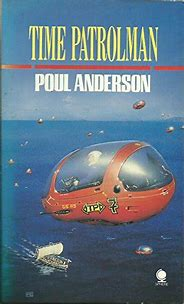
Apart from time travelling, timecycles also hover and fly on antigrav and sometimes fight with built-in guns.

"Ivory, and Apes, and Peacocks"
Seven Exaltationist cycles attack a Phoenician ship but are almost immediately englobed by forty Time Patrol cycles. Twenty are guncraft. The others aim to take prisoners. Attacking, Everard dodges a beam and draws his blaster. The gunners aim to kill the flying Exaltationists before they can escape into space-time whereas Everard and some others hope to capture the life-jacket-wearing spies aboard the ship. Everard approaches a bobbing figure who raises an energy pistol but the Patrolman shoots first, hauls up the semiconscious Exaltationist and finds that he has captured Merau Varagan.

"The Year of the Ransom"
A squadron jumps spatially from an orbiting spaceship to the sky above the Exaltationist base in Machu Picchu. Manse Everard and Gunner Tetsuo Motonobu, on a single timecycle, materialize near a hovering sentry and Motonobu shoots him down. Everard dives his cycle as his colleagues rake the buildings below them. When he arrives, the battle is over.

Monday, 20 June 2022

The Nature Of Time

What time travellers do, can do or are able to do depends on the nature of time.

The Time Traveller explores the future of mankind and of life on Earth.

Poul Anderson's Martin Saunders traverses the cosmic temporal cycle.

Anderson's Time Patrol agents must know how events could have occurred differently in order to ensure that they do not occur differently. Thus, Keith Denison traces Aryan migrations, obviously significant to the populations of India, Persia and Europe.

In Anderson's There Will Be Time, Jack Havig's group must know the course of events in order to achieve group aims within the limits laid down by those events. Thus, Caleb Wallis, never assassinated, will remain alive and apparently in control of his time travel group, the Eyrie, which manages future social developments. However, beyond a certain crucial moment, Havig's group will control Wallis.

The Time Patrol series complements abstract discussion of the nature of time with concrete realizations of human life in alternative timelines, e.g., in the Paris of 1980alpha:

narrow street;
high-peaked walls;
women with covered heads, wearing dark ankle-length gowns;
men in long coats and baggy pants;
smoke;
barnyard smells;
a Christian ziggurat instead of Notre Dame.

Real life but not as we know it. 

Monday, 15 March 2021

Physical Features Of The Ruadrath

A Circus Of Hells, CHAPTER SIXTEEN.

The Ruadrath spend a third of their lives underwater so their furred bodies are otter-like while their heads are sea-lion-like. They have no nose because breath goes through the gills. Their eyes, like those of Ythrians, have nictitating membranes. Webbed feet are fins underwater in summer and snowshoes on land in winter. 

Apart from this, the Ruadrath have:

two large, golden eyes;
two closable ears;
two arms;
two hands, each with four clawed digits;
two legs;
a long, strong tail, like the Merseians.

Thus, despite their curious life-cycle, the Ruadrath are basically humanoid.

Wednesday, 21 October 2020

Death And Life

There Will Be Time, XI.

The Maurai have a drug that makes a person "'...believe whatever he is told.'" (p. 126)

Havig will use this drug on Wallis to gain control of the Eyrie. Dominic Flandry allows a drug with the same effect to be used on himself in order to mislead a telepath.

Kossara Vymezal is an Orthochristian engaged to Dominic Flandry on Dennitza but murdered by agents of the Roidhunate. Xenia is an Orthodox Christian married to Jack Havig in Constantinople but murdered by agents of the Eyrie. Thus, two women are one in faith, and in Poul Anderson's imagination, but sundered by timelines.

Havig encounters a different worldview among the Maurai where a philosopher thinks that:

"'...the forefathers were wise who in their myths made Nan coequal with Lesu. A thing which endured forever would become unendurable.'" (p. 124)

This is the opposite of the significance of Jesus in Orthodox Christianity. When the Maurai philosopher continues:

"'Death opens a way, for peoples as well as for people.'" (ibid.)

- he refers to the old idea of death and life as cycle, not to the Christian idea of a permanent conquest of death.

Sunday, 29 March 2020

Primitive And Advanced Spaceships

"A Little Knowledge.", p. 616.

Like the Kirkasanters later in the Technic History, the Trillians know that faster than light interstellar travel is possible but must build their spaceships without the benefit of any higher technology.

They use:

large, clumsy fission units;

vacuum tubes;

glass rectifiers;

kilometers of wire;

data stored on tape, not in single molecules, retrieved with cathode-ray scanners, not with quantum-field pulses;

computers composed of miniaturized gas-filled units reacting in microseconds, not of photon interplays reacting in a single nanosecond.

By contrast, a Technic spaceship is an integrated system of:

a thermonuclear power plant;
initiative-grade navigation and engineering computers;
full-cycle life support;
solid-state circuits;
molecular- and nuclear-level transitions;
not moving parts but forcefields;
more energy than matter;
an organism rather than a mechanism.

Sounds good. Will it ever exist? Does it exist elsewhere already? Will we ever know?

Another reference to gravanol. (p. 627)

Saturday, 14 September 2019

Single Volume Approaches To Futures

By "single volume," I mean to exclude omnibuses. Thus, James Blish's Cities In Flight was first published as four novels, then as one omnibus volume.

HG Wells' Time Traveler tells his dinner guests that, after he had set off earlier that day, the night, then tomorrow, then tomorrow night "...came...'" (The Time Machine, 4, p. 24) (This confirms my belief that the Time Machine does not move but stands still while effectively fast forwarding, then rewinding, everything else.)

The "future" covers all of time from tomorrow and "the day after tomorrow" until the end of the universe and sometimes beyond that, as in Poul Anderson's single-volume Tau Zero or in James Blish's Cities In Flight, Volume IV.

Nine Single Volumes
Wells' The Time Machine fast forwards history from 1895 to 802,701 A.D., then to the end of life on Earth, then rewinds.

Wells' The Shape Of Things To Come is a historical text book covering the period 1900-2050.

Stapledon's Last And First Men is a historical text covering the entire future of humanity.

In James Blish's The Quincunx Of Time, people in a relatively near future receive messages from further futures, including a distress call from a world-line cruiser traveling from 8873 to 8704 on the rim of NGC 4725, eleven million light years away.

Brian Aldiss' Galaxies Like Grains Of Sand is nine stories with interstitial material covering the entire future of humanity.

Poul Anderson's Tales of The Flying Mountains is seven stories with conversational "Interludes," covering part of a future.

Anderson's Genesis ends with the far future re-creation of extinct humanity.

Anderson's Tau Zero fast forwards time to the beginning of the next cosmic cycle.

Anderson's "Flight to Forever" fast forwards circular time from, then back to, 1973.

Always more from Anderson.

Monday, 8 July 2019

In Space

(In 1907, not only cars but even fountain pens were a new big deal!
See A Hundred Years Or So.)

For Love And Glory, XLV.

("XLV" means "45," doesn't it? The trouble with these Roman numerals is that you have to keep working them out. This one means "50 - 10 + 5.")

Lissa, Hebo and Dzesi are going somewhere important in a spaceship so we have to have a chapter set inside the ship as we do more than once with Dominic Flandry and others.

Stars seen through the viewscreen are:

"...gems of frost strewn through a crystal darkness. How often had she beheld this? Yet it never failed to stir awe deep within her." (p. 251)

How often has Poul Anderson described this, always differently?

Here is something that we did not know about life in spaceships:

"Full health on a long trip required weatherlike variations in air." (ibid.)

This chapter describes two variations:

"At the present stage of the cycle it bore a slight, electric tinge of ozone." (ibid.)

"The air rustled, cooling off, smelling more and more like a rainstorm drawing nigh." (p. 253)

Dzesi the Rikhan goes "'...to kshanta.'" (p. 251)

All that her human partner, Hebo, knows about kshanta is that:

"'It involves being alone for several hours.'" (p. 252)

Discussing the characteristics of intelligent races, Hebo comments:

"'I wouldn't call anything except their basic biology true of every culture and every individual in any race.'" (ibid.)

Right. Intelligence is the ability to change our environments and thus also to change ourselves in the process. Human variations look like different species. See:

"Homo Sum"
The Discovery Of The Past II