Showing posts sorted by relevance for query Martians. Sort by date Show all posts

Monday, 8 June 2015

Poul Anderson's Martians: The Full List?

I am due to go out shortly but let's reflect for a moment. Reading SM Stirling's Martian novel has prompted discussion of fictional Martians in general and of Poul Anderson's various Martians in particular. By checking back, I am learning how many Martian races Anderson imagined and what they look like. I have even found a picture of Kreega in "Duel on Syrtis." (See image.)

Provisional conclusion - Anderson imagined at least six native Martian races:

hibernating natives in the Psychotechnic History;

Martians resisting Terrestrial rule in "Duel on Syrtis" and "War-Maid of Mars";

avian Martians in "The Martian Crown Jewels;"

small tentacled Martians in The Makeshift Rocket/"A Bicycle Built For Brew" and "Captive of the Centaurianess;"
 
Martians who conquer Earth in The War Of Two Worlds;

powerful, undescribed Martians in Shield -

- and two different groups that become "Martians" by colonizing Mars. There is always more to say but later.

Saturday, 12 October 2024

Martians

In "Holmgang," Bo Jonsson describes Martians as stiff and correct. In "Cold Victory," a Martian professor wears his academic gown even in a bar because Martians are like that.

Does that sound like Martians to you? Surely they are martial/warlike, or invaders of Earth or extinct by now or hidden underground where we cannot detect them? They are all these things and more. They are whatever an sf writer thinks that they are. CS Lewis tells us that HG Wells' Martians are very different from the real Martians - but he tells us this in a work of fiction!

And, of course, the point that I have glided over until now is that Poul Anderson's stiff, correct, academic "Martians" are human beings that have colonized Mars, not natives. There were native Martians earlier in the Psychotechnic History so what has become of them? An obvious answer springs to mind.

The Martians in Anderson's Technic History are extra-Solar colonists of Mars. Sf, and particularly Poul Anderson, covers every option.

Monday, 3 August 2026

Merseians And Martians

My mind has been elsewhere for most of today as my body will be elsewhere on Friday this week with a day trip to York. 

Meanwhile, we cannot really compare Merseians with Martians because there is only one fictional race of Merseians whereas there are no one knows how many fictional races of Martians. Poul Anderson's Merseians, at least those of the Roidhunate, like HG Wells' Martians, want to conquer Earth whereas Ray Bradbury's Martians are almost entirely wiped out by chicken pox brought from Earth - just as Wells' Martian invaders are killed by Terrestrial microbes - while at the same (in a different timeline) CS Lewis' Martians are protected from Terrestrial evil by superior beings in the Solar System. What could be more different? And those are just three of the most prominent examples.

The comparison that I have in mind here is with SM Stirling's Martians. Merseians are multicultural. See information about Cnif hu Vanden here and particularly here. By contrast, Stirling's Martians have been monocultural throughout a very long history and this makes it hard to tell how much of their psychology is genetic as opposed to cultural. Is a monocultural species easier to write about or must the author work harder to keep it consistent? As a mere reader, I can only guess.

Thank you all for so many page views for a day when this is the first post.

Sunday, 14 November 2021

What, No Martians?

Martians lingered surprisingly long in sf. There are stories, entire series, with Martians, stories with no Martians and:

Intermediate Versions Of Mars
(i) Whereas ERB's John Carter had astrally projected himself to present-day Mars, Michael Moorcock's Carter-pastiche character, Michael Kane, time travels to Mars at a time before the human race had emigrated to Earth.

(ii) In James Blish's They Shall Have Stars, Martians are extinct because they wasted resources spreading the Diagram of Power over the whole planetary surface.

(iii) Poul Anderson put Martians in the first Nicholas van Rijn story, "Margin of Profit," but then changed these Martians into extra-solar colonists.

(iv) In Anderson's The Fleet Of Stars, "Martians" are Terran and Lunarian colonists of Mars.

(v) SM Stirling wrote retro-sf with an inhabited Mars but this is set in an alternative history where a superior technology had terraformed Mars and Venus and imported Terrestrial organisms.

There are no doubt other examples.

Friday, 5 June 2015

Marses

SM Stirling, In The Courts Of The Crimson Kings (New York, 2008).

"Martians called their planet Zho'da..." (p. 26).

Did they? We must take SM Stirling's word for it! I know Martians who call their planet Barsoom and others, speaking Solar, not Martian, who call it Malacandra. But there are many races of Martians... CS Lewis casually informs us that HG Wells' Martians are very different from the real Martians. Of course they are!

Zho'dans have several similarities to Barsoomians:

airships;
canals;
"...traveling silks and furs..." (p. 27);
swords;
an ancient civilization;
monarchical government;
human form.

(A longer list than I realized when I started to write it.)

How would Terrestrials seem to Martians? We should be able to deduce this but, of course, we need an imaginative writer, in this case SM Stirling, to tell us:

"'...they ooze. They're positively slick with water and mucus most of the time. You can feel it on their breath.'" (p. 24)

Earth is wet, Mars is dry... We should have been able to deduce that for ourselves.

How many Martian races does Poul Anderson present?

The War Of Two Worlds
Shield
"Duel on Syrtis" and its sequel
The Technic History
Are Martians mentioned in the Psychotechnic History? (I cannot remember off hand.) (Later: They are. See here.)

Thursday, 21 August 2025

Mars And Martians

(I have maligned CS Lewis but first let us follow through the logic of the current post.)

Wells, Lewis and Anderson: what a trio of different imaginative authors!

Mars and Martians can be detachable items. Thus, HG Wells' The War Of The Worlds and Poul Anderson's The War Of Two Worlds are about Martians but are set on Earth - because, in both cases, the Martians have invaded Earth, obviously. Anderson never set an entire novel on the surface of Mars although there are scenes on the planet in a few of his works. Readers are invited to remember which. 

When Heinlein or Anderson wrote about Martians, it must still have been scientifically possible that Martians existed? - although Isaac Asimov acknowledged in The Early Asimov that Martians, Venerians and inhabitants of other Solar planets remained a convention in sf after they had ceased to be feasible. So much has been learned so recently with probes. 

Lewis, writing Out Of The Silent Planet before World War II - thus, in a very different era - does a very good job of explaining why Mars, which had been fertile a long time ago, appears inhospitable when observed by Terrestrial astronomers although air, water and life still persist within deep crevasses - the canali. Similarly, Lewis' oceanic Venus was no more counterfactual at the time of writing than versions of the planet written by Heinlein or Anderson.

So I was wrong to put Lewis in the same category as Bradbury.

Monday, 10 August 2020

"Martians" And Extinct Martians

Poul Anderson has half a dozen versions of Martians, then an uninhabited Mars visited in Twilight World and another uninhabited Mars colonized by Terrestrials and Lunarians in Fleet Of Stars. So, like sf in general, Anderson imagines Mars first as inhabited, then as uninhabited?

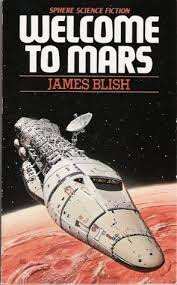
But there are intermediate positions. In James Blish's Cities In Flight and two Jack Loftus novels, Martians did exist but have become extinct. The last Martian dies as Earthmen arrive in Blish's Welcome To Mars. The hero of Michael Moorcock's ERB pastiche time travels to the era before the human race had migrated from Mars to Earth. The origin of the DC Comics superhero, the Martian Manhunter, changed from teleportation to time travel.

Anderson's "Margin of Profit" had Martians but, when the story was revised to fit it into the Technic History, those "Martians" had become extrasolar aliens who had colonized Mars. Every possibility is covered but this time not just by Anderson.

Sunday, 7 June 2015

Mars And Martians

Mars and Martians are a big subject. In fact, they need not even be a single subject. Mars can be uninhabited. Alternatively, if Martians are imagined to exist, then they can be encountered elsewhere, e.g., on Earth in Wells' The War Of The Worlds. Heinlein's Red Planet is set on an inhabited Mars whereas his A Stranger In A Strange Land features a Martian-raised man back on Earth.

When recently I listed Larry Niven as an author of a composite Mars, I forgot to mention that Martians also appear in his Known Space future history where water poisons them - and they continue to exist in the Map of Mars on the Ringworld long after a human protector has exterminated them in the Solar System.

I have mentioned Poul Anderson's several races of Martians but Anderson also presents a Mars that was uninhabited until colonized by human beings. See:

"Martians"
AI, Desert Planets And Jihads
Visions Of Mars
Inrai

A desert planet where water is precious and where human bodies must be entirely covered to protect them from the environment - SM Stirling's Mars sounds like Herbert's Dune, except that Dune is hot whereas Mars is cold.

Monday, 8 June 2015

Poul Anderson's Martians: Owlies, Hordes And Conquerors

Searching the blog for physical descriptions of Poul Anderson's Martians, I found this post that compares two of Anderson's Martian races. I remarked somewhere that, like ERB's green Martians, the Martians of the Technic History have social units called "hordes." However, I cannot find that post now so let me merely repeat the remark here.

That leaves only the Martians of The War Of Two Worlds, the most humanoid of Anderson's Martian races. Again, I am sure that I would have listed their physical characteristics in an earlier post but cannot easily find it so:

long straight legs;
lean waist and arms;
very broad chest and shoulders;
hairless brown skin;
high cheekbones;
domed forehead;
narrow chin;
long pointed ears;
small flat nose;
mobile, human-like mouth;
large slanted golden eyes;
small antennae.

An sf cliche? Sounding more like a man adapted to Mars than an independently evolved organism? Nevertheless, these particular Martians serve their purpose in this early novel.

Thursday, 28 November 2013

Martians

How many fictional races of Martians are there? I have lost count of Poul Anderson's although he surely has over half a dozen. One of his sets of "Martians" comprises extra-Solar colonists although they share certain physical characteristics with an indigenous Martian race in another story.

The "Marshies" of his The War Of Two Worlds (New York, 1959) sound like cartoon Martians:

seven feet tall;
long straight legs;
lean waist and arms;
large chest and shoulders;
hairless brown skin;
high cheekbones;
domed forehead;
narrow chin;
long pointed ears;
small flat nose;
mobile mouth;
large slanted golden eyes, protected by additional transparent eyelids from Terrestrial sunlight;
small antennae;
black uniforms;
able to live, uncomfortably, in Terrestrial atmosphere and gravity, unlike men on Mars;
huge spongy lungs drawing oxygen from food as well as from air by "...symbiosis with anaerobic bacteria." (p. 26)

This description has three features:

some logical extrapolations about what bipedal life should look like on Mars;
a few cartoonish elements;
recognizably characteristic Andersonian speculation about alternative life forms.

The Martian conquerors are polite like the Chinese. Thus, life on occupied Earth is not very different from being ruled by human beings of a different nationality. There is nothing really alien or unEarthly, as there was under Wells' very different Martians.

Saturday, 6 June 2015

Human Martians

Most fictional Martians are not human beings. Indeed, how could they be? In fact, there are three exceptions. Poul Anderson's six or more Martian races are of course all aliens but Anderson's sf was preceded by, among others, the works of Edgar Rice Burroughs.

The first Martians encountered by ERB's John Carter - green, twelve foot, hairless, tusked, six limbed and egg-laying - sound more like giant insects. However, in any ERBian universe, the hero has to marry a Martian princess. Therefore, without any explanation or rationale, Carter soon encounters humanoid Martians. He not only marries the Princess of Helium but even gets her pregnant even though her metabolism is so different that, instead of giving live birth, she lays a large egg that will hatch their son. ERB's Mars, with its canals and thin but breathable atmosphere, was based on contemporary astronomical observations but his ideas about Martian life were off the wall.

Michael Moorcock pastiched ERB and rationalized human beings on Mars. His hero, Michael Kane, accessed Mars not by ERBian astral projection but by time travel into the far past. Thus, his Mars still had oceans, an atmosphere and a human race that had not yet migrated to Earth.

Thirdly, in SM Stirling's In The Courts Of The Crimson Kings (New York, 2008), mysterious beings with a higher technology have terraformed Mars and seeded (?) it with humanity originating on Earth. Thus, these tall, thin, dry humanoids are not products of extraterrestrial evolution but are related to us. I have started Chapter Two. So far, I am finding the text less accessible than that of the previous volume, The Sky People, because several passages are presented from the point of view of an unsympathetic Martian character whose historical and political context have not yet been fully explained.

A book on imagining extraterrestrials made the point that we have to imagine an organism that has originated and evolved elsewhere. Thus, a tall, thin, large-chested humanoid is not a Martian but a Terrestrial adapted to Mars. However, that is precisely what Stirling describes:

"...Highlanders even more eerily elongated than the standard Martians and barrel-chested..." (p. 53).

Saturday, 3 October 2020

Who Are The Real Martians?

"Martian" can mean whatever an sf writer makes it mean. ERB's Martians are martial - and are called Barsoomians. Wells's are:

"...intellects vast and cool and unsympathetic..."
-HG Wells, The War Of The Worlds (Harmondsworth, Middlesex, 1974), BOOK ONE, 1, p. 9.
 
However, CS Lewis, a character within his own novel, refers to:
 
"...Mr Wells's Martians (very unlike the real Malacandrians, by the bye)..."
-CS Lewis, Perelandra IN Lewis, The Cosmic Trilogy (London, 1990), pp. 145-348 AT 1, p. 151.

Poul Anderson does many things with Mars. In "The Nest," Captain Olga Borisovna Rakitin of the Martian Soviet, who swears by Lenin, says:
 
"'...the odds are ridiculous... And as a Martian, I am Dostoyevskian enough to enjoy the fact a trifle.'" (p. 98)
 
OK. On the authority of one character in one short story, we accept, for the time being, that Martians are Dostoyevskian.

(In seeking out the references for this post, I discovered an odd literary parallel. The War Of The Worlds, about Martians coming to Earth, is dedicated "To my brother, FRANK WELLS, this rendering of his idea," whereas CS Lewis's Out Of The Silent Planet, about Earthmen going to Mars, is dedicated "TO MY BROTHER  W.H.L. A lifelong critic of the space-and-time story.")

Sunday, 7 June 2015

Poul Anderson's Martians: The Martian Crown Jewels And Shield

OK. I am trying to track down physical descriptions of Poul Anderson's half dozen or so Martian races but this is no easy matter and will take a while. I think that I am right to say, and have said before, that "A Bicycle Built For Brew" and "Captive of the Centaurianess" share a race of Martians even though these two stories are not otherwise connected, i.e., do not fit into the same continuity?

But my first task is to describe the Martians of "The Martian Crown Jewels." I have posted about this story but not included any description of its Martians so I must return to Anderson's text: a seven-foot, stork-like biped with a large, lean, crested head, red beak, deep yellow eyes, sinuous neck, white feathers, blue-plumed tail, thin red arms, four-fingered hands and erect posture, using phrases like "'...my tear chab...'" and "'Elementary, my dear fellow.'" (Call Me Joe, pp. 429, 430)

Unbelievable. The speech patterns on top of that physical description. Another problem I have is that, if such a description is offered just once early in the story without, e.g., any accompanying cover illustration, then I cannot remember the details while reading. Instead, I retain just an impression of a long thin body, nothing more. Later, I misremember it by, e.g., adding insectile features which are simply not there. I had forgotten that the creature was avian. But can this be a serious description of a possible Martian organism? Maybe not. If, as seems to be the case, the story is tongue-in-cheek, then its description of an alien body becomes a bit of a joke as well - although not one that appeals to me very much. Humor is a matter of taste. In fact, I would feel very uneasy around a large, beaked, bird-like being whether or not he was calling me a dear chap.

I am now searching the blog for posts about Shield and am finding some references to its Martians but, again, not a physical description as yet. See here and here. This topic will require more than one post.

Saturday, 6 June 2015

Marses II

We might as well discuss fictional versions of Mars and Martians in general but that is an enormous topic. This blog has already, in diverse posts, addressed Poul Anderson's several Martian races which seem to be sui generis, except that Anderson borrowed Wells' title with just a slight variation. See here.

I think that the main writers about fictional Martians are:

British
Wells
Stapledon
Lewis

American
Burroughs
Heinlein
Bradbury

The Brits form a perfect triad:

Wells writes separately both a future history and a novel about a Martian invasion of Earth;

Stapledon describes Martian invasions of Earth among many other events in a future history text book;

Lewis, disagreeing with Wellsian and Stapledonian visions of the future, locates evil only on Earth and tells us that Wells' Martians are very unlike the real Martians!

However, there are many other writers about Mars:

relevant to Burroughs
Edwin Arnold
Otis Adelbert Kline
Michael Moorcock

authors of composite Marses
Larry Niven
Alan Moore

James Blish incorporated Mars into his Haertel histories by putting the seminal character, Adolph Haertel, on Mars. Professor Quatermass thought that one group of alien invaders had come from Mars and Quatermass' successor on British television, Doctor Who, has his version of Martians, the Ice Warriors.

And that is as comprehensive as I feel like getting at present.

Monday, 20 August 2012

"Martians"

"Martians" usually means "natives of Mars." (See HG Wells, Olaf Stapledon, CS Lewis, ER Burroughs, Ray Bradbury, Robert Heinlein etc.) Poul Anderson thought of two other meanings. In his Technic History, extrasolar aliens for whom Mars is habitable colonize it and come to be called "Martians."

In The Fleet Of Stars, Terrans and Lunarians colonize Mars, and thus become "Martians," because:

both species can breed in Martian gravity which is neither too low for Terrans nor too high for Lunarians;
dwellings do not need domes or excavations as on Luna;
altered species can flourish on the surface;
mineral mining is profitable;
low gravity and proximity enable Martians to export to the asteroidal colonies.

Thus, many generations live on Mars so that some individuals and families want to remain there even when the original economic reasons no longer apply. Anderson understood that societies develop their own momentum.

Wednesday, 24 August 2016

Dwarfs

Poul Anderson, Operation Luna (New York), Chapter 27.

Tolkien, Lewis and Anderson all describe dwarfs. Lewis and Anderson also describe Martians. Dwarfs and Martians have big places in our collective imagination. They are fantasy and sf, respectively. When an author describes Martians, he is free to write whatever he wants. Lewis respects Wells well enough to inform us that the latter's Martians are very different from the "real Martians."

By contrast, when an author describes dwarfs, he has to be authentic to the myths and legends. It is as if the dwarfs were real beings. Lewis informs us that they like digging in the way we enjoy what we regard as leisure activities. Anderson describes the dwarf Fjalar exactly as we expect:

four feet tall;
wide and thick;
musceled and massively boned;
hairy;
large red nose;
bearded;
leather aproned;
sooty and scorched;
unwashed;
wearing wooden shoes.

Fjalar refers to "'...holmgang.'" (p. 246)

"Holmgang" was a story in Anderson's early Psychotechnic Future History. Thus, this is a third allusion to an earlier period of sf. See here.

Tuesday, 27 December 2022

Thirty Years On Mars

Poul Anderson, "Un-Man" IN Anderson, The Complete Psychotechnic League, Volume 1 (Riverdale, NY, July 2018), pp. 21-100.

(This volume was published in 2018. James Blish's Cities In Flight, Volume I: They Shall Have Stars, was alternatively titled Year 2018!)

In 2004, human beings have been on Mars for thirty years. In that time, they have built cities, mined, smelted and ranched. On this Mars, there are bogs at the poles, woods at the equator, animals and even a few secretive natives left. Martian organisms can sleep through drought and cold. Human beings might derive suspended animation from this but there is no further development of that idea later in the series.

The Martian natives are dying out, of course.

Earlier sf: Martians.
Later sf: no Martians.
Intermediate stages: Martians dying out; Martians extinct; extra-solar colonists of Mars in Anderson's Technic History.
Retro-sf: Martians in alternative timelines.

Monday, 15 November 2021

What, No Martians? II

See What, No Martians?

Of course there is yet another category:

(vi) Works of fiction that refer to Martians without claiming that the Martians are real, e.g., in James Blish's contemporary novel, Fallen Star, a character claims to be a Martian. However, I learned in conversation with Blish that we were supposed to regard that characters as psychotic! I am not sure that a reading of the text fully supports that view but, in any case, the question remains unresolved by the end of the novel. Similarly, The Autocracy Of Mr. Parham and Star Begotten by HG Wells feature Martians existing only in their human characters' minds.

Poul Anderson has a short story in which some spacemen fake an alien attack. This is not a faked Martian attack but nevertheless a faked alien attack, thus the same sort of idea. If fictional characters do not meet aliens, they can nevertheless refer to them just as we do.

Sunday, 7 August 2016

Martians And Morpheus

As CS Lewis points out in Perelandra, we imagine two distinct categories of non-human intelligences:

"scientific," e.g., Martians;
"supernatural," e.g., ghosts.

We are shocked when Lewis, who, in this text, is not only author but also narrator, informs us that, on Mars, his friend Ransom had met beings that were both extraterrestrial and supernatural - like Martian ghosts!

Poul Anderson presents:

 several races of Martians, who are kept well within the watertight compartment of hard sf;

supernatural beings in several works of fantasy.

In particular, The Broken Sword incorporates not only every national pantheon but also every species of folkloric sprite. Lewis rightly says that ETs and spirits are usually kept apart. Usually but not always - check out Heinlein's and Bradbury's Old Ones of Mars and Aldiss' Helliconian hereafter. See here.

Anderson approaches a rapprochement between fantasy and sf in his inter-universal inn, the Old Phoenix. Nicholas van Rijn does business with a Martian in "Margin of Profit" and also rubs shoulders with characters from works of fantasy in the Old Phoenix in "House Rule."

Superheroes fiction, a composite genre, unites fantasy and sf on an equal footing. Morpheus (definitely supernatural) meets the last Martian (definitely scientific) who sees Morpheus in a non-human form and addresses him thus:

"Lord L'Zoril, I greet you humbly: may you guard us in the darkness and on the pathway between waking hours, and protect us in dreams from the flame of your wrath."
-Neil Gaiman, The Sandman: Preludes And Nocturnes (New York, 1995), p. 146.

This race of Martians, not created by Gaiman but hailing, of course, from a dry planet, reacts to fire much as Krptonians react to Kryptonite.

I feel privileged to be able to navigate between these many worlds of the imagination.

Monday, 8 June 2015

Poul Anderson's Martians: Shield And Un-Man

Albeit without rereading Poul Anderson's Shield (New York, 1970) from cover to cover, I now think that I cannot find a physical description of the Martians in this novel because there is no such description. The entire action of the novel is on Earth. On p. 11, Koskinen, who has just returned from Mars, reminisces...

The Martian, Elkor, has a "huge form" and communicates with Koskinen with coded vibrations transmitted through a "palp" laid from behind on the Earthman's neck. That is all - and it is enough. As I said in the previous post, I usually forget details of a description of an alien form given once early in a text but, on rereading, these enigmatic hints about Elkor are preferable to the graphic stork-like bipedal form of "The Martian Crown Jewels."

(To touch base with SM Stirling's In The Courts Of The Crimson Kings, which is being read meanwhile, in "The Martian Crown Jewels," the Martian Syaloch's apartment is illuminated by "...glowsnakes..." (Call Me Joe, p. 429). Thus, these two races of Martians use biotech. ...Crimson Kings also features the very high tech of the Lords of Creation. This tech, concealed underground but glowing and affecting brains and minds when approached, reminds me of the Kryptonian tech in the Smallville TV series.)

Rereading part of Chapter III of "Un-Man" (New York, 1962) confirms that there are a few surviving native Martians, "...shy and secretive..." (p. 19), in Anderson's Psychotechnic History. Again, I do not think that there is any description. They are mentioned because it has been discovered that they can sleep through the winter or a drought. Although their blood freezes:

the freezing point is much lower than for human blood;

when freezing does occur, released enzymes prevent cell rupturing;

a process comparable to ion exchange circulates oxygen and nutrients even through the ice;

returning heat revives the organism.

I never knew that.