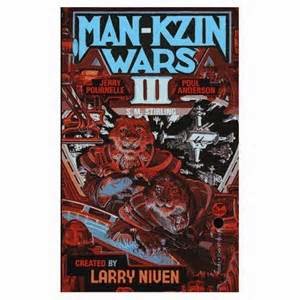
Poul Anderson, "Iron" IN Larry Niven, Ed, The Man-Kzin Wars (London, 1989), pp, 27-177.
Ulf Reichstein Markham and Tyra Nordbo first appeared in Man-Kzin Wars stories written by Poul Anderson, then reappeared in the fictionally earlier although later-written Man-Kzin Wars stories of Jerry Pournelle and SM Stirling. I thought that Pournelle and Stirling had introduced Markham but that was just me getting confused between the publication history and the fictional chronology.
Markham respects the "'...valiant, loyal, disciplined...'" (p. 44) kzinti. This sounds like Anderson's Olaf Magnusson respecting the Merseians.
Dorcas Saxtorph accuses Markham of uttering "'...an intolerable racist insult.'" (p. 56) I missed it but maybe his generalization about flatlanders counts. Before that, they had been having an interesting discussion about society. In a healthy society, according to Markham, lesser persons accept guidance from superior persons for the longer term social good. For the leader, power and glory are not ends but means to:
"'...the organic evolution of the society toward its destiny, the full flowering of its soul.'" (p. 55)
Sounds patriarchal? The kzinti are ruled by a Patriarch. Markham uses obscure terminology:
"'...we are replacing living Gemeinschaft with mechanical Gessellschaft.'" (p. 55)
Juan Yoshii of the Rover crew wants "'To be a poet.'" (p. 60)
- like Jesse Nicol in Anderson's Harvest The Fire.
Yoshii asks:
"'In the centuries of spaceflight, how much true poetry has been written?'" (p. 60)
- and Nicol, en route to the outer Solar System, exclaims:
"'The inhuman may be what's mine, stars, comets, hugeness, a universe that doesn't know or care but simply and gloriously is - but humans are there -'" (Harvest The Fire, New York, 1887, p. 190).
Anderson, a novelist of the space age, also recognized the need for poetry.
Just after the purchase of the hyperdrive, mankind is on the verge of "'...great adventures,...the age of discovery that must come...'" (p. 45) This reminds us of:
"The world's great age begins anew...
"...it is enough that we are on our way." (The Van Rijn Method, New York, 1997, pp. 555, 556)
A red dwarf moving through the galaxy at over a thousand kilometers per second is nearly as old as the universe. (p. 65) Such Andersonian cosmic sf transcends Known Space and the Technic History and is also to be found, e.g., in the "Pride"/Tau Zero diptych.
"'Every explorer is an amateur by definition.'" (p. 46)
This reminds us of the opening and closing chapters of The Boat Of A Million Years, set respectively before Christ and in an indefinite future.
Does anyone do it better than Anderson?
Showing posts sorted by relevance for query Markham. Sort by date Show all posts
Sunday, 3 April 2016
Saturday, 1 August 2020
Multi-Authorship: Slavers And Markham
Larry Niven created the Slavers, a species of hypnotic telepaths;
Poul Anderson created Ulf Markham;
Jerry Pournelle & SM Stirling deduced that Markham would welcome control by a Slaver.
Markham thinks:
"The Master's race was fit survive and dominate. Overman ... is demigod, he remembered. No more struggle, the Power proved whose Will must conquer."
-"The Asteroid Queen," Chapter VI, p. 116.
Well, yes. If you think that the only alternatives are to dominate or be dominated and if you are unable to resist domination by a Slaver...
Thus, Markham remains pro-Slaver even when out of the grip of the Power:
"Control must be maintained until the Master awoke; he could feel the others would be difficult. Only I truly understand, he realized. It was a lonely and terrible burden, but he had the strength for it. The Master had filled him with strength. At all costs, the Master must be guarded until he recovered." (p. 117)
Ye gods! While a Slaver is unconscious, kill him, if you cannot put him back into stasis.
Anderson's character, Yo Rorn, cannot resist mental incorporation by the extra-galactic Ai Chun. Unlike his own civilization, they give him:
"'Wholeness.'"
-Poul Anderson, World Without Stars (New York, 1966), XII, p. 81.
"'...something great, calm, beautiful, at peace with itself.'" (ibid.)
Humanity will be divided against itself if it encounters hostile aliens.
Poul Anderson created Ulf Markham;
Jerry Pournelle & SM Stirling deduced that Markham would welcome control by a Slaver.
Markham thinks:
"The Master's race was fit survive and dominate. Overman ... is demigod, he remembered. No more struggle, the Power proved whose Will must conquer."
-"The Asteroid Queen," Chapter VI, p. 116.
Well, yes. If you think that the only alternatives are to dominate or be dominated and if you are unable to resist domination by a Slaver...
Thus, Markham remains pro-Slaver even when out of the grip of the Power:
"Control must be maintained until the Master awoke; he could feel the others would be difficult. Only I truly understand, he realized. It was a lonely and terrible burden, but he had the strength for it. The Master had filled him with strength. At all costs, the Master must be guarded until he recovered." (p. 117)
Ye gods! While a Slaver is unconscious, kill him, if you cannot put him back into stasis.
Anderson's character, Yo Rorn, cannot resist mental incorporation by the extra-galactic Ai Chun. Unlike his own civilization, they give him:
"'Wholeness.'"
-Poul Anderson, World Without Stars (New York, 1966), XII, p. 81.
"'...something great, calm, beautiful, at peace with itself.'" (ibid.)
Humanity will be divided against itself if it encounters hostile aliens.
Tuesday, 1 April 2014
Roll Call
Anderson, Poul, "Iron" IN Niven, Larry, Ed., The Man-Kzin Wars (London, 1989), pp. 27-177.
An exploratory group travels in the hyperdrive spaceship Rover to the planetary system of a wandering red dwarf star where sub-groups visit moons and planets in smaller interplanetary craft. I sometimes lost track of who was where when. The full list is:
Captain Robert Saxtorph from Earth;
First Mate Dorcas Saxtorph from the Solar System Asteroid Belt;
Professor Arthur Tregennis, astrophysicist, from Plateau;
Laurinda Brozik, Tregennis' graduate student, from We Made It;
Ulf Reichsteim Markham, Interworld Space Commissioner, from Wunderland;
Kamehameha Ryan, Rover quartermaster, from Earth;
Carita Fenger, boat pilot, from Jinx;
Juan Yoshii, boat pilot, from the Belt.
Of these eight, two are a couple, four become couples and two die.
The red dwarf has five planets and the kzinti have a base on Secunda. When the single kzinti warship in the system rendezvouses with Rover, Carita and Juan have already set off for Prima, from where they must later be rescued, in ship's boat Fido, while the Saxtorphs and Laurinda have set off for Tertia in ship's boat Shep. Markham turns out to have been all along an agent of the kzinti. That leaves Tregennis and Ryan as prisoners.
A kzin kills Tregennis when the Saxtorphs and Laurinda rescue Ryan. Dorcas alone highjacks a kzinti tug, uses it to destroy the warship, then rendezvouses with Shep so that Ryan can join her in the tug. Robert, assisted by Laurinda, retrieves the captured Rover from a Secundan moon.
The Saxtorphs use the hijacked tug to deflect an asteroid so that it crashes onto the kzinti base. Their military manoeuvres against a more powerful enemy are masterful, as is Anderson's account of social upheavals on Wunderland after the liberation from kzinti occupation. Proles who had worked in kzinti war production storm the manors of "collaborationist" aristocrats. Markham, disgusted with Earth, admires the kzinti and passes hyperdrive information to them...
An exploratory group travels in the hyperdrive spaceship Rover to the planetary system of a wandering red dwarf star where sub-groups visit moons and planets in smaller interplanetary craft. I sometimes lost track of who was where when. The full list is:
Captain Robert Saxtorph from Earth;
First Mate Dorcas Saxtorph from the Solar System Asteroid Belt;
Professor Arthur Tregennis, astrophysicist, from Plateau;
Laurinda Brozik, Tregennis' graduate student, from We Made It;
Ulf Reichsteim Markham, Interworld Space Commissioner, from Wunderland;
Kamehameha Ryan, Rover quartermaster, from Earth;
Carita Fenger, boat pilot, from Jinx;
Juan Yoshii, boat pilot, from the Belt.
Of these eight, two are a couple, four become couples and two die.
The red dwarf has five planets and the kzinti have a base on Secunda. When the single kzinti warship in the system rendezvouses with Rover, Carita and Juan have already set off for Prima, from where they must later be rescued, in ship's boat Fido, while the Saxtorphs and Laurinda have set off for Tertia in ship's boat Shep. Markham turns out to have been all along an agent of the kzinti. That leaves Tregennis and Ryan as prisoners.
A kzin kills Tregennis when the Saxtorphs and Laurinda rescue Ryan. Dorcas alone highjacks a kzinti tug, uses it to destroy the warship, then rendezvouses with Shep so that Ryan can join her in the tug. Robert, assisted by Laurinda, retrieves the captured Rover from a Secundan moon.
The Saxtorphs use the hijacked tug to deflect an asteroid so that it crashes onto the kzinti base. Their military manoeuvres against a more powerful enemy are masterful, as is Anderson's account of social upheavals on Wunderland after the liberation from kzinti occupation. Proles who had worked in kzinti war production storm the manors of "collaborationist" aristocrats. Markham, disgusted with Earth, admires the kzinti and passes hyperdrive information to them...
Tuesday, 28 July 2020
Berserkers And Markham
"The Children's Hour," Chapter II.
Chuut-Riit reflects that:
human beings and kzinti panic differently;
"Heroes" (kzinti) either flee or go berserk.
"Berserker, he mused thoughtfully. The concept was fascinating; reading of it had convinced him that kzin and human kind were enough alike to cooperate effectively." (pp. 181-182)
Sf readers know of the Berserker series by Fred Saberhagen to which both Poul Anderson and Larry Niven contributed. See here. (Scroll down.) Hrolf Kraki's heroes include berserkers. See here.
When Chuut-Riit's human staffer reminds him that:
"'...the feral humans will be active...'" (p. 182)
- he responds:
"'Markham and his gang? I hope they do, Henrietta, I sincerely hope they do.'" (ibid.)
This is our first indication that this story is set during the time when Markham was against the kzinti.
Chuut-Riit reflects that:
human beings and kzinti panic differently;
"Heroes" (kzinti) either flee or go berserk.
"Berserker, he mused thoughtfully. The concept was fascinating; reading of it had convinced him that kzin and human kind were enough alike to cooperate effectively." (pp. 181-182)
Sf readers know of the Berserker series by Fred Saberhagen to which both Poul Anderson and Larry Niven contributed. See here. (Scroll down.) Hrolf Kraki's heroes include berserkers. See here.
When Chuut-Riit's human staffer reminds him that:
"'...the feral humans will be active...'" (p. 182)
- he responds:
"'Markham and his gang? I hope they do, Henrietta, I sincerely hope they do.'" (ibid.)
This is our first indication that this story is set during the time when Markham was against the kzinti.
Friday, 17 July 2020
Ulf Markham And Olaf Magnusson
Ulf Markham in the Man-Kzin Wars resembles Olaf Magnusson in the Technic History. However, there has been extensive blog coverage of both so maybe much more is not necessary?
If a multi-authored series is kept consistent, then anything introduced by one author cannot be contradicted by any other. Men win the First Man-Kzin War because they have the hyperdrive whereas the kzinti do not yet. However, the course of the Known Space History requires that the kzinti do acquire the hyperdrive and use it in subsequent Wars.
What Poul Anderson tells us in his first Man-Kzin Wars story is that it was Markham, a human traitor, who gave the kzinti the hyperdrive. That is a big contribution for a guest author to make to a future history series. However, given that Anderson's story was accepted into the series, no subsequent contribution can be allowed to contradict this explanation of kzinti acquisition of the hyperdrive although, of course, other authors might just not refer to it. They have considerable leeway to write completely different kinds of stories in a two-hundred year stretch of Larry Niven's future history. Do I want to follow rereading Anderson's Man-Kzin Wars stories by reading other stories in this sub-series?
If a multi-authored series is kept consistent, then anything introduced by one author cannot be contradicted by any other. Men win the First Man-Kzin War because they have the hyperdrive whereas the kzinti do not yet. However, the course of the Known Space History requires that the kzinti do acquire the hyperdrive and use it in subsequent Wars.
What Poul Anderson tells us in his first Man-Kzin Wars story is that it was Markham, a human traitor, who gave the kzinti the hyperdrive. That is a big contribution for a guest author to make to a future history series. However, given that Anderson's story was accepted into the series, no subsequent contribution can be allowed to contradict this explanation of kzinti acquisition of the hyperdrive although, of course, other authors might just not refer to it. They have considerable leeway to write completely different kinds of stories in a two-hundred year stretch of Larry Niven's future history. Do I want to follow rereading Anderson's Man-Kzin Wars stories by reading other stories in this sub-series?
Friday, 8 April 2016
Overlapping Trilogies III
Ulf Markham is still alive in Jerry Pournelle's and SM Stirling's last Man-Kzin Wars story and is killed in Poul Anderson's first Man-Kzin Wars story. Therefore, all the Pournelle-Stirling stories are set before all the Anderson stories. Simple.
In "Warriors," Larry Niven introduced the kzinti, thus creating a Man-Kzin Wars period in his Known Space future history which also features several human colony planets including Wunderland in the Alpha Centauri system.
In "The Children's Hour," Jerry Pournelle and SM Stirling introduced Harald's Terran Bar in Munchen on Wunderland during the kzinti occupation.
In "Iron," Poul Anderson introduced Robert and Dorcas Saxtorph who fly from Sol to Alpha Centauri to negotiate with Commissioner Markham of the Interworld Commission after the kzinti occupation.
In "Inconstant Star," Anderson introduces Tyra Nordbo who meets with Robert Saxtorph in Harald's Terran Bar.
"The Children's Hour" and "The Asteroid Queen" by Pournelle and Stirling show us Markham before he meets Saxtorph. Their "In The Hall of the Mountain King" shows us Tyra before she meets Saxtorph.
And I think I have got that right.
"'...[the kzinti] did invent the gravity polarizer.'" (The Man-Kzin Wars, p. 80)
This was said before it was learned that the kzinti got all their space technology from another race. Many, though not all, of the apparent contradictions in a series can be ironed out by reflecting that most statements are made from particular points of view. In Anderson's Technic History, are the Merseians mammals? See here.
When Saxtorph visits Harald's Terran Bar, it no longer displays a "humans only" sign. Saxtorph reflects:
"Mustn't offend potential customers or, God forbid, local idealists." (Man-Kzin Wars III, p. 175)
Those who object to a "humans only" sign are to be disparaged as "idealists"? I would experience a certain amount of social friction if I were to meet some of Anderson's characters.
There will be more but not tonight.
Tuesday, 1 April 2014
Connections
Although any fiction stands or falls by the quality of its writing and ideas, an additional pleasure in series fiction is consistency between details in successive installments, even more so when the series is a multiply-authored shared universe. My current interest is the three Man-Kzin Wars stories written by Poul Anderson but it is impossible not to notice connections between these works and some of the other contributions to the series.
The Man-Kzin Wars, or Wars Against Men, occur in a two century period of Larry Niven's Known Space future history, in which:
the Thrintun ruled the galaxy a billion years before men or kzinti;
one Thrint survived in stasis and others might;
men won their first war against the kzinti because they bought the hyperdrive from another race;
kzinti acquired the hyperdrive and fought more wars against men but always lost because they attacked before they were ready.
Anderson's first Man-Kzin story reveals that a human traitor called Markham gave the kzinti the hyperdrive. Two stories co-written by JE Pournelle and SM Stirling feature both the Thrintun and a younger Markham. Thus, four writers' works interconnect.
Markham, not created by Niven, performs a role implied by Niven's texts and, as far as I know so far, is killed in his first published appearance but this does not prevent him from re-appearing in two later-written works set earlier. In Anderson's second story, Robert Saxtorph visits Harold's Terran Bar which I suspect was introduced by Pournelle and/or Stirling.
Niven adapted a Known Space story as a Star Trek animated episode, thus importing Thrintun and kzinti into the Star Trek universe, and Alan Dean Foster adapted that animated episode back into prose short story form but within the Star Trek universe. Thus:
three works;
two authors;
two media;
two fictional universes.
The Man-Kzin Wars, or Wars Against Men, occur in a two century period of Larry Niven's Known Space future history, in which:
the Thrintun ruled the galaxy a billion years before men or kzinti;
one Thrint survived in stasis and others might;
men won their first war against the kzinti because they bought the hyperdrive from another race;
kzinti acquired the hyperdrive and fought more wars against men but always lost because they attacked before they were ready.
Anderson's first Man-Kzin story reveals that a human traitor called Markham gave the kzinti the hyperdrive. Two stories co-written by JE Pournelle and SM Stirling feature both the Thrintun and a younger Markham. Thus, four writers' works interconnect.
Markham, not created by Niven, performs a role implied by Niven's texts and, as far as I know so far, is killed in his first published appearance but this does not prevent him from re-appearing in two later-written works set earlier. In Anderson's second story, Robert Saxtorph visits Harold's Terran Bar which I suspect was introduced by Pournelle and/or Stirling.
Niven adapted a Known Space story as a Star Trek animated episode, thus importing Thrintun and kzinti into the Star Trek universe, and Alan Dean Foster adapted that animated episode back into prose short story form but within the Star Trek universe. Thus:
three works;
two authors;
two media;
two fictional universes.
Tuesday, 28 July 2020
A Marked Man
"The Children's Hour," Chapter II.
Pournelle and Stirling write:
kzinti, created by Larry Niven;
Ulf Markham, created by Poul Anderson;
new characters created by themselves -
- a three-layered narrative.
Markham:
is as arrogant as a kzin, according to a subordinate;
will not have the kzinti called "ratcats";
calls the UN "'...fat cowards...'" (p. 192)
Thus, there are multiple foreshadowings of his later conversion to the cause of the kzinti, which is already known to us if we have read the Man-Kin Wars series in order of publication.
Well over 100 pages of Pournelle's and Stirling's first Man-Kzin Wars story still lie ahead of us but they will not be read here tonight.
Hunt well.
Pournelle and Stirling write:
kzinti, created by Larry Niven;
Ulf Markham, created by Poul Anderson;
new characters created by themselves -
- a three-layered narrative.
Markham:
is as arrogant as a kzin, according to a subordinate;
will not have the kzinti called "ratcats";
calls the UN "'...fat cowards...'" (p. 192)
Thus, there are multiple foreshadowings of his later conversion to the cause of the kzinti, which is already known to us if we have read the Man-Kin Wars series in order of publication.
Well over 100 pages of Pournelle's and Stirling's first Man-Kzin Wars story still lie ahead of us but they will not be read here tonight.
Hunt well.
Tuesday, 5 April 2016
Two Biblical References
See here.
"What is man, that thou art mindful of him-?" (The Man-Kzin Wars, p. 77)
This verse gave Asimov an appropriate robot story title.
"'You win, you Judas...'" (p. 137)
Markham, here accused of treachery, had called Christianity "'A religion for slaves.'" (p. 44) Nevertheless, the Bible is part of us: no one wants to be called Judas or Pontius Pilate although we might identify with Doubting Thomas or Barabbas?
More on Markham later. Lunch and a walk now. Brevity is the soul of wit (I hope).
"What is man, that thou art mindful of him-?" (The Man-Kzin Wars, p. 77)
This verse gave Asimov an appropriate robot story title.
"'You win, you Judas...'" (p. 137)
Markham, here accused of treachery, had called Christianity "'A religion for slaves.'" (p. 44) Nevertheless, the Bible is part of us: no one wants to be called Judas or Pontius Pilate although we might identify with Doubting Thomas or Barabbas?
More on Markham later. Lunch and a walk now. Brevity is the soul of wit (I hope).
Tuesday, 28 July 2020
Contributions And Interactions
In The Man-Kzin Wars (1988), "Iron" by Poul Anderson introduces Ulf Markham who dies at the end of this story.
In Man-Kzin Wars II (1989), "The Children's Hour" by Jerry Pournelle and SM Stirling:
introduces Haold Yarthkin-Schotmann and his Terran Bar in Munchen on Wunderland in the Alpha Centaurian System;
features Ulf Markham - because this story is set earlier than "Iron."
In Man-Kzin Wars III (1990), "Inconstant Star" by Poul Anderson includes a scene set inside Harold's Terran Bar.
If, like me, you get into the Man-Kzin Wars series by first reading Poul Anderson's contributions, then you might think that Anderson created Harold's Terran Bar. Careful chronological analysis of the texts becomes necessary.
In Man-Kzin Wars II (1989), "The Children's Hour" by Jerry Pournelle and SM Stirling:
introduces Haold Yarthkin-Schotmann and his Terran Bar in Munchen on Wunderland in the Alpha Centaurian System;
features Ulf Markham - because this story is set earlier than "Iron."
In Man-Kzin Wars III (1990), "Inconstant Star" by Poul Anderson includes a scene set inside Harold's Terran Bar.
If, like me, you get into the Man-Kzin Wars series by first reading Poul Anderson's contributions, then you might think that Anderson created Harold's Terran Bar. Careful chronological analysis of the texts becomes necessary.
Monday, 3 August 2020
Hypnotic Control
"The Hall of the Mountain King," CHAPTER THREE.
Are we to understand that, during the events of Poul Anderson's "Iron," Ulf Markham remembers that, for several weeks, he enjoyed being hypnotically controlled by a telepathic Thrint but just doesn't mention it? No. UN "pscychists" have suppressed those memories and made Markham susceptible to hypnotic control by General Early from Earth!
That the ARM, and through them the Brotherhood, control governments by such means is a plot element in the Known Space future history that, as far as I can see, appears only in two stories by Pournelle & Stirling. Authors contributing to an existing series can exercise considerable latitude, especially if they are able to invoke memory loss in their characters.
Stories by other authors need not mention these facts but also must not contradict them.
Are we to understand that, during the events of Poul Anderson's "Iron," Ulf Markham remembers that, for several weeks, he enjoyed being hypnotically controlled by a telepathic Thrint but just doesn't mention it? No. UN "pscychists" have suppressed those memories and made Markham susceptible to hypnotic control by General Early from Earth!
That the ARM, and through them the Brotherhood, control governments by such means is a plot element in the Known Space future history that, as far as I can see, appears only in two stories by Pournelle & Stirling. Authors contributing to an existing series can exercise considerable latitude, especially if they are able to invoke memory loss in their characters.
Stories by other authors need not mention these facts but also must not contradict them.
Tuesday, 5 April 2016
Patriarchs And Patricians
In Latin:
pater, father;
patres, forefathers;
patricius, of the forefathers;
patricii, patricians, aristocrats.
Patres is plural of pater and patricii of patricius.
In Poul and Karen Anderson's King of Ys Tetralogy, St Martin says that his cousin, Sucat, will become Christ's patrician. Sucat is renamed "Patricius," in English "Patrick," and canonized, thus St Patrick.
In Poul Anderson's History of Technic Civilization, a star is named "Patricius." Thus, the star and its planets are the Patrician System.
In Larry Niven's Known Space future history, the kzinti are ruled by a Patriarch. In Poul Anderson's Man-Kzin Wars stories, Ulf Markham admires the kzinti and has a hereditary vote in the Wunderlander House of Patricians although only on federal matters. Election as a consul of his state would give him a say in who attends the House of Delegates. This sounds to me like Anderson's political thinking enriching the Wunderlander constitution in Niven's future history.
Markham leaks the hyperdrive to the kzinti. His excuse:
"'They would inevitably have gotten it. Only by taking part in events can we hope to exercise any influence.'" (The Man-Kzin Wars, p. 125)
A familiar argument: we can influence Apartheid by supporting it instead of sabotaging and ending it.
pater, father;
patres, forefathers;
patricius, of the forefathers;
patricii, patricians, aristocrats.
Patres is plural of pater and patricii of patricius.
In Poul and Karen Anderson's King of Ys Tetralogy, St Martin says that his cousin, Sucat, will become Christ's patrician. Sucat is renamed "Patricius," in English "Patrick," and canonized, thus St Patrick.
In Poul Anderson's History of Technic Civilization, a star is named "Patricius." Thus, the star and its planets are the Patrician System.
In Larry Niven's Known Space future history, the kzinti are ruled by a Patriarch. In Poul Anderson's Man-Kzin Wars stories, Ulf Markham admires the kzinti and has a hereditary vote in the Wunderlander House of Patricians although only on federal matters. Election as a consul of his state would give him a say in who attends the House of Delegates. This sounds to me like Anderson's political thinking enriching the Wunderlander constitution in Niven's future history.
Markham leaks the hyperdrive to the kzinti. His excuse:
"'They would inevitably have gotten it. Only by taking part in events can we hope to exercise any influence.'" (The Man-Kzin Wars, p. 125)
A familiar argument: we can influence Apartheid by supporting it instead of sabotaging and ending it.
Monday, 3 August 2020
Character Continuities
"The Hall of the Mountain King," CHAPTER SIX.
In their Man-Kzin Wars trilogy, Jerry Pournelle and SM Sterling adapt not only Ulf Markham but also the Nordbo family from Poul Anderson's MKW trilogy. If we have read the Man-Kzin Wars volumes in order of publication or if, being Poul Anderson fans, we have read Anderson's contributions before anyone else's, then we already know much of what will happen to Markham and to the Nordbos before we read of these characters in installments written by Pournelle and Stirling. The restrictions of continuity focus creativity. Characterization must be kept consistent and anyone who is going to be alive later cannot be killed earlier. However, creative writers can exercise enormous freedom within established continuities although I get the impression that the Dune series was prolonged purely for the purpose of publishing more books with the word Dune in their titles.
It will be a different reading experience if and when the MKW series is repackaged in chronological order of fictitious events as was done with Anderson's History of Technic Civilization - although I still like the original Technic History reading order, beginning with van Rijn, not even with his earliest installments, then filling in earlier events in later volumes.
Trader To The Stars begins "The world's great age begins anew..." and Mirkheim concludes with the beginning of the end of the Polesotechnic League so that the opening four volumes, these two with The Trouble Twisters and Satan's World between them, form a complete tetralogy which is a good introduction to a future history series, raising questions, answered later, about what had happened earlier and what would happen after the League.
In their Man-Kzin Wars trilogy, Jerry Pournelle and SM Sterling adapt not only Ulf Markham but also the Nordbo family from Poul Anderson's MKW trilogy. If we have read the Man-Kzin Wars volumes in order of publication or if, being Poul Anderson fans, we have read Anderson's contributions before anyone else's, then we already know much of what will happen to Markham and to the Nordbos before we read of these characters in installments written by Pournelle and Stirling. The restrictions of continuity focus creativity. Characterization must be kept consistent and anyone who is going to be alive later cannot be killed earlier. However, creative writers can exercise enormous freedom within established continuities although I get the impression that the Dune series was prolonged purely for the purpose of publishing more books with the word Dune in their titles.
It will be a different reading experience if and when the MKW series is repackaged in chronological order of fictitious events as was done with Anderson's History of Technic Civilization - although I still like the original Technic History reading order, beginning with van Rijn, not even with his earliest installments, then filling in earlier events in later volumes.
Trader To The Stars begins "The world's great age begins anew..." and Mirkheim concludes with the beginning of the end of the Polesotechnic League so that the opening four volumes, these two with The Trouble Twisters and Satan's World between them, form a complete tetralogy which is a good introduction to a future history series, raising questions, answered later, about what had happened earlier and what would happen after the League.
Thursday, 16 July 2020
Future Racism
"Iron."
Markham on Robert Saxtorph:
"'He is a flatlander.'" (6, p. 56)
Dorcas Saxtorph in reply:
"'...you have delivered an intolerable racist insult.'" (ibid.)
Arthur Tregennis, commenting:
"'There is a certain prejudice against the Earth-born among the space-born. I understand it is quite widespread.'" (p. 57)
No doubt it is. I did not realize the racist content of "flatlander" when Markham said it so I did not initially understand Dorcas' response. We are invited to imagine a different society with a different language.
Markham on Robert Saxtorph:
"'He is a flatlander.'" (6, p. 56)
Dorcas Saxtorph in reply:
"'...you have delivered an intolerable racist insult.'" (ibid.)
Arthur Tregennis, commenting:
"'There is a certain prejudice against the Earth-born among the space-born. I understand it is quite widespread.'" (p. 57)
No doubt it is. I did not realize the racist content of "flatlander" when Markham said it so I did not initially understand Dorcas' response. We are invited to imagine a different society with a different language.
Friday, 17 July 2020
Inter-Species Respect
When Flandry and Djana are prisoners of Merseians, their chief captor explains:
"'As for my standing, I belong to the Vach Urdiolch and' - he stood up and touched his brow while he finished - 'it is my high honor that a brother of my late noble father is, in the glory of the God, Almighty Roidhun of Merseia, the Race, and all holdings, dominiums and subordinates of the Race.'
"Flandry scrambled to his feet and yanked Djana to hers. 'Salute!' he hissed in her ear, in Anglic. 'Like me! This chap's a nephew of their grand panjandrum!'"
-Poul Anderson, A Circus Of Hells IN Anderson, Young Flandry (Riverdale, NY, 2010), pp. 193-365 AT CHAPTER TWELVE, pp. 281-282.
When three human beings are prisoners of kzinti:
"A new huge and ruddy-gold form entered. The guard saluted, sweeping claws before his face. Markham jumped up. 'For God's sake, stand,' he whispered. 'That's the captain.'"
-"Iron," 12, p. 87.
Flandry is alerted by the reference to the Roidhun, Markham by the guard's salute. Does Anderson invent the nature of the kzinti salute: claws before face?
"'As for my standing, I belong to the Vach Urdiolch and' - he stood up and touched his brow while he finished - 'it is my high honor that a brother of my late noble father is, in the glory of the God, Almighty Roidhun of Merseia, the Race, and all holdings, dominiums and subordinates of the Race.'
"Flandry scrambled to his feet and yanked Djana to hers. 'Salute!' he hissed in her ear, in Anglic. 'Like me! This chap's a nephew of their grand panjandrum!'"
-Poul Anderson, A Circus Of Hells IN Anderson, Young Flandry (Riverdale, NY, 2010), pp. 193-365 AT CHAPTER TWELVE, pp. 281-282.
When three human beings are prisoners of kzinti:
"A new huge and ruddy-gold form entered. The guard saluted, sweeping claws before his face. Markham jumped up. 'For God's sake, stand,' he whispered. 'That's the captain.'"
-"Iron," 12, p. 87.
Flandry is alerted by the reference to the Roidhun, Markham by the guard's salute. Does Anderson invent the nature of the kzinti salute: claws before face?
Wednesday, 29 July 2020
"The Children's Hour": Miscellania
"The Children's Hour."
"'Play something appropriate, Sam.'"
-Chapter II, p. 177.
This is an obvious cinematic reference, as is confirmed in the combox to Contributions And Interactions.
Markham casually kills some human independent operators who are no longer useful to him and tries to hijack the UN military mission to Wunderland. With allies like that, who needs enemies?
The conscious computer informs Jonah that, for a distance of twenty-three point six light years ahead of the Catskinner, there is nothing but:
hard vacuum
micrometeorites
interstellar dust
possible spacecraft
bodies undetectable because either too small or non-radiating
superstrings
shadowmatter (p. 189)
He does not mention virtual, mutually annihilating, matter-antimatter particles. I do not know when they were first hypothesized and/or detected.
"'Play something appropriate, Sam.'"
-Chapter II, p. 177.
This is an obvious cinematic reference, as is confirmed in the combox to Contributions And Interactions.
Markham casually kills some human independent operators who are no longer useful to him and tries to hijack the UN military mission to Wunderland. With allies like that, who needs enemies?
The conscious computer informs Jonah that, for a distance of twenty-three point six light years ahead of the Catskinner, there is nothing but:
hard vacuum
micrometeorites
interstellar dust
possible spacecraft
bodies undetectable because either too small or non-radiating
superstrings
shadowmatter (p. 189)
He does not mention virtual, mutually annihilating, matter-antimatter particles. I do not know when they were first hypothesized and/or detected.
Tuesday, 21 July 2020
A Seamless Sequel
"Inconstant Star."
How to write a sequel that continues the story from the end of the previous installment: although the Saxtorphs are based in the Solar System, their expedition in "Iron" began and ended in the Alpha Centaurian System where they were subsequently detained by the business of reporting that Interworld Space Commissioner Markham had been a kzinti spy as well as having repairs done to their ship, replacing one of its boats, waiting for insurance money etc. Thus, they hope for more business to come their way while they are delayed on Wunderland. Of course a job does come their way, otherwise there would not have been a story, and of course the business turns out to involve kzinti, otherwise the story would not have been part of this particular future history sub-series.
An author like Poul Anderson can perpetuate a series as long as there is a market for it but, fortunately, he also did more than just repeat van Rijn or Flandry indefinitely.
How to write a sequel that continues the story from the end of the previous installment: although the Saxtorphs are based in the Solar System, their expedition in "Iron" began and ended in the Alpha Centaurian System where they were subsequently detained by the business of reporting that Interworld Space Commissioner Markham had been a kzinti spy as well as having repairs done to their ship, replacing one of its boats, waiting for insurance money etc. Thus, they hope for more business to come their way while they are delayed on Wunderland. Of course a job does come their way, otherwise there would not have been a story, and of course the business turns out to involve kzinti, otherwise the story would not have been part of this particular future history sub-series.
An author like Poul Anderson can perpetuate a series as long as there is a market for it but, fortunately, he also did more than just repeat van Rijn or Flandry indefinitely.
Sunday, 19 July 2020
Undeclared War: Conclusion
"Iron," 24.
The captured kzinti tug tows an asteroid. The Saxtorph's last act in the red dwarf system is to hurtle the asteroid at the kzinti surface base before returning to human space. It does seem very easy to kill kzinti in this story. It is assumed that the traitor, Markham, dies with the base but surely there is scope for an escape and return?
At the very end of this story, Saxtorph delineates two contradictory human capacities: for "'...wishful thinking...'" and "'...muddling through.'" (ibid.)
Human muddling through in the face of multiple threats is so spectacular that the Puppeteers attribute it to luck and secretly organize the Birthright Lottery, thus changing human nature. Maybe Poul Anderson remembered these future events when writing Saxtorph's remark about muddling through. Either way, we are conscious of the Known Space history stretching ahead beyond the end of the Man-Kzin Wars period. Meanwhile, we contemplate multiple multi-authored volumes set during that period and there are two further stories by Poul Anderson.
The captured kzinti tug tows an asteroid. The Saxtorph's last act in the red dwarf system is to hurtle the asteroid at the kzinti surface base before returning to human space. It does seem very easy to kill kzinti in this story. It is assumed that the traitor, Markham, dies with the base but surely there is scope for an escape and return?
At the very end of this story, Saxtorph delineates two contradictory human capacities: for "'...wishful thinking...'" and "'...muddling through.'" (ibid.)
Human muddling through in the face of multiple threats is so spectacular that the Puppeteers attribute it to luck and secretly organize the Birthright Lottery, thus changing human nature. Maybe Poul Anderson remembered these future events when writing Saxtorph's remark about muddling through. Either way, we are conscious of the Known Space history stretching ahead beyond the end of the Man-Kzin Wars period. Meanwhile, we contemplate multiple multi-authored volumes set during that period and there are two further stories by Poul Anderson.
Thursday, 30 July 2020
Scream And Leap - And An AI
"The kzin screamed and leaped."
-Poul Anderson, "Iron" IN Larry Niven, ed, The Man-Kzin Wars (London, 1989), pp. 27-177 AT I, p. 29.
"The kzin screamed and leapt."
-"The Asteroid Queen," Chapter II, p. 55.
We notice kzinti consistency and a slight difference in English spelling.
After a prologue set three billion years ago, "The Asteroid Queen," Chapter I opens only two months after the events of "The Children's Hour." UNSN Catskinner is still in the Alpha Centaurian System and still in the possession of Markham who is about to encounter a real master race albeit a third rate one according to the prologue, on p. 37.
The conscious AI in Catskinner:
simulates a "...monoblock..." (p. 53) exploding and matter dissipating until, eons later, monatomic atoms are evenly dispersed through a space ten light years in diameter;
through half a million subjective years and several objective nanoseconds, watches its universe grow and decay;
has already lived through subjective geological eras, mostly outside the external perceptual universe of its human creators;
has noticed an "...arbitrariness to subatomic phenomena...," (p. 53) which might be an operating code for a simulation.
Quiz question: In which novel by Poul Anderson do a man and a woman experience a virtual reality in which they are a god and a goddess creating and directing a universe?
-Poul Anderson, "Iron" IN Larry Niven, ed, The Man-Kzin Wars (London, 1989), pp. 27-177 AT I, p. 29.
"The kzin screamed and leapt."
-"The Asteroid Queen," Chapter II, p. 55.
We notice kzinti consistency and a slight difference in English spelling.
After a prologue set three billion years ago, "The Asteroid Queen," Chapter I opens only two months after the events of "The Children's Hour." UNSN Catskinner is still in the Alpha Centaurian System and still in the possession of Markham who is about to encounter a real master race albeit a third rate one according to the prologue, on p. 37.
The conscious AI in Catskinner:
simulates a "...monoblock..." (p. 53) exploding and matter dissipating until, eons later, monatomic atoms are evenly dispersed through a space ten light years in diameter;
through half a million subjective years and several objective nanoseconds, watches its universe grow and decay;
has already lived through subjective geological eras, mostly outside the external perceptual universe of its human creators;
has noticed an "...arbitrariness to subatomic phenomena...," (p. 53) which might be an operating code for a simulation.
Quiz question: In which novel by Poul Anderson do a man and a woman experience a virtual reality in which they are a god and a goddess creating and directing a universe?
"The Children's Hour": Some Details
"'Beautiful job on the false idents, by the way. If we hadn't been tipped we'd never have found them.'"
-Chapter V, p. 271.
Who tipped the Munchen Police about the two infiltrators from Sol? (If the answer is that it is clear in the text, then I will just have to reread earlier passages.)
The Police Chief has a Matisse, two Vorenagles (?) "...and a priceless Pierneef..." (Chapter III, p. 226)
When Jonah and Ingrid meet a Yakuza contact, the word, "tekkamaki," is used as a password. The Yakuza guy considers it a joke to refer to Markham as "'...our esteemed GVB...,'" which he explains as "'Gotz von Blerichgen...'" (p. 219)
It takes a while for the Man-Kzin Wars series to open out to a wider variety of authors:
The Man-Kzin Wars
Niven
Anderson
Ing
Man-Kzin Wars II
Ing
Pournelle & Stirling
Man-Kzin Wars III
Niven
Pournelle & Stirling
Anderson
I have yet to receive my copy of IV.
The Wikipedia article presents a longer list of authors for later volumes. I expect at last to read more of this series. Morecambe Library has reopened, with reduced hours, for the Lancaster District so I might be able to borrow some of those Worlds books. I continue to think that Poul Anderson's Technic History excels as a future history series. Larry Niven's Known Space History, like Jerry Pournelle's CoDominium History, differs from Anderson's in having more installments written or co-written by other authors. I have been drawn back into Known Space by Anderson's contributions and am currently appreciating its MKW period.
Subscribe to:
Posts (Atom)