Maxime Bary emailed me links to copies of three articles by John K. Hord. (Scroll down.) Hord's former colleagues in the International Society for the Comparative Study of Civilizations had advised Maxime to contact the Dickinson College Archives in Pennsylvania. That College then mailed Maxime copies of the articles that are in their possession. These are the articles that are linked here. You might be asked to confirm that you wish to follow the link and it will also be necessary to zoom on the text to make it large enough to be legible.
Showing posts sorted by relevance for query John K. Hord. Sort by date Show all posts
Showing posts sorted by relevance for query John K. Hord. Sort by date Show all posts
Monday, 21 August 2023

Wednesday, 1 May 2019
Creatures Of The Long Night by John K. Hord
Saturday, 1 June 2013
Hord's Theory

Anderson's article answers one of my questions about Desai's theory. According to Hord, not all civilizations are locked into the pattern that he describes. Instead, some, existing at the time he was writing, were in "free growth." (p. 10)
But, in most cases:
society fails to solve some basic problem;
about 125 years later, that society breaks down unless, within that time, the breakdown event is retrospectively identified and the damage repaired;
but, with the passage of time, repair becomes harder, then impossible;
loyalty to failing institutions is strained until civil wars (Chinese "Contending States") ensue;
many brilliant achievements of a civilization date from this epoch;
one contender succeeds "...and establishes a Toynbeean 'universal state'" (p. 11);
the "principate" phase of the universal state is, first, enlightened and tolerant but, later, corrupted and losing all legitimacy;
a new round of civil wars and equally ruthless although quieter power struggles leads to the increasingly oppressive "dominate" phase, which also breaks down;
in the following dark age, a new society is born;
the gestating society has bad times but also hopeful periods, for example when its "ghost empire" disintegrates (I have heard the Catholic Church described as the ghost of the Roman Empire enthroned on its tomb but I do not know whether this is one of Hord's "ghost empires");
having exhausted the pattern, society takes off into "free growth," apparently able to develop in any direction unless, presumably, another basic problem remains unsolved, thus re-initiating the pattern of about 1500 years from breakdown to rebirth, although some broken-down societies have been retrieved by "conversion tyrannies" with their own shorter pattern and some universal states have been aborted (that would be by invasion and conquest, according to Desai).
Hord's contributions are the closely measured spans for the stages but also the recognition that there is no absolute inevitability.
Tuesday, 4 October 2022
Hord And Spengler

Hord's relevance to the Technic History is explained in a SFWA Bulletin article by Anderson and is spelled out, without naming Hord, by Chunderban Desai in A Knight Of Ghosts And Shadows and by Dominic Flandry in A Stone In Heaven.
In Cities In Flight, Volume II, A Life For The Stars, the New York City Fathers (computers) electrocram Chris DeFord with:
"Whole systems of world and interstellar history - Machiavelli, Plutarch, Thucydides, Gibbon, Marx, Pareto, Spengler, Sarton, Toynbee, Durant and a score of others -...."
-James Blish, A Life For The Stars IN Anderson, Cities In Flight (London, 1981), CHAPTER NINE, p. 208.
That sounds like Max Abrams tutoring Dominic Flandry, especially the reference to Machiavelli.
Cities In Flight has an:
AFTERWORD: THE EARTHMANIST CULTURE: CITIES IN FLIGHT as a Spenglerian History by Richard D. Mullen (pp. 597-605), followed by a Table on pp. 606-607.which shows Epochs like Hord's stages for Classical, Arabian, Western and Earthmanist Cultures. ("Earthmanist" approximates Anderson's "Technic.")
Wednesday, 1 May 2019
Spengler, Hord And Two Science Fiction Authors
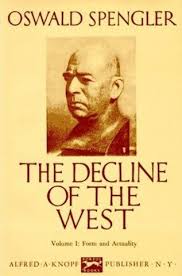
"Creatures Of The Long Night: Man And Society At The End Of Civilization" by John K. Hord (see here)
Cities In Flight by James Blish
The Technic Civilization Saga by Poul Anderson
Time Patrol by Poul Anderson
Hord presents a chart, "After Empire: Sample Cases," with the sub-headings, "Universal State," "Resurrection State" and "Future Civilization," but I have not yet made sense of this. Hord's essay is directly relevant to the two works by Anderson.
The omnibus collection of Blish's Cities In Flight (London, 1981) ends, on pp. 597-607, with:
"AFTERWORD:
"THE EARTHMANIST CULTURE:
"CITIES IN FLIGHT as a Spenglerian History"
by Richard D. Mullen.
The Afterword closes with a table comparing four cultures:
Classical;
Arabian;
Western;
Earthmanist.
Thus, Anderson's and Blish's future history series are each closely related to a different theory of historical decline.
Saturday, 1 June 2013
Anderson On Hord's Theory

Again according to Hord, as reported by Anderson, Cromwellian conversion tyranny separated England and its colonies, thus begetting new societies. Anderson's own idea, based on Hordian theory, is that American society broke down in 1913 when direct election of senators destroyed the federal republic, income tax undermined liberty and privacy and the Federal Reserve started wrecking the economy. Americans have until about 2040 to repair the damage...
Yet again, I would see the main problems as lying elsewhere but my purpose in this and the last few posts has been to track down what Anderson tells us about Hord and how the latter affected the world of van Rijn, Falkayn and Flandry. I am now much clearer on these issues and hope that some of my readers might be as well.
Wednesday, 27 January 2021
Three Stages Of Flandry

Young Flandry (three novels)
- one non-Flandry volume (story + novel)
Captain Flandry (two collections and one novel)
Admiral Flandry (two novels)
- one post-Flandry collection
Flandry is taught by Max Abrams in Ensign Flandry, the first Young Flandry novel, and by Chunderban Desai in A Knight Of Ghosts And Shadows, the Captain Flandry novel. See "Know A Man By His Heroes II" and "Theory And Practice II," both here. Desai expounds the historical theory of John K. Hord without naming him. Hord is the dedicatee of A Stone In Heaven, the first Admiral Flandry novel.
Flandry, as Captain, already intuits the gist of Hord's theory. See Indian Summer II. He imparts this intuitive understanding to Kit as Captain Flandry and, much later, explains the developed theory to Miriam/Banner as Admiral Flandry.
Wednesday, 17 February 2021
Desai And Toynbee

For John K. Hord on the blog, see here.
For Chunderban Desai, see here.
For Desai on the stages of a historical cycle, see here.
For Toynbean stages, see here.
According to Toynbee:
response to challenge transforms primitive societies into civilizations;
a cycle of challenge and response causes growth;
in 1939, the challenge for Modern Western society was to create a political world-order and the framework for an economic world-order;
a civilization breaks down when its "Creative Minority" degenerates into a "Dominant Minority";
in the final breakdown, the"Dominant Minority" creates a universal state to preserve its power.
Desai refers to growth, breakdown and the universal state.
Tuesday, 22 August 2023
Historical Theories, Past And Future

Edward Gibbon, The Decline and Fall of The Roman Empire
Hari Seldon's psychohistory
James Blish, Cities in Flight
Oswald Spengler, The Decline of The West
cultural morphology
Poul Anderson, The Psychotechnic History
games theory etc
Eino Valti's psychodynamics
Poul Anderson, The Technic History
John K. Hord, unpublished works
Chunderban Desai's historical analysis
Seldon and Valti mathematicise social prediction whereas Spengler and Hord/Desai historicize it. Desai presents detailed historical analysis.
Wednesday, 29 September 2021
A Philosophical Basis For SF?

A theory of human nature is useful when speculating about human capabilities and prospects on a cosmic time-scale. Anderson's Harvest Of Stars future history presupposes that the memories and sense of identity of a human personality can be reproduced either in an artificial neural network or in a newly grown organic body, thus that consciousness is materially based, thus further that personal identity is not dependent on any unique immaterial soul.
Science fiction is about change. An sf writer should not merely project past or future societies into future periods - unless he can present a good reason to do this. And, even then, many details at least should differ.
I think that we can say more about human consciousness than just that it is materially based. Human beings are differentiated as a species by the fact they have changed their environment with hands and brain and have changed themselves in the process and continue to do so. They have changed themselves into homo sapiens through labor, language and abstract thought. This species can either destroy or transform an entire planet. Human beings are dynamic and plastic, not static. "Human nature" means the nature of humanity but should not imply any unchanging essence although it is commonly used to mean the latter.
With technologically produced abundant wealth, there will no longer be any need to accumulate, hoard, compete, fight or steal any more than we currently fight for the air that we breathe whereas, if even air comes to be in short supply, that will be a different matter. At present, poverty and deprivation cause violence which is ideologically rationalized in terms of received beliefs that otherwise would be of merely historical interest.
So what do I expect for the further future? Either extinction or a very different and much better world. However, I am not an sf writer so meanwhile I commend Poul Anderson's Harvest Of Stars and Genesis.
Addendum: People born into a completely different culture and brought up to live in a completely different way will not be people as we know them now. Those who are used to peace and prosperity have no reason to resort to crime or terrorism.
Wednesday, 7 December 2022
Augustus And Argos

Augustus Caesar, founder of the Roman Empire, in "August" by Neil Gaiman;
Manuel Argos, founder of the Terran Empire, in "The Star Plunderer" by Poul Anderson.
The Terran Empire did not last because it was a stage in the decline of a civilization as analysed by John K. Hord and Chunderban Desai.
The Roman Empire did not last because Terminus, god of boundaries, asked Morpheus to visit Augustus in a dream.
Speculative fiction as against fantasy but both make a serious point. Expressed mythologically, even Jupiter must bow to Terminus.
Monday, 25 January 2021
Beginning Flandry's Legacy: A Stone In Heaven

Like Poul Anderson's World Without Stars and The Rebel Worlds, his A Stone In Heaven begins with an alien point of view. This is familiar Andersonian sf which does not immediately tell us that it is part of his Technic History.
In Baen Books' Flandry's Legacy:
p. i is an extract from the last story, "Starfog";
p. ii is a list of Baen Books titles by Poul Anderson;
p. iii is the title page;
p. iv is publishing information;
p. v is the Contents;
p. vi is Acknowledgments;
pp. vii-xii are an Introduction, "The Wheel Turns," by the Compiler, Hank Davis;
p. 1 is an internal title page for A Stone In Heaven;
p. 2 is the dedication to John K. Hord;
pp. 3-16 are Chapter I of XIV.
P. 3 introduces the Kulembarach clan who deal with "...the strangers from the stars."
P. 4 introduces the viewpoint character, Yewwl, while she is hunting with her husband, Robreng, and their three youngest children. A human being called Banner shares Yewwl's sensory experiences through a collar worn by Yewwl and has done so for eighteen years.
On p. 12, we learn that Banner is Miriam Abrams based in Wainwright Station as she becomes our viewpoint character. We might remember that, in Ensign Flandry, Max Abrams had referred to his young daughter, Miriam.
On p. 13, Banner, now referred to as "Abrams," says that she is from the planet Dayan and we might remember that Max Abrams was from there.
On p. 14, she describes Yewwl as a Ramnuan and mentions the Terran Empire.
At the very bottom of p. 15, she refers to the Grand Duke of Hermes! (We move closer and closer to familiar territory.)
on p. 16, Abrams will go to Terra to appeal to what she calls "'...the very top...,'" not, in the first instance, the Emperor but:
"'...have you ever perchance heard of Admiral Flandry?'"
End of chapter. We knew of a Dominic Flandry but had not yet known that he had become an Admiral. He himself will not come on-stage until p. 28 and the beginning of Chapter III.
Wednesday, 5 October 2022
Future Civilizations

Maybe some future histories, like Heinlein's, just show Western civilization continuing into an indefinite future? On the other hand, Heinlein's Time Chart ends:
"Civil disorder, followed by the end of human adolescence, and beginning of first mature culture."
-Robert Heinlein, The Man Who Sold The Moon (London, 1963), p. 7.
This suggests the transcendence of all earlier civilizations. HG Wells' The Shape Of Things To Come, basing its narrative on completely different presuppositions and premises, also culminates in a first mature culture. After all the wars and revolutions, something better is possible. At least, that is one possible way of looking at the future. There are others.
Wells and Heinlein are names to conjure with regarding future histories and their successors include Poul Anderson and James Blish.
The opening instalment of Anderson's Technic History, "The Saturn Game," must be set during the transition from Western to Technic civilization. Earth is not yet politically united and we do not know whether the O'Neill colonies have been constructed yet. However, there is an Apollo University in Leyburg on Luna and the Solar System is being explored. The concluding four instalments of the Technic History are, in this sense, post-Technic although not, of course, post-technological. Human beings are, if not maturing, then at least mutating.
Volume I of Blish's Cities In Flight shows the Caesarism of Western civilization. Earthmanism exists in Volumes II and III. In Richard D. Mullen's Table of Classical, Arabian, Western and Earthmanist cultures, terms like "interregnum" and "Caesarism" are familiar if we have read Poul Anderson's accounts of John K. Hord's theory. In Mullen's Table, Classical culture is Arabianized, Arabian culture is Westernized and Western culture is Earthmanized. And that might be our last word on the subject!
Monday, 14 November 2022
Desai's Contributions

Chunderban Desai:
summarizes the Terran Empire section of the Technic History to date in his conversation with Uldwyr;
introduces Aycharaych in his conversation with the latter;
introduces Aeneas in his conversation with Peter Jowett;
learns about Cosmenosis in his conversation with Tatiana Thane;
resolves the immediate crisis in his concluding conversation with Ivar Frederiksen and Tatiana Thane;
summarizes John K. Hord's cyclical theory of history in his conversation with Dominic Flandry in a later volume.
Poul Anderson's History of Technic Civilization is packed with characters appearing only once or twice but making significant contributions who should not be overshadowed by the Big Three.
Friday, 12 November 2021
The Technic History, Cities In Flight And Flying Mountains

James Blish's Cities In Flight opens with They Shall Have Stars, published in 1956, set in 2013. The first manned vehicle in space was in 1962. (In our timeline: Yuri Gagarin, 1961.) Titan Station was established in 1981.
They Shall Have Stars is preceded by two quotations, the first from the real Dylan Thomas, the second from the fictional "Acreff-Monales: The Milky Way: Five Cultural Portraits." The Prelude to Book One is preceded by a quotation from the real J. Robert Oppenheimer. Thus, Blish's lead-in to his future history is unusually elaborate. See The Structure Of They Shall Have Stars, coincidentally posted in 2013.
The Technic History refers to the historical theory of John K. Hord whereas Cities In Flight refers to Oswald Spengler's The Decline of The West.
Cities In Flight resembles Anderson's Tales Of The Flying Mountains in that it begins with a politician giving attention to a crackpot theory of gravity. See:
Humor III (a comparison with Heinlein's "The Man Who Sold The Moon")
Sunday, 2 June 2013
The Technic History And Anderson's Genesis

(i) The Technic History is a series written sporadically from 1951 to 1985 whereas Genesis is a single work published in 2000.
(ii) Both are future histories. However, the History is an originally unplanned Heinleinian future history series comprising stories and novels covering several centuries and millennia whereas Genesis synthesizes the Heinleinian and Stapledonian future history models by covering millions of years with some chapters featuring characters and conversations (the Heinlein model) but others summarizing Solar and galactic developments on much longer time scales (the Stapledon model):
"Sol swung onward through its orbit, once around galactic center in almost two hundred million years..." (Genesis, New York, 2001, p. 96)
(iii) In the Technic History, consciousness-level computers were developed but discontinued because they lacked intuition whereas, in Genesis, it is inter-linked post-organic intelligences that gradually become a Stapledonian galactic brain.
(iv) Some parts of the Technic History are based on John K Hord's theory of history. According to that theory, the failure of the fifteenth-century ecclesiastical conciliar movement was a breakdown point for Western European society. Genesis features an AI "emulation" in which that movement succeeded, restoring power from the papacy to the bishops, thus preventing the Reformation. I still think that, in any history that went beyond feudalism, bourgeois individualism would have led to private interpretation of scripture, salvation by "faith alone" and "predestination" fantastically reflecting the unaccountability of success in a competitive economy. All of these changed religious beliefs would entail a challenge to the authority not only of the Pope but also of bishops and priests.
Thursday, 20 June 2024
Alternative Histories And A Summation
two short stories are set in alternative histories - Alexander did not die young, the Jews did not return from Babylon;
in the Time Patrol series, Stane describes the peaceful future that he had hoped to bring about, two Neldorians do help Carthage to defeat Rome, quantum fluctuations upset the Medieval church-state balance of power, first one way, then the other;
in Genesis, Gaia generates an emulation where the conciliar movement succeeded and there was no Reformation or wars of religion but later Germany became powerful and oppressive.
SM Stirling added a Time Patrol story where World War I was prevented but, of course, the Patrol had to restore it.
John K. Hord, whose theory of historical cycles underpinned Anderson's Technic History, regarded the failure of the conciliar movement as a historical breakdown point. Again, Anderson's Genesis, whose title implies a new beginning, also seems like a summation of all that has gone before.
Thursday, 15 May 2025
A Stone In Heaven

the usurper, Hans Molitor;
the pretender, Edwin Cairncross, Grand Duke of Hermes;
the pretender, Admiral Sir Olaf Magnusson;
Magnusson's father, Erik.
We will perhaps reread A Stone In Heaven which features Cairncross. A Stone... is dedicated to John K. Hord whose theory of history Anderson applies in A Knight Of Ghosts And Shadows and in A Stone...
In the opening chapter of A Stone..., the Ramnuan, Yewwl, has an oath-sister, "Banner," based in Wainwright Station. The name of the station suggests that it is staffed by human beings but we do not at first suspect, although we will soon be informed, that "Banner" is Miriam Abrams. Nor has the text yet confirmed that Ramnu exists in the Technic History universe.
Other reading: I think that there is a structural problem in Robert Harris' Conclave relating to the seal of Confession.
Tuesday, 3 October 2017
Learning History IV

See Learning History III.
In Europe, the Edwardian period was called the belle epoque." (p. 184)
In York Minster, the windows include the Five Sisters. (ibid.)
Christian and Laurinda hear Mass at the tierce hour, then, after, the Nunc Dimittis, wander around the Minster. (p. 185)
This alternative York has "...somehow Teutonic architecture." The George and Dragon public house is in a Tudor building and serves Continental beer. (p. 186)
In this emulated history, the conciliar movement succeeded. The Councils of Constance and Basel healed the Great Schism and made a reconciliation with the Hussites. (p. 187) In Poul Anderson's SFWA Bulletin article, he tells us that John K. Hord regarded the Council of Basel as the beginning of the breakdown of Western European civilization.
Monday, 29 April 2019
Learning

the decline of the Polesotechnic League;
the transition from League to Empire;
the changes in the Empire during Flandry's lifetime;
the almost inevitable Fall of the Empire;
the possibility of free growth in post-Imperial history.
I have not finished posting about the Technic History but am still revisiting the character of Nicholas van Rijn who appears in ten of the forty three installments of the History. His character is consistently presented but new details are still there to be found like throwing crockery. The planet discovered in the van Rijn story, "Hiding Place," is later named Vanrijn, (scroll down) as we learn in the Dominic Flandry novel, The Rebel Worlds. There is no end to the History's solidity and internal consistency.
Subscribe to:
Posts (Atom)