Showing posts sorted by relevance for query How many billions and trillions. Sort by date Show all posts

Monday, 23 September 2019

The Contemporary In The Cosmic

New York at the time of writing in 1954:

"He looked out of his window. Lights flamed against a hectic sky; the streets crawled with automobiles and a hurrying, faceless crowd; he could not see the towers of Manhattan from here, but he knew they reared arrogant toward the clouds."
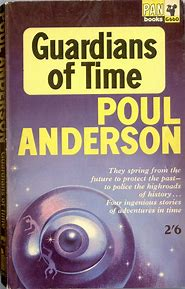
-Poul Anderson, "Time Patrol" IN Anderson, The Guardians Of Time (New York, 1981), pp. 9-63 AT 3, p. 26.

Anderson conveys dynamism:

lights flame;
the sky is hectic;
streets are full of autombiles;
the crowd hurries;
towers rear arrogantly;
people are on the move;
a civilization is going somewhere.

But, so far, it is what is happening at the time of writing. Then comes the perspective, not only past but also future:

"And it was all one swirl on a river that swept from the peaceful prehuman landscape where he had been to the unimaginable Danellian future."
-ibid.

So some reflection is appropriate:

"How many billions and trillions of human creatures lived, laughed, wept, worked, hoped, and died in its currents!"
-ibid.

How many? Also: how many! That last sentence is not a question because it ends with an exclamation mark.

Wednesday, 5 March 2014

River Of Time, Stream Of History

Poul Anderson, Time Patrol (New York, 2006); The Shield Of Time (1991).

Manson Everard reflects that the crowded streets and towers of Manhattan are:

"...all one swirl on a river that swept from the peaceful prehuman landscape where he had been to the unimaginable Danellian future." (TP, p. 17)

- and again:

"History. The stream of events, great and small, running from cavemen to Danellians." (ST, p. 120)

This temporal setting contrasts with the spatial setting:

"'So many, many stars...a hundred billion in this one lost lonely dust-mote of a galaxy...and we on the edge, remote in a spiral arm where they thin toward emptiness...what do we know...?'"
- Anderson, Young Flandry (New York, 2010), p. 217.

- of the History of Technic Civilization. (Later civilizations spread through several spiral arms.)

Everard contemplates the inhabitants of this river or stream of time:

"How many billions and trillions of human creatures lived, laughed, wept, worked, hoped, and died in its currents!" (TP, pp. 17-18)

"But what about the eddies, the bubbles, the insignificant little individuals and happenings that are also soon forgotten, whose being or nonbeing makes no difference to the course of the stream?" (ST, p. 120)

Each story focuses on a few "eddies."

There is a dramatic contrast between the fact that, on the one hand, the course of the stream is laid out with its major turning points and destination known at least in their broad outlines but, on the other hand, throughout the series, Time Patrolmen have new experiences and adventures within the river of time. The entire series is only the title page of a potential series that could continue indefinitely.

Friday, 9 June 2023

Individuals In The Time Stream

From the window of his New York apartment, Manse Everard sees that:

"Lights flamed against a hectic sky; the streets crawled with automobiles and a hurrying, faceless crowd..."
-Poul Anderson, "Time Patrol" IN Anderson, Time Patrol (Riverdale, NY, 2010), pp. 1-53 AT 3, p. 17.

He knows that:

"...the towers of Manhattan...reared arrogant toward the clouds."
-ibid.

He reflects that:

"And it was all one swirl on a river that swept from the peaceful prehuman landscape where he had been to the unimaginable Danellian future. How many billions and trillions of human creatures lived, laughed, wept, worked, hoped, and died in its currents!
"Well..."
-ibid., pp. 17-18.

A long time later in his career, and fifty two years earlier in history, Everard reflects:

"History. The stream of events, great and small, running from cavemen to the Danellians. But what about the eddies, the bubbles, the insignificant little individuals and happenings that are also soon forgotten, whose being or nonbeing makes no difference to the course of the stream?"
-Poul Anderson, The Shield of Time (New York, 1991), PART TWO, 1902 A. D., 120.

Of course, a river or stream takes time to flow so time itself is not a river or stream. However, time as a river remains a powerful image. In "Time Patrol," the river sweeps from the prehuman landscape to the Danellian future and human beings live in its currents. In The Shield of Time, the stream runs from cavemen to Danellians with individuals as its eddies or bubbles. 

From space, it is possible to observe the entire length of the Mississippi, the Thames or the Nile from its source to the sea. However, a photograph records only a single instant of the river's flow. Everard is contemplating all the instants as if they were an entire length. From that perspective, there is no flow. However, as soon as he travels to 464 A.D. or to 209 B.C., Everard is caught up in the course of events, the currents of the river, and becomes one of the eddies or bubbles. We can experience events, then read about them. A Time Patrolman can read, then experience.