Wednesday, 22 March 2023

Vilkui And The New Humanity

Genesis, PART TWO, IX-XI.

After reading about an individual Vilku, Ilyandi, we later receive a list definition of the Vilkui:

"...an international order of sacerdotes, teachers, healers, and philosophers..." (IX, p. 210)

- what CS Lewis would have called "the intelligentsia."

Ilyandi believes that she serves the star-gods. In fact, it is the Terrestrial intelligence alone that has created and guided this second human race. But Ilyandi is right that there are comparable intelligences among the stars. She is wise within the parameters of her understanding which is the most that anyone can be. 

The new human race has very black skin, thin nose and lips, oblique eyes and straight blond hair. Christian reflects that there was no such race on old Earth and the new human beings do not suspect that they had predecessors. 

The extra-solar intelligences might intervene to end Gaia's experiment. Time will tell but not to us.

Visions And Voices

Fictional characters, like real people, entertain very different concepts of deity. Thus, in Poul Anderson's Technic History -

Merseians of the Roidhunate: the God (relates to the Race, not to individuals);

Ythrians of the New Faith: God the Hunter (honoured at the moment of death, not in a hereafter);

Jerusalem Catholics: God (incarnated on Terra three thousand years ago).

Also as in real life, some characters can have visions of their version of God. Thus, Djana, synthesizing her Catholic upbringing with Merseian conditioning, conjures up a vision of a Merseian Christ. There is no evidence of such a belief among the Merseians but, even if there were, the content of Djana's vision is a projection of her mind, not an objective reality.

The situation is very different when some of CS Lewis' characters hear voices:

"'It is not for nothing that you are called Ransom,' said the Voice."
-CS Lewis, Perelandra IN Lewis, The Cosmic Trilogy (London, 1990), pp. 145-348 AT II, p. 277.

"'My name is also Ransom,' said the Voice."
-ibid., p. 278.

"'I have cast your Enemy into sleep,' said the Voice. 'He will not wake till morning. Get up. Walk twenty paces into the wood; there sleep. Your sister sleeps also.'"
-ibid., p. 280.

After a lot of preparation, not only inspiration and guidance but also practical instructions.

"...a voice at whose sound my bones turned to water: 'Child, child, child, let me in before the night comes.'"
-CS Lewis, "The Shoddy Lands" IN Lewis, The Dark Tower and other stories (London, 1983), pp. 104-111 AT p. 110.

That last passage speaks to me and is incorporated into the agnostic prayers that I offer. Personified reality speaks through Lewis.

After Such Knowledge And Time Blowing Past

Genesis, PART TWO, XII.

In Poul Anderson's works, we notice significant phrases.

Gaia, discussing Laurinda and Christian with Wayfarer, asks:

"'After such knowledge as they have tasted of, how could they return to me?'" (p. 246)

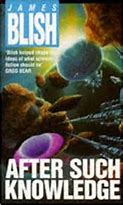
I imagine that Anderson knowingly quoted the title of James Blish's After Such Knowledge Trilogy.

The opening paragraph of the novel (PART ONE, I, p. 3) had informed us that ghosts, gods and time pass through the story and that, of these, time is the most mysterious. In the concluding chapter, when Gaia and Wayfarer converse, the latter hears:

"A sigh as of time itself blowing past." (p. 243)

Readers probably do not remember that opening paragraph. Nevertheless, beginning and end connect. And time blowing past evokes many other works by Anderson, notably the Time Patrol, especially since Gaia's:

"'...ultimate annihilations of history after history...'" (p. 243)

- is something that could have been done with real histories in the mutable timeline of the Time Patrol.

Apart from cosmic issues, Anderson presents a love story with a happy ending:

"...what they were will be together, as one, and will live on, unforgotten." (p. 248)

Much later, they might again be resurrected in an appropriate emulation.

Three Confrontations

If Earth alone were Fallen, in the theological sense, then the summit of scientific achievement, space travel, would be a way to spread Terrestrial evil to sinless worlds! CS Lewis believed precisely that whereas Poul Anderson's Fr. Axor finds:

"'...that every oxygen-breathing species ever encountered is in no state of grace, but prone to sin, error, and death.'"
-Poul Anderson, The Game Of Empire IN Anderson, Flandry's Legacy (Riverdale, NY, June 2012), pp. 189-453 AT CHAPTER ONE, p. 209.

Did all Fall independently or was there some single galactic Original Sin?

Lewis' Elwin Ransom confronts a demonically possessed evil scientist on Venus. Brian Aldiss' Joe Bodeland confronts both Frankenstein and his monster when nuclear war disrupts time itself. In Anderson's Genesis, an extra-solar intelligence confronts the Terrestrial intelligence which has deliberately re-created "'...the ancient ape...'" (p. 245)

Three very different imaginative representations of crucial issues about the future of science and mankind.

Tuesday, 21 March 2023

Belief And Unbelief II

Genesis, PART TWO, 5.

Laurinda and Christian appear to a scientist in one of Gaia's emulations. He calls their appearance a miracle but soon converses avidly with them:

"Christian recalled myths of men who were lovers of goddesses or who tramped the roads and sat at humble meat with God Incarnate. The believer accepts as the unbeliever cannot." (pp. 226-227)

I had remembered this passage about God Incarnate but not where I had read it until I reread it.

To Christian Brannock, God Incarnate is a myth. Nicholas van Rijn unquestioningly accepts that:

"'The very first miracle Our Lord did was turning water into wine...'"
-Poul Anderson, Mirkheim IN Anderson, Rise Of The Terran Empire (Riverdale, NY, March 2011), pp. 1-291 AT IX, p. 136.

Fr. Axor says that Our Lord Jesus Christ was born on Terra and walked on Terra but then adds:

"'If science can show that the gospel account of Christ is not myth but biography...'"
-Poul Anderson, The Game Of Empire IN Anderson, Flandry's Legacy (Riverdale, NY, June 2012), pp. 189-453 AT CHAPTER ONE, p. 210.

I am not sure of the strength of that "If..." Does Axor mean that science has shown this, therefore... or just that science might show it at some time in the future. (I once tried to say, "If this is the case, then...," but the person to whom I was speaking kept interrupting to say, "It is!" because she misinterpreted my "If..." to mean doubt, not an implication.)

In CS Lewis' Ransom Trilogy, we are to understand that the Incarnation is not a myth or a belief but a historical fact:

"'[Death] is horrible. It has a foul smell. Maleldil Himself wept when He saw it.'"
-CS Lewis, Perelandra IN Lewis, The Cosmic Trilogy (London, 1990), pp. 145-348 AT 5, p. 203.

Belief And Unbelief

Of course willing suspension of disbelief is involved in all reading of fiction, including all fantasy and science fiction. However, one difference remains. Human characters created by both Poul Anderson and CS Lewis encounter both Martians and demons. In Anderson's works, Martians and demons are on an equal footing. Both are fictional. In Lewis' works, Martians are fictional but demons are not. In works both of non-fiction and of fiction, Lewis polemicizes for a world-view in which supernatural beings, including demons, literally exist.

"Though he was theoretically a materialist, he had all his life believed quite inconsistently, and even carelessly, in the freedom of his own will."
-CS Lewis, That Hideous Strength IN Lewis, The Cosmic Trilogy (London, 1990), pp. 349-752 AT CHAPTER 12, 7, p. 630.

What is free will and why is it inconsistent with materialism? We can discuss such questions and an author can show his characters discussing them but, in this passage, the narrator (who is sometimes omniscient and sometimes first person) assumes a traditional theological position on the issue. We should appreciate the work as a novel, a long prose fiction, while also understanding that some of its passages are polemical - and we may well disagree with its author.

Wells-Lewis Debate

CS Lewis was avowedly anti-Wells but where does the debate, if that is what it is, go after that?

Some of Poul Anderson's characters, like Peter Berg and Fr. Axor, address theological issues but in a hard sf context where the text remains neutral between the characters' beliefs. Theology does become an empirical science in some works of fantasy, like Operation Chaos, but there the existence of the supernatural is a fictional premise. We do not believe but suspend disbelief.

Two volumes of James Blish's After Such Knowledge Trilogy are post-Lewis. Philip Pullman's His Dark Materials Trilogy is anti-Lewis. And that is as far as it goes as far as I know. Anyone setting out to continue Lewis' Ransom or Narnia series would have to share, or at least to fully empathise with, Lewis' distinctive blend of Platonic Anglicanism - which seems improbable. Alternatively, Christianity is broad enough to allow its literary proponents to tackle the same fundamental issues from widely different perspectives.

The Machines

Genesis, PART TWO, XII.

"'The former race went up in the machines, not because it was forced but because it chose, because that was the way by which the spirit could live and grow forever.'" (p. 245)

The phrase,"...went up in the machines...," transcends the usual mechanistic connotations of the word, "machine."

Contrast this technological future with Elwin Ransom's words to the revived Merlinus Ambrosius:

"'The poison was brewed in these West lands but it has spat itself everywhere by now. However far you went you would find the machines, the crowded cities, the empty thrones, the false writings, the barren beds: men maddened with false promises and soured with true miseries, worshipping the iron works of their own hands, cut off from Earth their mother and from the Father in Heaven.'"
-CS Lewis, That Hideous Strength IN Lewis, The Cosmic Trilogy (London, 1990), pp. 349-753 AT CHAPTER 13, 5, p. 656.

Lewis' political programme?:

technophobia 
rurality
absolute monarchies
no birth control

Lewis wrote science fiction in order to oppose Wellsian-Stapledonian-Andersonian pro-technological science fiction.

Far Future Conflict

Genesis, PART TWO, VIII.

The robot Brannock addresses Kalava and his men:

"'Hear me. There is war in heaven. I am cast away from a battle, and enemy hunters may find me at any time. I carry a word that must, it is vital that it reach a certain place, a...a holy mountain in the north. Will you give aid?'" (p. 203)

Brannock reflects to himself:

"This must be a business of high importance; and the implications went immensely further, a secession from the galactic brain. His job was to get the information to Wayfarer." (p. 208)

I would not have thought that conflict was possible between post-organic intelligences as described but Poul Anderson finds a way: a secession from the galactic brain.

Ilyanda the Vilku wisely asks Brannock how they can know that he is of the gods but he proves that he is from the stars by displaying his knowledge of the usually cloud-hidden sky: the constellations, the ecliptic, the precession and the Great Comet. The Vilkui know of these things through centuries of observation.

"'...he is from the stars. Trust him. We, we dare not do otherwise.'" (p. 203)

As a matter of fact, the galactic brain might judge that Gaia was wrong to re-create humanity. On the other hand, the solution would not be extermination.

A Robotic Walk On The Future Earth

Genesis, PART TWO, VIIX.

In several works, Poul Anderson describes alternatives to grass on other planets. Genesis is set so far in the future that there is an alternative to grass even on Earth:

"...the thick-lobed carpeting of glades..." (IX, p. 207)

- and every other plant and animal is alien. The winged fliers are not birds.

The robot Brannock proceeds almost as slowly as a man because he does not want to leave a visible trail through the forest and up Mount Mindhome. However, he does not need to rest, eat or sleep. His directional sense is attuned to the magnetic field and to planetary rotation and an inertial integrator counts kilometres. He senses in every direction and across every wavelength, can amplify sounds, has a memory the size of a library, has four arms, hands that can be reshaped into tools and a retractable third leg and can display different faces on the holographic screen on the front of his head.

Asimov's robots are a major part of the Frankenstein tradition especially since Asimov's Three Laws of Robotics are designed to counteract fear of robots which Asimov describes as the "Frankenstein complex." Genesis is a Frankensteinian novel because it asks whether men are right to create artificial intelligences and whether a post-organic intelligence is right to re-create humanity and also because it features the robot Brannock.