Tuesday, 21 December 2021

Sandra On Hermes

Mirkheim.

In Prologue, Y minus 24, the sun sets and Peter Asmundesn proposes to Sandra Tamarin on a terrace of her ancestral mansion, Windy Rim. In Chapter II, the sun rises and Lady Sandra-Tamarin, waking up, reaches for Pete before remembering that he died in an accident four years previously. In Y minus 24, Sandra is probably about to become Grand Duchess of Hermes. In II, she is Grand Duchess, resident in the New Keep in Starfall.

In Y minus 24, Sandra says that she must curb the devil that is in her illegitimate son, Eric, from his father. Those who have read The Man Who Counts might remember that Sandra had been on Diomedes with Nicholas van Rijn and Eric Wace and might then deduce that Eric Tamarin is named after Eric Wace and that van Rijn is his father. Sandra confirms the second deduction in the following sentence.

After Peter Asmundesn's proposal:

"The breeze lulled, the tilirra chanted, the river laughed on its way to the sea." (p. 7)

Nature is appropriately peaceful. We hear the river's laughter as happy, not mocking.

Monday, 20 December 2021

Van Rijn And Age III


Mirkheim, Prologue, Y minus 7.

Van Rijn:

"'...I am thirty years your senior, Davy boy, and even if I got long-life chromosomes and lots of good antisenescence treatment, still, in the end a fellow gets tired. I will not do much.'" (pp. 17-18)

That is explicit. Age slows down van Rijn.

Later, he concedes a point to Eric:

"Suddenly van Rijn looked shrunken. 'No,' he whispered.
"He's old, passed through Eric, weary, and, here at last, forsaken. He wanted to clasp the bent shoulders." (XIV, p. 202)
 
When Sandra meets him:
 
"Why, he's old, Sandra knew..." (XIX, p. 253)
 
However:
 
"And then van Rijn, damn his sooty heart, refused to be pitiable but grabbed her hand, bestowed a splashing kiss upon it, and pumped it as if she expected water to gush from her mouth. 'Good day, good day,' he bawled..." (XIX, p. 254)
 
Best of all is his invitation to Sandra:

"'You take the Long Trail with me!'" (XXI, p. 287)

- which we have quoted before.

Van Rijn And Age II

Falkayn and van Rijn look straight at each other in the moment of their confrontation. Then Falkayn looks at Coya. Van Rijn watches them. Adzel, Chee Lan and Hirharouk watch van Rijn. (Need I say: a tense moment?)

Then:

"He shook his head. 'Hokay,' said Nicholas van Rijn, well-nigh too low to hear. 'I keep my mouth shut. Always. Now can we sit down and have our party for making you welcome?' He moved to pour from a bottle; and Coya saw that he was indeed old."
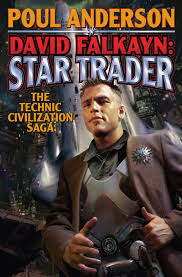
-Poul Anderson, "Lodestar" IN Anderson, David Falkayn: Star Trader (Riverdale, NY, 2010), pp. 631-682 AT p. 680.

He is indeed old but more than age went into this decision. He sees the next generation after that of his granddaughter and her prospective husband.
 
An Aside
When a character has become established in the minds of his audience, an extremely powerful dramatic effect can be made by having that character, in sufficiently extreme circumstances, act out of character. How does van Rijn characteristically communicate? He shouts. How does he communicate here? He speaks almost too quietly to be heard. Subdued - but insisting on a party.
 
In a British TV comedy, It Ain't Half Hot, Mum, a tough British Army Sergeant, disgusted to be put in charge of an entertainment troupe, addresses them only with shouted insults until, one day, in the grip of great emotion, he says quietly, "Fall the men in..."

"Sir! That's the first time you've called us 'men'!"

Van Rijn And Age

"Lodestar" and Mirkheim are the two works that address van Rijn in even older age. I called "Lodestar" a mini-Mirkheim. In SFWA Bulletin, Fall 1979, Poul Anderson wrote that:

Satan's World had not got around to spelling out the point that he was trying to make;

"Lodestar" was a preliminary attempt to spell it out;

however, because it was only a novelette lacking space for sociological analysis, "Lodestar" could only "...show van Rijn as an old man whose day was ending." (p. 12):

Mirkheim should finally have clarified matters.

My Comments
"Lodestar" brilliantly shows van Rijn as an old man whose day etc but it also contains some sociological analysis.

When van Rijn concedes a point in argument, is this because the point is valid or because he is getting too old to keep fighting or partly both? We will consider the examples.

Age And Change

A series of any length shows its characters aging unless an author arbitrarily decrees that his characters will not age while the world changes around them but I regard that as unacceptable. Some tricks or jokes with chronology and age are acceptable but not mere denial of the aging process. The best such joke is Ian Fleming's second last James Bond novel - it contradicts dates as given in earlier volumes but then informs us that those volumes, written by a former colleague and friend of Commander Bond, were inaccurate. An author should closely control such details. I am reading John Grisham's seven Theodore Boone juvenile novels. Theodore is thirteen in Volume I and only four months elapse between that volume and the end of Volume III. Agatha Christie made problems for herself because Hercules Poirot began his lengthy series already retired from the Belgian police force.

In sf, some characters have access to anti-aging processes. For as long as we read about him, Poul Anderson's Manson Everard remains based in the twentieth century, from 1954 to 1990. He spends an unknown amount of time in other periods, some of them not in this timeline, but remains physically unaged thanks to future medical treatment. However, how much does he age mentally? Time Patrolmen seem to look forward to no retirement.

Dominic Flandry advances from his teens to his sixties but is well-preserved thanks to regular exercise and antisenescence treatment. David Falkayn advances from teens to middle-age and greater maturity. In "Wingless," he is a grandfather but remains off-stage. Nicholas van Rijn begins his series already old, then ages even more...

More Van Rijnisms

Mirkheim, XIV.

The last two missions of the original trade pioneer crew, although not as a trade pioneer crew, are in Mirkheim. The first is a mission of inquiry and informal diplomacy to Babur on behalf of their employer, van Rijn. The second is a scouting expedition to Baburite-occupied Hermes. For this, Eric Tamarision has commissioned David Falkayn, Adzel and Chee Lan as officers of the Hermetian navy and given them one of his ships. Van Rijn's other comparably qualified staff are all Commonwealth citizens.

At the bottom of p. 199, van Rijn addresses Eric:

"'You is my son for sure, a chip off...'"

We think that we know what is coming. We turn the page:

"'...the old blockhead...'" (p. 200)

Further down that page:

"'...what has all this pile of maneuvers been for?'" (ibid.)

"...pile of maneuvers..." sounds familiar because it sounds like "pile of manure..."

On the following page:

"'The jeopardy cannot change its spots.'" (p. 201)

Van Rijn maintains this line of talk all the way to his memorable closing dialogue with Eric's mother in Chapter XXI when the novel unfortunately concludes.

Introductions, Beginnings And Endings


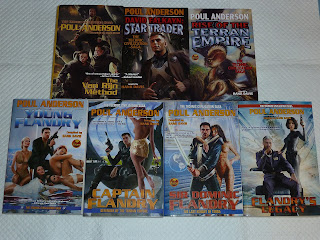
The number of installments collected in each volume of The Technic Civilization Saga.

I: 11, including 1 novel.
II: 7, including 1 novel.
III: 6, including 2 novels.
IV: 3 novels.
V: 6, including 1 novel.
VI: 4, including 1 novel.
VII: 6, including 2 novels.
 
Of the 11 installments in Volume I, each had been published as a single work and then republished at least once in a collection before being re-collected in the Saga. Each had also acquired an introduction when republished. The Man Who Counts acquired two in different editions. The introduction to "The Saturn Game," although interesting, is not directly relevant to the story and therefore was not included in the Saga, Volume I, The Van Rijn Method. However, the remaining eleven introductions (two for The Man Who Counts) are included. One of the The Man Who Counts introductions is presented as an Afterword to the novel. In it, Anderson directly addresses his readers whereas the remaining ten introductions are fictitiously written within the Technic History.

The introduction to "Hiding Place" begins "'The world's great age begins anew..." and really introduces the entire Polesotechnic League period. "Hiding Place," preceded by this introduction, was the first story in the collection, Trader To The Stars but is the last in The Van Rijn Method. Much had happened earlier as is made clear when the Saga, for the first time ever, presents the Technic History in chronological order of fictional events. Mirkheim, which concludes the League period, was the fourth volume in the Polesotechnic League Tetralogy but is the first installment collected in the Saga, Volume III, Rise Of The Terran Empire. An end is a beginning.

Sunday, 19 December 2021

Elegy

Mirkheim, XIV.

I remember a review that said something like "Poul Anderson combines elegiac prose with visions of mankind's future."

Chee Lan rides on Adzel's back on a beach shortly before they depart on their last mission, this time to David Falkayn's home planet, Hermes. Chee says:

"'After this is done with, if we're still alive, I'm going  back to Cynthia. For aye...
"'I've been thinking about it since the trouble began...'" (pp. 202-203)

This is indeed the end. Not only has the old team been reassembled only temporarily but also Chee now says that she will retire.

During their conversation, Adzel shakes his head to mean no but it is explained that he has learnt this gesture from human beings. (Some other aliens do it anyway.)

They pass David and Coya Falkayn looking only at each other:

"Of three races and one fellowship, these four had little they need conceal between them." (p. 204)

A fellowship, as in Tolkien.

Continuing their conversation, Adzel tells Chee:

"Oh, I regret nothing... The years have been good. I will but wish my children have the same fortune I did, to fare among miracles.'" (p. 204)

Unlike Adzel, I regret much: all those unenlightened motivations and actions and wasted thoughts. But we can continue to meditate.

Chee wishes likewise but adds:

"'...I'm afraid we've had the best of what there was. The time that is coming -' Her voice trailed off." (ibid.)
 
We have come a long way from:
 
"The world's great age begins anew ...'"

- at the beginning of Trader To The Stars. (But Dornford Yates' Jonathan Mansel says that the great days will come again.)

Adzel advises Chee:

"'Let us savor this final adventure of ours for what it is.'" (ibid.)

And we do.

Analysis Of Data

"Oh, a tinker came a-strollin',
"A-strollin' down the Strand -"
-Poul Anderson, Satan's World IN Anderson, David Falkayn: Star Trader (Riverdale, NY, 2010), pp. 329-598 AT XV, p. 476.
 
I googled these lines of verse and found them only in - David Falkayn: Star Trader.
 
To return to Mirkheim, XI, although Coya had not traveled to Babur with the crew, we see her and David working together when analyzing data after Muddlin' Through has returned to Earth.

David: Although Baburute tech is modeled on Technic designs, certain transistors could not have been manufactured in a hydrogen atmosphere because hydrogen would have poisoned the semiconductors.
 
Coya: Produced off Babur, maybe on a satellite?
 
David: Maybe but there are other kinds of transistors that would not have required off-planet production. Also, a presumed containment field-strength regulator uses cupric oxide as a rectifier at high temperatures even though hydrogen reduces hot cupric acid to copper and water. The regulator is protected in an iron shell but hydrogen penetrates iron so this regulator needs regular replacement.
 
Coya: Haste leading to bad engineering?
 
David: But why didn't the oxygen-breathers helping the Baburites do a better job?
 
(Because they want to control the Baburites.)
 
Later:
 
David: It is not in the Baburites' interests to treat Polesotechnic League independents so badly.
 
Coya: Maybe you were detained by an overzealous official?
 
David: No. The Baburites are organized in overlapping Bands, not in hierarchies of individuals.
 
Coya: Might the Seven be in touch with Babur?

David: Possibly but they could easily have been kept in the dark about the Imperial Band's intentions. 
 
(They were involved in those intentions.) 

David Falkayn's Maturation

Falkayn defies van Rijn:

"'Sir, you don't need the money. You stopped needing more money a long while back.'"
-Poul Anderson, "Lodestar" IN Anderson, David Falkayn: Star Trader (Riverdale, NY, 2010), pp. 631-682 AT p. 679.

"'Do you want a response? I deem best we let what is past stay dead.'"
-ibid., p. 680.

Coya converts him from promiscuity to monogamy:

"'I used to daydream about an infinity of women, all beautiful and accessible. But I found that you were plenty, and then some.'"
-Mirkheim, I, p. 32.

He accepts the full implications of his older brother's death:

"'I'm the new head of the family and president of the domain. That's where my first duty lies.'"
-XII, p. 180.

It turns out that he is not needed as domain president on Hermes but then he becomes acting CEO of SLL and, later again, Founder of the colony on Avalon.