Sunday, 2 April 2023

What Will Become Of The Empire?

Ensign Flandry, CHAPTER ONE.

At the Coral Palace, for the Emperor's Birthday, Crown Prince Josip receives:

"[Hauksberg] often wondered what would become of the Empire when that creature mounted the throne." (p. 9)

We find out later in The Rebel Worlds. Then, later again, in A Knight Of Ghosts And Shadows, we find out what happens when Emperor Josip has died without leaving an heir. After a civil war, most of which has happened between volumes, Captain Flandry takes his orders directly from Emperor Hans - the usurper. The new Molitor dynasty is still in place by the end of the Flandry subseries although there have been two attempts to overthrow it. The Empire is in a turbulent period which the Merseians understand and attempt to exploit. Indeed, the pretender, Olaf Magnusson, is their man although this is exposed not by Flandry but by a new team including his daughter. And we want this story to continue although, unfortunately, the next instalment of the Technic History is set after the Fall of the Empire. We are relieved to learn that Merseia has not filled to space left by Terra but we could use some information on the decline of the Roidhunate.

As JRR Tolkien wrote of The Lord of the Rings: "It is too short."

Van Rijn And Abrams

Nicholas van Rijn appears in six works in his own right and in four others that also feature David Falkayn. Van Rijn is Catholic and is Falkayn's mentor and Falkayn eventually marries his granddaughter. Van Rijn's main contribution is that he embodies the spirit of free enterprise.

Max Abrams appears in two Dominic Flandry novels, the second time only briefly in his daughter's memory. Abrams is Jewish and is Flandry's mentor and Flandry eventually marries his daughter. Abrams' main contribution is a theoretical framework for the Terran Empire.

We want to read some young van Rijn and maybe some older Abrams after Flandry and he have parted company just as we see John Ridenour once more after he has met Flandry on Starkad. Characters weaving in and out of narratives give a series body. The finest example of this within Poul Anderson's Technic History is that appearances by van Rijn and Falkayn and Adzel and references to the planet Cynthia occur separately before van Rijn and his trader team come together in four works including the two that are the climax of the Polesotechnic League subseries.

Grand Surveys And Ancestors

Ensign Flandry.

"Though 254 light-years from Sol, the [Saxonian] system was discovered early, during the first Grand Survey." (p. 3)

Here ( if nowhere else?) is proof that there was more than one Grand Survey.

"Our ancestors did that." (CHAPTER ONE, p. 6)

"...did that..." means "built the Terran Empire." We saw them do it. Manuel Argos proclaimed the Terran Empire in "The Star Plunderer." The Empire expanded in "Sargasso of Lost Starships" and adjusted its frontier with the Domain of Ythri in The People of the Wind. Reading a future history series has an accumulative effect on its readers. After a lot more reading, we will see an interregnum, then two further stages of interstellar civilization, after the Empire and Anglic will become a long dead language.

Predictions And Decline

Isaac Asimov's Hari Seldon mathematically predicts the Fall of the Galactic Empire whereas Poul Anderson's Chunderban Desai historically analyses the decline of the Terran Empire. We feel that Anderson describes a concrete situation that Asimov is able to address only in the abstract. Although we recognize certain parallels - the centralized Imperium regards anyone who is competent as untrustworthy -, Anderson's account is considerably more detailed. 

Anderson did deploy the Asimovian idea of a predictive science of society in his earlier Psychotechnic History but again Anderson's account is more plausible. In Asimov's future history, psychohistorical predictions are derailed by a single individual mutant whereas, in the Psychotechnic History, the psychotechnicians are overwhelmed by chaotic events. Millennia later, after two periods of Dark Ages, a Galactic civilization has at last achieved the aims of psychotechnics.

Ensign Dominic Flandry, Evening And Morning

Conventional film-makers might consider it inappropriate that the title character of Ensign Flandry does not come on-stage until the opening sentence of CHAPTER FOUR:

"Ensign Dominic Flandry, Imperial Naval Flight Corps..."
-Poul Anderson, Ensign Flandry (Riverdale, NY, January 2010), p. 29.

However, I would want the novel to be filmed exactly as written.

The first three chapters, but no others, each have a heading:

Evening on Terra-
Night on Starkad-
Morning on Merseia-

The obvious implication is that Terra is in decline whereas its enemy, Merseia, is ascending. (Night on Starkad is the supposed death of Flandry.) In the last Captain Flandry instalment, A Knight of Ghosts and Shadows, before Flandry becomes an Admiral, Chunderban Desai confirms to Flandry that Terra is in a late stage of decline and that the Merseians probably know this and respond accordingly. However, Desai and Flandry wonder whether Merseia is also in decline and how they would know this. I think that the terminal decline of Merseia begins with Tachwyr's discouragement at the end of The Game of Empire. Too many Merseian schemes have been thwarted, mainly by Flandry. Even the aggressive Merseians can become demotivated.

Retcon And Overlapping Narratives

The Young Flandry Trilogy and its two sequels, "Outpost of Empire" and The Day Of Their Return, are one long retcon (retroactive continuity) because Dominic Flandry and the Terran Empire were introduced in the first Captain Flandry story published years earlier. The Day Of Their Return also completes the story of human-Ythrian interaction because it:

features a new Ythrian character, Erannath of Stormgate Choth on Avalon;

informs us that human governmental institutions have died out on Avalon;

also informs us that the Domain of Ythri now cooperates with the Terran Empire against the Merseian Roidhunate.

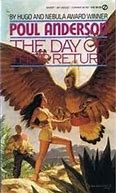
Apart from one later reference by Flandry, this information in The Day Of Their Return is the last that we read about the biracial colony on Avalon. Narratives overlap. The Technic History comprises League and Empire linked by Ythrians with a few other works set both before and after. It is good that one cover illustration for The Day Of Their Return shows an Ythrian in flight.

Saturday, 1 April 2023

Close To The End And A Long Way To Go

The transition from Volume III to Volume IV of The Technic Civilization Saga moves us:

out of the period covered by The Earth Book of Stormgate;

into a later period of the Terran Empire and

into the lifetime of Dominic Flandry.

Thus, in one sense, we have come close to the end of the Technic History because only four of the forty three instalments of the History are set later than Flandry's lifetime but, in another sense, we still have a long way to go because fifteen instalments filling three and a half of the seven volumes of the Saga are set during Flandry's lifetime. It is an achievement to incorporate such a long series about an individual character into such a long future history series. Also, two of the instalments set during Flandry's lifetime do not feature Flandry. But that is all that we are going to say about them tonight.

Fair winds forever.

Transition To Empire

The Technic Civilization Saga, Volume III, Rise of the Terran Empire, ends with The People of the Wind. Volume IV, Young Flandry, begins with Ensign Flandry. This is the fictional chronological order of these two novels, the single Ythrian novel and the first Flandry novel. However, Hloch's twelve introductions and one afterword to The Earth Book of Stormgate are fictitiously written shortly after the events of The People of the Wind, therefore long before the events of Ensign Flandry. In the pre-Saga reading order, the Earth Book directly preceded Ensign Flandry. 

In "Sargasso of Lost Starships," the Terran Empire annexes the planet, Ansa. In The People of the Wind, a Terran Imperial armada including a Planet-class cruiser called Ansa fails to annex the planet, Avalon. Thus, we have twice seen the Empire in conflict outside the Solar System. Ensign Flandry begins with the planet-wide carnival of the Emperor's Birthday on Earth.

We have seen the Empire as an aggressor. With Flandry as hero, we will read narratives recounted from the Imperial point of view. But first we get Lord Marcus Hauksberg's perspective:

the Empire was won and is maintained by naked power;
the central government is corrupt;
the frontier is brutal;
the Navy is the last organization with high morale;
but it it lives for war, oppression and anti-intellectualism.

Ythrians And Nature

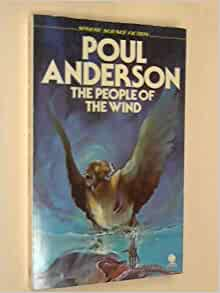
The People of the Wind.

Ythrians are part of their natural environment, not alienated from it.

"Sunlight from behind turned her wings to a bronze fringed by golden haze. She could be the sun itself, he thought, or the wind, or everything wild and beautiful above this ferroconcrete desert." (XIV, p. 590)

"The roofs of the buildings, the peak beyond them stood in impossible clarity against a sky which a pair of distant wings shared with the sun." (XV, p. 610)

Mourning Vodan, Eyath flies alone in a storm, then perches on a crag for hours, cold, wet and stiff but energized by air in nostrils and antlibranchs. Despair is burned out by straining wings, buffeted out by wind and washed out by rain. She swoops on a reptiloid, snaps its neck and eats it raw. She will rest not indoors but among trees and flowers. Earth odours make her lightheaded and her blood sing.

Arinnian, Eyath, Tabitha And Philippe

The People of the Wind, XI.

Arinnian and Eyath are as close as a male and female of two different species can be - species for whom sex is physically impossible. Arinnian's regard for (what he sees as) Eyath's "purity" makes it difficult for him to relate to "bird" women, female choth members.

Daniel Holm quotes "'- their finest hour -'" (p. 567), then, after a double space between paragraphs, we read with pleasure:

"Tabitha Falkayn shoved off from the dock..." (ibid.)

Tabitha has to be Poul Anderson's most attractive woman character: her appearance, her personality, her life, both independent and adventurous. In this passage, she entertains the Terran prisoner of war, Philippe Rochefort, but she will wind up with Christopher Holm/Arinnian - after helping to straighten him out.