First, even from here, nature is visible. Although the tower extends as far as he can see:
Friday, 4 March 2022
Future Cities
From The Lowlevel
In the Lowlevel, Svoboda was sold as a child to a thiefmaster. When he was twelve, an explosive slug from a guard's pistol smashed his left foot. He was reapprenticed to a fence and therefore learned to read and write. He has read Alice but wonders how many others have. At age thirty seven, he was an upper-level Guardian and Commissioner for Astronautics although we read unhappily that the Astronautical Department is a dead end. At sixty, he is Commissioner of Psychologics and has not found time to prosthetize the broken foot which pains him from inside a special shoe.
A hard life in a hard future and an unpromising start to a future history series. Why can't we read about some utopian futures just for a change?
A Future History Without Space Travel
it is unquestionably a future history series despite being so short;
it involves no space travel.
Of course, there need not be any space travel in the future. Merlin prophesied none. And, even if space travel does occur, a history of the future might recount only Terrestrial events, remaining the history of a single planet. Mankind as a whole does not leave Earth or the Solar System - unless a very large scale evacuation becomes necessary. In some future histories, mankind spreads through the galaxy so that eventually there are more people off Earth than on it but that does not happen immediately. I imagine that, in the Solar Commonwealth period of Poul Anderson's Technic History, I would live quite happily on Earth - until the Troubles start.
The Rustum History
The Rustum History comprises:
four stories collected as Orbit Unlimited and culminating in the colonization of the extra-solar planet, Rustum;
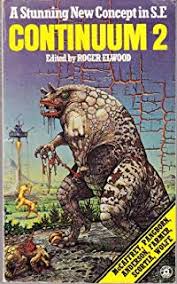
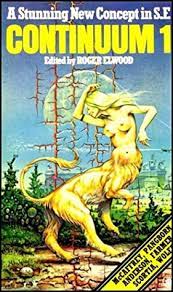
the four stories originally published in Continuum I-IV and later collected in New America;
"The Queen of Air and Darkness," set on another planet, Roland, in the same timeline and also collected in New America;
thus, nine stories that could be collected in a single volume as The Rustum History.
Talk
Poul Anderson was an expert action fiction writer. There are vivid fight scenes in the first two Maurai stories. However, in this third installment, the characters just talk. Even when, at the dramatic climax of the story, an armed man apprehends the narrator engaged in spying, their confrontation is merely conversational:
The talking continues. Maurai policies are explained, reaffirmed and enforced. But there are also two anticipations of the sequel, Orion Shall Rise:
"So many seas unsailed, lands unwalked, girls unloved, risings of Orion and the Cross unseen!" (p. 165)
The End
Wells's Time Traveler:
Lack Of Resources And Of Understanding
Because the text is a letter, the narrator/letter writer is free to interrupt his narrative with exposition:
the War of Judgment destroyed some cities;
however, the subsequent famine, plague and political collapse killed more;
population had grown while resources were depleted;
(this sounds familiar);
records and apparatus were too abundant for utter destruction;
barbarians burned libraries but other men preserved books and knowledge;
not ignorance but lack of resources prevented rebuilding;
technology had to be applied to biology;
the Maurai Federation is the only great power but does not understand the many other diverse cultures that have developed separately.
Thursday, 3 March 2022
Mong Long Ago
"'...Calforni threw out the Mong long ago...'" (p. 148)
- so a single sentence tells us that a lot of history has passed.
Assessing the competing pantheons, the mayor of Hope, the new settlement with the mysterious windmills, says that:
Oktai and his fellow gods are Asians so they should have left with the Mong;
Sanacruceans attend the church of Tanaroa and Lesu Haristi because the Maurai do;
the Meycans worship Esu Carito;
but he himself trusts in science and arms.
In Preston, near here, there is a dog leg street with a Hindu Temple at one end and a riverside pub at the other. For a while, a Pagan moot met in the pub so I like to imagine Indian gods at one end of the street and British gods, including the river god, at the other. The gods enrich our lives but we imagine them, not vice versa. If we lived nearer, I would visit that Temple now and again.
The Maurai Mission
The Maurai strive to prevent a return to the kind of technology that had led to the War of Judgment. Readers make their own value judgments about the Maurai Federation as also about the Polesotechnic League, the Terran Empire and the Time Patrol. Eventually, the Federation's single superpower status will be successfully resisted. We read different accounts of this in Orion Shall Rise and There Will Be Time. Poul Anderson presents not only several future histories but also among them two, Maurai and Kith, that exist in different versions.
Futuristic sf comments on the present. Do crowding, sensory deprivation and artificial environments bring on the mass lunacy that leads to nuclear war? It is us that they are talking about although I question whether we are sensorially deprived.
"Windmill"
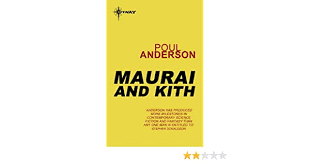
Poul Anderson, "Windmill" IN Anderson, Maurai And Kith (New York, 1982), pp. 139-239.
Imagine reading "Windmill" by Poul Anderson in Saving Worlds (later reissued as The Wounded Planet). The text begins in mid-sentence because it is an extract from a letter written by the viewpoint character. There are indications that "Windmill" is a third Maurai story, which would be appropriate for this themed anthology: