Saturday, 4 May 2019

A Hostile Environment

Poul Anderson, "Territory" IN Anderson, David Falkayn: Star Trader (Riverdale, NY, 2010), pp. 1-76.

(The contents page classifies "Territory" as a "novella": longer than a short story but shorter than a novel.)

There are many terrestroid planets in sf but Anderson also shows us some that are different, e.g.: t'Kela:

temperature 60 below;
enough nitrogen to induce narcosis;
enough ammonia to burn lungs;
no water vapor;
enough oxygen to sustain life for several minutes.

Human beings have several kinds of business on t'Kela but must be permanenetly protected from its environment. Would you want to spend any time there? And why is van Rijn without a helmet in that cover illustration?

Interference From Real Life

The fact that I can blog so much about works of fiction should not generate the impression that life is always peaceful here. A man who has instigated violence against Muslims in Britain and who also attended an anti-Semitic march in Poland is standing for the European Parliament here in the North West of England. It has become necessary to campaign against him.

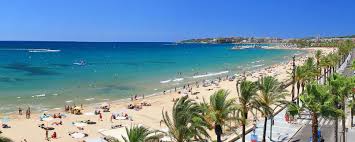
Very early in the morning (call it the middle of the night) on Saturday, 11 May, Sheila and I will depart on a coach trip to Salou in Spain (see image), not to return until Sunday, 19 May. I am very unlikely to blog during that period.

In Poul Anderson's "How To Be Ethnic In One Easy Lesson," (see here) James Ching has "...occasional trips to Luna..." (p. 178) including, most recently, one for his sixteenth birthday. However, because, in the 25th century, there is regular FTL interstellar travel, Jimmy wants to attend the Academy, join the Brotherhood, become a spaceman and visit extra-solar planets like Cynthia, Gorzun and Ythri. Reading the Technic History chronologically, we have already seen Ythri and heard of Cynthia although this is the first mention of Gorzun. A future history is built brick by brick. From his aircar, Jimmy sees a bus containing a Lunarian, an Alfzarian, a spacehand and a journeyman merchant. The sounds like our pluralist society but more so.

The Polesotechnic League In Its Glory

Poul Anderson's The Technic Civilization Saga is full of distractions for anyone who tries to reread it in search of a particular theme. Having more or less reread the four works in Volume I that feature van Rijn, I ought to turn to Volume II but my attention is first caught by Hloch's Earth Book Introduction to "How To Be Ethnic In One Easy Lesson." Hloch writes that this story:

"...gives a picture from within Terran society when the Polesotechnic League was in its glory..."
-Poul Anderson, "How To Be Ethnic..." IN Anderson, The Van Rijn Method (Riverdale, NY, 2009), pp. 175-197 AT p. 176.

He also advises his Avalonian readers:

"To screen a glossary of obscure terms, punch Library Central 254-0691.
"-Hloch of the Stormgate Choth
"The Earth Book of Stormgate"

The Earth Book is a historical, almost scriptural, document about how the choth came to being so hopefully it will outlast those specific instructions about the Library reference.

What Makes Nicholas Van Rijn Stand Up?

I was taught that it was a sign of respect to stand up when someone entered a room but this is not always appropriate in our informal society. Customs will differ in the Solar Commonwealth and the Polesotechnic League makes its own rules.

"Three men sat... Only one of them rose... Nicholas van Rijn wallowed his bulk deeper into his lounger... I bowed to him as is fitting to a merchant prince..."
-Poul Anderson, "The Master Key" IN Anderson, David Falkayn: Star Trader (Riverdale, NY, 2010), pp. 273-327 AT p. 277.

The second, younger, man who does not rise apologizes for "'...staying put...'" (ibid.) He is unwell.

On another occasion:

"[Van Rijn's] corpulent corpus did not rise from the lounger. Dalmady didn't mind. Not only bulk but height would have dwarfed him."
-Poul Anderson, "Esau" IN Anderson, The Van Rijn Method (Riverdale, NY, 2009), pp. 517-553 AT p. 520.

Dalmady didn't mind - so there was some expectation that van Rijn might rise. Later, he does. When Dalmady announces his intention to seek employment elsewhere and starts to leave:

"Van Rijn avalanched upward to his own feet."
-ibid., p. 551.

Suddenly there is something worth standing up for!

Uncrowned King

The Man Who Counts, see here.

"'Kill me that fat worm!' shouted T'heonax." (XX, p. 491)

T'heonax, admiral and Oracle of the Fleet, head of state and church, is surrounded by his advisory council and armed guards. His full titles are:

Grand Admiral;
herditary Commander-in-chief of the Fleet of Drak'ho;
Fisher of the Western Seas;
Leader in Sacrifice;
Oracle of the Lodestar.

The "fat worm" responds:

"'Van Rijn waved an impatient hand at him. 'Be quiet, you. I make the talkings. So! Sit down, both you nations, and listen to Nicholas van Rijn!'" (ibid.)

A Biblical turn of phrase. Who or what is van Rijn? Some people have it and most of us don't.

Speculution (Speculative Evolution)

The Man Who Counts, see here.

Rereading this novel, I have reached a point where I would want to summarize Poul Anderson's speculations about extraterrestrial evolution but find that I have already done so:

Diomedean Evolution
Diomedean Evolution II
Explanation
Alien Evolution

That fourth post also refers to evolution on Starkad, Ythri and Dido and to life cycles on Talwin. These five planets all appear in Anderson's main future history series, the History of Technic Civilization. Thus, Anderson presents not only future history but also fictional evolution.

For evolution on two other Technic History planets, t'Kela and Throra, see Making Sense Of T'Kela.

Friday, 3 May 2019

A Few Short, Focused Future Histories

Long future histories - Heinlein's, Anderson's or Niven's - are just about the future whereas a few short future historical series focus on a single concept.

Ray Bradbury, The Martian Chronicles: Mars;
Isaac Asimov, I, Robot: robots;
James Blish, The Seedling Stars: "pantropy";
Poul Anderson, Tales Of The Flying Mountains: "gyrogravitics";
Poul Anderson, Maurai: post-nuclear recovery;
Poul Anderson, Kith: STL interstellar travel;
ERB, The Moon Maid: Lunar invasion;
Larry Niven, Teleportation: teleportation.

Eight loose examples, three by Anderson. Whatever is said about sf is usually said about Anderson.

Studying a future history, an sf fan's mind moves either forward along a single timeline, e.g., with van Rijn on Diomedes, or sideways between timelines as above. Although we imagine multiple timelines, each future history usually remains autonomous except once when van Rijn visits the Old Phoenix.

This Bank Holiday weekend:

May Day March;
a moot;
the big annual charity car boot sale at Ryelands Park.

For the retired, life is a long weekend.

Sun, Clouds And Sea

I am receiving the message, "Sorry! We could not copy your photos to your blog." Have I come to the end of my allowable number of free images from Google?

(Later: After another attempt, the image has just gone on.)

The Man Who Counts, see here.

"The wind ruffled waves and strummed idly on rigging. The sun struck long copper-tinged rays through scudding cloudbanks, to walk on the sea with fiery footprints. The air was cool, damp, smelling a little of salty life. It would not be an easy time to die, thought Wace." (XIX, p. 483)

Strumming (sound);
sun (sight);
cool and damp (sensations);
salt (smell and, by implication, taste);
a thought (inner reflection).

A complete picture. We need more wind, sun and clouds in hard sf. Wace and van Rijn have just fought alongside some Diomedeans against others and will now try to bring peace between them but meanwhile Anderson rightly describes the sea scene on the planet Diomedes.

Compilations And Culminations II

See Compilations And Culminations.

This question has arisen again: Does "The Chapter Ends" belong in Poul Anderson's Psychotechnic History? See Introductions And Interstitial Material and combox. For previous blog discussions, see:

Chronological Questions
Chronological Questions II
Fifty Thousand Years
"The Galactic Synthesis Of Human Psychodynamics With Interstellar Coordination," here
Later Than We Think
The Human Form II

Despite my initial skepticism, I have come to accept that there are just enough common references to make it acceptable to regard the events of "The Chapter Ends" as occurring in the very remote future of the Psychotechnic History.

Thus, I return to my comparison of four future history series each culminating in a further future:

in Anderson's Psychotechnic History, human beings and their allies control cosmic forces and migrate to the Galactic Center;

in Anderson's Technic History, human civilizations spread among several spiral arms of the galaxy;

in James Blish's The Seedling Stars, Adapted Men spread through the galaxy;

in Larry Niven's Known Space History, unaging and genetically lucky human beings with fail-safe high technology inhabit the Thousand Worlds.

These four scenarios are all interstellar but also differ. Niven's is particularly utopian, an equivalent in this respect being Blish's The Quincunx Of Time.

Despite the many future interstellar wars in various works, Anderson also shows us rational species cooperating:

oxygen- and hydrogen-breathers share out the galaxy in "The Chapter Ends";

human beings and Ythrians share out the Avalonian continent of Corona in the Technic History;

also in the latter series, Merseians have a House in the tri-cameral parliament of Dennitza.

Every possibility: causes of conflicts but also potentials for peace.

Combat Experience

The Man Who Counts, see here.

"A catapult bolt came whirring over the wall, ripped through [van Rijn's] sleeve and showered ice chips where it struck." (p. 470)

He is nearly hit by a flamethrower.

"A slingstone bounced off his leather-decked abdomen, an arrow ripped along one cheek, blowgun darts pincushioned his double cuirass." (p. 475)

Then he fights with an ax, kills one Drak'ho with a blow to the head and strangles another that has wrestled him from behind. With Wace and the Lannachska, he drives the defenders back. Van Rijn could have been killed at any moment. However, he is protected by the laws of action-adventure fiction. If our hero is to die in combat, then it will be dramatically near the end of a narrative, not casually in a skirmish.

When they have fought to the pre-planned cease-fire, van Rijn tells Wace:

"'Comes now the talking. So far we have had it soft. This is the times that fry men's souls. Ha! Have you got the nerve to see it through?'" (p. 481)

Talking is harder? Sure. It could all go wrong. Van Rijn and Wace could be lynched by enraged Diomedeans from either side. We remember another conversation:

"'I am not a man of war,' Desai said.
"Beneath a shelf of brow ridge, Uldwyr's eyelids expressed skepticism while his mouth grinned. 'You mean you don't like physical violence. It was quite an effective war you waged at the conference table.'"
-Poul Anderson, The Day Of Their Return IN Anderson, Captain Flandry: Defender Of The Terran Empire (Riverdale, NY, 2010), pp. 74-238 AT p. 84.