See previous post.
But then, thinking this through again - and please tell me if I get anything wrong -, that tax-hungry Dominancy is presented in Chapter 21 of Starfarers which is the altered form of "Ghetto." It becomes necessary to compare the texts of "Ghetto," collected in Maurai And Kith, and of Starfarers, Chapter 21. We find several textual alterations including this one: the regime that is called "the Dominancy" in Starfarers had been called "the Star Empire" in the original version. That explains why members of its highest caste are called the Star-Free.
Thus, in the original version of the History, it was to be understood that the increased taxation introduced in "Ghetto" had preceded the physical suppression that was later referred back to in "The Horn of Time the Hunter." Did that suppression occur during the long period when Envoy was away from Earth in Starfarers?
Poul Anderson wrote:
"...I made "Ghetto," much revised, a part of my novel Starfarers. I was going to incorporate "The Horn of Time the Hunter" as well, but Karen convinced me that it was too dark."
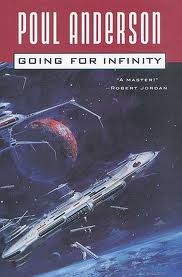
-Poul Anderson, Going For Infinity (New York, 2002), p. 137.
I think that:
the several stories that Anderson revised for later republication should be preserved in both versions;
the way to do this with the Kith stories is to publish both a three-story collection and the later novel;
thus, in the original History, the Star Empire oppressively taxes and later physically suppresses the Kith, whereas, in the Starfarers future history, the Dominancy oppressively taxes the Kith but is later superseded by the Governance and other regimes.
Saturday, 30 May 2015
Friday, 29 May 2015
Two Volumes?
Of Poul Anderson's three Kith short stories, two were incorporated in different forms into his novel, Starfarers. Should there therefore be two Kith volumes? -
a collection of all three stories in their original forms;
the novel.
These two volumes would constitute alternative versions of the Kith History. Both versions culminate with a ship returning from an unusually long exploratory voyage, either five or ten thousand years/light years. But they are different ships with different missions.
In the short story, "The Horn of Time the Hunter," the exiled Kith ship, the Golden Flyer, has explored the fringes of the galactic nucleus. We are not told what her crew found there except that it was neither wisdom nor the Elder Race. The story ends before they reach the Solar System but, en route, they have found, on an extrasolar planet, human colonists who have adapted to living in water. As in Anderson's Technic History, enough time has elapsed for human beings to adapt to different planetary environments.
This story also summarizes some future history that diverges in detail from the course of events presented in Starfarers. In the novel, a political regime called the Dominancy persecutes the Kith with exorbitant taxes whereas in "The Horn of Time...," a regime called the Star Empire physically attacks the Kith so that those who are not captured flee from the Solar System and meet in council at Tau Ceti, a rendezvous point in both versions of the History.
This mention of the Star Empire reads like a reference to an earlier installment of the series and, of course, even if such an installment did not exist at the time when "The Horn..." was written, Anderson could have added such a "prequel" later.
The viewpoint character of "The Horn..." is Jong Errifrans of the Golden Flyer and in "Ghetto," incorporated into Starfarers, Kenri Shaun recalls his friend, Jong Errifrans of the Golden Flyer.
a collection of all three stories in their original forms;
the novel.
These two volumes would constitute alternative versions of the Kith History. Both versions culminate with a ship returning from an unusually long exploratory voyage, either five or ten thousand years/light years. But they are different ships with different missions.
In the short story, "The Horn of Time the Hunter," the exiled Kith ship, the Golden Flyer, has explored the fringes of the galactic nucleus. We are not told what her crew found there except that it was neither wisdom nor the Elder Race. The story ends before they reach the Solar System but, en route, they have found, on an extrasolar planet, human colonists who have adapted to living in water. As in Anderson's Technic History, enough time has elapsed for human beings to adapt to different planetary environments.
This story also summarizes some future history that diverges in detail from the course of events presented in Starfarers. In the novel, a political regime called the Dominancy persecutes the Kith with exorbitant taxes whereas in "The Horn of Time...," a regime called the Star Empire physically attacks the Kith so that those who are not captured flee from the Solar System and meet in council at Tau Ceti, a rendezvous point in both versions of the History.
This mention of the Star Empire reads like a reference to an earlier installment of the series and, of course, even if such an installment did not exist at the time when "The Horn..." was written, Anderson could have added such a "prequel" later.
The viewpoint character of "The Horn..." is Jong Errifrans of the Golden Flyer and in "Ghetto," incorporated into Starfarers, Kenri Shaun recalls his friend, Jong Errifrans of the Golden Flyer.
Literary Lineages
This blog locates Poul Anderson within certain literary lineages:
The Bible
Homer
Virgil
The Eddas
The Sagas
William Shakespeare
Mary Shelley
Mark Twain
Rudyard Kipling
HG Wells
Olaf Stapledon
Arthur Conan Doyle
L Sprague de Camp
John W Campbell
Robert Heinlein
This is not the long list of every writer with whom Anderson can be compared but the shorter list of those whom he clearly quotes, refers to or comes after. Anderson is more than a Campbellian sf writer. His roots are in the far past. The second part of the lineage is his successors:
Larry Niven
Jerry Pournelle
SM Stirling
etc
I apologize for my ignorance of current sf. Contributions on other post-Anderson sf writers would be welcome. Since this blog has recognized SM Stirling as a worthy successor, there have been posts on his two works set in the Angrezi Raj and on the first of the three works in the Lords of Creation series. I hope soon to acquire the remaining two installments of this series. Meanwhile, there is another Anderson work to reread.
(I said that I might end May with the round number of 100 posts and have now carried on to 110 with two days still to go. I might end this month here.)
The Bible
Homer
Virgil
The Eddas
The Sagas
William Shakespeare
Mary Shelley
Mark Twain
Rudyard Kipling
HG Wells
Olaf Stapledon
Arthur Conan Doyle
L Sprague de Camp
John W Campbell
Robert Heinlein
This is not the long list of every writer with whom Anderson can be compared but the shorter list of those whom he clearly quotes, refers to or comes after. Anderson is more than a Campbellian sf writer. His roots are in the far past. The second part of the lineage is his successors:
Larry Niven
Jerry Pournelle
SM Stirling
etc
I apologize for my ignorance of current sf. Contributions on other post-Anderson sf writers would be welcome. Since this blog has recognized SM Stirling as a worthy successor, there have been posts on his two works set in the Angrezi Raj and on the first of the three works in the Lords of Creation series. I hope soon to acquire the remaining two installments of this series. Meanwhile, there is another Anderson work to reread.
(I said that I might end May with the round number of 100 posts and have now carried on to 110 with two days still to go. I might end this month here.)
Starfarers And The Time Patrol
In the Time Patrol series:
macroscopic time travel is possible - people can go;
past events can be changed;
a post-human Danellian confirms that the purpose of the Patrol is to prevent random changes, which would preclude life or consciousness.
In Starfarers:
subatomic time travel is possible - information can be sent;
past events cannot be changed;
a message from the future confirms that the interstellar drive stabilizes the universe.
Thus, in Starfarers, interstellar travelers fulfill a cosmic role similar to that of Time Patrollers. Among its many other qualities, Starfarers is a contribution to the theory of time travel.
macroscopic time travel is possible - people can go;
past events can be changed;
a post-human Danellian confirms that the purpose of the Patrol is to prevent random changes, which would preclude life or consciousness.
In Starfarers:
subatomic time travel is possible - information can be sent;
past events cannot be changed;
a message from the future confirms that the interstellar drive stabilizes the universe.
Thus, in Starfarers, interstellar travelers fulfill a cosmic role similar to that of Time Patrollers. Among its many other qualities, Starfarers is a contribution to the theory of time travel.
Captain Ricardo Iriarte Nansen Aguilar
Poul Anderson, Starfarers (New York, 1999).
Captain Nansen is one lucky guy. Of the four women in the Envoy crew, he is with one, Kilbirnie, until she unfortunately dies during the voyage and is married to another, Dayan, by the end of the novel.
In Chapter 5, Nansen and Dayan ride on his family estate in Paraguay.
In Chapter 49, he has a similar estate on the planet Harbor.
In Chapter 52, Nansen and Dayan, married, ride on the estate on Harbor.
Such an estate traditionally employs servants. Such are unnecessary on Harbor but Anderson reproduces that ambiance. The household staff are really apprentices spending time with the starfarers.
Nansen addresses parliament. Chapter 52 is a beginning:
the Envoy crew and the surviving Kith are coming together;
better starships are being built with new knowledge;
new terrestroid planets will be colonized;
planetary engineering systems will make settlement possible or easier than before;
anyone who wants to will be able to star travel;
other races will be contacted;
millions of starships flying will make the cosmic substrate more stable (this was explained earlier);
now that they know that it is possible, human beings will discover how to build transtemporal communicators.
Most of this is still to happen. It does not necessarily involve recontacting the quantum intelligences as I had thought. But it was those intelligences that had received messages from the future about the cosmic role of interstellar travel.
Captain Nansen is one lucky guy. Of the four women in the Envoy crew, he is with one, Kilbirnie, until she unfortunately dies during the voyage and is married to another, Dayan, by the end of the novel.
In Chapter 5, Nansen and Dayan ride on his family estate in Paraguay.
In Chapter 49, he has a similar estate on the planet Harbor.
In Chapter 52, Nansen and Dayan, married, ride on the estate on Harbor.
Such an estate traditionally employs servants. Such are unnecessary on Harbor but Anderson reproduces that ambiance. The household staff are really apprentices spending time with the starfarers.
Nansen addresses parliament. Chapter 52 is a beginning:
the Envoy crew and the surviving Kith are coming together;
better starships are being built with new knowledge;
new terrestroid planets will be colonized;
planetary engineering systems will make settlement possible or easier than before;
anyone who wants to will be able to star travel;
other races will be contacted;
millions of starships flying will make the cosmic substrate more stable (this was explained earlier);
now that they know that it is possible, human beings will discover how to build transtemporal communicators.
Most of this is still to happen. It does not necessarily involve recontacting the quantum intelligences as I had thought. But it was those intelligences that had received messages from the future about the cosmic role of interstellar travel.
Inside And Outside
Poul Anderson, Starfarers (New York, 1999).
"'You - you are from outside?'" (p. 489)
The Kith crew of Fleetwing have been enclosed within their large, now immobile, interstellar spaceship for years. Those who were children have grown up but the crew has stopped having children and has practiced euthanasia to conserve resources. Each of them looks at the stars once a year.
It is easy to imagine a situation in which:
resources are recycled indefinitely;
new generations continue to be born;
the crew forgets how to look out at the stars;
it seems to them that their ship is the entire universe.
I was fascinated when I read about such an enclosed artificial universe in Robert Heinlein's Orphans Of The Sky. Brian Aldiss presented a more elaborate version in Non-Stop and James White creatively adapted the idea to a marine setting in The Watch Below. The Fleetwing crew do retain their knowledge of the outside universe but nevertheless it is a considerable shock when some of them meet unfamiliar spacesuited figures and one exclaims:
"'You - you are from outside?'" (p. 489)
The Kith crew of Fleetwing have been enclosed within their large, now immobile, interstellar spaceship for years. Those who were children have grown up but the crew has stopped having children and has practiced euthanasia to conserve resources. Each of them looks at the stars once a year.
It is easy to imagine a situation in which:
resources are recycled indefinitely;
new generations continue to be born;
the crew forgets how to look out at the stars;
it seems to them that their ship is the entire universe.
I was fascinated when I read about such an enclosed artificial universe in Robert Heinlein's Orphans Of The Sky. Brian Aldiss presented a more elaborate version in Non-Stop and James White creatively adapted the idea to a marine setting in The Watch Below. The Fleetwing crew do retain their knowledge of the outside universe but nevertheless it is a considerable shock when some of them meet unfamiliar spacesuited figures and one exclaims:
"'You - you are from outside?'" (p. 489)
The Shauns Of Fleetwing
Poul Anderson, Starfarers (New York, 1999).
The crew of the Kith ship, Fleetwing, includes Shauns:
in Chapter 1, Ricardo Nansen rescues his friend, Mike Shaughnessy, on an extrasolar planet;
in Chapter 10, Michael Shaughnessy meets his older great-grandson, Ramil Shauny;
in Chapter 12, old Michael Shaughnessy goes to the planet Feng Huang to die;
in Chapter 17, Ormer Shaun is second mate of Fleetwing;
in Chapter 21, when Fleetwing visits Earth, its crew include Wolden Shaun and his son, Kenri Shaun;
in Chapter 46, when Fleetwing is at the planet Brent its crew includes Vodra Shaun;
in Chapter 51, Ricardo Nansen rescues the surviving crew of the wrecked Fleetwing, including Evar Shaun.
I realized the Shaughnessy-Shauny-Shaun line of descent and Nansen's opening and concluding rescue missions only while listing Shauns. There is always more to be found in Anderson's texts when we look more deeply into them.
The crew of the Kith ship, Fleetwing, includes Shauns:
in Chapter 1, Ricardo Nansen rescues his friend, Mike Shaughnessy, on an extrasolar planet;
in Chapter 10, Michael Shaughnessy meets his older great-grandson, Ramil Shauny;
in Chapter 12, old Michael Shaughnessy goes to the planet Feng Huang to die;
in Chapter 17, Ormer Shaun is second mate of Fleetwing;
in Chapter 21, when Fleetwing visits Earth, its crew include Wolden Shaun and his son, Kenri Shaun;
in Chapter 46, when Fleetwing is at the planet Brent its crew includes Vodra Shaun;
in Chapter 51, Ricardo Nansen rescues the surviving crew of the wrecked Fleetwing, including Evar Shaun.
I realized the Shaughnessy-Shauny-Shaun line of descent and Nansen's opening and concluding rescue missions only while listing Shauns. There is always more to be found in Anderson's texts when we look more deeply into them.
Thursday, 28 May 2015
Emprises And A Dominancy
Poul Anderson, Starfarers (New York, 1999).
The Venture League is:
"...an organization that aimed to launch fresh emprises among the stars." (p. 471)
"Emprise" evokes both "empire" and "enterprise." Envoy has returned with enough information to launch, on Harbor, if not on Earth, an industrial revolution, a scientific revolution and religious and philosophical transformations. Al Brent, if he had survived, would probably have argued for conquering the unenterprising Earth to which they returned.
We learn the name of yet another political regime. There has been not only a Dominancy and a Governance but also a Mandatory that left warhead craters on Harbor during its dying days.
Nansen and Dayan, with a much younger crew, take Envoy to rescue the last Kith ship. Like Captain Kirk, Nansen boards the stranded Fleetwing but, unlike Kirk, he is able to argue that his experience makes him the most suitable candidate for this role. He of course knows the doctrine that "'The commander should stay with the ship.'" (p. 479)
We approach the conclusion of Starfarers. How many entirely different situations have we encountered in its fifty two chapters? Several of the characters appear in only a single chapter. Others survive for many chapters and millennia thanks to time dilation. The Envoy crew sitting "...under a vine-draped trellis..." (p. 472) are like the immortals conferring around a picnic table in The Boat Of A Million Years yet how different are their stories.
The Venture League is:
"...an organization that aimed to launch fresh emprises among the stars." (p. 471)
"Emprise" evokes both "empire" and "enterprise." Envoy has returned with enough information to launch, on Harbor, if not on Earth, an industrial revolution, a scientific revolution and religious and philosophical transformations. Al Brent, if he had survived, would probably have argued for conquering the unenterprising Earth to which they returned.
We learn the name of yet another political regime. There has been not only a Dominancy and a Governance but also a Mandatory that left warhead craters on Harbor during its dying days.
Nansen and Dayan, with a much younger crew, take Envoy to rescue the last Kith ship. Like Captain Kirk, Nansen boards the stranded Fleetwing but, unlike Kirk, he is able to argue that his experience makes him the most suitable candidate for this role. He of course knows the doctrine that "'The commander should stay with the ship.'" (p. 479)
We approach the conclusion of Starfarers. How many entirely different situations have we encountered in its fifty two chapters? Several of the characters appear in only a single chapter. Others survive for many chapters and millennia thanks to time dilation. The Envoy crew sitting "...under a vine-draped trellis..." (p. 472) are like the immortals conferring around a picnic table in The Boat Of A Million Years yet how different are their stories.
A Secular Prophet
Poul Anderson, Starfarers (New York, 1999).
Chandor Barak, director of the Venture Society academy, tells Captain Nansen:
"'...you are the hero. I could well say you're the prophet. We need your imagination.'
"Nansen felt uncomfortable about that. But no matter. The zeal before him lighted his own fire afresh. This was not about gain or glory, it was about the nature of humankind, and humankind's place in the universe." (p. 466)
That does sound prophetic. But is it mankind's place in the universe that motivates people to travel long distances into unknown regions? I think that Europeans invaded other continents for gain and glory and sometimes rationalized their own enrichment with fine sounding phrases. Anderson imagines a situation in which the returned Envoy crew members have no economic motive for space exploration but instead really do believe that this is the way forward for mankind.
That is my hope for the future. Freed by technology from material want, some human beings may relapse into passivity but others will be freed to pursue worthy goals like the exploration of the universe. Knowledge is primarily an end, not a means.
Chandor Barak, director of the Venture Society academy, tells Captain Nansen:
"'...you are the hero. I could well say you're the prophet. We need your imagination.'
"Nansen felt uncomfortable about that. But no matter. The zeal before him lighted his own fire afresh. This was not about gain or glory, it was about the nature of humankind, and humankind's place in the universe." (p. 466)
That does sound prophetic. But is it mankind's place in the universe that motivates people to travel long distances into unknown regions? I think that Europeans invaded other continents for gain and glory and sometimes rationalized their own enrichment with fine sounding phrases. Anderson imagines a situation in which the returned Envoy crew members have no economic motive for space exploration but instead really do believe that this is the way forward for mankind.
That is my hope for the future. Freed by technology from material want, some human beings may relapse into passivity but others will be freed to pursue worthy goals like the exploration of the universe. Knowledge is primarily an end, not a means.
The Venture League
Poul Anderson, Starfarers (New York, 1999).
(The present Queen of England, occasionally mentioned on this blog, will visit her Duchy of Lancaster tomorrow after a week of exhaustive security preparations. This means that, if we look out at the right time, we will see the Royal Train passing behind our house early in the morning.)
In the previous post, does the autumnal sunlight pervading a summer day on Harbor presage that the Envoy crew will be unable to reverse the inexorable decline of interstellar travel? As it turns out, they do reverse it. Although Anderson wrote two short dystopias, all of his longer works end optimistically. The Night Face ends somberly - but is not very long.
Captain Nansen's Venture League encounters political opposition already discussed here. Reverting for a moment to what Nansen found on Earth before traveling to Harbor:
Kith Town is empty except for robot caretakers;
the newest homes were last occupied centuries ago;
few visit physically because everyone on Earth can access virtuals;
but there is a visitors' center with overnight accommodation;
ships come rarely and stay briefly;
crews stay in a hostel or aboard;
constellations and the North Star have changed;
the Town is surrounded by ruins because -
"From time to time, a city had engulfed the starfarers' dwelling place." (p. 462)
It was the realization that more than one city had enclosed Kith Town that brought home to me the passage of time in this future history. With nothing to be done on Earth, Nansen and his crew travel to Harbor to found their Venture League there. What happens next?
(The present Queen of England, occasionally mentioned on this blog, will visit her Duchy of Lancaster tomorrow after a week of exhaustive security preparations. This means that, if we look out at the right time, we will see the Royal Train passing behind our house early in the morning.)
In the previous post, does the autumnal sunlight pervading a summer day on Harbor presage that the Envoy crew will be unable to reverse the inexorable decline of interstellar travel? As it turns out, they do reverse it. Although Anderson wrote two short dystopias, all of his longer works end optimistically. The Night Face ends somberly - but is not very long.
Captain Nansen's Venture League encounters political opposition already discussed here. Reverting for a moment to what Nansen found on Earth before traveling to Harbor:
Kith Town is empty except for robot caretakers;
the newest homes were last occupied centuries ago;
few visit physically because everyone on Earth can access virtuals;
but there is a visitors' center with overnight accommodation;
ships come rarely and stay briefly;
crews stay in a hostel or aboard;
constellations and the North Star have changed;
the Town is surrounded by ruins because -
"From time to time, a city had engulfed the starfarers' dwelling place." (p. 462)
It was the realization that more than one city had enclosed Kith Town that brought home to me the passage of time in this future history. With nothing to be done on Earth, Nansen and his crew travel to Harbor to found their Venture League there. What happens next?
Subscribe to:
Posts (Atom)