Showing posts sorted by date for query dead leaves. Sort by relevance Show all posts

Monday, 21 September 2026

Waking Up

"Terminal Quest."

Rugo wakens to sunlight, birds, wind, chattering leaves, a receding dream, dew, mist, dales, a conveniently low branch for pulling himself erect, green bushes and trees on a hillside and dead leaves underfoot. My point here is that, judging from this description, he might have been on Earth although he is not. This story published in 1951 shows us none of Poul Anderson's extraterrestrial plants or other environmental details.

However, Rugo himself, while clearly intelligent, has four feet and a large scaly head so it is established very early in the narrative that he is not human.

As to what happens next, I have reached that point in the evening - nearly midnight - when, as regular blog readers know, I am disinclined to blog any further! But we have covered some ground today. 

Friday, 19 June 2026

Before The Eddas And The Vedas

To Turn The Tide, CHAPTER ELEVEN.

An apprehended but suiciding assassin invokes a name which Saruke and we recognize:

"'Wodinaz...God of fighters. God of good warrior death, leads warrior dead to halls of Gods.'" (p. 165)

When Denesh leaves the Bakhri, King Thuliash asks:

"'...Indra the Thunderer that he bid his warrior Maruts watch over you for as far as their range may reach...'"
-Poul Anderson, The Shield Of Time (New York, July 1991), PART SIX, p. 278.

These gods were around a long time ago, still multiple and of limited range, of course, back then.

In Preston ("Priest Town," a hot-bed of Catholicism), near here, by the river, there is a dog leg street with a Hindu Temple at one end and a pub that used to host a Pagan Moot at the other. I contemplate Vedic gods, British gods and the river god... As a matter of fact, the Temple is closed to the public in the afternoon so, on visits to Preston, I used to meditate in a more convenient Jesuit Church in the City Centre. Why am I posting about this now? I am inspired by references to Woden and Indra in different timelines.

Wednesday, 6 May 2026

Bluster, Chill, Whine

The Broken Sword, VII.

"On a blustery fall day, with the smell of rain in the keen air and leaves turned to gold and copper and bronze, Ketil and a few comrades rode forth to hunt." (p. 42)

They feel bluster and keenness, smell rain and see colours: three senses.

After chasing a huge noble white stag, Ketil is separated from his companions and:

"A thin chill wind whimpered through dusk." (ibid.)

Later, when Valgard seeks his now lost brother, Ketil:

"Wind whirled dead leaves through the air like ghosts hurrying down hell-road, and its whine gnawed at Valgard's nerves." (p. 44)

Wind blusters when the hunt is good, whimpers when Ketil is separated and whines when Valgard follows him. Poul Anderson's winds always follow his narratives. Will these autumnal Northern winds whirl two brothers down hell-road? Maybe but not tonight. I am going back to Stieg Larsson, then to bed.

Good night if you are in a part of the world where it is dark right now...

Saturday, 10 January 2026

Wind On T'Kela

"Territory," pp. 85-86.

Wind:

whimpers when t'Kelans watch approaching human beings;

increases as the stellar flare swells;

blows dust and dead leaves, flattens fires and shivers tents when the flare resembles a second star.

I could look ahead for any more wind activities but it is getting late here.

Van Rijn will impress the t'Kelans by defying their flaring sun, even firing his blaster at it. Unlike the well-meaning Esperancians, the merchant has deduced the t'Kelans' psychology and how to get on equal terms with them.

As ever, with an Andersonian hero, the problem of apparently inexplicable hostility will be solved.

We are on our way.

Thursday, 4 December 2025

Gutherius And Nehalennia

"Star of the Sea," III.

When the light fails, the white stag that Gutherius has chased vanishes and:

"Wind piped among the trees." (pp. 625-626)

The following day, as he blunders through a lifeless part of the forest:

"...there was only the wind soughing in the crowns and tearing dead leaves loose." (p. 626)

The following night, during a great storm, trees groan and toss as the wind tears branches loose and hurtles them. 

The old woman who was Nehalennia had predicted woe, then reward.

The following morning, Gutherius' reward begins. The weather is:

"...calm and sunny." (ibid.)

The hound of Nehalennia leads him to a beach where he helps a shipwrecked crew so that later he is rewarded with a fair share of the cargo. Thus, he invests in a ship that trades with Britain:

"Ever did she enjoy fair weather and a following wind..." (p. 628)

Gutherius raises an altar, makes generous offerings and always bows to the evening and morning stars.

We have quoted the closing paragraph before but it bears repetition:

"Hers are the trees, the vine, and the fruits thereof. Hers are the sea and the ships that plow it. Hers are the well-being of mortals and peace among them." (ibid.)

Amen. 

Sunday, 26 October 2025

Wind In Beringia

The Shield Of Time.

Paleo-Indians from Siberia, led by Red Wolf, arrive in Beringia and confront the archaic Caucasoids, led by Wanda's friend, Aryut, whose ancestors had come from Asia earlier. 

"Red Wolf stopped three paces from [Aryut]. Eyes stared into eyes. Silence stretched amidst the wind." (p. 156)

Wind often underlines pregnant silences.

Wanda, now absent, had protected Aryut at his first encounter with Red Wolf but:

"'Where is your protector today?' Red Wolf jeered. Only the wind replied." (p. 157)

This means that there is no reply but often the wind comes across as an active participant. 

Poul Anderson's universes are haunted by winds. Anderson quotes Shelley in Trader To The Stars so here is some relevant Shelley:

O wild West Wind, thou breath of Autumn's being,
Thou, from whose unseen presence the leaves dead
Are driven, like ghosts from an enchanter fleeing,
-from here. 

Tuesday, 23 September 2025

Wardens And The Wind


The Corridors Of Time, CHAPTER SEVENTEEN.

"[Lockridge] stood for a time and raged. Outside, the wind gusted under the eaves." (p. 154)

As within, so without.

When he goes outside:

"The wind streaked around him, with a rattle of dead leaves." (ibid.)

Dead leaves - death. The moon looks shrunken and he also hears the hunters.

When he rejoins Auri, who immediately says that Storm is not and cannot be the Goddess, Lockridge replies:

"'She isn't...'" (p. 156)

He has seen enough to know that Storm is not the Goddess as understood by Auri. 

He has also begun to move towards a position independent of both Wardens and Rangers. More must happen in just under fifty pages. The conclusion approaches and, unlike Jack Havig, Lockridge's contribution will be in the past, not in the future.

Thursday, 28 August 2025

Morning

The Merman's Children, Book Three, III.

Rain has washed the dawn pure. (I think that we know that feeling.)

Tomislav and Vanimen stand at the edge of the woods before the former departs.

The sky is white in the east, blue above them and violet in the west.

The western sky holds a planet and the Moon. (The mention of a planet makes Poul Anderson's readers think science fictional thoughts.)

Trees are described as "...all bronze and brass and blood..." (p. 139)

Dead leaves crunch.

Cocks crow.

Air is chill.

Maybe all Poul Anderson's descriptions of mornings, evenings, nights, storms and seasons comprise a vaster narrative than the doings of mere mortals? 

Tuesday, 19 August 2025

Mermen And Ythrians

The Merman's Children, IX.

Every part of a dead merman returns to nature where it wanders widely at one with the world. His spirit goes into sunlight, spindrift and sea-surge, his flesh into fleetness of fish and fowl, his bone and blood-salt back to the Bearer. I am paraphrasing a song of farewell that ends:

"The sky take you.
"The sea take you.
"And we will remember you in the wind." (p. 60)

At an Ythrian funeral, a Wyvan speaks the words of the New Faith which end:

"'Go hence now, that which [God's] talents left, be water and leaves, arise in the wind; and spirit, be always remembered."
-Poul Anderson, The People Of The Wind IN Anderson, Rise Of The Terran Empire (Riverdale, NY, March 2011), pp. 437-662 AT X, p. 559.

Two intelligent species on two planets in two timelines in one author's imagination.

Tuesday, 12 August 2025

Lucas And The Wind

Rogue Sword, CHAPTER XIII.

The wind plays an active role for a few pages.

"The draperies rippled. Outside, a noisy wind chased clouds across the sun and away again." (p. 189)

Noisy wind echoes human uproar:

"The next several weeks roared."
-Chapter XI, p. 158.

Such uproar brings rapid changes - bad, then good; darkness, then light - alternating quickly. This continues:

"Lucas wandered among trees that tossed and soughed in the great streaming wind. Light and shadow fled across the world." (p. 189)

Djansha's voice is timid, scarcely audible through "...the gusty air." (ibid.) Wind snatches petals from roses behind her and flaps her skirt, revealing her ankles. Dead leaves whirl. Shadows rush along the Boca Daner, a stretch of water. When Lucas promises to provide Djansha's dowry:

"'The gale alone answered him.'" (p. 191)

His heartbeat outshouts the wind. 

The wind is a constant background with everything else measured against it.

Tuesday, 22 July 2025

Seasons

Some chapters open by marking the passage of the seasons in:

Poul and Karen Anderson's The King Of Ys;
Poul Anderson's "Star of the Sea";
Poul Anderson's Brain Wave.

Brain Wave, 15:

"...the late fall of snow..." (p. 131)

17:

"Spring had come late, but now there was warmth in the air and a mist of green on the trees." (p. 143)

18:

"Early summer: the first shy green of leaves has become a fullness enchanted with sunlight, talking with wind; it has rained just an hour ago, and the light cool wind shakes down a fine sparkle of drops, like a ghostly kiss on your uplifted face; a few sparrows dance on the long, empty streets; the clean quiet mass of the buildings is sharp against a luminous blue sky, the thousand windows catch the morning sun and throw it back in one great dazzle." (p. 149)

(It does not surprise regular Anderson readers that the wind talks.)

21 (the closing chapter):

"Autumn again, and winter in the air. The fallen leaves lay in heaps under the bare dark trees and hissed and rattled across the ground with every wind. Only a few splashes of colour remained in the woods, yellow or bronze or scarlet against grayness.
"Overhead the wild geese passed in great flocks, southward bound. There was more life in the sky this year - fewer hunters, Brock supposed. The remote honking drifted down to him, full of wandering and loneliness. It was a clear pale blue up there, the sun wheeled bright and heatless, spilling its coruscant light across a broad and empty land. The wind was strong, flowing around his cheeks and flapping his clothes, the trees were noisy with it." (p. 181)

A full year.

I did not set out to quote at such length but it was difficult to stop, especially since the autumnal passage above culminates with a trademark strong wind.

Autumn is the beginning of an end with the promise of a new beginning if only because there is a cyclical return. This autumn is an end of all the old ways on Earth but much is happening elsewhere and is still happening for Archie Brock on Earth. The season is not dead. The wind flaps his clothes and is noisy in the trees.

Sunday, 20 July 2025

A Changed World

Brain Wave (originally THE ESCAPE), 12.

In every detail, Poul Anderson demonstrates that his characters live in a changed world. 

Peter Corinth calculates intranuclear stresses in a faster than light drive field simultaneously with the construction of the hull, engine, armour, doors, ports and controls of the first interstellar spaceship, all designed as an unprecedented piece of precision engineering.

The Institute works nonstop because its many liberated minds now have unimaginable horizons. The future belongs to the young, strong, purposeful and balanced technicians whereas Corinth feels exhausted at thirty-three. He and Helga are now so perceptive that they cannot conceal their feelings for each other and do not try. 

Thin, sharp air smells of autumn and sea. Dead leaves swirl. Frost has come. That is not new, of course, although it is standard Andersonian description, but what is new is that New York streets are half empty. Pedestrians and cars are rare. Skyscrapers are dark.

Roger's Cafe is:

"'A new night club for the new man.'" (p. 106)

Inside, there is a blue twilight. Corinth immediately deduces the new fluorescence principle used. Tables are spaced farther apart than formerly and are arranged in a spiral that minimizes distances to be walked by waiters. However, the waiter is a wheeled machine that extends slate and stylus for orders.

An orchestra including some previously famous musicians plays both old and new instruments to a now more appreciative audience. The new ability to see each other more clearly has eliminated former social distinctions. Corinth and Helga communicate with looks, gestures and very few words. 

He remembers liking:

"Ah, Love, could thou and I with Fate conspire -" (p. 110)

- but now sees it as childish.

Sunday, 17 November 2024

Flandry In The Technic History

And so we return to Dominic Flandry although I am not sure how much remains to be said about him. I first read of Flandry in "The Game of Glory" in a British reprint edition of Venture SF. I did not know at first that Flandry was a series character or, later, that his series was part of a future history. It did not occur to me that that remark about lying to a telepath referred to an earlier story. At some stage, I learned of Nicholas van Rijn and his protege, David Falkayn, but was surprised to read in an sf mag letter column that Falkayn might have had dealings with Merseians. Now, of course, each of us can, if we want to, own the entire The Technic Civilization Saga with Flandry's name in the titles of four of the seven volumes. Van Rijn and Falkayn get one each which leaves just one other title: Volume III, Rise Of The Terran Empire, begins with Mirkheim and ends with The People Of The Wind with four pivotal shorter works between them. That is the turning point of the entire Technic History.

When Abrams thought that Flandry was probably dead, he could well have been. How many people did die that would have made a big difference if they had lived? Does even a hypothetical omniscient being know all the alternative possibilities? Or do these possibilities exist in any case? Such questions take us out of the Technic History but into other works by Poul Anderson.

Sunday, 22 September 2024

Death

"Un-Man."

When a man dies, things happen to his body, his brain and the society from which he has departed. Thus, Naysmith imagines Donner. Physically, the dead man sprawls sightlessly, muscles stiff, body devouring itself. Socially, he leaves a gap in the Brotherhood. (This Brotherhood has not been fully explained yet but we are starting to get the idea.) That leaves Donner's brain:

"...brain darkened, withdrawn into the great night..." (p. 48)

"...darkened..." is an appropriate description of a brain that has ceased to be conscious. It is not an entity in the brain but the brain itself that has entered "...the great night..." of unconscious, inanimate matter. But, of course, even "darkness" and "night" are not fully accurate descriptions of unconsciousness. We can be conscious on a dark night, not seeing but still thinking and using our other senses. Death is the permanent cessation of all that. At least, many of us believe so... Death is not only night but also a permanent dreamless sleep. I felt my consciousness cease under a general anesthetic and remember that now only because I regained consciousness later. 

Monday, 25 March 2024

Wind And Lorenzen

Question And Answer.

OK. I am rounding up no less than three remaining references to the wind. Maybe some such references do just describe the weather and nothing else?

"A few wounded aliens crawled out of sight, a few dead lay emptily where they had fallen. There was a sharp reek of smoke in the chill windless air." (CHAPTER XVI, p. 132)

A pause in hostilities is marked by a pause in the wind.

"A low little wind sighed through the grove and rustled the leaves." (CHAPTER XVII, p. 136)

The pause in hostilities continues while men must think about what to do next. Appropriately, the wind now sighs rather than roaring, raging etc.

"'I think I see,' murmured Lorenzen. The wind wove around his voice, and a moonbeam flitted across his eyes." (p. 141)

He sees, helped by a moonbeam. The wind supports his articulation of what he sees... OK. That is it with the wind in this novel (I think).

We have to think about what Lorenzen and Avery say and not necessarily just agree with either of them.

Lorenzen:

"'I claim that with all our failures and all our sins, we've still done damn well for an animal that was running around in the jungle only two hundred lifetimes ago.'" (p. 145)

I agree with that but what follows from it? I think that it means that we have changed our condition and can change it again, indeed are changing it now. Lorenzen goes on to say:

"'I like man how he is...'" (ibid.)

How man is: he is changing his environment and himself in the process. Does Lorenzen want to take a snapshot and hold us indefinitely just where we are now?

This sentence concludes:

"'...not man as a bunch of theorists thinks he ought to be.'" (ibid.)

We need some theoretical understanding! We need to consider how we think we ought to be, not just affirm how we are! Of course Avery's "bunch of theorists" is doing it wrong, manipulating instead of advising.

Avery wants to use:

"'...the hidden interplay of economics and religion and technology - to evolve the culture we want.'" (CHAPTER XVI, p. 140)

Nothing should be hidden. Everyone should understand economics, religion and technology.

Avery wants restraint, dignity, contentment and thought as opposed to blindness, greed and ruthless animality. That sounds like an irreconcilable antithesis. Restraint and contentment could be mere passivity. We need the energy that was expressed through greed although shared technological wealth should certainly make greed as such redundant.

If an author sets up an irreconcilable antithesis, then indeed it remains irreconcilable.

Wednesday, 27 December 2023

Human Arts And Aliens

The Way of Zen by Alan Watts ends with a chapter on "Zen in the Arts." We remember:

the haiku in Poul Anderson's Genesis;

Adzel's hanging scrolls of a landscape and of the Compassionate Buddha and his tea ceremony in "How To Be Ethnic In One Easy Lesson";

Aycharaych's appreciation of Tu Fu:

"'...the poet of dead leaves flying amidst snow, cranes departing, or an old parrot shabby in its cage...'"
-Poul Anderson, A Knight of Ghosts and Shadows IN Anderson, Sir Dominic Flandry: The Last Knight of Terra (Riverdale, NY, March 2021), pp. 339-606, AT IX, p. 460.

(Aycharaych's telepathic insight into human beings enables him to understand and empathise with their arts.)

Saturday, 14 October 2023

The Adventures Of Uroch

The Game of Empire, CHAPTER ELEVEN.

A Terran flotilla intercepts a Merseian task force. Cyntath Gadrol Cannonshield, Vach Ynvory, commands the dreadnaught, Ardwyr. The battle is cover for the departure toward Gorrazan of a Merseian squadron led by Qanryf Bryadan Arrowsmith, Vach Hallen, in the cruiser, Tryntaf, which, on arrival in Gorrazanian space, smashes defence squadrons and broadcasts propaganda at the planetary surface. An escadrille of twenty gunboats led by Afal Uroch the Lucky, Vach Rueth, leaves Tryntaf and enters the Gorrazanian atmosphere. 

Warcraft attack. The escadrille evades. The Gorrazanians pursue, firing bullets, missiles and energy beams. Merseian gunners hit most of the projectiles. Most of the others, and of the rays, miss. Forcefields and armour absorb most hits. One gunboat falls. To evade a second defence force, Uroch takes his escadrille between peaks in a mountain range that he has studied in advance. Several pursuing flyers crash. Others lose contact. Uroch shakes off the remainder of the flotilla by going into space and hiding, free-fall, in the ionized gas from the nuclear detonations between two battling warships.

Re-entering atmosphere, the gunboats hide in a hurricane that takes them to their target where they shoot down defence missiles and aircraft. Their own missiles destroy a Folkmoot command centre, thus aiding the revolutionary Liberation Council. The gunboats fight their way back to Tryntaf. The squadron returns to Gadrol's fleet which eludes a Terran search and returns to Merseia.

As the omniscient narrator observes: epic material. The chapter closes with a Gorrazanian female singing to her dead child.

Saturday, 2 September 2023

Native Wildlife

Mirkheim, XVI.

The mercenaries have:

"...an instrument sensitive to the gases of breath and perspiration." (p. 211)

Thus, Falkayn cannot hide in a wood and they call him out. However, they disregard Chee Lan:

"An arboreal creature clinging to a high branch didn't count. It was inconspicuous, its fur gray with black spots, its posture that of a creature frozen into immobility. Chee had rolled in the humus below the dead leaves. And the men were not Hermetians, they knew nothing of the planet's wildlife. Perhaps none of them had even noticed her." (p. 213)

Chee hides her gun between her body and the tree, then uses it to destroy the "sniffer," to kill the man holding it and to injure one of his companions. The trader team, now undetectable, flee through the wood while their pursuers retreat.

This reminds me of an Indian immigrant to Britain who, finding a hedgehog in his garden, phoned the nearest zoo, thinking that one of its animals had escaped. What would we see that we did not expect on arriving in India?

In a future history series, we can alternate between focusing on a single detail in a single instalment and contemplating the fictional history in its totality. 

Friday, 4 August 2023

Rufinus And Eochaid

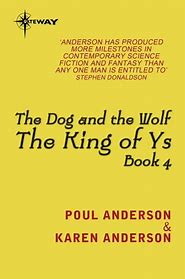
The Dog And The Wolf, XVII, 2.

"'This is no real home for me,' rustled from [Eochaid], like dead leaves blowing." (p. 337)

Dead leaves are becoming ubiquitous like the wind.

Rufinus joins Eochaid whose ship will join Niall's fleet. We begin to glimpse Rufinus' plan to eliminate Niall. Individual assassinations are preferable to mass slaughters but we have come to that time in the evening when I turn to other reading so we must leave Niall as he prepares to celebrate Beltene in the opening paragraph of Section 3. The story continues. The plot thickens. I even remember some of it from previous readings.

Niall reminds me of Harald Hardrada, the title character of Poul Anderson's The Last Viking Trilogy: a tall man whose only activity is to seize wealth created by others. Harald's death in battle is recorded as having happened at a particular time and place in English history whereas the Andersons have considerable literary freedom when recounting the death of Niall. They will give him a good send-off.

Tuesday, 1 August 2023

Wind Hooting, Biting And Scattering

The Dog And The Wolf, XII, 1.

When the scheming and conniving Procurator Bacca says that:

"'the interests of Rome...are the interests of civilization itself...'" (p. 235):

"Wind hooted and dashed rain across roof tiles." (ibid.)

Roof tiles represent civilization. Hooting wind represents the hostile elements but also Bacca's threat to the freedom of the former Ysans.

When Gratillonius informs his people of their admittance into the "Republic" (Empire), the weather, including of course the wind, provides a pathetic fallacy:

"The market day shone bright. Clouds scudded over the blue, wavelets ran upon rain puddles, the woods tossed and distantly roared as wind bit into them, leaves broke free of yonder red-brown-yellow minglement and scrittled across fields, the last migratory birds trekked aloft with cries ringing as cold as the air, all the world seemed to be in departure. That, at least, was right, thought Gratillonius." (p. 237)

This time, the viewpoint character confirms the pathetic fallacy: the brightness of a new beginning and the departure of olden freedoms.

When he has finished speaking:

"The wind scattered his words with the dead leaves." (p. 240)

Section 2 begins:

"He shut it out when he closed the door of Cadoc's house behind him." (ibid.)

"...it..." is the wind, ever present although we can shut it out for a while.