Showing posts sorted by date for query "Sister Planet". Sort by relevance Show all posts

Thursday, 23 July 2026

Solar Planets In The Pulps And Later In Heinlein, Asimov, Blish, Anderson And Stirling

Follow the link from "Northwest Smith " in Planetary Adventurers.

Ninety years ago, pulp sf writers treated the Solar System like a galaxy of inhabited planets with breathable atmospheres and even jungles on moons of Jupiter. Such an approach even affected Robert Heinlein's Future History although that series is primarily about the future development of human society, not about human-alien interactions. Isaac Asimov admitted in The Early Asimov that he wrote in this tradition even when he knew better.

We can see later writers emerging from the tradition. In James Blish's Cities In Flight and Mission To The Heart Stars, Martians had existed but are now extinct. Poul Anderson has half a dozen versions of Martians. There are Martians in his Psychotechnic History and in the original version of his "Margin of Profit" although, when that story was revised to fit into his Technic History, these "Martians" had become extra-Solars who had colonized Mars. Anderson also has Venerians in "Sister Planet," Jovians in Three Worlds To Conquer and Mercurians in "Life Cycle." 

When SM Stirling wrote a series in which Mars and Venus turned out to be more or less how earlier sf writers had imagined them, he also worked towards an explanation. A scientist working on Venus says:

"'Sam thinks...and I think...that two hundred million years ago, in the earliest Jurassic...this planet was different. Radically different from what we have now; as far as we can tell, it didn't have life at all. And we don't have any idea what changed it.'"
-SM Stirling, The Sky People (New York, October 2007), CHAPTER TWO, pp. 40-41.

But they will find out.

Wednesday, 4 February 2026

Enduring Explosion

James Blish,  POUL ANDERSON: THE ENDURING EXPLOSION IN Blish, The Tale That Wags The God (Chicago, 1987), pp. 86-92.

(A posthumous non-fiction collection. This article was published in FSF, April 1971.)

Anderson was first published in an sf mag in 1944.

He was prolific and, uniquely, his work was of consistently high quality. Blish though that Anderson was the only surviving Golden Age Astounding author whose work had not gone downhill. He identifies Anderson as:

scientist
technician
stylist
bard
humanist
humorist
artist

- and immune to changes in fashion.

Blish had labelled Anderson's works as "hard copy," meaning deeply felt and carefully crafted, but was taken to mean scientifically correct, hence the term "hard sf" - which Anderson also wrote. His electrons were not miniature planets and his asteroids did not have jungles. Blish praises Tau ZeroThe Day After Doomsday, "Sister Planet," The High Crusade and "A Bicycle Built for Brew," but was not so keen on "Hoka."

He points out yet another Biblical quotation, this one in "Sister Planet": Ezekiel 7: 3-4.

Anderson's works were not just adventures, tragedies etc but wholes. He deliberately appealed to at least three senses in every scene. He appealed for "unitary" sf combining every aspect of life which is a good prescription for any kind of fiction.

Sunday, 1 February 2026

Opening And Closing Paragraphs

The People Of The Wind.

In the opening paragraph, a human father addresses his son. In three short concluding paragraphs, an Ythrian thinks of her human friends.

Opening:

"'You can't leave now,' Daniel Holm told his son. 'Any day we may be at war. We may already be.'" (I, p. 9)

Imminent war grabs our attention. Excitement. Not fear for us since this is fiction. War means change in the lives of individuals and maybe in the life of their society. For some, life is so bad that (they think) any change can only be for the better.

Closing:

"Muscles danced, wings beat, alive to the outermost pinion. The planet spun toward morning. My brother, my sister have found their joy. Let me go seek my own.
"Snowpeaks flamed. The sun stood up in a shout of light.
"High is heaven and holy." (XIX, p. 176)

The aliveness of an Ythrian in flight. Morning. New beginning. Andersonian descriptions: flame; shout of light. A line from a traditional Planha carol quoted earlier in Chapter I - alliterative verse:

High is heaven and holy.

Friday, 24 January 2025

Pytheas

The Boat Of A Million Years, XIX, 12-13, pp. 498-501.

Pytheas leaves the Solar System.

"...the ship approached Jupiter..." (p. 498)

The ship crosses the orbit of Mars without necessarily passing close to the planet. However, she does approach Jupiter in order to swing around that planet and out of the ecliptic. 

Near Jupiter, Sol is:

"...scarcely more than the brightest among the stars." (ibid.)

Thus, Sol would not appear to be a sun. How would anyone out there know that they were in orbit around it? Saturn and Neptune are even further out.

Although we highlight descriptions of the Milky Way, Poul Anderson's views from space usually encompass:

innumerable stars;
the Milky Way;
nebulae;
the Magellanic Clouds;
at least one other galaxy.

This passage is no exception. The sister galaxy is said to beckon. Such galaxies are usually beyond reach but are visited in Anderson's World Without Stars and Tau Zero.

The Survivors mark the course change with a ceremony involving drum, dance and song. The physical universe and human consciousness interact. The song:

"...called to the spirits." (p. 500)

All eight Survivors know that the spirits are in their imaginations and aspirations. Any local nature spirits have been left behind! As a philosopher, I write "human consciousness" but could have written "human spirit."

(If a "spirit" is an invisible subject of consciousness, then the universe is conscious of itself through individual psychophysical organisms and is mostly invisible so it is the omnipresent spirit of the Upanishads. Thou art THAT.)

Robots leave the ship to deploy the ramscoop and fire chamber. Acceleration under torch drive generates enough speed for the scoop and the computer-controlled harvester fields to gather many hydrogen atoms. Laser beams separate electrons from nuclei. The fields sweep the plasma safely past the hull to the magnetohydrodynamic vortex of the fire chamber where mutual annihilation with a small amount of released anti-matter transforms particles into energy which starts fusion reactions which in turn power the fields to hurl plasma aft so that reaction drives Pytheas forward, restoring full Terrestrial weight to the crew. In less than a year, they will travel half a light-year and approach light speed. 

Saturday, 16 November 2024

An Adventure

"The Chapter Ends."

"...half a dozen children watched [Jorun] with large eyes. The younger Terrans were the only ones who seemed to find this removal an adventure." (p. 204)

Just so. In my childhood, when my younger sister was told that we would be moving house, she regarded it as an adventure, not as a cause for regret.

This could be the cue for a series of juvenile narratives about extra-terrestrial colonization: a well-established literary tradition. Earlier in the Psychotechnic History, eleven year old Wilson Pete joined his uncle and aunt on Nerthus during the early colonization of that extra-solar planet. Later, we saw the planet when it had been fully settled. In Poul Anderson's Technic History, David Falkayn's twelve year old grandson is involved in the early colonization of the Hesperian Islands on Avalon. Later, we see that planet when it has been fully settled. 

Imagine colonizing a planet with non-human inhabitants. On Nerthus, there were non-humans because it was not known that there were natives when the first human colonists arrived. On Avalon, there are non-humans because human beings and Ythrians jointly colonized the planet. In "The Chapter Ends," the Galactics find an uninhabited Earthlike planet for the evacuated Terrans. Slightly less adventure, maybe.

Robert Heinlein's Scribner Juveniles feature extra-terrestrial colonization, e.g.: Red Planet; Farmer In The Sky; Time For The Stars. These three novels and two others, Space Cadet and The Rolling Stones, share a background with the first interplanetary period of Heinlein's Future History. (Of course, Time For The Stars diverges by presenting an alternative account of early interstellar travel.)

Tuesday, 29 October 2024

Khazaki Politics

"Star Ship." 

For discussion of Khazak, see Planet Stories, combox.

OK. On Khazak, King Aligan of Krakenau had outlawed Prince Volakech who, however, raised an army of pirates, mercenaries and other outlaws and bargained with groups within the city. The rebels capture the royal arsenal of human-made guns and crush resistance. Volachek also seizes the single recently constructed rocket because he wants to reach the orbiting Star Ship and thus command the planet. The rebels within the city were led by Masefield Carson, now King Volachek's lieutenant, but so far have failed to apprehend Carson's sister, Ellen, the only being of either species on Khazak who can fly the rocket because she had learned astrogation from her grandfather, killed by the rebels. 

As you can see, this is quite a complicated scenario specific to a single short story. The instalments of Poul Anderson's Psychotechnic History are not episodes of a single narrative but more like beads on a string. When the conflict in Krakenau has been resolved, the History will move to another planet, Nerthus.

Saturday, 7 October 2023

Chereionites And Ythrians

A lot of fictional history is understatedly summarized in The Day Of Their Return:

the planets, Chereion, Ythri and Aeneas, are terrestroid but smaller, colder and drier than Earth;

Chereionites colonized appropriate planets, including Aeneas;

they were possibly wiped out by their telepathic parasites;

the parasites have survived on various planets;

Ythrians, colonizing those planets, encounter the parasites;

having realized the parasites' nature, the Ythrians exterminate them;

before any Ythrians had entered the Virgilian System, human beings had already colonized Aeneas in order to study the inhabitants of the sister planet, Dido;

Aenean tinerans are addicted to the emotional stimulation provided by the parasites.

Thus, over time, Chereionites, Ythrians and human beings have interacted in unexpected ways. 

Tuesday, 5 September 2023

Hermes And Ansa

"Sargasso of Lost Starships."

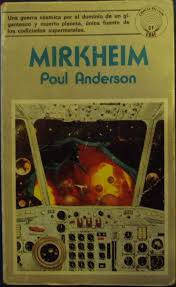
On Hermes, David Falkayn was a son of a baron although the title became "president of the Falkayn domain" in Mirkheim where, also, a castle became a manor house. See here. When their father died, David's elder brother, Michael, became head of the family. Then, when Michael died, David inherited the presidency although in fact his mother, younger brother and sister had been coping with running the domain during Michael's naval service.

On Ansa, Basil Donovan became the Earl of Lanstead when his father and elder brother had been killed in the war against Imperial annexation although, since the Ansan resistance was unsuccessful, the planet was incorporated and its aristocracy abolished.

However, will extra-solar colonists establish social hierarchies with barons and Earls in charge?

Thursday, 20 April 2023

Virgil And Aeneas

The Rebel Worlds, CHAPTER SIX.

Virgil is half again as luminous as Sol with more ultraviolet.

Aeneas, the fourth planet, orbits in 1.73 standard years at a distance of 1.5 astronomical units and receives two-thirds the radiation of Terra. Its mass is 0.45 Terran and surface gravity 0.635. The Terran diameter is 12,742 kilometers; Aenean 10,700. The Aenean atmosphere is humanly breathable, comparable to Denver at the lowest level and to the Peruvian altiplano at the highest. The density gradient is small and mountains are low. Water molecules have ascended and been cracked open by cosmic radiation. Hydrogen has escaped and oxygen has united with minerals. Oceans have shrunk, deserts grown. 

Scientists settled Aeneas to study the natives on the sister planet, Dido. Others came but the intellectuals dominated. Aeneans respect learning like their remote descendants, the Kirkasanters. Students and scholar travel vast distances to the University of Virgil in Nova Roma on Aeneas. A heritage of the Troubles is universal military training. Baronial families hold strongholds and lands. Aeneas supplies many men to the Terran armed services.

One thing is certain: if the Terran Empire becomes oppressive, then Aeneans will resist.

(The woman in the attached cover image could be either Kathryn or Kossara.)

Sunday, 8 January 2023

Fantastic Venus!


Farewell, Fantastic Venus, (1968) edited by Brian W. Aldiss and Harry Harrison, collected various works about Venus. Of particular interest to us, perhaps, were:

Poul Anderson, "The Big Rain"; "Sister Planet"
Arthur C. Clarke, "Before Eden"
extracts from novels by Olaf Stapledon, Edgar Rice Burroughs and CS Lewis

There were others (see above link) but these were the ones that I found particularly significant. It is good that both of Anderson's stories were included. In conversation at the British Easter Con in 1970, Aldiss disclosed that he had asked Robert Heinlein for permission to include "Logic of Empire," which obviously would have fitted in very well, but Heinlein had replied, "You can't have that! That's part of my Future History!" Thus, two future histories, Anderson's Psychotechnic History and Stapledon's Last And First Men, were represented but not the Future History.

Secondly, at the Easter Con, Aldiss disclosed that, when asked for "Sister Planet," Anderson had replied, "Yes, but can you use the original version which has never been published?" Aldiss responded, "Yes, of course," but then found that the revised version was very religious!

Anderson deserved to be included twice and Heinlein should have agreed to be included.

Friday, 31 December 2021

Civil War

Mirkheim, XX.

The Polesotechnic League civil war is a catalogue of colonized planets:

the Free Hermetian Navy destroys the Abdallah Enterprises centrum on Hopewell;

Hermetians hijack supermetals carried from Mirkheim by Interstar Transport for the Stellar Metals Corporation, thus causing staggering losses to Timebinders Insurance;

Hermetians destroy equipment and data stores of XT Systems in Maharajah on Ramanujan;

bribed union leaders call a strike of technicians working for Sanchez Engineering on the metal-rich St. Jacques, sister planet of Esperance;

independent League companies, Sinbad Prospecting and the Society of Venturers, attack and loot the Galactic Developments entrepot on a Germanian moon;

on Hermes, the patriot army storms Starfall.

"Government by terror does not work on people used to liberty, if they have hope of deliverance." (p. 273)

Hope makes a difference. A population endlessly ground down does not necessarily Rise in its Wrath.

Monday, 19 April 2021

Land And Sea

One of the greatest environmental contrasts in our experience is between sea and land: two realms each lethal to most of the organisms living in the other; perhaps our closest approach to visiting another planet without leaving Earth. Compare diving suits and submarines with spacesuits and spaceships.

In the first Biblical creation myth, water covers the earth whereas, in the second, the earth is dry, without rain. In some sf works, e.g., Poul Anderson's "Sister Planet," Venus is oceanic whereas, in others, e.g., Anderson's "The Big Rain," it is a hot desert.

Dominic Flandry travels from the cold, dry planet Altai to torrential rain and Swamp Town on Unan Besar and later to Nyanza, almost completely covered with water. Another oceanic planet in the Technic History, although not visited by Flandry, is Kraken.

Of course, there are also many other planets, like Jupiter and Mirkheim, that are simply not comparable to anything on Earth. Over many works, Poul Anderson shows us the universe.

Wednesday, 17 February 2021

Respect For Learning

A Knight Of Ghosts And Shadows, IV.

On Dennitza, as on Aeneas, learning is socially respected:

"'The Shkola - university and research centrum - is nearly as old as the colony. The toughest backwoodsman respects learning as much as he does marksmanship or battle bravery.'" (p. 399)

(On Aeneas, the University of Nova Roma is as old as the colony because Aeneas was colonized for the purpose of studying the inhabitants of the sister planet, Dido.)

I have worked with manual laborers who despised scientific research and academic life. While I think that research is obviously necessary, I also think that there is too big a social divide. If I had become a professional academic, then I would also have become an ivory tower intellectual completely divorced from any practical aspect of life. There has to be a better way of doing things.

Friday, 1 January 2021

The Unexpected In Fiction

Poul Anderson's first, Psychotechnic, future history series was pre-planned and contains almost no continuing characters (three characters appear twice and that's it) whereas his second, Technic, future history series grew organically and incorporated two long sub-series, both packed with continuing characters. This meant that the author wound up developing his characters and their interactions in (some) directions as unexpected to him as to his readers.

"Margin of Profit" introduces Nicholas van Rijn.

"The Three-Cornered Wheel" introduces David Falkayn.

In "A Sun Invisible," Falkayn is employed by van Rijn's company.

In "The Trouble Twisters," Falkayn meets van Rijn.

"Lodestar," originally expected to conclude the series, introduces van Rijn's granddaughter, Coya Conyon.

Mirkheim introduces Falkayn's mother, brothers and sister and David and Coya Falkayn's daughter and son, the latter named after his great-grandfather.

"Wingless" introduces Nicholas Falkayn's son, Nat.

In The People Of The Wind, a remote descendant, Tabitha Falkayn, informs us that David Falkayn's granddaughter named the planet Avalon.

I think that Anderson introduced David Falkayn in order to have him employed by van Rijn but that that was as far as any pre-planning went. At the end of Mirkheim, Falkayn has become acting CEO of Solar Spice & Liquors while van Rijn embarks on an important mission elsewhere. "Wings of Victory" introduced the Ythrians as a distinct plot element but then "Wingless" fruitfully fused them, plot-wise, with the Falkayns in the colonization of Avalon.

Sunday, 13 December 2020

Cultural Synthesis

The People Of The Wind, VI.

"'...the movement into the choths has begun snowballing.'" (p. 510)

Tabitha means the movement of Avalonian human beings into choths. But do the Ythrians not fear dilution of their ethos? They resist incorporation into the Terran Empire because that would involve unrestricted immigration. Of course, the two issues are not the same. Every human being on Avalon does not automatically join a choth. On the contrary, Imperial immigrants would probably strengthen the human institution, the Parliament of Man.

I began this post because I wanted to discuss Tabitha's observation that human choth members "'...have gotten pretty good at picking up face and body cues.'" (p. 510)

Human beings do this already, of course. The face evolved as a signalling device. A comic strip scripted by Garth Ennis had an authentic piece of Northern Irish dialogue with a woman asking her brother (of their younger sister), "D'ye see the face on her?" So maybe "birds" will develop a new language that is not just sounds but also face and body movements modeled on Planha with its twitching, rippling feathers? Human beings will become very alien after many generations on another planet shared with another intelligent species. Tabitha knows of the Ythrian Old Faith but had never heard of Homer although, of course, his epics are in Library Central and the scholar, Arinnian, is able to quote them. What will the eventual cultural synthesis be like, in the time of Dominic Flandry and Erannath and beyond?

Thursday, 10 December 2020

Connections

Of the characters listed in the previous post:

Daniel and Christopher Holm, father and son, are descended from or related to Ivar Holm who featured in "Rescue on Avalon";

Eyath is a daughter of Lythran and Blawsa and therefore is a sister of the Wyvan Tariat who tells Hloch to write The Earth Book Of Stormgate;

Tabitha Falkayn is descended from Athena, David, Nicholas and Nathaniel Falkayn, who appeared in earlier installments of the Technic History;

Ekrim Saracoglu, Imperial Governor of Sector Pacis, is based on Esperance, home planet of Joyce Davisson whom van Rijn met in "Territory";

Luisa Cajal is the daughter of the Terran Fleet Admiral - and they are from Nuevo Mexico as was an ensign in the van Rijn story, "The Master Key";

Ferune of Mistwood and Vodan of Stormgate are not connected to anyone else that we know.

Saturday, 5 December 2020

Favorite Anderson Novel?

Early morning post.

The People Of The Wind might be my favorite Poul Anderson novel: great characters, character interactions and inter-species interactions, imaginatively and sympathetically described Ythrians, future historical continuity and cross-references, exotic Avalonian setting - like the unique Japanese setting of Ian Fleming's You Only Live Twice. Of course, several other works share such features. Mirkheim has an even larger cast of characters and a more important historical turning point.

The two main themes of The People Of The Wind  are perhaps living in troubled times and flying high. It begins:

"'You can't leave now,' Daniel Holm told his son. 'Any day we may be at war. We may already be.'"
-Poul Anderson, The People Of The Wind (Riverdale, NY, 2011), pp. 437-662 AT I, p. 437.
 
It ends:
 
"Muscles danced, wings beat, alive to the outermost pinion. The planet spun toward morning. My brother, my sister have found their joy. Let me go seek my own.
"Snowpeaks flamed. The sun stood up in a shout of light.
"High is heaven and holy."
-op. cit. XIX, p. 662.

Tuesday, 1 December 2020

Ivar Caught Fire

The Day Of Their Return, 4.

"Then Kathryn McCormac, [Ivar's] father's sister, was taken away to Snelund's palace; and her husband was arrested, was rescued, and led the mutiny." (p. 104)

In The Rebel Worlds, we read about Kathryn, Snelund, Kathryn's husband, his rescue and mutiny. We did not yet know of Ivar. We knew that these events at the top of Aenean society had had massive repercussions for the planetary population. Now we are told something of those repercussions. The passage continues:

"Ivar caught fire, like most Aenean youth. His military training, hitherto incidental, became nearly the whole. But he never got off the planet, and his drills ended when Imperial warcraft hove into the skies.
"The insurrection was over." (ibid.)
 
The insurrection was over thanks to Dominic Flandry although we are not told that here. But the occupation and reconstruction of Sector Alpha Crucis cause further conflicts and Ivar Frederiksen tries to lead a new insurrection. This reads like real history. World War I led to World War II... Victory is followed not by peace but by the next war, at least as long as the underlying causes of conflict remain.

Sunday, 19 July 2020

Undeclared War: Phase 2

"Iron," 20.

From what Kam overheard while a prisoner, Saxtorph deduces that a kzinti space tug waits uncrewed in orbit to shunt an approaching displaced asteroid. It follows that Saxtorph and his crew can approach under cover of the asteroid to hijack the tug. The author sets up conditions to favor his principal protagonists and the next phase of this local war begins.

During a hours-long spacesuited transit to the tug, Dorcas sees:

"...the stars, Milky Way, nebulae, sister galaxies, glory upon glory." (p. 155)

This is not a description of the Milky Way, just a reference to it. We have had a glory of suns before. We could also catalogue references to sister galaxies. They are seen from space within the Milky Way and Poul Anderson wrote four novels in which there is travel between galaxies.

Dorcas gets a fix on a planet with "...her diriscope..." (p. 154) but I cannot find "diriscope" anywhere.

The universe beckons.

Saturday, 9 May 2020

Wind Whined

Here is something at the climax of Virgin Planet that I noticed but forgot to post about:

"'You don't know he's a Man,' she stammered.
"'I sure do, sister. Do you think we'd have stormed the Holy Ship for a Monster?'
"'Night and silence lay thick across the land. A salt wind whined around red-stained battlements.
"'Almighty Father,' choked Bess. 'I think you're right.'"
-Poul Anderson, Virgin Planet (London, 1966), CHAPTER XIX, pp. 146-147.

And earlier, when two clone-sisters argue over the Man, Davis:

"They neared each other, stiff and claw-fingered. Davis cowered into his corner.
"The wind hooted and banged the shutters."
-CHAPTER XVII, p. 125.

As often in Anderson's works, the wind comments. See here. It whines as Bess realizes that she has been fighting on the wrong side and hoots when Barbara and Valeria argue and nearly fight. Pathetic fallacy is almost as pervasive in Anderson's texts as correct grammar.