Showing posts sorted by relevance for query proto-series. Sort by date Show all posts

Wednesday, 12 June 2013

Proto-Series

By a "proto-series," I mean a single work that is potentially the opening installment of a series. If Poul Anderson had written nothing further about Nicholas van Rijn, Dominic Flandry or Manson Everard, then the stories that had introduced these characters, "Margin of Profit," "Tiger by the Tail" and "Time Patrol," would have been easily identifiable as three proto-series. (Each of these titles defines the role of its respective central character to a certain extent.)

In fact, each of these narratives was not only extended forwards but also expanded sideways. In other words, we learn more about the Polesotechnic League than just about van Rijn, or even about his protege Falkayn, more about the Terran Empire than just about Flandry, or even about his adversary Aycharaych, and more about the Time Patrol than just about Everard, or even about his protege Tamberly.

Regular readers will know that the League and the Empire were fitted into a single timeline, as the History of Technic Civilization, whereas the Patrol guards an alternative timeline, in the separate Time Patrol series. With the benefit of hindsight, we might have preferred if all three series had been unified. However, Everard operates in historical, not future historical, periods and interacts with the Roman, not the Terran, Empire. Thus, even if the few futuristic references in the Time Patrol series had mentioned the League or the Empire, there would not have been a lot of overlap.

If a proto-series is a single work, then a series is at least two works. In this sense, the Flandry series is followed by, and the Technic History is ended by, one series and three proto-series:

The Game Of Empire is a proto-series about Diana Crowfeather, Flandry's daughter;
"A Tragedy of Errors" is a proto-series about Roan Tom, a star rover during the Long Night;
The Night Face and "The Sharing of Flesh" are a short series about the Allied Planets;
"Star Fog" is a proto-series about Daven Laure, a Ranger of the Commonalty.

Flandry cameos in The Game Of Empire but the last novel about him is the previous volume, A Stone In Heaven, which, I think, deserves further attention for its presentation of the now fully matured Flandry.

Earlier in the Technic History, "Wings of Victory" describes first contact with Ythri during the Grand Survey. Thus, it is both a Grand Survey proto-series and the opening Ythrian story.

Monday, 26 September 2022

Five Proto-Series


A proto-series is a story or novel that is potentially the opening instalment of a series. Thus:

"Time Patrol" would have remained a proto-series if Poul Anderson had written nothing further about the Time Patrol;

"Margin of Profit" would have remained a proto-series if he had written nothing further about Nicholas van Rijn;

"Tiger by the Tail" would have remained a proto-series if he had written nothing further about Dominic Flandry;

and so on.

The six works collected in Flandry's Legacy present at least five proto-series. More could have been written about:

the new team of Dominic Flandry and Miriam Abrams;
Diana Crowfeather and her friends;
Roan Tom's exploits during the Long Night;
the Allied Planets recivilizing isolated interstellar colonies;
Daven Laure, Ranger of the Commonalty.

We would also like to know what became of Merseians, Ythrians, Avalon, Cynthians and Wodenites and whether Aycharaych survived. He would be a changed Chereionite and might have been able to help Fr. Axor to find and interpret Ancient inscriptions.

Wednesday, 10 January 2018

Proto-Series II

I explained what I meant by a "proto-series" here. Poul Anderson's "Margin of Profit," "Tiger by the Tail" and "Time Patrol" became series whereas his The Game Of Empire, "A Tragedy of Errors" and "Starfog" remained proto-series.

In SM Stirling's works, the Draka and the Change are series whereas Conquistador remains a proto-series with a conclusion opening up endless possibilities for sequels. See Just Beginning. The Peshawar Lancers is borderline. On the one hand, there is a single additional short story but, on the other hand, it is a prequel, therefore does not advance the history of the Angrezi Raj, which is what we want.

These reflections were initiated by opening the most recent Change novel, The Sea Peoples, and recognizing the names of familiar characters. Each new series is a world unto itself, easily reentered. We appreciate the many series that exist - and want to read more about New Virginia and the Angrezi Raj.

The Richness Of The Technic History

The previous post cited:

three series and three proto-series by Poul Anderson;
two series, one proto-series and one intermediate case by SM Stirling.

Of the six works by Anderson:

one series is the Time Patrol;
two series are sub-series of the Technic History;
the three proto-series are installments of the Technic History -

- and that History encompasses much more these five items. For this and other reasons, I think that the Technic History is the richest of the sf future histories although I know that some fans would champion one or other of its competitors.

Thursday, 13 April 2023

One Series And Aliens

In the immediately preceding post, I referred to:

the conflict between the Terran Empire and the Merseian Rodhunate;

centuries of history following that conflict;

seven cosmic events, mainly involving rogue planets and supernovae.

All of this and more is presented in a single sf series, Poul Anderson's History of Technic Civilization. The first three cosmic events are described in the David Falkayn sub-series, the second three in the Dominic Flandry sub-series and the seventh in the Commonalty proto-series. (A proto-series is a single story that could have become the opening instalment of a series.)

The mere physical presence of an alien might be frightening. I would not welcome close physical proximity with feather-covered Ythrians even though they have mouths instead of beaks. Flandry and Djana are present when two large Merseians, Ydwyr and Morioch, confront each other. Seated on feet and tails, they seem crouched to spring. Their voices are deep and their language, Eriau, explosively guttural. Not understanding their speech, Djana senses anger and sees that Flandry is worried. He understands the words, the forms of address and the markings on Morioch's uniform but not Ydwyr's rank, datholch.

In A Circus of Hells, CHAPTER TWELVE, the opening paragraph is narrated from Djana's viewpoint whereas the second and the rest of the chapter are from Flandry's.

Wednesday, 8 April 2020

More Proto-Series

See Proto-Series II.

"'You can't study the human mind without studying the body too. What's he done? Are you the mutant they're always speculating about? Did Dr. Tighe create or find homo superior?'"
-"The Sensitive Man," VII, p. 143.

Studying society is very different from studying individual minds and bodies but these guys do both.

"Un-Man" and "The Sensitive Man" could each have been the opening installment or origin story for an open-ended series. The Un-Man series would be able to feature different members of the Brotherhood, alone or in teams. There could be different Sensitive Men and a regular Un-Men/Sensitive Men team-up/crossover. A team of writers could be commissioned to work on such series while the creator, Poul Anderson, continued to extend the future history series within which these two teams inhabit just one period. Superheroes are an off-shoot of sf. Their prototype was extraterrestrial. His successors include mutants.

Sunday, 1 September 2013

Deathwomb

Immediately after "Hunter's Moon" in Poul Anderson's collection, Space Folk (New York, 1989), is his paradoxically entitled short story, "Deathwomb," which turns out to be his contribution to Fred Saberhagen's Berserker series. Yet again, I have had this story on a shelf for years without, as far as I can remember, ever having read it.

Thus, to reiterate some points made earlier, of the twelve items in Space Folk:

"Pride" is a prequel to Anderson's novel, Tau Zero;
"Quest" is a sequel to his The High Crusade;
"Hunter's Moon" is part of Harlan Ellison's Medea series;
"Deathwomb" is part of Saberhagen's Berserker series;
"Symmetry" has the background of Anderson's Psychotechnic future history although it is not part of that series;
"Commentary" is non-fiction.

I think that the remaining six stories are independent although at least two of them are what I call "proto-series":

"Horse Traders" could easily be the first installment of a "horse traders" series;

the very Heinleinian story, "Escape The Morning," written for the Boy Scouts of America, is about young people living, and effecting a rescue, on the Moon and could very easily initiate a series of such stories, similar to the Moon period of Heinlein's Future History.

Anderson contributed to so many other authors' series or shared universes that an entire volume of his Complete Works would be able to hold his Medea story, his Berserker story, his Robots story, his Man-Kzin Wars stories, his Isaac's Universe stories etc;
"Pride" and "Quest" should be published with their respective novels;
"Commentary" belongs in a non-fiction collection;
"Symmetry" could fit in an Appendix of the collected Psychotechnic History;
thus, Space Folk would be halved to six stories which, in turn, could be incorporated into a longer volume about space exploration.

Having said all that, I ought to get on with reading "Deathwomb."

Friday, 20 April 2012

The Long Night

Poul Anderson over-uses the term "Long Night" which refers to the immediate post-Imperial period in his Technic History. The Imperialist Flandry continually anticipates the Long Night with apprehension. Four millennia later, Daven Laure says:

"Sir, the League, the troubles, the Empire, its fall, the Long Night...every such thing - behind us. In space and time alike. The people of the Commonalty don't get into wars." (1)

The Lancaster sf book seller, Pete Pinto, commented that, if the Commonalty has arisen from the "Long Night," then Commonalters should not call it that. Of course, the author is mainly signalling to the reader through a character that the latter exists in the same timeline as van Rijn and Falkayn of the Polesotechnic League and Flandry of the Terran Empire. Laure can hardly be speaking League Latin or Imperial Anglic so we might regard the phrase "Long Night" in his dialogue as translating whatever phrase he does use into terms familiar to us. 

Anderson made this point in relation to his earlier future history:

"...a story laid some centuries hence must be thought of as a translation, not merely of language but of personalities and concepts corresponding only approximately to anything we know." (2)

The League and its successor the Empire occupied only a small part of one spiral arm of the galaxy whereas, by 7100, the Commonalty operates in one of several divergent human civilizations thinly occupying two or three spiral arms. There is mention of human diversity but not of any interaction with other rational species. This implicitly contradicts the earlier series but only implicitly. Anderson could have extended the series even further by recounting what the Long Night had done to Merseians, Ythrians, Cynthians, Wodenites etc. However, he regarded the History as already having made its point about the periodic, though not inevitable, rise and fall of civilizations so why belabor the point?
 
"Better to seek new themes." (3)

...which he did in future histories about human-AI interaction and post-human AI without ET's or FTL (i. e., without extra-terrestrials or faster than light interstellar travel): a different though less implausible scenario. 

If "the Long Night" means not just "later than the Empire" but, more specifically, the period of chaos and barbarism immediately following and resulting from the Fall of the Empire, then "Starfog," about the Commonalty, is set well after the Long Night. Only three works are set between the last Empire novel, The Game of Empire, and "Starfog." The first of these, "A Tragedy of Errors," is definitely set during the Long Night. It begins:

"Later ages wove a myth about Roan Tom. He became their archetype of those star rovers who fared forth while the Long Night prevailed." (4)

Again, the phrase is used to clarify not only which series this story belongs to but also which period of the series it is set in. 
 
"A Tragedy of Errors" is deceptively simple, on the surface a conventional action-adventure story but with informed scientific speculation throughout. The planet Nike has been colonized not only by human beings but also by "...the more efficient, highly developed species that man commonly brought with him...": oak; birch; primroses; grass overwhelming "...a pseudo-moss that apparently had a competitive advantage only in shade..." although, in one place, the dense vegetation is "...principally native Nikean, dominated by primitive but tree-sized 'ferns.'" (4) (5)

This theme continues in the next short story, "The Sharing of Flesh," set, according to Sandra Miesel, four centuries later. On another planet, a plant descended from clover is "...scattered low among the reddish native pseudo-grasses." (6) The view point character, Evalyth, remembers that:

"Clover was another of those life forms that man had brought with him from Old Earth, to more planets than anyone now remembered, before the Long Night fell." (6)

Evalyth's home world Kraken has altered pines, gulls and rhizobacteria but Krakeners had forgotten that these organisms came from Earth with their ancestors.

Returning to "A Tragedy of Errors," Tom and his wives, even while fleeing from their (temporary) enemies, speculate about the scientific oddities of Nike and its sun and have found answers by the end of the story. Despite its small size, Nike has a breathable atmosphere and a biosphere because it is old enough for its weak gravitational field to have had enough time to pull the heavier elements into the kind of solid core that generates atmosphere-producing planetary forces. It follows that Nike's sun is also old. This explains its variability and enables Tom to import solar meteorologists who will predict the weather on a planet where harsh and previously unpredictable storms were catastrophic. But first he must learn that, in the local lingo, he needs to " 'change " with "camarados," not to "do business" with "friends."

The main point of the story is that words change their meanings over time. An opening and closing quotation clarifies that "awful" once meant "awesome" etc. In the story, space raiders attacking the isolated Nike had ironically introduced themselves as "friends" coming to do "business." A decade later, a refugee seeking help and using those same words is in trouble, especially when he refuses to "slave" himself, i. e., to accept precautionary arrest. This is the main communication problem but there are other examples of linguistic shift. When a scientifically based society degenerates into a feudalism, then "Engineer" becomes the title of a feudal lord. Twice in the Technic History, in the League and Empire periods, a "rogue planet," meaning a loose or sunless planet, had played a pivotal role in history. Tom would call that a "bandit planet" because to him "rogue planet" means a planet, like Nike, with an unusual orbit or composition. A character who has studied the classics knows some science because, in the Long Night, scientific knowledge is a classical art!

"A Tragedy of Errors" is one of at least three proto-series in the Technic History, i.e., Roan Tom could have become a series character. The two other potential series characters are Diana Crowfeather and Daven Laure. By contrast, "Margin of Profit," introducing van Rijn, and "Tiger by the Tail," introducing Flandry, would have been proto-series if they had not had sequels. We are told that, during Tom's life-time, his "...name was already in the ballads of a dozen planets." (7) 

He even introduces the story from an imaginary Valhalla where Earth grown tobacco is available but this is only a narrative device. Anderson stops short of introducing the fantasy of a literal Valhalla into the hard sf of the Technic History. One Empire novel refers to Manuel Argos "...in whatever hypothetical hell or Valhalla the Founder dwelt." (8) Fittingly, the Valhalla references link Manuel, slave and Emperor, to Tom, trader and warlord. Manuel responds to the Troubles by leading a slave revolt and founding the Terran Empire. Tom copes with the Long Night by trading when possible and fighting when necessary. He shares van Rijn's ability to identify common interests and to arrange mutually advantageous exchanges that can transform potential enemies into trading partners and allies.

  I would not have remembered the details about Nike, and thus would not have fully appreciated Anderson's work, if I had not set out to re-read and summarize the details.

The remaining three post-Imperial works deal with more fundamental changes than linguistic alterations. "The Sharing of Flesh" occurs when the Allied Planets are restoring interstellar civilization, thus at the beginning of the end of the Long Night. A mutation in a small and impoverished population which for one or two generations had practiced cannibalism for survival entails that boys can reach puberty only by gaining the extra hormones provided by cannibalism. Thus, cannibalism continues until the Allied Planets provide hormone pills, then Terrestrial-type meat animals.

In "Starfog," the Kirkasanter population that has been isolated for millennia has an instinctual compulsion to have children but cannot interbreed with the people of the Commonalty. Thus, Laure cannot after all marry a Kirkasanter woman whom he has met. The single post-Empire novel, The Night Face, is set before "The Sharing of Flesh." Organizations from two civilized planets join forces to explore Gwydion which has been isolated throughout the entire Imperial period. The Gwydiona are unusually peaceful and harmonious without any legal coercion or government control but something mysterious, a transcendent experience that they cannot describe, occurs once a year. It turns out that everyone becomes insane for a few days. They can harm themselves or each other but instantly forget that it is they themselves that have done it. They have unconsciously developed ways to minimize the harm. For example, when everyone is insane, ritual chanting and dancing channels the energy that would otherwise be expressed as homicidal violence. But the ritual is disrupted by the presence of extra-planetary visitors who do not understand what is happening... (9) I think there was a Star Trek episode like this but, of course, Anderson does it better.

What can we say about the post-Imperial period of the Technic History? It comprises four works. Each work describes an encounter with an isolated human community, not with a new non-human species. In each work, something important has changed: language; biology; psychology; again biology. The first biological change is reversible. The second is not. The works present four stages of development from the barbarism of Roan Tom in a small part of the former Imperial volume of space to the support services of the Commonalty stretching across a spiral arm.

Would the Technic History be better balanced and more satisfactory if there were less of Flandry and more of the Long Night? In my opinion, the series would be better if there were more of Flandry and more of the Long Night. It is long but seems too short.

(1) Anderson, Poul, "Starfog," Analog, 1967, IN Anderson, The Long Night, New York, May 1983, pp. 240-310 at p. 251.
(2) Anderson, P, Virgin Planet, London, April 1966, 151.
(3) Anderson, P, "Concerning Future Histories," Bulletin of the Science Fiction Writers of America, Volume 14, No 3, Whole No 71, Fall 1979, pp. 7-14 at p. 13.
(4) Anderson, P, "A Tragedy of Errors," Galaxy, 1967, IN The Long Night, pp. 133-201 at p. 155.
(5) Anderson, P, ibid, p. 177.
(6) Anderson, P, "The Sharing of Flesh," Galaxy, 1968, IN The Long Night, pp. 203-240 at p. 205.
(7) Anderson, P, "A Tragedy of Errors," p. 139.
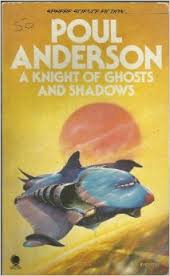
(8) Anderson, P, A Knight of Ghosts and Shadows, London, 1978, p. 39.
(9) Anderson, P, The Night Face, London, 1972, pp. 113-124.


Sunday, 3 January 2021

Quantity Versus Quality

Star Trek has proliferated into multiple series but can do that because it is multi-authored. Larry Niven's Known Space grew by becoming multi-authored. CJ Cherryh's Alliance-Union future history series is twenty seven novels plus seven anthologies. Poul Anderson's Technic History is impressively vast for a single-author work, comprising forty three installments, including at least ten novels, depending on how we classify them.

I gather that Picard, Enterprise Captain in the second Star Trek series, has acquired his own series. I once saw a paperback that was a volume of a series about a Klingon Bird of Prey Commander. Anderson was not able to match all that quantity. However, in his "Wings of Victory," both the Grand Survey and the character of Aram Turekian are what I call proto-series and one passage in The Game Of Empire recounts a mission led by Afal Uroch of the Vach Rueth, commanding a Fangryf-type gunboat. Everything is there in Anderson except, impossibly, more quantity.

Sunday, 20 April 2014

The Call Of The Old Days

Nicholas van Rijn, Master Merchant, Polesotechnic League, reflects:

"He thought back to the days when he had ridden ships through yonder spaces, bargaining in strange cities or stranger wildernesses, or beneath unblue skies and in poisonous winds, for treasures Earth had not yet imagined. For a moment, wistfulness tugged at him. A long time now since he had been any further than the Moon..."
- Poul Anderson,The Van Rijn Method (New York, 2009), p. 147.

This is in the story that introduces van Rijn. So here is a potential series: how van Rijn, born poor, worked as a spacehand and became rich. Anderson's History of Technic Civilization contains several proto-series, single stories that could each have initiated a series, and potential series, chronological gaps that could each have been filled with an entire sequence of adventures. Van Rijn's earlier life is yet another in the latter category.

Hercule Poirot retired as a uniformed policeman before becoming a private detective and I have heard that Agatha Christie realized that she had a problem, writing a long series about a character who was old to begin with. Anderson shows us the older van Rijn and the younger Falkayn as they age. They remain active and learn as the world changes around them. 

Friday, 16 September 2022

Sequels Galore

When I said at the beginning of the previous post that I was big on sequels, I was really thinking not of Nicholas van Rijn and David Falkayn but of Dominic Flandry. The Captain Flandry series has a prequel, the Young Flandry Trilogy, in which Flandry advances from Ensign to Commander, and a sequel, A Stone In Heaven, in which Flandry is an Admiral. The following volume, The Game Of Empire, is a proto-series, because it is potentially the opening volume of a series about Diana Crowfeather, and features three cameo appearances by Diana's father, Fleet Admiral Flandry. The Young Flandry Trilogy, Volume III, The Rebel Worlds, has a sequel, The Day Of Their Return, that quotes intelligence gathered by Commander Flandry.

At the end of the Captain Flandry series, Volume III, A Knight Of Ghosts And Shadows, Flandry had intended not only to marry Kossara Vymezal but also to settle down with her on her home planet, Dennitza. However, Kossara has been martyred. Nevertheless, Flandry's new plan to return home surprises Kossara's uncle, the Gospodar of Dennitza, Bodin Miyatovich:

"'Go back to Terra?... In God's name, why?'"
-Poul Anderson, A Knight Of Ghosts And Shadows IN Anderson, Sir Dominic Flandry: The Last Knight Of Terra (Riverdale, NY, March 2012), pp. 339-606 AT XX, p. 604.

Flandry watches the bombardment of Chereion before replying:

"'I have my own people.'" (ibid., p. 605)

There ends the narrative although it is followed by a prayer of thanksgiving for Gospodar Bodin. But what happens to Flandry after he has returned home? Indeed, as we would want, there is a sequel.

Thursday, 17 September 2015

Cartels And Chaos

The Polesotechnic League
Nicholas van Rijn's protege, David Falkayn, is a series character in his own right, with one story set before he works for van Rijn's company, another before he meets van Rijn, four about the trader team led by Falkayn and a grand conclusion.

The Terran Empire
Dominic Flandry acquires a protege, his own daughter, Diana Crowfeather, who stars in what I call a "proto-series," i.e., a single work that was potentially the opening installment of a new series.

The Time Patrol
Manse Everard's protege, Wanda Tamberly, becomes a new continuing character in The Shield Of Time.

League, Empire and Patrol each confront their external opponents, most notably:

the Merseian Roidhunate aims to destroy the Terran Empire;
Neldorians and Exaltationists try to change the history guarded by the Time Patrol.

However, civilizations face not only external threats to their continued existence but also internal causes of their own decline. Chunderban Desai tells Dominic Flandry that:

"'...wrong decisions bring breakdown...Technic civilization started on that road when the Polesotechnic League changed from a mutual-aid organization of free entrepreneurs to a set of cartels. Tonight we are far along the way.'"
-Poul Anderson, Sir Dominic Flandry: The Last Knight Of Terra (New York, 2012), pp. 388-389.

We last saw van Rijn and Falkayn trying to hold the League together for a while after the fatal wound inflicted by cartelization. What had seemed to be an external threat had really been engineered by one cartel.

The most fundamental threat to the Patrol is internal not merely to the time-traveling civilization but to the cosmos: quantum chaos changes history unpredictably. We last see Everard and Wanda shortly after they have counteracted one accidental quirk in the temporal flux.

Tuesday, 9 December 2014

Textual Inconsistencies

I argue here that (what I call) the first four Captain Flandry stories form a coherent tetralogy. However, unusually for him, Poul Anderson also wrote a partly inconsistent prequel (see here). In The Day Of Their Return, set earlier, Terran Naval Intelligence learns of Aycharaych's telepathy even though, at the beginning of the second Captain Flandry story, Dominic Flandry, a Terran Naval Intelligence officer, does not know about it.

It is always possible - and enjoyable - to try to iron out even the most glaring inconsistencies in a fictional series as Holmesians, who included Poul Anderson, know. However, the simplest explanation of this particular inconsistency is just that, although Anderson did revise some of the Captain Flandry stories for later republication, it escaped his notice that the later written prequel necessitated one specific revision of "Honorable Enemies."

Some texts are finished products, perfect and complete with not a word out of place, whereas others remain works in progress even after publication. An example of the former is Pride And Prejudice, although even it was enhanced by gestures and facial expressions added in a high quality TV dramatization. An example of the latter is Hamlet which means whatever a theater company can make it mean in each performance. I have seen one short dialogue given diametrically opposed meanings without the alteration of a single word. Shakespeare revised plays between performances. However, as soon as as an author has died, his texts become fixed, although their interpretation and reinterpretation continue.

Any unfinished or on-going series is a permanent work in progress. Thus, in Anderson's Technic History, "Diana, Daughter of Dominic" remains a proto-series because Anderson needed time to write some less space operatic speculative fictions. So we can try to iron out the telepathy contradiction or can just accept that, massive though it is, the History of Technic Civilization remains a fascinating work in progress.

Monday, 14 December 2015

Stefan Rostomily

Stefan Rostomily was a child during World War II. Thus, his earliest life history overlaps with ours.

"'He knew music and composed some good songs of his own - rowdy but good. They're still being sung out on Mars.'" (The Psychotechnic League, p. 114)

This puts him in the same league as Heinlein's Rhysling and Anderson's Hugh Valland.

A few of his cells were used as a chromosome source for the Rostomily Brotherhood. I have been calling the Brotherhood "clones" although that word did not yet exist when this story was written. And cloning would not have given them all an interest in Shakespeare!

Rostomily was dead at the time of "Un-Man." However, he appears in "Marius," written later but set earlier. Several sf characters, including two others in this future history, have been presented in this way: either a dead character has later been shown while still alive or an older character has later been shown while still young.

"Un-Man," about the Brotherhood, and its sequel, "The Sensitive Man," are each what I call a "proto-series," i.e., two open-ended series could have been written, one about the Un-men, the other about the sensitive men. (Indeed, they would make excellent superheroes.) Instead, Anderson wrote a future history about different aspects of society over time. Within this more comprehensive series, the Un-men and one of the sensitive men get just one instalment each.

Sunday, 24 January 2021

Flandry's Legacy

I imagine that, for commercial and practical purposes, Baen Books preferred The Technic Civilization Saga to comprise seven volumes of approximately uniform length. Uniformity also has an aesthetic appeal. However, if instead we consider the contents of the series and the periods of the Technic History, then we are bound to envisage volumes of unequal length. For example, I had originally thought that the concluding volume of the complete Technic History should be entirely post-Flandry and therefore that his name should not appear in its title. That would make the concluding Saga volume identical in contents with the earlier collection, The Night Face And Other Stories. But that would have been a much shorter volume.

I have become more inclined to think that both the contents and the title of the existing Volume VII, Flandry's Legacy, make sense. The legacy of a man's earlier and middle years begins to appear during his later years. It continues after his death but has begun before then.

A Knight Of Ghosts And Shadows, A Stone In Heaven and The Game Of Empire do not really comprise a concluding Flandry Trilogy. A Knight... concludes the Captain Flandry series. Flandry has retained his freedom of movement by not as yet accepting the rank of Admiral. Instead, he answers directly to the recently installed new Emperor, Hans I, on a roving commission.

This is very different from the situation in A Stone In Heaven at the beginning of Flandry's Legacy when Flandry, now a Vice Admiral, has his own staff and his legacy is becoming apparent. The new Molitor dynasty which he has supported is firmly established and his achievement at Chereion is discretely referred to. Flandry, now a Fleet Admiral, merely cameos in The Game Of Empire which is a proto-series about his daughter. Starkadians have been settled on Imhotep.

In the four post-Flandry installments, certain planets have survived the Long Night, Vixen has even established a colony and the descendants of rebels expelled by Flandry have thrived and now re-contact civilization. These six works fit together.

Wednesday, 18 April 2018

Rangers

A big part of my childhood was The Lone Ranger although I preferred the fight scenes in The Range Rider. The Lone Ranger had a neat origin story. A group of Texas Rangers was ambushed, shot and left for dead but one survived and became the anonymous "Lone Ranger" to avenge the others. He could have been any of them.

Although I liked Westerns, I preferred sf and therefore noticed when the word "Rangers" recurred among "spacemen." Isaac Asimov wrote David Starr, Space Ranger, Andre Norton wrote Star Rangers and Rangers also appear in comics (also here).

Not having read every "Rangers" story, I must not generalize too much. However, I am fairly confident that Poul Anderson's Rangers of the Commonalty are among the best of the science fictional "Rangers." They deserve their own series including an installment about an expedition to Old Earth but, unfortunately, "Starfog" remained one of the several proto-series in Poul Anderson's Technic History.

Monday, 12 December 2022

A Dynamic History

Poul Anderson's Technic History is not linear but somehow dynamic. Sub-series proliferate and overlap: League, van Rijn, Falkayn, trader team, with Adzel and Ivanhoe off-shoots .Nearly every one-off instalment is a proto- (potential) series. Many one-off characters could have become series characters. I need hardly list the names. Reflecting on the connections between any two parts of the History, we remember other connections and wind up thinking about the whole History but always seemingly from a new perspective. The series never becomes just a static list of titles. In fact, we never read the full list of forty three titles except in the Chronology where they are surrounded by other information. A Wellsian future history, fictitious historical text, could be written about the Solar Commonwealth, the Terran Empire, the Domain of Ythri, the Dispersal of Ymir, the Roidhunate of Merseia, the Realm of Gorrazan, the Betelgeusean System, Hermes, Dennitza, Aeneas, the Commonalty etc. A step has already been taken in this direction with the contributions of Hloch and other commentators. No discussion ever exhausts all the possibilities. Is this true of any other future history?

Sunday, 21 January 2018

Early Exploration In Future Histories

In James Blish's Cities In Flight: Jupiter.

In Larry Niven's Known Space: Mercury, Venus, Mars and Pluto.

In Poul Anderson's Technic History, "The Saturn Game": the Solar System in general and the Saturnian System in particular.

In the Technic History, "Wings of Victory": extra-solar planets in general and Ythri in particular.

Both of these Anderson stories are proto-series. An indefinite sequence could have been set inside the Chronos and another during the Grand Survey. Instead, these two stories serve as launching pads for Anderson's second future history.

"The Saturn Game" prefigures later events when one of its characters mentions an upbringing influenced by the Jerusalem Catholic Church. Whatever the nature of that religious change or development, it is due to happen some time in the first half of the twenty first century.

"Wings of Victory," more closely integrated into the History, refers to Cynthia, Woden and Hermes and is the opening installment of The Earth Book Of Stormgate, with an Introduction by the Avalonian Ythrian historian, Hloch. Coincidentally (?), Hermes, Woden and Cynthia are, respectively, the home planets of the three members of Nicholas van Rijn's first trade pioneer crew, David Falkayn, Adzel and Chee Lan. Also, Falkayn will found the colony on Avalon in the Domain of Ythri.

The Technic History is multi-faceted but also remarkably integrated.

Tuesday, 8 August 2023

Series: Poe; Doyle; Heinlein; Anderson


It is getting late here. I might start a line of thought in this post and continue it later. Poe's three Dupin stories are what we call a series because of character continuity. There is not only Dupin himself but also the unnamed first person narrator, his assistant, a proto-Watson. However, "The Murder in the Rue Morgue" (1841) was published in Graham's Magazine, "The Mystery of Marie Roget" (1842) was serialized in three parts in Snowden's Ladies' Companion and "The Purloined Letter" (1844) was published in a literary annual, The Gift for 1845. I think that Doyle was the first author to conceive of a new kind of "serial," the series, to be published regularly in the same periodical, in this case, The Strand, with each instalment a complete story so that occasional readers would not be disappointed by unfinished narratives but regular readers might appreciate the continuity of characters and settings.

Heinlein meant his Future History to be bound together not by continuing characters but by background details like place names in the Lunar, Martian and Venerian colonies. Anderson does this even better in his Technic History but this is where I break off for today. Thank you all for your attention and patience.

Sunday, 7 February 2016

Close Reading Needed

Like Poul Anderson's "Losers' Night," his "Eutopia," first published in Harlan Ellison's Dangerous Visions, is a story that clearly I had not read closely enough before. I had thought that it was nothing but chase scenes followed by a shock ending.

Instead, it presents:

a rational man's disgust with our timeline;
the unique and original Westfall timeline;
a proto-series, Iason "...could be reassigned to some history he might find more congenial." (p. 139);
a new version of familiar Andersonian arguments about humanity.

Iason asks whether Daimonax means that:

"'Without fighting, clannishness, superstition, ritual and taboo...man has nothing?'" (p. 137)

Daimonax replies:

"'More or less that?'" (ibid.)

More or less? How much more and how much less? I disagree. A false dichotomy is being set up. Is emotion without reason better than reason without emotion? Why not have both reason and emotion?

Daimonax asks:

"'Because we have made our world one, where are color and contrast...?'" (p. 138)

One world incorporates color and contrast. Unity need not be uniformity. My slogan is: "Difference without division; unity without uniformity." See "Fundamental Issues."

Daimonax continues:

"'...where is pride in being peculiarly ourselves?'" (ibid.)

Why do we need this? But, in any case, it is there for the asking. Humanity is diverse and everyone is unique. I will probably pick through more of Daimonax's speech but it is getting late here.