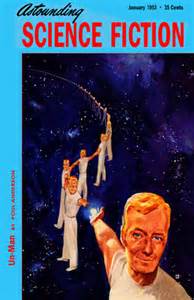
Showing posts with label "The Sensitive Man" by Poul Anderson. Show all posts

Monday, 14 December 2015

Stefan Rostomily

Stefan Rostomily was a child during World War II. Thus, his earliest life history overlaps with ours.

"'He knew music and composed some good songs of his own - rowdy but good. They're still being sung out on Mars.'" (The Psychotechnic League, p. 114)

This puts him in the same league as Heinlein's Rhysling and Anderson's Hugh Valland.

A few of his cells were used as a chromosome source for the Rostomily Brotherhood. I have been calling the Brotherhood "clones" although that word did not yet exist when this story was written. And cloning would not have given them all an interest in Shakespeare!

Rostomily was dead at the time of "Un-Man." However, he appears in "Marius," written later but set earlier. Several sf characters, including two others in this future history, have been presented in this way: either a dead character has later been shown while still alive or an older character has later been shown while still young.

"Un-Man," about the Brotherhood, and its sequel, "The Sensitive Man," are each what I call a "proto-series," i.e., two open-ended series could have been written, one about the Un-men, the other about the sensitive men. (Indeed, they would make excellent superheroes.) Instead, Anderson wrote a future history about different aspects of society over time. Within this more comprehensive series, the Un-men and one of the sensitive men get just one instalment each.

What We Expect

In a Poul Anderson story, we expect:

action;
intelligent, informed analysis of society;
scenery and sunsets.

If the story is futuristic sf, we additionally expect road vehicles that are also VTOL aircraft. Thus, in "Un-Man," Naysmith:

shoots his way past armed Security men;

explains world politics;

flies his boat "...east until it was following the mighty spine of the Rockies, an immensity of stone and forest and snow turning gold with sunset." (The Psychotechnic League, p. 75)

Analysis
I have come to understand what was meant by the "protean enemy." The UN tries to move society towards a single sane world civilization. Thus, the UN's enemies include every opponent of either unity or sanity, every kind of separatist or ideologue. These disparate groups can seem to be diverse manifestations of a single enemy and indeed they do temporarily unite under the leadership of "the gang," which explains why the title character of "The Sensitive Man" later refers to a return of "...political gangsterism." (p. 138)

After the defeat of the gang, Naysmith even more clearly delineates the enemy:

"The enemy was old and strong and crafty, it took a million forms and it could never quite be slain. For it was man himself - the madness and sorrow of the human soul, the revolt of a primitive against the unnatural state called civilization and freedom. Somebody would try again. His methods would be different, he might not have the same avowed goal, but he would be the enemy and the watchers would have to break him. And who shall watch the watchmen?" (pp. 125-126)

That question is central to the Psychotechnic History, where the successive watchers are the UN, the Psychotechnic Institute and the Coordination Service.

In Anderson's Brain Wave, human intelligence is enhanced and wins its ancient battle against instinct but a disparate gang of conspirators, including one Hindu, tries to return humanity to its previous state. Fortunately, they are easily outmaneuvered. Mystics seek either regression or transcendence. Transcendent mystics should welcome the change in Brain Wave.

In James Blish's The Night Shapes, surviving dinosaurs are found in an African valley but the hero realizes:

"'...the shapes are inside us. They've always lived there. They always will.'"
-James Blish, The Night Shapes ( London, 1965), p. 125.

Sunday, 13 December 2015

Chronology

In January this year, I posted in detail, from here to here, about Poul Anderson's Genesis, a late single volume future history covering geological epochs. This December, I have become entirely focused on the first three installments of Anderson's first future history series, the Psychotechnic History.

In this early period of the Psychotechnic History, Secret Servicemen work for the UN whereas, in a transitional period of Genesis (see here), a gifted woman works alone liaising between humanity and the planet-controlling Artificial Intelligence. Ideas of the future change as we move into it.

"A Chronology Of The Psychotechnic Series" on pp. 283-284 of Poul Anderson, Starship (New York, 1982) is:

"Prepared by Sandra Miesel, based in part on the chronology published by Poul Anderson in Startling Stories, Winter, 1955." (p. 284)

So we do not know how much of the 1982 Chronology is by Anderson and how much by Miesel - unless someone has a copy of that Startling Stories? The 1982 Chronology begins:

1958  World War III
1964   "Marius"
1965  First Conference of Rio makes U.N. world government
1975   Psychotechnic Institute established Expeditions to Mars and Venus, then colonization
2004  "Un-Man"
2009  "The Sensitive Man"

It should read:

1958  World War III, followed by Years of Hunger
1964  "Marius"
1965  First Conference of Rio makes U.N. an instrument of multilateral negotiation
           Years of Madness
1975  as above plus Pilgrims emigrate to Mars
           the Socialist Depression and other economic breakdowns
2004  as above
2009  as above

At the time of "Un-Man":

"'The U.N. is in the process of becoming a federal world government.'" (p. 71)

Saturday, 12 December 2015

More Background Details

It is too easy to categorize the opening installments of Poul Anderson's Psychotechnic History merely as action-adventure fiction and thus to miss their background contributions to the future history.

In "The Sensitive Man":

"Even the hulking bodyguard was probably a college graduate, Third Class."
-Poul Anderson, The Psychotechnic League (New York, 1981), p. 138.

Someone with a third class University degree? No. The educational system is outlined in the preceding installment, "Un-Man." Modern technology replaces not only unskilled laborers but also routine intellectuals. First class education, starting early and remaining free for those who are able to keep passing exams, produces large numbers of graduates trained to the limit of their capacity, PhD's at twenty or younger. The complex global civilization requires this educational elite but relegates the less able to Second and Third schools, with consequent social friction.

Another social factor: the family had been an economic and social unit but technology destroyed the first function; World War III and subsequent upheavals destroyed the second. Creches, schools and public entertainment take children away from the home. Old style marriage becomes extremely rare.

Thirdly, there are global anachronisms like Hindu peasants. Many people want to restore the old ways without realizing that technology has changed human nature. Geriatrics and birth control are making the population old and rigid just when new thinking is required.

This is a complex and well realized future history. The World Wars, the Years of Hunger and Madness and the economic breakdowns are parts of its fabric and should be included in the Chronology.

A Link To Holmes And Dreyfus

For the first time, the enemy possesses the dead body of a member of the Rostomily Brotherhood, Martin Donner, and will be able to apply:

fingerprinting;
retinals;
bloodtyping;
Bertillon measurements; (Read this Wiki article!)
autopsy;
etc.

"'We can expect them to check that set of physical data against every ID office in the country. And when they find the same identification under different names and numbers in each and every file - all hell is going to let out for noon.'
"'It will take time, of course,' said Fourre. 'We have put in duplicate sets of non-Brother data too, as you know; that will give them extra work to do. Nor can they be sure which set corresponds to Donner's real identity.'"
-Poul Anderson, The Psychotechnic League (New York, 1981), p. 58.

I do not fully follow this. The Brothers are clones who live in different parts of the country with different names and occupations. Because they are clones, their physical data are identical. Trying to establish Donner's identity, the enemy will check the records, will find the same data under different names and therefore will not know which of these names is Donner's but will know that something strange is going on. But why and how has the UN Secret Service put in duplicate sets of other data and how will that give the enemy extra work?

When I read the reference to "Bertillon measurements," I took this to mean some kind of credible scientific system. However, according to Wikipedia, although Bertillon was commended by Sherlock Holmes, he was involved in the framing of Dreyfus, who is mentioned in the Time Patrol series. It is impossible to predict emergent links.

Future History Continuity

In "Un-Man":

"...Sofie [was] an engineer on the Pacific Colony project..."
-Poul Anderson, "Un-Man" IN Anderson, The Psychotechnic League (New York, 1981), pp. 31-129 AT p. 49 -

- and, in "The Sensitive Man," published later the same year, 1953, the narrative begins in the Mermaid Tavern which is in deep water under the caissons of one of the gyro-stabilized stations of the floating city called "the Pacific Colony," near the main anchor cable. An elevator takes the title character up from the tavern past storehouses, machine rooms, kitchens etc to a kiosk opening onto an upper deck thirty feet above the surface with a view of tiers descending to the main deck where there are people and a small park.

This "Pelican Station," holding shops, theaters, restaurants, services and entertainment is linked by bridges and boat traffic to other stations, where there are mineral-extracting plants, fisheries and experimental and research facilities. Nearby are a sea ranch and the undersea settlement of oil wells, mines, and exploration tanks.

Sofie says:

"'I remember the tail-end of the Years of Hunger, and then the Years of Madness, and the Socialist Depression...'" (p. 51)

We saw the "Years of Hunger" in the first Psychotechnic History story, "Marius," but, since "Un-Man" is only the second story, we must understand that the Madness and the Depression have meanwhile happened off-stage.

A man called Stefan bursts through a window near the end of "Marius." A man called Stef has died on Mars before the beginning of "Un-Man." We learn:

that "Stef" was "Stefan";
that his full name was Stefan Rostomily;
that he was the original of the cloned "Un-Men."

Friday, 11 December 2015

The Role Of Cross-References

A future history is built on its cross-references. I quoted here a list of "enemies":

Fascist
Nazi
Shintoist
Communist
Atomist
Americanist

and remarked that:

the first three are World War II;
the fourth is Cold War and maybe World War III;
the fifth and sixth must be post -WWIII?

In fact, as I am reminded by rereading the series out of order, the Americanist Party was the collective villain of the preceding installment of the Psychotechnic History - so that is where they came from. The first and second installments are linked by the character of Fourre; the second and third by their common reference to Americanists. In these opening episodes of this future history series, groups with incompatible philosophies fight to determine the course of their future history.

And any series by Poul Anderson has a rich vocabulary.

While investigating the Americanists, the Un-Man "...painted his fingertips with collodoin." (The Psychotechnic League, p. 31)

"...he inserted a few cubic cenitmeters of levinite [?]..." (p. 34)

"He had only time to see the stet-gun [?] within..." (ibid.)

"'Mr. Wade is...Rodney Borrow, Exogene Number -'" (p. 37)

Wednesday, 9 December 2015

A Few More References

See here.

"'...the psychology of Freud and his successors...gave the first real notion of human semantics.'" (p. 188)

The successors must include Jung? There is the reference to semantics again. But "human semantics"? General semantics is clearly relevant and different from linguistic semantics.

"'Comparative historians like Spengler, Pareto, and Toynbee realized that history did not merely happen but had some kind of pattern.'" (ibid.)

James Blish's Okies future history is Spenglerian.
Poul Anderson's Technic Future History is Hordian.
Isaac Asimov's Robots and Foundation future history is Gibbonian.

Not much is known about Hord.

Some References In "The Sensitive Man"

Why was "semantics" regarded as so important?

"'...a state of semantic equilibrium on a world-wide scale, which of course has never existed...'" (The Psychotechnic League, p. 147)

"He didn't notice the vicious cholla through which he raced..." (p. 163)

"They climbed up on one of the hogback rocks... (p. 170)

"'You war against the sunset-glow. The judgment follows fast, my lord!'" quoted Dalgetty. Heriot's Ford was one of the few poems he liked." (p. 173)

(Kipling again!)

"'Francis Bacon speculated about a genuine science of man. Boole did some work along those lines as well as inventing the symbolic logic which was to be such a major tool in solving the problem.'" (p. 187)

Logic is merely consistency between propositions as semantics is meanings. I get the impression that, in an earlier period, it was hoped that these disciplines would contribute to a science of man.

"'Cybernetics developed such concepts as homoeostasis and feedback... Games theory, the principle of least effort, and Haeml's generalized epistemology...'" (p. 188)

I can't find Haeml.

"'Read Voltaire's Micromegas.'" (p. 190)

"The Old And Protean Enemy"

The title character of Poul Anderson's "The Sensitive Man," reflecting on "political gangsterism," thinks:

"The old enemy - the old and protean enemy, who had been fought down as Fascist, Nazi, Shintoist, Communist, Atomist, Americanist, and God knew what else for a bloody century - had grown craftier with time."
-Poul Anderson, The Psychotechnic League (New York, 1981), p. 138.

He is a very protean enemy if he can take all those forms! The first three are World War II. The fourth is the Cold War and maybe World War III. The fifth and sixth must be post-WWIII? In their real meanings, "Communist" and "Nazi" do not belong on the same list but, of course, Dalgetty is thinking of the meanings that those words came to have. Stalin's Communism was not international socialism but "socialism in one country." Sounds familiar? Should: Naziism is National Socialism.

Somewhere between the ages of seven and eleven, I read a Classics Illustrated comic book adaptation of The Time Machine. This authentic adaptation accurately reproduced short sections of the text. The Time Traveler, observing that the Eloi lived communally in large, palatial buildings, made two comments that I did not understand. First, that the private house had disappeared. I (mis)understood this literally. Thus, I thought that the Time Traveler had seen a single building, although I had not, and that that building had then vanished or become invisible. This was not only puzzling but also quite disturbing. Secondly, he remarked, "Communism." (Chapter 6, "The Sunset of Mankind.") I did not understand this because I did not yet know that the original meaning of the word was simply common ownership.

Anderson continues Wells' serious speculation about the future of society.

The Old House

"...the old house...stood on a ridge, long and low, and weathered gray like a part of the earth. By day it had rested in a green sun-dazzle of trees or a glistening purity of snow. By night you heard the boards creaking and the lonesome sound of wind talking down the chimney. Yes, it had been good." (The Psychotechnic League, p. 150)

Very well observed. It was the nighttime description that caught my attention in this passage - the wind sounds lonesome - but the daytime description is good as well.

Poul Anderson's "The Sensitive Man" is a pulp sf story that presents such descriptions as well as a dramatized discussion of the most basic issues about humanity and society. See here.

Mankind

"Briefly there was sorrow in him, an enormous pity for the millions of mankind. They did not know themselves, they fought themselves like wild beasts, tied up in knots, locked in nightmare. Man could be so much if he had the chance."
-Poul Andeson, "The Sensitive Man" IN Anderson, The Psychotechnic League (New York, 1981), pp. 131-198 AT p. 155.

Time Patrol training makes Manse Everard the man he should have been. We face the inner nightmare in meditation. A Zen monk told me, "There is a swamp inside. We need to drain it."

Both as a species and as individuals, we were active organisms long before we became reflective subjects. By the time we became able to reflect, we were already:

living with the consequences of past actions;
strongly inclined to continue acting in the same way even if that had been problematic;
lacking in understanding;
attached to inadequate ideas, e.g., blaming scapegoats for social problems.

"'I take it you favor libertarian government...In the past, it's always broken down sooner or later, and the main reason has been that there aren't enough people with the intelligence, alertness, and toughness to resist the inevitable encroachments of power on liberty.'" (p. 173)

The Psychotechnic Institute tries to change individuals and society. I suggest that, if the population are empowered, then power cannot encroach on their liberty. Suggestions:

election and recallability of all public officials;
no elected official to earn more than the average wage or salary of the electorate;
no standing army or professional police force;
the entire population self-organized as a militia for security and defense as long as these functions remain necessary;
conscientious objectors to drive ambulances, fire engines, lifeboats etc instead of carrying weapons.

Tuesday, 8 December 2015

The Mermaid Tavern

I need a break from reading about SM Stirling's Draka!

Another of Poul Anderson's colorful inns is the underwater Mermaid Tavern in "The Sensitive Man," with its aquarium, coral pillars and grottos, swordfish and murals of Neptune on the walls and windows showing nothing but green-blue seawater.

SM Stirling's Conquistador quotes a song that refers to the Mermaid Cafe.

Simon Dalgetty, whom we first meet in the Mermaid Tavern, was trained in sensitivity by an Englishman who lived in an old house in Maine. This recalls Professor Xavier and the X-Men.

Dalgetty's apparent telepathy is the hearing and interpretation of subvocalized thoughts but do most people subvocalize in this way and would it really be possible to discern and interpret the vibrations?

I can only manage brief posts at present but they are intended to provoke thought.

Psychotechnic Theory Of Mind

"'Dad's work was mostly in mass-action psych...but he has plenty of associates trying to understand the individual human being as a functioning mechanism. A lot's been learned since Freud, both from the psychiatric and the neurological angle. Ultimately, those two are interchangeable.'"
-Poul Anderson, The Psychotechnic League (New York, 1981), p. 196.

Similarly, in Isaac Asimov's Foundation series, Hari Seldon's psychohistory addressed the galactic population but his Second Foundation also develops expertise in individual psychology.

Are "the psychiatric" (or psychological) and "the neurological" interchangeable? (See also here.) Not exactly. An account of an externally observed cerebral process and an account of an inwardly experienced mental process are not the same account. Minds are neither reducible to nor independent of but emergent from interactions between particles - I think.