Showing posts sorted by relevance for query Yasmini. Sort by date Show all posts

Sunday, 1 March 2015

The Fall And The Time-Stream

SM Stirling, The Peshawar Lancers (New York, 2003).

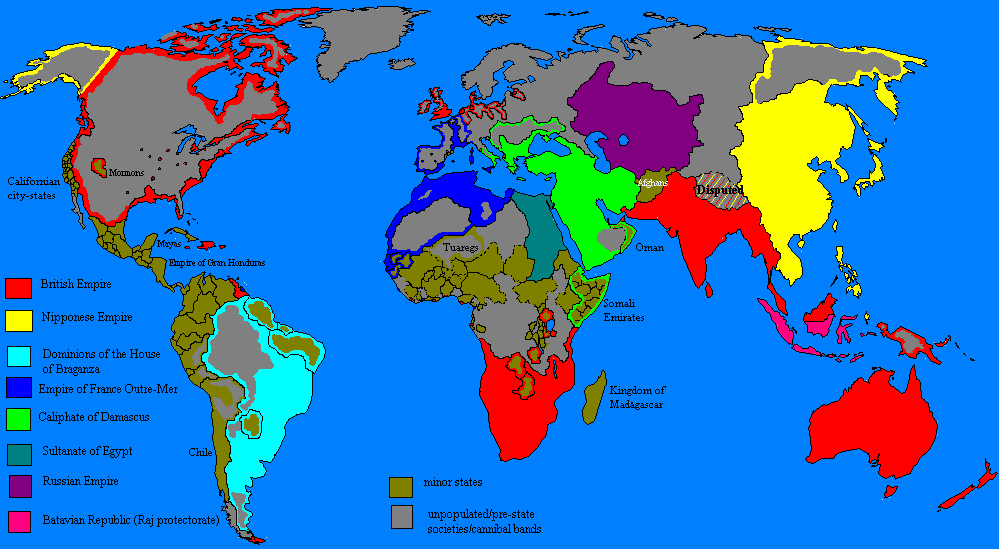
In this novel, "...the Fall..." (p. 8) means not a moral Fall of mankind in prehistory but the physical fall of a comet or comets in 1878. Benjamin Disraeli discussed the consequences of the cometary impacts with:

Stokes, the secretary of the Royal Society;
Sir William Thomson from Glasgow;
Tait from Edinburgh;
Maxwell from Cambridge;
two others.

Since the action of the novel occurs in the second century after the Fall, Disraeli's conversation with the scientists could have been presented, for example, in a prologue or a flashback. Instead, a clairvoyant called Yasmini has the curious ability to observe several categories of events:

distant;
"...might have been..." (p. 6);
might yet be;
past.

She somehow knows that this vision is of the single past that led to her present. As a disembodied consciousness, she sees a snow- and ice-bound London, then enters a building where she not only recognizes Disraeli but also "...feel[s] the being of him, not just the appearance..." (p. 7).

By virtue of Yasmini's feeling of being and after the transitional three dots..., we now read an account that is narrated from Disraeli's point of view although we are also informed that Yasmini somehow understands "...the pure English of six generations past..." (ibid.).

This elaborate clairvoyance is not necessary to inform the reader of Disraeli's conversation with the scientists so it must instead be intended to establish Yasmini's powers in order that they can be put to further use - for espionage? - later in the novel. (However, I blog as I read so I might be mistaken.) The omniscient narrator - or, alternatively, a narrative that has temporarily returned to Yasmini's point of view - conveys something of what this extra-temporal clairvoyance feels like to her:

"It was as if her mind rode with his, a deep well full of memory and thought, where concepts and ideas rose with a darting quickness, like trout in a mountain stream." (ibid.)

I think that this means that Disraeli's mind is the "...deep well..." rather than that there is a deep well of collective consciousness within which it is possible for one mind to "ride with" another?

Several factors:

that this novel is set in a divergent timeline;
that Yasmini time travels, albeit mentally;
that she knows of events that "...might have been..." as well as of the single past that has led to her present;
that she sleeps in a cave in the Hindu Kush (p. 6) -

- might remind us of Poul Anderson's Time Patrol series. In particular, the Patrol played an elaborate trick "...in the mountains of the Hindu Kush..." -Anderson, The Shield Of Time (New York, 1991), p. 73.

A Patrol agent disguised as a Russian captain gives the lost private Garshin "'...an important object...'" (Anderson, p.14) to deliver to his superiors.

"When Garshin glanced rearward, a last time, he saw sunlight from behind the [captain's] helmet make a kind of halo, as if on an angel who guarded some place mysterious and forbidden." (p. 16)

That place could not possibly be more mysterious or forbidden because the Patrol, for purposes of its own, prevents Garshin's meeting with the captain from ever having happened. Thus, although we read an account of their conversation, we later learn that that entire encounter is a "...might have been..." and, at the end of the appropriate section of the narrative:

"Yuri Alexeievitch Garshin stumbled lost and alone." (p. 123)

Yasmini's time travel to a past mind where ideas are like trout in a mountain stream might also remind us of Anderson's account of time as "...a river..." -Anderson, Time Patrol (New York, 2006), p. 17 - that can be diverted, therefore is guarded by the Patrol. Mentally at least, Yasmini's universe of discourse is very similar to that of the Time Patrol.

Saturday, 18 July 2015

Bhang Lassi

I refer to lassi here. In SM Stirling's The Peshawar Lancers (New York, 2003), the clairvoyant, Yasmini, drinks "...bhang lassi..." (p. 38) which, to my surprise, has a "...bitter, sweet-sour taste..." (ibid.). However, this kind of lassi turns out to contain cannabis, as the recipe shows. (See the second link above.) Also -

Bhang lassi

Bhang (or bhung) lassi is a special lassi that contains bhang, a liquid derivative of cannabis, which has effects similar to other eaten forms of cannabis. It is legal in many parts of India and mainly sold during Holi, when pakoras containing bhang are also sometimes eaten. Uttar Pradesh is known to have licensed bhang shops, and in many places one can buy bhang products and drink bhang lassis.[2]

- copied from here. 

Thus, this post is another in our long food thread.

I am reading The Peshawar Lancers for the second time but have noticed this information about bhang lassi for the first time. Like Poul Anderson, SM Stirling should be not only read but reread.

Thursday, 31 May 2018

Changing Probabilities

SM Stirling's Shadowspawn have the psychic "Power" to change probabilities by directly affecting quantum events. Thus, their antagonists become more likely to suffer heart attacks, gun misfires or other mishaps.

In Poul Anderson's Time Patrol series, quantum probability-waves can change their rhythm, thus altering the timeline.

Now imagine a Shadowspawn personal causal nexus able to make probability-waves change their rhythm. Would he initiate a divergent timeline while remaining in his original timeline or find himself transported with unchanged memories into an alternative timeline?

One Shadowspawn, Adrian Breze, seems to share the ability of the psychic, Yasmini, to detect alternative futures.

Each of us exists because of probabilities. If a different sperm and egg had met, then our parents would have had offspring with a different genetic combination. Imagine a being with a level of consciousness and power able to affect that. S/he would be able to choose between innumerable alternative world populations.

Tuesday, 21 July 2015

Oblique Commentaries

Works of fiction set in alternative histories obliquely comment on what we regard as real history.

(i) In a British TV play with the premise that the Germans won World War II, a man making a TV drama about the War said, "I can't rewrite history..."

(ii) In Poul Anderson's Operation Luna, cooperation between Einstein and Planck released forces previously regarded as magical. What would have happened if they had continued to work separately?

(iii) In Alan Moore's Watchmen:

when a superhero has won the Vietnam War for the US, someone remarks that, if we had lost this war, we would have gone mad as a nation;

two journalists called Bernstein and Woodward are found dead;

the headline "RR to run for President?" is greeted with the question, "Who wants a cowboy actor in the White House?" Of course the headline refers to Robert Redford.

(iv) In SM Stirling's The Peshawar Lancers (New York, 2003), Warburton remarks that, if the Fall had not thrown back progress, then by 2025 the world would be beyond the possibility of a World War and might even have been united by the British Empire. Yasmini, a clairvoyant who sees alternative realities, stirs, then subsides... "Ask later, [King] thought." (p. 315)

Monday, 29 May 2017

High Priestesses

SM Stirling, The Scourge Of God (New York, 2009), Prologue.

The High Priestesses seeing visions are like the Nine Witch Queens of Ys. Both groups are told that a storm is breaking over the world.

One Priestess says:

"'An oracle's voice speaks like the wind in a forest, turning and twisting like Time Herself.'" (p. 11)

Wind and Time are Andersonian themes although we are not familiar with a feminine "Time." The Priestess continues:

"'They don't show us more than we can bear.'" (ibid.)

In meditation, too much self-knowledge too soon might be unbearable.

Are the Priestesses acquiring some of the clairvoyant powers of Yasmini in The Peshawar Lancers? Have I asked such a question before? I am getting some deja vu feelings.

Saturday, 16 December 2017

Ways Of Knowing: Tomorrow Is Yesterday

(I referred here to an object passing through the Solar System. Here is a later report.)

How might we learn about multi-dimensional space-time? Our inter-dimensional guides this evening are:

HG Wells;
Robert Heinlein;
James Blish;
CS Lewis;
Poul Anderson;
Neil Gaiman;
SM Stirling.

Wells, Men Like Gods
An experiment in the Utopian timeline transports several Earthlings to Utopia.

Heinlein, "Elsewhen" and Waldo
Thought alone gives access to other universes.

Blish, The Quincunx Of Time and Midsummer Century
After receiving a message about time-projection from 25,000 AD, Thor Wald invents a metalanguage which shows that science cannot choose between future paradigms because it is one of those paradigms.
John Martels falls into a radio telescope of a radically new design with an inconceivable reach, thus prompting the message intercepted by Wald.

CS Lewis, Perelandra and "The Dark Tower"
In Oxford, Lewis reads an early seventeenth century Latin text about the celestial frame of spatial references.
In Cambridge, Lewis and his colleagues observe an alternative Earth through a chronoscope which also becomes the mechanism for an inter-Earth mind transference.

Poul Anderson, A Midsummer Tempest
Valeria Matuchek's theorems let her reach the continuum that she wants "'...or a reasonable facsimile of it.'" (Chapter xii, pp. 95-96) whereas Holger Danske has traveled at random, using a "'...superstition-riddled medieval grimoire...,'" (p. 96) so Valeria refers Holger to Sokolnikoff's Introduction to Paratemporal Mathematics and to the Handbook of Alchemy and Metaphysics.

Neil Gaiman, The Sandman: The Wake
A reality storm strands travelers in the Inn of the Worlds' End. When they leave, they will return to the worlds from which they came or very similar ones.

SM Stirling, The Peshawar Lancers
A clairvoyant simultaneously experiences multiple alternative presents.

I like the contrasts between:

the radio telescope and the chronoscope;

Wald's Machine language message from 25,000 AD, Lewis' Latin manuscript from the seventeenth century and Valeria's reference books;

Valeria reaching the continuum she wants or a facsimile of it and the Inn guests returning to their worlds or similar ones;

Wald theorizing about multidimensionality and Stirling's Yasmini directly experiencing alternative realities.

Sunday, 1 March 2015

In The Angrezi Raj

SM Stirling, The Peshawar Lancers (New York, 2003).

As expected, the text continues to be full of (to me) unfamiliar terms like "Dogras..." (p. 18) but I have stopped googling every one because this would slow the reading to a snail's pace. In fact, encountering the word, "...Deniers..." (p. 20), I thought this was another such term until I realized that, despite the capital letter, it simply meant "deniers," in other words "those who '...refused the Truth...' (p. 21), i.e., unbelievers, infidels, heretics etc. (What I would call "disagreers.")

Yasmini, contemplating her extra-temporal visions, uses the terms "...time lines..." (p. 27) and "...world lines..." (p. 38). As readers of hard sf, we are familiar with such phrases but would they be in her vocabulary?

Since history diverged in 1878, Rudyard Kipling lived into the alternative history and therefore wrote alternative poetry. For example, in the Exodus Cantos of his epic Lament For The Lost Homeland, he described the burning dome of St Paul's:

"'...stark flame against a sleet-filled August sky...'" (p. 25)

Neat.

Not only that but the artist Leighton, inspired by Kipling's epic, included the burning dome in the background of his painting, Martyrdom of St. Disraeli (p. 24). (That's Benjamin Disraeli to you and me.)

Even neater. Alternative history incorporates alternative politics, poetry and painting, a notion worthy of Poul Anderson. In fact, we have definitely found a successor of Anderson. (I write "a successor," not "the successor," because I am not sufficiently familiar with more recent sf. And, of course, a worthy successor is an original, not a mere imitator.)

The Appendices summarize information about:

the Fall;
the Exodus;
the New Empire;
Languages;
Technology and Economy.

Such appendices could have been presented as written in the alternative history which they describe or as written by an observer of alternative histories. Instead, in this case, they are simply the author addressing his readers as we realize when we read that 10,000 rupees is approximately equivalent to $125, 000 US dollars in 2000 values. (p. 473) That's our 2000, not theirs.

SM Stirling writes in his own distinctive style but I think that this paragraph reads a bit like Anderson:

"By the late twentieth century an exuberant mercantile and industrial capitalism was reemerging, wheeling and dealing, disrupting ancient patterns as men and women began to trickle from the countryside into the growing cities. Knowledge increased, in a civilization where the sciences and their practical application had high respect and much official support." (p. 480)

Dynamic economies, social change and respect for knowledge are recognizable aspects of fictional societies described by Anderson. In particular:

"Under such conditions, an exuberant capitalism was bound to arise."
-Poul Anderson, The Van Rijn Method (New York, 2009), p. 146.

Thursday, 23 July 2015

Foresight And Desert

SM Stirling, The Peshawar Lancers (New York, 2003), pp. 362-374.

Athelstane King's band fights nomads in the Thar, the Great Indian Desert. Yasmini responds to the nomads' movements from foresight, not from physical sight. Desert dwellers and foresight based on perception of multiple timelines recall Frank Herbert's Dune. However, the two works are otherwise dissimilar - apart from the use of the term Padishah, which further reminds us that both novels also present fictional empires.

As ever, reference to a work like Dune prompts from me the observation that Poul Anderson addressed such themes far better than some better known authors. See here.

Sunday, 8 March 2015

Warnings From Alternative History

SM Stirling, The Peshawar Lancers (New York, 2003).

"'...to set us all at each other's throats and bring on this general war, this...'
"'World War,' David bar-Elias said.
"'Yes, World War. Merciful Krishna, what a ghastly concept!'" (p. 314)

Because and only because their civilization has been knocked back by a physical catastrophe, the post-Fall British Imperialists are only just approaching the possibility of a first World War in 2025 - and one of their number has a grossly over-simplistic idea about how history might have gone without the Fall. Continuing the dialogue:

"'It is,' Warburton said. 'If there hadn't been a Fall to throw back progress, we'd be beyond the possibility of such things already. Probably the Empire would have united the world by now.'" (pp. 314-315)

Right!

The Fall was (or was not) in 1878;
the First World War began thirty six years later;
the Second followed twenty one years after the First;
a Third was prevented only by the madness of MAD (Mutual Assured Destruction);
none of that has prevented continued destruction on comparable scales in selected geographical areas.

Lacking experience of our twentieth century, Warburton cannot know that the complex dynamism of industrial civilization sweeps away any Empire long before it can unite the world. Could the current global economy be reorganized so as to preserve its creativity while lessening its destructiveness? Unless it is transformed into or replaced by something else, our economy will retain an inner dynamic of competitive accumulation, causing boom and slump cycles, monopolization and armed conflicts for resources, as Poul Anderson showed on an interstellar scale in Mirkheim.

Yasmini the seeress prophesies:

"'I have...dreamed it. War over all the world, cities burning and bombed from above, both sides building new and terrible weapons...the Great Powers fighting until they are exhausted...'" (pp. 313-314)

- exactly as HG Wells predicted.

Thursday, 20 May 2021

Genre Overlaps

As we know, and there is no need to list every example yet again, Poul Anderson wrote:

science fiction, including space opera, speculative fiction, future history, alternative history etc
historical fiction
historical science fiction
fantasy
historical fantasy
heroic fantasy
historical fiction with an element of fantasy
a contemporary novel with one element of fantasy (or just of psychology?)
detective fiction
 
- so genres can overlap.
 
How much is permissible in a contemporary novel before it tips over from mainstream into genre fiction? Psychic abilities and apparitions are attested, although not yet scientifically explained, so does the following dialogue belong in a contemporary novel?

"'Do you ever see the future?'
"'Yes, but there are many futures and not all of them come true.'"
-Susan Howatch, Glittering Images (London, 1996), PART TWO, ELEVEN, VIII, p. 424.

- as well as a visible "ghost" in a later volume?

My friend, Fran Cobden, claimed to be able to see the future in this way. The proposition that there are many futures not all of which come true does not surprise us in sf but pushes a boundary in contemporary fiction. See SM Stirling's character, Yasmini. Poul Anderson also presents a single, unalterable future in There Will Be Time.

Sunday, 1 March 2015

Samarkand

(The image shows the Road to Samarkand.)

SM Stirling, The Peshawar Lancers (New York, 2003), p. 10.

Count Ignatieff has "...boyar arrogance..."

Yasmini says, "'Veno vat...'" and "'...pajalsta...'" (The latter means "sorry" or "excuse me.")

Ignatieff is an initiate in the cult of Malik Nous or Tchernobog, the demiurge worshiped in Samarkand.

On just this one page, I have found these seven words or phrases that I wanted to google. I found no information for "Veno vat..." Of course I have heard of demiurges but what are they exactly? And Samarkand but what is its significance? Alan Moore refers to Malik Nous (or Taus) in Top 10. Czernobog shows up in Neil Gaiman's American Gods.

If The Peshawar Lancers continues to be full of such interesting words, then I will have to start skipping past them to get on with the story.

Athelstane King's orderly is Narayan Singh - a Sikh surname. Poul Anderson's Ensign Flandry served briefly under a Commander Singh in an interstellar battle.

Wednesday, 22 July 2015

This World And Two Nearer Ones

Imaginary worlds are inside us so they are nearer to us than the external world.

Although I recently compared SM Stirling's Angrezi Raj to Poul Anderson's Terran Empire, the two imaginary worlds of this post are the timelines of the Angrezi Raj and of Anderson's Time Patrol.

The Patrol prevents divergent timelines whereas Stirling's seeress, Yasmini, tries to prevent an end-of-life-on-Earth timeline;

in the Patrol timeline, John Watson recounts the real adventures of Sherlock Holmes whereas, in the Angrezi Raj timeline, Conan Doyle recounts the fictional adventures of a detective in an alternative timeline...

Common to these timelines and ours is Bradshaw's Guide.

"Mainwethering consulted his Bradshaw. 'You can get the 8:23 out of Charing Cross tomorrow morning,' he said."
-Poul Anderson, Time Patrol (New York, 2006), p. 23.

""The Lancer officer dug into one of the bundles, pulling out a copy of Bradshaw's Indian
Imperial Railways, by Newmans of Calcutta, and lost himself in thought."
SM Stirling, The Peshawar Lancers (New York,2003), p. 343.

I posted about Bradshaw before. The subject of Bradshaw has come up again because, on Sheila's birthday yesterday, her presents included the dvd's of Michael Portillo's third, fourth and fifth TV series based on Bradshaw. Thus, Bradshaw ties together our three timelines.