Showing posts sorted by relevance for query Spica. Sort by date Show all posts

Friday, 28 October 2016

Spica, Star Or Sector

The planet Ikrananka is in orbit around a dwarf star. From the Ikranankan surface, David Falkayn sees, through dull light and thin air, a few stars including the white jewel of Spica. The reader thinks no more of this. The narrator has named a star. However, we later learn why Falkayn is on Ikrananka:

"A sector would be chosen, out where the traffic is still thin: Spica, for instance. A base would be established." (David Falkayn: Star Trader, p. 99)

The star has given its name to a sector of space and Falkayn is the captain of the first trade pioneer crew. Later in the Technic History, the Spican marches are mentioned and Dominic Flandry:

"...accepted reassignment to the Spican province." (Captain Flandry, pp. 303, 304)

The sector has become an Imperial province. (See here.) Every background detail in Poul Anderson's works is there for a reason and has deeper repercussions.

Monday, 30 October 2017

Spica And Betelgeuse

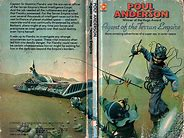
"...those few stars - like diamond Spica and amber Betelgeuse - which were too bright and near to be veiled."
-Poul Anderson, "Outpost of Empire" IN Anderson, Captain Flandry: Defender Of The Terran Empire (New York, 2010), pp. 1-72 AT p. 1.

This deceptively simple opening paragraph of a short story makes passing reference to two stars that in fact play major roles in Poul Anderson's Technic History, which is why I have linked to the previous blog posts mentioning either Spica or Betelgeuse.

Friday, 17 January 2025

Notes From Reading

During a period without Internet access, I reread some Dominic Flandry texts and took some notes but must now decipher the notes. What does "incense and candles" mean? It means that Nicholas van Rijn offers candles to a saint whereas Sumu the Fat offers incense to some gods: essentially the same practice. Polytheism and monotheism interact in different ways. Some monotheists have three divine persons, a Mother of God and thousands of angels and saints but remain monotheists.

The note, "Spica," means that I had recently posted about Spica but then read some more about it. There is quite a lot. See Spica.

Some notes have already become the bases of subsequent posts, e.g., about Catawrayannis Base and a Moslem-Buddhist synthesis.

I find ten quoted phrases about "wind." Either Poul Anderson is writing a detailed nature description or he is using the wind to comment on the action of the story or maybe both. We can study these passages but not tonight, thank you. After that, I will have exhausted posts drafted or notes taken while off line and will just have to do some more reading.

Onward, Earthlings.

Tuesday, 23 July 2013

Flandry's Career

Dominic Flandry's one man mission to track down conspirators on Llynathawyr was cut short when he was kidnapped by the Scothani. After he had single-handedly subverted the Scothani Empire, he was put in charge of Intelligence in the frontier province of Spica. Thus, it was he who dispatched such men as were available to hunt for an escaped enemy agent that was known to be hiding in the province but without success.

In the following two years, Flandry:

was sent to Betelgeuse, where he learned how to lie to a telepath;
entered the Merseian Roidhunate and established an advance base for Naval Intelligence;
had an eventful leave on Terra;
was re-assigned to Spica;
led Intelligence during the conquest of Brae;
on Brae, detected a clue as to the whereabouts of the missing enemy agent;
defeated that agent on Nyanza, thus also preventing a Nyanzan rebellion against the Empire;

- my point being that a significant period of Flandry's career, covering his first three short stories, is so understated that we might miss it.

Here is another interesting detail: "The Game of Glory," about Brae and Nyanza, mentions the breakup of the Commonwealth in its original, unrevised, form, even though it was published two years before "A Plague of Masters," containing the first reference to van Rijn in a Flandry story, so maybe the idea of uniting the van Rijn and Flandry series was around earlier than was thought?

Wednesday, 18 June 2014

To Altai And Back

For a summary of information on the native Altaians, see here.

OK. I have reconstructed Flandry's itinerary. For the investigation of Altai:

Intelligence shipped him to Betelgeuse, where the Terran Embassy gave him his orders with a dossier and an expense account;

he engaged passage to Altai on a Betelgeusean trading ship.

To return to Terra:

he engaged passage on a Betelgeusean tramp ship as the quickest way to reach the Imperial port at Spica VI, from where he would return home on a luxury liner, the Empress Maia;

however, the tramp stopped on Orma, where a Betelgeusean trader informed him of another isolated human colony, Unan Besar, and he rented a space flitter to go and investigate that planet;

presumably, having liberated Unan Besar, he returned to Orma, thence to Spica VI and Terra, although we next see him, some time later, on Varrak in the Taurian Sector - if you accept my revision of the Chronology in recent posts.

Tuesday, 24 June 2014

The Master Of Deceptions

(I might order Multiverse and NESFA Vol 2 soon but meanwhile have been enjoying the current extended time journey back through the Technic History.)

"The Plague of Masters" ends with another of Dominic Flandry's elaborate deceptions, so complicated that it is impossible to remember the details except by rereading the story.

(i) Nias Warouw, director of the Guard Corps, is enticed to fly to Ranau, accompanied by four armed Guards, to arrest Flandry in the house where the latter has been living high in one of the Trees. (It makes sense that the local Biocontrol dispenser, with direct access to Warouw, is loyal to his own people, not to the planetary oligarchs.)

(ii) Flandry must distract the five Corps men while his confederates climb from neighboring Trees to the back of the house instead of approaching it by the ladder at the front. At this stage, Flandry must speak gibberish and move his limbs and body to feign insanity and could certainly have been shot dead.

(iii) Unfortunately, there is a gun fight. Wiarouw, who must be taken alive, is not easily subdued and two good men die as a result.

(iv) However, once Warouw is secured, everything proceeds smoothly. He can die in a cage deprived of the antitoxin (appropriate, because this is what he has done to others) or start afresh on another planet with a cash stake.

(v) Now controlled by Flandry, Warouw radios his aircar crew of armed men hidden nearby to land on the airstrip where they are killed by vengeful Ranauns.

(vi) He will tell Biocontrol that he and some of his men will take Flandry in the latter's space flitter accompanied by another ship to Spica, will let Flandry's flitter crash with him in it, will tell the Imperial authorities that they are returning Flandry's courtesy call and are shocked to hear of his death.

(vii) However, the "Guards" traveling to Spica will be Ranau men in uniforms taken from the aircar crew and will guard Warouw, not Flandry. Biocontrol will be easily deceived because, as already established, they are so incompetent.

(viii) Imperial entrepreneurs will bring cheap synthesized antitoxin for all the dispensaries while the Biocontrol fanatics, deprived of their power, destroy their now redundant vats. Flandry had earlier speculated about a big commission for himself. The spirit of Polesotechnarch Van Rijn lives on.

Tuesday, 21 April 2020

Captains' Council

The Peregrine, CHAPTER II.

Tapestries and polished metal reliefs hang from the carved pillars and panels of the Captains' Hall on Rendezvous.  When the captains are seated around the Council table, Traveler Thorkild Helmuth says:

"'In the name of Cosmos, rendezvous...'" (p. 7)

Then a ritual is followed by a meeting to discuss facts, determine policy and make proposals for voting. All Nomad ships except five are either present or accounted for. The Vagabond has brought word from the Wayfarer and the Pilgrim that they cannot attend this year. The Peregrine has brought the same message from the Vagrant which is making a deal near Canopus.

Present are:

Wanderer
Gypsy
Hobo
Voyageur
Bedouin
Swagman
Trekker
Explorer
Troubador
Adventurer
Migrant
Vagabond
Peregrine
Traveler (we remember when she was the only Nomad ship)
Romany
Stroller
Fiddlefoot

It is traditional to use names from human languages. Although human beings join choths in the Technic History, non-humans have not joined Nomad ships in the Psychotechnic History.

The Romany claims the territory fifty light-years around Thossa;

the Bedouin might help the Adventurer to subvert the trader-taxing Shan of Barjaz-Kaui who cannot be overthrown by force because the Coordination Service knows the planet;

the Cordies stopped the Stroller from selling guns to a particular race;

the Fiddlefoot, bartering for expensive Solarian goods at Spica, is prepared to sell shares in this enterprise;

the Peregrine wants to investigate the loss of five Nomad ships toward Sagittari in ten years.

Sunday, 14 June 2026

What The Usurper Said

Hans Molitor wears:

"...the pyrocrystal ring of Manuel the Great..."

- and has a:

"...huge Roman nose..." (ibid.)

- if the latter is of any significance.

He tells Flandry that he:

has been Emperor for six years;

spent the first three fighting;

needs another twenty or thirty years to make this jerry-built, dry-rotted Empire last a few more generations;

must lead an armada to quell the barbarians in Sector Spica.

His son, Otto, unfortunately killed, would have been a trustworthy heir, unlike Dietrich or Gerhart.

Sunday, 3 June 2012

Flandry's Life

"The Game of Glory" gives a unique account of Dominic Flandry's life over a period of two or more years, not just during a single incident or assignment.

During this period, Flandry:

has a first encounter with the Merseian agent A'u on the frontier planet Conjumar in the Spican province;

dispatches agents who search, unsuccessfully, for the escaped A'u on nearby planets;

has a first encounter with the Merseian agent Aycharaych in the Betelgeusean system;

infiltrates the Merseian Rhoidunate;

there finds an uninhabited terrestroid planet set aside as an aristocratic hunting preserve where the Terran Navy then builds an advanced base;

has leave on Terra where he spends three months at the Lyonid family's perpetual banquet, then fights a duel;

returns to Spica;

is involved in the conquest of the planet Brae where a clue enables him to track down A'u on the planet Nyanza.

We wish that the Flandry series had provided more such details.

Wednesday, 22 April 2020

Another Moving Moon And The Milky Way

The Peregrine, CHAPTER III.

On Rendezvous, three moons are up and one is:

"...almost full and hurtling between the stars so that [Peregrine Thorkild Sean] could see it moving." (p. 18)

Thus, Sean has three shadows and one of them moves. Also above him:

"Overhead were the stars, constellations unknown to the home of humanity. The Milky Way was still there, a bridge of light, and he could see the cold brilliance of Spica and Canopus, but most of heaven was strange." (ibid.)

We have already found the Milky Way described as a "...ghostly bridge of stars..." later in The Peregrine. See here.

Sunday, 21 August 2022

Hans Molitor

Hans Molitor:

was born to colonial bourgeois parents on Germania;

had several years of wild adventure in space;

enlisted in the Terran Navy;

rose through the ranks by ability alone;

was a hero of the battle of Syrax;

was proclaimed Emperor by his personnel in the succession crisis;

is a shrewd, uncultured pragmatist;

leads an armada to quell the barbarians in Sector Spica;

will be succeeded by dull Dietrich, then by scheming Gerhart, although he would have preferred dead Otto.

When Flandry sees Hans glance at the picture of Otto, he almost reads the Emperor's mind: a Sherlock Homes stunt.

When we read in the Chronology that Hans is succeeded by Dietrich who is succeeded by Gerhart, we might ask, "Why do such details matter?" But every character does matter. In fact, did Gerhart murder Hans, then Dietrich?

Wednesday, 18 June 2014

Projected Dates For The Fall Of Empire

Information about Poul Anderson's fictitious planet, Altai, continues to be posted here here, here and here.

The unreliability of projected dates for the Fall of the Terran Empire is also shown by another consideration. At least twice during Dominic Flandry's lifetime, the Empire could have fallen suddenly and unexpectedly - if the Terran fleet had been destroyed at Starkad or if a jihad had been launched from Aeneas.

These possibilities preexisted the computer projection quoted by Aycharaych to Flandry. Nevertheless, they demonstrate the instability and unpredictability of the period. And an even less predictable possibility arose shortly afterwards. If a Merseian sleeper had become Terran Emperor, then the Empire would not have fallen but have been incorporated into the Roidhunate.

Chunderban Desai thinks that what he calls the Empire's anarchic phase will last for another eighty years, although modern technology, nonhuman influences and interstellar distances could change that time scale.This will be followed by a "rise," then the final collapse, but there is no absolute inevitability and the development is often cut short by foreign conquest. By leading an armada to Sector Spica to quell the barbarians, Emperor Hans risks losing the throne to an insurrection at home, especially since Aycharaych knows how to foment civil wars.

Thus, even Desai's predicted dates could easily be overturned.

Saturday, 24 March 2018

Imperial Sectors

Sean M. Brooks estimates that, in Poul Anderson's History of Technic Civilization, there are 100 sectors of the Terran Empire. See here. Sean reasons very closely from hints given in Anderson's texts.

How many Inperial Sectors do we know by name?

Sector Aldebaran
Sector Alpha Crucis
Sector Pacis
Sector Spica
Sector Arcturus
Sector Taurus

Not many.

I have a feeling that, in some future history, if not in this one, Terra/Earth is in Sector Sirius but it is too late at night to start consulting other volumes. (However, see Fifty Thousand Years and, more generally, here. Scroll down.)

Onward.

Thursday, 15 March 2018

Bar Scene

We enjoy bars in real life and bar scenes in fiction. There are many inns in Poul Anderson's and SM Stirling's works and there is an understated bar scene in Anderson's "The Plague of Masters." Dominic Flandry has traveled in a Betelgeusean/Alfzarian tramp ship from Altai to Orma en route to Spica VI where he will catch the luxury liner, the Empress Maia, on its way to Terra. (Alfzar is the main inhabited planet in the Betelgeusean System just as Terra is in the Solar System.)

While waiting on Orma, Flandry sips raw local brandy and speaks Alfzarian with a blue-faced Betelguesean captain who trades for hides, natural fibers and fruit on the nearby human colony planet of Unan Besar where the single, small, antiquated spaceport, without even a bunkhouse for off-planet traders, is a hundred jungled kilometers away from the capital city and where, furthermore, the native longshoremen are forbidden to speak to the traders, as though the rulers of Unan Besar have something to hide. Flandry knows that if he files a recommendation that the planet be checked on, it will not be acted on, so he hires a space flitter to check for himself.

Monday, 14 August 2017

Truth In The News?

How can we believe anything that we hear in the news? In the fictional scenario of A Knight Of Ghosts And Shadows, Poul Anderson shows us how everything could be faked.

Why do Terran and Dennizan Intelligence reports about Merseian movements differ?
Are any Merseian movements a mere show for Dennitzan scouts?
Kossara's enslavement on Terra was not reported there but this inflammatory news did get quickly back to Dennitza. (She is the Gospodar's niece.)
Could barbarians in Sector Spica have been encouraged to attack in order to draw Imperial attention there? (Emperor Hans is less accesible while he leads a fleet against them.)
Are Merseian undercover men high in the Gospodar's councils keeping important information away from him?
Instead of directly approaching the Gospodar, should Flandry and Kossara covertly visit her parents and send a domestic servant with a secret message for the Gospodar while Chives proceeds openly to Zorkagrad with false papers forged by Flandry?

The mind boggles.

Sunday, 22 June 2014

The Game Of Glory

"The Game of Glory" occupies 36 pages in Poul Anderson, Captain Flandry: Defender Of The Terran Empire (New York, 2010) and is divided into sections numbered I to VIII. Section I, three and a half pages, is almost a separate story, summarizing two years of Dominic Flandry's life.

Flandry:

tries to track down an escaped Merseian spy in the Spican province of the Terran Empire;
encounters Aycharaych (not named here) at Betelgeuse;
infiltrates the Merseian Empire;
has leave on Terra;
fights a duel;
is reassigned to Spica;
heads the Intelligence operation during the conquest of Brae;
finds a clue that will lead him to the human colony planet, Nyanza.

My previous posts on this story have focused on Section I. Sections II-VIII are set on Nyanza. See here and here.

Thursday, 8 December 2022

Tramp Ships, Flitters And The Hooligan

Despite representing the Terran Empire, Dominic Flandry had travelled to Altai as a passenger in a Betelgeusean merchant ship. When Terran Navy ships arrived to rescue him, he could have returned at least as far as Catawrayannis in one of them but instead preferred to travel in another Betelgeusean ship to the Imperial port at Spica VI. From there, he would have returned to Terra in the luxury liner, the Empress Maia. However, the second merchant ship stopped at Orma where Flandry learned about the self-isolating human colony planet, Unan Besar, and hired a space flitter to go and investigate. On a later mission, he took a high-speed flitter to travel from Brae to Nyanza. The main point here is that Flandry did not as yet have his private spaceship, the Hooligan.

Shortly after returning home from Nyanza, Flandry is in possession of the Hooligan and is served by the Shalmuan, Chives, whom, we later learn, he had acquired, initially as a slave, while outside the Solar System. I deduce that Flandry had acquired Chives before going to Altai, that Chives had remained on Terra while Flandry was on Altai and Unan Besar and that Flandry completed the purchase of the Hooligan shortly after returning from Nyanza.

Friday, 11 November 2022

The Outbackers

"Outpost of Empire."

Freehold, like Dennitza and Daedalus, is on the Betelgeusean frontier of the Terran Empire, facing the Merseian Roidhunate. At the beginning of this story, Karlarm sees two nearby stars:

"...diamond Spica and amber Betelgeuse..." (p. 1)

When Karlsarm meets his prisoners, Uriason and Ridenour, on p. 24, this encounter is described from Karlsarm's point of view but the narrative returns to Ridenour's pov on p. 27. We have meanwhile learned that Uriason's daughter is studying on Ansa. (p. 15) We are continually reminded that we are reading a substantial future history series.

The outbackers, who destroy the city of Domkirk by turning its own missiles against it, represent an anti-urban way of life. They are very much in conflict with the Nine Cities but are in no way taking sides in the interstellar conflict between Terra and Merseia although we can readily imagine that they would be accused of doing precisely that.

These outbackers, like the Avalonians, win their struggle against the forces of the Terran Empire. The Technic History really does present multiple perspectives.

Thursday, 4 July 2013

"Sector Governors in the Terran Empire," by Sean M. Brooks

I recall seeing speculation by fans of Poul Anderson who wondered how much "territory" was covered by a sector governor's "province" in Anderson's Terran Empire tales. And while recently rereading THE REBEL WORLDS I came across a few texts which gives us some information on that point.

Poul Anderson likes to give readers some idea of the over all size of the Terran Empire in many of his stories.  Because he believed it gives us some idea of the sheer vastness of the background setting before he focuses on "smaller" scenes.  THE DAY OF THEIR RETURN was no exception and this is what I found in Chapter 3: "The vaguely defined, roughly spherical volume over which Terra claimed suzerainty had a diameter of some 400 light-years; it held an estimated four million stars, whereof half were believed to have been visited at least once; approximately 100,000 planets had formalized relations with the Imperium, but for most of them it amounted to no more than acknowledgment of subordination and modest taxes, or merely the obligation to make labor and resources available should the Empire ever have need."

A sector governor ruled regions of the Empire analogous to the jurisdictions held by the viceroys and governor generals of the former Spanish and British Empires on Earth.  On an interstellar scale, the territory over which he held authority was almost inconceivably vast, as this quote from the opening paragraph of Chapter III of THE DAY OF THEIR RETURN indicates: "A sector governor oversaw such vastness that to him it became a set of abstractions."  And I found a rare indication of how large a sector was in THE REBEL WORLDS, Chapter I: "...a sector governor, viceroy for His Majesty throughout some 50,000 cubic light years surrounding Alpha Crucis."  I am sure this is the only text in the stories where a specific figure was given indicating the SIZE of a sector.

As we already know, there were 100,000 planets owning formal allegiance to the Imperium.  These planets included both worlds colonized by humans and planets inhabited by non human rational beings.  It is my guess that, on average, a sector had 1000 of these planets.  The evidence on which I based this is the following quote from Chapter II of THE REBEL WORLDS, from the passages describing Admiralty Center: "Crowds moved by and overflowed the offices.  Their members ranged from junior technicians to admirals on whose heads might rest the security of a thousand worlds.."  I understood this to mean that the military defense of the border sectors of the Empire entrusted to these admirals averaged a thousand worlds.  And it is reasonable to think the sectors of the inner Empire also averaged a thousand planets.  Therefore, I argue the Empire was divided into 100 sectors for administrative purposes.

How important were sector governorships?  Important enough that the persons chosen for them were matters of intense interest to the Throne and the Policy Board.  Here's a bit from Admiral Kheraskov's briefing of Dominic Flandry in Chapter II of THE REBEL WORLDS: "Elevation [of Aaron Snelund] to a higher rank would have kicked up a storm, but viscounts are a millo a thousand.  However, it's sufficient for a major governorship.  Many sectors would be too rich, powerful, close to home, or otherwise important.  The Policy Board would not tolerate a man in charge of them who couldn't be trusted."

Moreover, to do their jobs, sector governors HAD to have wide powers, despite this also allowing the risk of abuse of those powers occurring.  As Flandry said in Chapter III of THE REBEL WORLDS: "We have *got *to give our proconsuls wide discretion.  We've *got *to let them recruit auxiliaries, and hope those auxiliaries will know the local scene better than Imperial regulars."  THE REBEL WORLDS takes its plot from a bad governor's abuse of his office and powers.

In his Terran Empire stories Poul Anderson named the sectors not after planets but for either astronomically prominent stars or stars orbited by politically influential planets.  Examples being Sector Aldebaran, Sector Alpha Crucis, Sector Pacis, Sector Spica, etc.

Wednesday, 23 April 2014

"Sandra Miesel's Technic Civilization Chronology," by Sean M. Brooks

Prefatory Note.  Dr. Shackley kindly published on his blog (April 26, 2012) an earlier version of this essay written by me.  Since then, I decided it needed to be revised, mostly from dating the birth of Nicholas van Rijn to 2421 instead of my earlier suggestion he was born in 2424.  And that made it necessary to revise my suggested dates for the birth of David Falkayn and many of the stories set during the Polesotechnic League. I also found it necessary to change some of the dates for the stories set in the Imperial era.

Several editions of the Technic Civilization stories of Poul Anderson (Gregg Press, Ace Books, Baen Books) have attached to them a chronology compiled by Sandra Miesel, an excellent commentator on the works of Anderson.  This chronology lists in internal chronological order all the stories and novels of the Technic Civilization series through periods like that of the Polesotechnic League and the Terran Empire.  Miesel also added many annalistic notes to her chronology.

For those who wish to read the Technic Civilization stories in chronological order, or merely to have a list of the stories in a correct temporal sequence, Sandra Miesel has done readers of Anderson's works a real favor.  However, commentators like Dr. Paul Shackley have discovered inconsistencies in some of Miesel's proposed dates which contradicts what the texts says.

For example, Miesel dates the birth of Nicholas van Rijn to AD 2376 and the crucial Polesotechnic League's Council of Hiawatha to 2400.  However, as discussed by Dr. Shackley in his note "Inconsistencies II," Nicholas van Rijn was born too late to have attended that council.  The section of Chapter IX of MIRKHEIM which discussed the Council of Hiawatha ended with "But when a century had passed--".  Nicholas van Rijn could not have attended that council because he was 80 years old at the time of the Mirkheim/Baburite crisis.  He would need to have been, implausibly, well over a century in age.

I have no objection to keeping Miesel's dating of the Council of Hiawatha to 2400, but I believe dating van Rijn's birth to 2421 is more accurate.  And since the Mirkheim/Baburite war came when van Rijn was 80 years old, that means it should be dated 2501 (not in 2456, Miesel's date).  This has the advantage of not contradicting what Chapter IX of MIRKHEIM said about "But when a century had passed."

Another error in Miesel's chronology contradicting what the texts say are her dates for "Lodestar" and MIRKHEIM.  She dates the events in "Lodestar" and MIRKHEIM to 2446 and 2456.  However, the Prologue to MIRKHIEIM clearly dates the events in that book to EIGHTEEN, not 10, years after "Lodestar."  My revision of her chronology dates those stories to 2483 and 2501.

The next major inconsistency in Miesel's chronology contradicting what the texts say came from her dating the foundation of the Terran Empire to the 28th century and the birth of Dominic Flandry to AD 3000.  These dates clash with what Chapter 10 of ENSIGN FLANDRY says, as the Merseian prime minister Brechdan Ironrede was going to the Imperial embassy for an official reception: "His destination was another offense, a compound of residences and offices in the garish bubble style of the Imperium four hundred years ago."  This indicates the Empire had existed for over four centuries by the time of ENSIGN FLANDRY (because it is reasonable to think schools of architecture needed some time after the Empire arose to become popular).

However, one problem with this dating is that we don't know how long the year of the planet Merseia was when compared to our Earth's year.  We don't know whether it was longer or shorter than the Terran year. Nonetheless it does indicate the Empire was older than the three centuries or so her chronology gives it by the time of ENSIGN FLANDRY.

Moreover, Miesel herself contradicts her chronology when she wrote in her "Introduction" for THE PEOPLE OF THE WIND (Gregg Press: 1977): "The Empire is its third century when it moves against the Domain in its first aggressive campaign against a civilized foe."  Another chronological indication can be found in Chapter 8 of Anderson's THE DAY OF THEIR RETURN, as Ivar Frederiksen briefly summarized the history of relations between the Empire and the Domain of Ythri: "Still, it [the Domain] grew.  So did Empire, Terra's, that is, till they met and clashed.  Couple centuries ago, they fought."  Now, if the Empire had existed a little over two centuries by the time of the Ythrian War and then that conflict was at least two centuries in the past by the time of THE DAY OF THEIR RETURN, that can only mean it had lasted more than four centuries by then.

Therefore, I would argue for dating the birth of Dominic Flandry to AD 3100, not 3000 (the year Miesel chose).  The later date better fits the chronological evidence I collected from the texts.  I am still puzzled how Miesel could have missed, for example, such crucial indications as the Prologue of MIRKHEIM saying the Baburite war occurred 18 years after "Lodestar."

Because of Dr. Paul Shackley's zeal and devotion to accuracy, I became aware of mistakes I made in my proposed ordering of the Dominic Flandry stories beginning with "Tiger By The Tail" and ending with WE CLAIM THESE STARS.  While working on a revision of Sandra Miesel's Chronology of Technic Civilization, I erred in too quickly accepting Miesel's listing of these stories when I should have paid attention to certain texts in THE PLAGUE OF MASTERS and WE CLAIM THESE STARS.  This time I made what I believe is a more accurate listing and "dating" of these six stories.

"Tiger By The Tail" is at the head of this listing because Dominic Flandry  was not yet a knight in that story.  That honor was conferred on him by the Emperor because of how he had nullified the Scothanian threat.  And also because we see Aline Chang-Lei saying in "Honorable Enemies," while trying to cheer up an anxious Flandry: "Dominic Flandry, the singled-handed conqueror of Scothania, brought down by that overgrown buzzard?" So I placed "Honorable Enemies second after "Tiger By The Tail."

"The Game of Glory" begins with mention of how an agent  serving Merseia escaped the Terrans from a planet named Conjumar in a spaceship so badly damaged that this agent, Aa'u, was forced to hide on another frontier world of the Empire. Then we read: "Two years went by. He was sent to Betelgeuse and discovered how to lie to a telepath," referring to "Honorable Enemies," which happened before the "Game of Glory" proper.  So we arrive at this partial listing: "Tiger By The Tail," "Honorable Enemies," and "The Game of Glory."

Next comes the problem of where to most accurately list, chronologically, "A Message in Secret" and THE PLAGUE OF MASTERS.  In Chapter II of PLAGUE we read: "The Betelgeuseans were ubiquitous throughout this sector of space.  Flandry had engaged passage on one of their tramp ships, as the quickest way to get from his completed assignment  on Altai to the big Imperial port at Spica VI." Which means "A Message in Secret " came immediately before THE PLAGUE OF MASTERS.  Last, in Chapter I of WE CLAIM THESE STARS, we see Flandry saying to Lady Diana Vinogradoff: "The Nyanza business was a trifle wearing, y' know,"  to remind her  of yet another exploit of his on yet another exotic planet.  "I came home for a rest. And the Merseians are such damnably strenuous creatures.  It makes me tired, just to look at one, let alone spar with him." And that places "The Game of Glory " not long before WE CLAIM THESE STARS.  Summing up, we get this listing: "Tiger By The Tail," "Honorable Enemies," "A Message in Secret," THE PLAGUE OF MASTERS, "The Game of Glory," and WE CLAIM THESE STARS.

 In addition, I suggested below that Josip died in 3142 rather than in 3141 (Miesel's date was 3041) because a slightly longer reign for that Emperor fitted better the background of the stories.  That is, it gives more time for the events recorded in those stories to take place without being crowded together too tightly.

If the argument I gave above is correct, then that means many, not all, of the dates given by Miesel in her chronology needs to be changed.  Mostly by proposing dates later than the ones she chose.  In the chronology given by me below, the dates I advocate are given first while Miesel's dates are given in square brackets.  For the most part I used the "Chronology of Technic Civilization" to be found in the Gregg Press edition of ENSIGN FLANDRY.  I also thought it best, for simplicity's sake, to omit many of the annalistic notes added by Sandra Miesel.  I omitted many bibliographical details for similar reasons.

In my proposed revision of Sandra Miesel's Chronology I preferred to list the stories by their first magazine or book publication dates.  To be strictly accurate I should say that Poul Anderson revised a few of these stories: "Margin of Profit," "The White King's War," "Tiger by the Tail," "Honorable Enemies," and "Warriors from Nowhere." These later versions should be considered canonical and first appeared in THE EARTHBOOK OF STORMGATE ("Margin of Profit") and in the Ace Books and Gregg Press editions of the Dominic Flandry stories ("The White King's War," GALAXY, October 1969, was incorporated in A CIRCUS OF HELLS.)

The Breakup and the Polesotechnic League

2055  "The Saturn Game," ANALOG SCIENCE FICTION (cited as ASF), February, 1981
2150  "Wings of Victory," ASF, April, 1972
24th century  "The Problem of Pain," FANTASY AND SCIENCE FICTION, February, 1973
2400  The Council of Hiawatha
2421 [2376]  Birth of Nicholas van Rijn
2451 [2406]  Birth of David Falkayn
2461 [2416]  "Margin of Profit," ASF, September, 1956
2461 [2416]  "How to be Ethnic in One Easy Lesson," FUTURE QUEST, ed. Roger Elwood, Avon Books, 1974
2468 [2416]  "The Three Cornered Wheel," ASF, October, 1963
2471 [2426]  WAR OF THE WING MEN, Ace Books, 1958
2471 [2426]  "Esau," ASF, February, 1970
2472 [2427]  "Hiding Place," ASF, March, 1961
2472 [2427]  "Territory," ASF, June, 1963
2473              "A Sun Invisible," ASF, April, 1966
2476 [2427]  "The Trouble Twisters," as "Trader Team," ASF, July-August, 1965
2478 [2433]  "Day of Burning," as "Supernova," ASF, January, 1967
3478 [2433]  "The Master Key," ASF, July, 1964
2482 [2437]  SATAN'S WORLD, Doubleday, 1969
2482 [2437]  "A Little Knowledge," ASF, August 1971
2482 [2437]  "The Season of Forgiveness," BOY'S LIFE, December, 1973
2483 [2446]  "Lodestar," ASTOUNDING: THE JOHN W. CAMBPBELL MEMORIAL ANTHOLOGY, ed. by Harry Harrison, Random House, 1973
2501 [2456]  MIRKHEIM, G.P. Putnam's Sons, 1977
Early 26th century [late 25th century], settlement of Avalon
26th century, "Wingless on Avalon," BOY'S LIFE, July, 1973
26th century, "Rescue on Avalon," in CHILDREN OF INFINITY, ed. Roger Elwood, Franklin Watts, 1973
26th  centruy, dissolution of the Polesotechnic League

The Time of Troubles and the Terran Empire

2600-2700 [27th century]  The Time of Troubles
Late 27th century, "The Star Plunderer," PLANET STORIES (cited as PS), September, 1952
2700  Manuel Argos founds the Terran Empire, Principate phase begins
28th century, "Sargasso of Lost Starships," PS, January, 1952
29th century [30th C], Covenant of Alfzar
2925 [29th century], THE PEOPLE OF THE WIND, New American Library, 1973
3100 [3000]  Birth of Dominic Flandry
3112 Battle of Mirzan, Alarri invasion crushed by the Navy.
3119 [3019]  ENSIGN FLANDRY, Chilton, 1966
3121 [3021]  A CIRCUS OF HELLS, New American Library, 1971
3122 [3022]  Josip succeeds Georgios as Emperor
3125 [3025]  THE REBEL WORLDS, New American Library,1969
3127 [3027]  "Outpost of Empire," GALAXY, December, 1967
3128 [3028]  THE DAY OF THEIR RETURN, Doubleday, 1973
3132 [3032]  "Tiger by the Tail," PS, January, 1951
3135 [3033]  "Honorable Enemies," FUTURE COMBINED WITH SCIENCE FICTION STORIES, May, 1951
3137 [3037]  "A Message in Secret," as MAYDAY ORBIT, Ace Books, 1961
3137 [3038]  "A  Plague of Masters," as EARTHMAN, GO HOME, Ace Books, 1961
3139 [3040] "The Game of Glory," VENTURE, March, 1958
3140 [3040]  WE CLAIM THESE STARS! (also HUNTERS OF THE SKY CAVE), Ace Books, 1959
3042 [3041]  Hans Molitor succeeds Josip as Emperor after brief civil war, supplants short lived Imperial relative as Emperor.
3143 [3042]  "Warriors from Nowhere," as "Ambassadors of Flesh," PS, Summer, 1954
3148 [3047]  A KNIGHT OF GHOSTS AND SHADOWS, New American Library, 1975
3155  Dietrich succeeds Hans as Emperor
3157  Gerhart succeeds Dietrich as Emperor
3162 [3061]  A STONE IN HEAVEN, Ace Books, 1979
3167 [3064]  THE GAME OF EMPIRE, Baen Books, 1985
Early fourth millennium, the Empire enters its Dominate phase
Circa AD 3500, Fall of the Terran Empire, the Long Night begins.  War, piracy, anarchy, economic collapse, and isolation devastate countless worlds.

The Long Night

3600  "A Tragedy of Errors," GALAXY, February, 1968
3900  THE NIGHT FACE, Ace Books, 1978
4000  "The Sharing of Flesh," GALAXY, December, 1968
7100  "Starfog," ASF, August, 1967