Showing posts sorted by relevance for query Quatermass. Sort by date Show all posts

Saturday, 6 June 2015

Marses II

We might as well discuss fictional versions of Mars and Martians in general but that is an enormous topic. This blog has already, in diverse posts, addressed Poul Anderson's several Martian races which seem to be sui generis, except that Anderson borrowed Wells' title with just a slight variation. See here.

I think that the main writers about fictional Martians are:

British
Wells
Stapledon
Lewis

American
Burroughs
Heinlein
Bradbury

The Brits form a perfect triad:

Wells writes separately both a future history and a novel about a Martian invasion of Earth;

Stapledon describes Martian invasions of Earth among many other events in a future history text book;

Lewis, disagreeing with Wellsian and Stapledonian visions of the future, locates evil only on Earth and tells us that Wells' Martians are very unlike the real Martians!

However, there are many other writers about Mars:

relevant to Burroughs
Edwin Arnold
Otis Adelbert Kline
Michael Moorcock

authors of composite Marses
Larry Niven
Alan Moore

James Blish incorporated Mars into his Haertel histories by putting the seminal character, Adolph Haertel, on Mars. Professor Quatermass thought that one group of alien invaders had come from Mars and Quatermass' successor on British television, Doctor Who, has his version of Martians, the Ice Warriors.

And that is as comprehensive as I feel like getting at present.

Saturday, 13 July 2024

Invasions

How many fictional alien invasions of Earth are there? Probably uncountable. How many specifically Martian invasions? I know of three of the latter: Wellsian, Stapledonian and Andersonian. (OK: There is also a Tim Burton film, Mars Attacks! and Quatermass thinks that one of his sets of aliens is from Mars.) Recalling relevant works reveals some strange anomalies. Edgar Rice Burroughs (ERB) has Martians and an invasion of Earth but not a Martian invasion of Earth. His alien invaders are Moon Men in a sequel to his Martian series. Also, the ERBian Jovians are planning to invade Mars. CS Lewis reverses the whole deal when an evil scientist from Earth invades the sinless Venus. And, of course, one of Olaf Stapledon's later human races exterminates the Venerians in order to colonize their planet.

Wells' big four contributions are in the fields of space travel, alien invasion, time travel and future history. Poul Anderson contributes to these four themes. His alien invasions are in:

The War Of Two Worlds (Martians and extra-solars)
"Soldier From The Stars" (a subtle economic invasion)

However, Anderson's main contributions are in time travel and future history.

Sunday, 21 May 2017

Endless Comparisons

Because I find it more convenient to read a book in the hand than an ebook on screen and because I prefer sf to detective fiction, I have easily been diverted from reading Poul Anderson's Murder In Black Letter to rereading James Blish's The Star Dwellers while comparing:

Blish's Haertel overdrive with Anderson's Mach drive;
Jack Loftus with Dominic Flandry;
Jack's mentor, Howard Langer, with Flandry's mentor, Max Abrams;
the Hegemony of Malis with the Roidhunate of Merseia;
Anderson's, Niven's and Blish's feline aliens (Blish's remain quadrupedal).

Other comparisons and contrasts are possible. Flandry's contemporary, John Ridenour, reflects that the universe produces sophonts as casually as snowflakes. Langer goes further, claiming that intelligences arises wherever it can. In Langer's period, the evidence has proved him right but he claims that this was expected. Is it?

For heuristic purposes, Blish's foreign service cadets are under an oath of celibacy whereas Flandry is anything but. In fact, Abrams plans to make Machiavellian use of his assistant's sexual activity: have the Ensign sent Home in disgrace - carrying military intelligence with him under the noses of the appeasers.

Blish's industrialist, McCrary, has got one of the energy beings called Angels to inhabit and control a fusion plant for him and wants to employ Angels to do this all over Earth whereas the Secretary for Space more prudently wants a treaty with the Angelic race or nation first. Would Anderson's capitalists be more cautious? CS Lewis (the character) knows that his friend, Elwin Ransom, receives visits and communications from extra-planetary angels and fears that Ransom is a beachhead for invasion. In the horror sf of Quatermass, any alien visitation could only be a threat.

Tomorrow, I will travel to Birmingham by train, carrying a book but not my laptop.

Monday, 25 March 2024

Astronautical Organizations

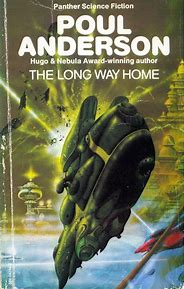
The National Aeronautics and Space Administration (NASA) was founded in 1958 when it replaced the National Advisory Committee for Aeronautics (NACA). Poul Anderson's The Long Way Home is copyright 1955 and therefore does not refer to NASA. In this novel, the United States Department of Astronautics launches the United States Interplanetary Ship, Explorer, in 2047. The captain and pilot, Edward Langley, is a graduate of Goddard Academy and a captain in the Astronautic Service. The Department, the Academy and the Service do not exist in 2024 and are unlikely to come into existence by 2047 but we appreciate past fictional futures.

In the 1950's British TV series, Quatermass, there was a (British) Experimental Rocket Group. In a 1979 sequel, the ERG was said to have preceded NASA and Apollo. In the 1950's Dan Dare comic strip, the Interplanetary Space Fleet and Astral College were based in London at the end of the twentieth century. No doubt there are other examples.

Friday, 12 April 2019

Alien Archetypes

Poul Anderson's Merseians, like Dan Dare's Treens, are bald, green, humanoid conquerors whereas William Dexter's Vulcanids, like HG Wells' Martians and Doctor Who's Daleks, are evil, non-humanoid monsters. These five archetypes are not equally known to the public. In fact, the public thinks that "Vulcans" are not giant adaptable anemones but pointed-eared logicians inter-fertile with Terrestrials and Star Trek adds the humanoid Klingons to the list of aliens-as-threats.

In some sf, e.g., Quatermass, all aliens are threats whereas Anderson presents every kind of alien from Merseians and Chereionites to Cynthians and Wodenites - those are just four of many in one series - and CS Lewis deliberated reversed the archetype, presenting aliens as threatened.

(Couldn't sleep so got up to write this short post.)

Friday, 16 June 2017

What Do You Remember?

SM Stirling, The Scourge Of God (New York, 2009), Chapter Three, p. 82.

Denson: "'You're not old enough to remember the Change, are you?'"
Ingolf: "'Nope...Not really. I remember the flash of light and the headache, but not much before that and not much more after, not for years. I wasn't even six then.'"
Denson: "Yeah, I can't remember much of when I was six either.'"
Ingolf: "'I do remember how scared everyone was.'"
Denson: "'Yes...I was old enough to know.'"

Each of us can parallel this dialogue from our own life experience:

I am not old enough to remember the War;
I do remember living in a post-War period;
I have no memory of the Coronation in 1953 although I do remember it being referred to as a recent important event;
I remember saying that I was six and, a year later, seven;
I finished secondary school and started University in 1967, the Summer of Love - fifty years ago;
in 1989, when there was a film about the Profumo Affair, I was a mature College student and told younger students that I remembered asking, "What's this Profumo business?," and adults not answering.

Poul Anderson's Dominic Flandry remembers that, when he was a boy, there were news reports of the Alarri fleet crossing the marches with nuclear weapons, then being defeated by an Imperial Navy task force at the Battle of Mirzan. The first Quatermass TV serial climaxes with the appearance of an extraterrestrial monster on the roof of Westminster Abbey and, in the novelization of the fourth serial, a character remembers his mother pulling him away from the TV screen...

Sunday, 29 July 2018

The Alien As Threat

(There are a lot of good covers of The War Of The Worlds. See here.)

One phrase in Poul Anderson's The Avatar, XXV, recalls:

three short stories by Anderson;

one short story by James Blish;

one novel each by HG Wells, Robert Heinlein and Larry Niven & Jerry Pournelle;

Volume II of the Ransom Trilogy by CS Lewis;

two TV series, Quatermass and The Invaders;

a feature film, Independence Day -

- but there are many examples of "alien as threat." (In fact, did the Kryptonians send Kal-El to Earth to conquer it? Is that self-made man, Lex Luthor, the champion of non-superpowered humanity?)

In The Avatar, Ira Quick thinks that the human heritage is "...now menaced by inhumanness." (p. 215)

In Anderson's "How To Be Ethnic In One Easy Lesson," the organizers of the Festival of Man think that:

"'...the Solar Commonwealth is deluged with alien - nonhuman - influence...the false glamour of ideas never born on man's true home.'"
-Poul Anderson, "How To Be Ethnic..." IN Anderson, The Earth Book Of Stormgate (New York, 1979), pp. 49-67 AT p. 53.

In Anderson's "Interloper," an alien alliance secretly exploits Earth. In his "Soldier From The Stars," militarily superior extra-solar humanoid aliens sell their services to the highest bidder among human governments and thus conquer Earth economically.

Wells' Martians come to consume our blood but we are sorry for them when they die in London. Lewis as character fears that his friend, Ransom, who has been to Mars and who is still in touch with extraterrestrial intelligences, is the Trojan Horse for an invasion from outer space but Lewis as author reverses this notion by showing us Terrestrial evil invading the sinless Venus.

In James Blish's "Citadel of Thought," human telepaths detect:

"'...an alien thing, not human, and inimical, cold, deadly, coming from we knew not what nadir beyond our Earth...We felt this deadly current, this other-world pattern, playing coldly across the Earth, and we were afraid.'"
-James Blish, "Citadel of Thought" IN Blish, The Best Of James Blish, Ed. Robert Lowndes (New York, 1979), pp. 1-19 AT p. 8.

Does that remind you of Wells' Martians?

"...intellects vast and cool and unsympathetic, regarded this earth with envious eyes, and slowly and surely drew their plans against us."
-HG Wells, The War Of The Worlds (Penguin Book, Harmondsworth, Middlesex, 1974), p. 9.

In "Citadel of Thought," when the alien ship is destroyed, the defenders:

"...caught brief, horror-sickened glimpses of things forever unknowable and indescribable..." (p. 18)

There is an (earlier) kind of sf in which the alien is merely horrific. Many years ago, our local sf bookseller displayed a publishers' poster that read:

"Remember the days when androids didn't have personality problems, every Earthman was a hero and the only good alien was a dead one?" 

Tuesday, 19 December 2017

Invasion

A theme of British history is invasion, or sometimes just fear of invasion, of this island from the nearby Continent. A theme of science fiction is alien invasion of Earth. And the British theme generated the sf theme because HG Wells wrote The War Of The Worlds in which Martian invaders of Earth land in England! The two themes remained intertwined:

in CS Lewis' Perelandra, published during World War II, Lewis as character fears that Ransom, who has been to Mars and is still in contact with the presiding intelligence of that planet, has become a bridgehead for alien invasion of Earth;

instead, Lewis as author reverses the alien invasion theme by showing Terrestrial evil polluting Venus;

after the War, fictional alien invasions continued on British television in Quatermass and Doctor Who.

We know that Poul Anderson wrote a Martian invasion novel with almost the same title as Wells' but Anderson also addressed the British invasion theme. In different passages of his "Time Patrol," Saxons and Jutes invade England and Germans bomb London. This story, most notable for its inspiration by and incorporation of one of Dr Watson's untold cases, should also be appreciated for its vivid presentation of these two periods of British history, with the word "British" meanwhile changing its meaning.

Saturday, 11 May 2013

More On Mars

Someone could compile an encyclopedia just about all the fictitious Martian races, maybe starting with the major writers -

British: Wells, Stapledon, Lewis;
American: Burroughs, Heinlein, Bradbury;
also: Blish, Anderson, Niven, Weinbaum;
ERB-related: Arnold, Kline, Moorcock;
screen: Quatermass and the Pit, Doctor Who's Ice Warriors, Mars Attacks!;
comics: DC Comics' Martian Manhunter.

And many others. Some of these writers have more than one version of Mars and its inhabitants and some of the Martians exist only in the imaginations or speculations of the fictitious characters.

Here is a question for Anderson fans: how many Martian races does Anderson have? (And should we include extra-solar colonists of Mars who come to be called "Martians"?)

Fictitious Martians are either serious scientific speculation about hypothetical Martian life or exercises in imagination about possible other life forms. Anderson's Shield contains both. He mentions something like gnarled trees with long branches, an idea about conceivable Martian vegetation. But the Martians themselves have a different language for each sense, vocal, tactile etc. Further, each language articulates a different aspect of experience so that they are not mutually translatable but between them build up a completer view. Here, Anderson has gone beyond talking about Mars and is instead speculating about alternative modes of consciousness.

Thursday, 23 May 2019

SF And Horror

Satan's World.

Horror intersects with fantasy, sf and realistic fiction:

ghosts or vampires;
Frankenstein monsters or Body Snatchers;
cannibals or serial killers.

Some people's idea of sf might be just its horror element:

Frankenstein;
Quatermass;
Doctor Who's monsters.

There is a nightmare quality to some passages in William Dexter's Children Of The Void and also to Chapter XVI of Poul Anderson's Satan's World - Falkayn, holding down the plunger of a grenade, not only confronts a monstrous Minotaur-like alien but also moves closer to that being in order not to be trapped on the wrong side of a bomb-proof barrier where he could be killed by a robot. Many people would be inclined to escape from this situation merely by removing their thumb from the plunger...

Sunday, 23 July 2017

The Arrow Of Time In Wells And Anderson I

I began to reflect on the "arrow of time" in two Time Patrol stories but first applied this line of thought to The Time Machine.

In our experience, the "arrow of time" differentiates the single temporal dimension from any of the three spatial dimensions. Thus, in a single temporal direction, organisms live from birth towards death, memories accumulate and entropy increases.

On his outward journey, the Time Traveller follows this arrow of time:

"at ten o'clock today," he pressed the starting and stopping levers of his Time Machine, then saw that the clock had jumped to nearly half-past three;

holding down the starting lever, he saw Mrs Watchett, who did not see him, shoot across his laboratory like a rocket;

then he saw night following day like the flapping of a black wing and the sun like a brilliant arch...

It is unnecessary to recount the entire journey to 802,701 AD and beyond.

Returning, the Time Traveller saw Mrs Watchett proceed backwards through the laboratory. He comments that this seemed odd but surely it is to be expected? Just before seeing Mrs Watchett this second time, he glimpsed "Hillyer" for a moment. I took Hillyer to be another servant. Since the Time Traveller is now travelling pastward, Hillyer must have entered the laboratory some time after Mrs Watchett had left it. Because of the Time Traveller's speed, Hillyer might have come a day or so later rather than immediately after Mrs Watchett.

The following day, the outer narrator of The Time Machine enters the laboratory just as the Time Machine bearing the Time Traveller departs for a second time, never to return, then the man-servant enters from the garden. So one of these two men must be Hillyer. However, the outer narrator was present just as the Time Machine was disappearing/beginning to accelerate whereas the man-servant entered immediately afterward when, as the Time Traveller had said of his first journey, the slowest snail would dash past too fast for him to see. The outer narrator glimpses a ghostly, indistinct, transparent, instantly vanishing figure. This must be the moment when the Time Traveller glimpsed "Hillyer." (No! I am imagining that it is the older Time Traveller departing from this moment, not the younger Time Traveller returning through this moment, that sees the outer narrator and fails to see the man-servant. Hillyer could still be either man.)

Also, the Time Traveller's dinner guests, to whom he narrates his adventures, include the outer narrator. These men would be used to addressing and referring to each other by their surnames and would be less likely to know the man-servant's surname. Therefore, we deduce that the outer narrator is Hillyer.

The Time Machine had departed from the south-east corner of the laboratory but returned in the north-west because the Morlocks had moved it.

On his futureward journey, why does the Time Traveller not see his returning self, and vice versa? Even if invisible to everyone else, which I doubt (see here), he should be visible to another time traveller, including his older and younger self.

Finally, Doctor Who has two precursors, the Time Traveller and Professor Bernard Quatermass, head of the British Experimental Rocket Group, hero of the first BBC TV sf series.

Tuesday, 16 March 2021

Moonraker And Orion II

See Moonraker And Orion.

"'Orion shall rise.'"
-Poul Anderson, Orion Shall Rise (London, 1988), CHAPTER TWO, p. 24.

That slogan means that a spaceship will be launched in spite of the Maurai.

"'...development for Man's great journey away from the confines of this planet...'
-Ian Fleming, Moonraker (London, 1974), CHAPTER XX, p. 147.
 
That speech by the British Prime Minister in 1954 meant that the technology of the Moonraker rocket would be used for more than nuclear warfare (or so he thought). Another fictional project that would have put Britain in the forefront of space travel was Bernard Quatermass's pre-NASA Experimental Rocket Group.

Poul Anderson mainly wrote sf after the period when the earliest ventures into space had been a common fictional theme. However, in Orion Shall Rise, a nuclear exchange has interrupted space travel and it has become necessary to start again and against the enforced policies of the dominant world power, the Maurai Federation. Thus, "Orion shall rise," a powerful slogan that means exactly what it says.