Showing posts sorted by relevance for query "Thus shall ye think of. Sort by date Show all posts

Tuesday, 15 September 2015

"Not Even Dreams"

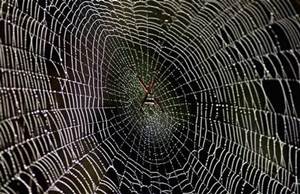
"'...think of the countless world lines intermeshed throughout the continuum as a spiderweb. A touch on one strand trembles through many. A disruption somewhere changes the configuration of the whole.'" (The Shield Of Time, p. 135)

But spiderwebs are very fragile. Thus, another comparison is also used:

"'...it's rather as if the continuum were a mesh of tough rubber bands. It isn't easy to distort it; the tendency is always for it to snap back to its, uh, "former" shape.'" (Time Patrol, p. 15)

"'World lines, our tracks through space-time. They're like a mesh of tough rubber bands, right? Pull on them and they'll try to spring back to their proper, uh, configuration.'" (The Shield Of Time, p. 31)

The phrase, "...tracks through space-time...," is misleading. We do not move along the fourth dimension, leaving a track behind us, nor is there already a track laid out for us to move along. Rather, if this "space-time" model is valid, then we simply extend in that direction. (I would say that we endure through time and leave it at that.)

A completely different image is that of a river whose course can be diverted although again not easily. (The Shield Of Time, p. 399) Shaken by her experience of the divergent alpha and beta timelines, Wanda uses a fourth, more abstract, image:

"'...if there is nothing out there, no firm reality, only a mathematical shadow show that for all we can tell keeps changing and changing and changing, with us not even dreams within it -'" (ibid., p. 433)

Hold on there, Wanda. Let's differentiate between:

something that is not even a dream (what is it, then?);
dreams;
dreamers;
waking experiences.

We are at least dreamers because we seem to ourselves to be experiencing something. But we can classify some of our experiences as "dreams" only because we are able to contrast them with the shared experience of the stabler environment that is perceived in what by consensus we call waking experience. Thus, it would not make any literal sense to ask if all our experiences might be dreams, although this is a powerful metaphor -

Lewis Carroll: "Life, what is it but a dream?" See here.

Buddhism:
"Thus shall ye think of all this fleeting world:
"A star at dawn, a bubble in a stream,
"A child's laugh, a phantasm, a dream." See here.

Could reality be changing continually without our knowing? If it did, then all our memories and records would have to be changing consistently with it. Otherwise, we would notice. So we only need to concern ourselves about the world that we seem to be living in right now. In a new season of a TV series, a familiar character might be played by a different actor. We have to accept that other characters' memories plus any photographs or other records have changed accordingly. Only we, looking into that fictional world from entirely outside it, notice the difference. Might someone looking into our universe notice such differences? Could my memories of what I think I was doing this afternoon have been inputted to my brain only a moment ago? When I remember, I do not seem to be consulting a present record of past events. It seems to me that I have direct knowledge of my own past experiences and actions. But that is how it seems.

The Danellian who reassures Wanda uses yet another image:

"'Think, if you wish, of diffraction, waves reinforcing here and cancelling there to make rainbow rings. It is incessant, but normally on the human level it is imperceptible.'" (ibid., p. 434)

Rainbow rings seem much more positive than a shadow show. Everard had already though of reality as:

"...a spectral flickering, diffraction rings across abstract, unstable space-time, a manifold brightness..." (Time Patrol, p. 480)

Some of the language used sounds beautiful rather than threatening. Do the Danellians perceive the incessant diffraction that is normally imperceptible on the human level?

"'I will come to you on the rainbow,' Niaerdh plighted.
"So it was. So it is." (ibid., p. 469)

Sunday, 12 June 2016

The Wisdom Of Hadding

(There are more covers of The Broken Sword than of War Of The Gods on the internet.)

I hope that readers of these posts also read the comments. Recently we have discussed the Bible and the Paris Commune. We start with Poul Anderson but from there we can go anywhere. The sky is the limit. And we need more points of view.

Hadding says:

"'...what I've seen in my life whispers to me that sometimes the gods themselves must go by strange roads toward ends that are unknown to men.'"
-Poul Anderson, War Of The Gods (Tor Books, New York, 1999), p. 152.

He senses this partly because he is himself an incarnated god without yet realizing it. I think that what he says reflects the processes of spiritual growth. We learn by sometimes taking wrong roads.

"'We cannot let the harm done to a goodly folk like the Niderings go unavenged. Otherwise lawlessness will spread like wildfire, along with trollery and everything else unhuman. Could this be why the gods hold back their help?'" (p. 153)

The gods do not help us because we must help each other? Or because they are not there? Either way, theists and atheists must agree on practical measures for the good of society. In Ys, Rufinus worked for Gratillonius who cooperated with Corentinus. In the twentieth century, a Jain taught Gandhi who inspired Martin Luther King.

"Softly Thorfinn voiced the words of old.

"Kine die, kinfolk die,
"And so at last oneself.
"This I know that never dies:
"How dead men's deeds are deemed.

"'True,' said Hadding." (p. 161)

That is a good verse but I think that its second line is redundant. I imagine that, at some multi-faith gathering, I am invited to contribute short readings or recitations to express traditions with which I have some sympathy.

For Norse Paganism:

"Nine worlds I knew, the nine that are in the Tree..."
Then the above minus line 2.

For materialist philosophy:

"Nothing is eternal but eternally changing, eternally moving matter and the laws according to which it moves and changes."

For Buddhism:

"Thus shall ye think of all this fleeting world:
"A bubble in a stream,
"A child's laugh, a phantasm, a dream."

For the Bible:

"I said, "Ye are gods.'"

For Hinduism:

something from the Gita on karma yoga.

Addendum - For Mithraism:

"Tene Mithra, etiam miles, fidos nostris votis nos." (See here.)

Monday, 28 July 2014

"Not Even Dreams"?

"We are such stuff as dreams are made on..."

"Life, what is it but a dream?"

"Thus shall ye think of all this fleeting world:
"A bubble in a stream,
"A child's laugh, a phantasm, a dream."

Wanda Tamberly goes further:

"'If everything is random and causeless - if there is nothing out there, no firm reality, only a mathematical shadow show that for all we can tell keeps changing and changing and changing, with us not even dreams within it -'"
-Poul Anderson, The Shield Of Time (New York, 1991), p. 433.

Not even dreams? We are more than dreams. We are at least dreamers.

I think that there is a gap in our vocabulary. When someone is asleep, we say that he is unconscious and he is indeed not conscious of us or of his surroundings. However, dreams are sleeping experiences sometimes remembered when awake so we are "conscious" or "aware" of them when they happen? We experience them and I regard "to experience..." and "to be conscious of..." as synonyms.

An experience can be called "a dream" only if it is fleeting and is contrasted with something longer lasting before and after it. Thus, Shakespeare's:

"We are such stuff as dreams are made on
"And our little life is rounded with a sleep..."

- is apt because we are not conscious of anything before our births or (I believe) after our deaths yet we have evidence that the universe existed for a very long time before us and will continue to exist for a very long time after us. But to call the entire universe "a dream" would be meaningless because there would be nothing longer lasting to contrast it with.

(If I dream of meeting Hamlet, then I do not believe that the Hamlet in my dream is conscious of meeting me! - but, in the "dream" of life, the other "dreamers" are as conscious as I am.)

Thursday, 18 February 2021

The Mask Of Emptiness

A Knight Of Ghosts And Shadows, VII.

This blog follows Poul Anderson's texts wherever they take us. This can be into philosophy where, of course, we will disagree.

The agnostic prayer is addressed to whom it may concern, to whatever gods may be. Dominic Flandry goes one step further by formulating an atheist prayer, explicitly denying the reality of the Addressee:

"O God Who is also unreal, a mask we put on emptiness, be gentle to her. She has been hurt so much." (p. 432)

This prayer is perhaps Buddhist in three senses:

it is non-theistic;
it expresses compassion;
"emptiness" is the most fundamental category in Buddhist ontology.
 
"Emptiness" means that everything that seems to be single and substantial is really composite and transient. There is no immortal soul either in the world or in any individual psychophysical organism. The world is a beginningless, endless causal sequence. Each of its parts is an interaction between all its other parts. A human being is a temporary coming together of a set of physical and mental properties.

I think that those properties are caused by heredity, not by rebirth. Ancient teachings should be synthesized with modern scientific knowledge.

I have quoted the Buddhist verse:
 
"Thus shall ye think of all this fleeting world..."

- in four previous posts. See here.

Friday, 22 December 2017

Ways

SM Stirling's Empress of Japan says that her people follow the Way of the Gods and honor the Way of the Buddha. An admirable arrangement.

In Buddhist mythology, gods rise and fall while the Buddha Dharma endures. In reality, I suggest, religions change while the issues addressed by meditation remain.

Poul and Karen Anderson's last King of Ys lives through a major transition when the Olympians, the Ysan Triad and his own former deity, Mithras, withdraw before the new God of the Piscean Age.

Poul Anderson's time travelers and immortals see gods come and go. The oldest immortal, Hanno, expediently converts to Christianity, then outlives that religion.

Meditational and science fictional perspectives converge:

"Thus shall ye think of all this fleeting world:
"A star at dawn, a bubble in a stream,
"A child's laugh, a phantasm, a dream." (See here.)