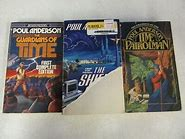
Thursday, 21 July 2022

Food And History

"Ivory, and Apes, and Peacocks."

Manse Everard, and every other Time Patrol agent, cannot be vaccinated against every disease in history:

"...vaccinations against every disease that came and went through the ages would long since have overloaded his immune system.)" (p. 310)

So how do they survive through long periods in previous centuries?

"(...Without the gene-tailored protective microbes the Patrol medics had implanted in him, he'd never have dared touch local [food] that wasn't cooked dead." (ibid.)

That is one of the many details that I had not remembered from previous readings.

The Exaltationists threaten to destroy Tyre with explosives during Hiram's reign. In case they succeed, Epsilon Korten advocates:

"'...let us establish a strong standby - personnel, organization, plans - in Jerusalem, ready to minimize the effects there. The less that Solomon's kingdom suffers, the less powerful the change vortex will be. That should give us more likelihood of damping it out altogether." (pp. 308-309)

Thus, neither Biblical scholars nor archaeologists in later centuries will suspect that Tyre was destroyed during Solomon's reign? Chaim Zorach says that Korten is:

"'...playing fast and loose with history.'" (p. 309)

I suggest that he is tearing it up by its roots.

The Director Of Jerusalem Base

"Ivory, and Apes, and Peacocks."

Epsilon Korten, director of Jerusalem Base, is:

"...responsible for temporal activities throughout the Hebrew lands, between the birth of David and the fall of Judah." (p. 307)

The Jerusalem office of a company or other organization is a place where a man can work as director for a period of time. At the end of that period, he will be succeeded by another director. No one knows how long that office will be in Jerusalem or how many directors it will have.

However, the Hebrew lands from the birth of David to the fall of Judah is both a place and a period of time. Korten must direct the Base for that entire period of time and will not have a successor in that Base for that period of time. Thus, when Korten's career as director of Jerusalem Base is completed, the entire involvement of the Time Patrol with that Base is also completed. The Patrol deals with finite periods of time. With their extended lifespans, Patrol agents should be able to live through those periods. Everard's modern milieu extended only from 1850 until 2000 and its three Headquarters existed only from 1890 until 1910. The Patrol's task begins to seem manageable.

More About Religion

"Ivory, and Apes, and Peacocks."

In the temple of Asherat, men stroll past women on stools. Some women make gestures of invitation. Of the men, Everard notices that:

"Their deportment was reasonably polite; it was a church here." (p. 269)

Prostitution in a church? I had the same thought as Everard - "This is the equivalent of a church" - when I visited the largest Jain Temple in the Western Hemisphere in Leicester, England. There was a side chapel for every Jain sect and, in one chapel, a life-sized male nude statue. A far cry from the Virgin Mary... In India, a temple of Hanuman is a monkey zoo.

What constitutes respect or disrespect to the Lord is entirely a matter of which tradition we are practising in. Someone whose previous experience of Buddhism had been Pure Land was shocked when she entered our Zen meditation hall to see people sitting with their backs to the Buddha: the height of disrespect.

I would not attempt to meditate in the temple of Asherat.

In Tyre

"Ivory, and Apes, and Peacocks."

In 950 BC:

"...Everard displayed some small ingots of bronze. Coinage would not be invented for several centuries, but the metal could be swapped for whatever he wanted." (p. 235)

"Nobody here kept journals or saved letters, nor did anybody number years in the manner of later civilizations." (p. 289)

Coins, written records and year dates are things that we take for granted when thinking about civilization. If writing a narrative to be set in 950 BC, I would not have known that none of these things had existed back then. When Everard asks King Hiram about events in his father's reign, it is difficult to find anyone still alive who remembers details.

Another difference was that people only snacked in the evenings because the dimness of lamps made it difficult to prepare a meal. It is hard to imagine how different life was back then but Time Patrolmen are used to adjusting to different eras.

Wednesday, 20 July 2022

Tyrian Gods

"Ivory, and Apes, and Peacocks."

The patron god of Tyre is Melqart, also known as Baal-Melek-Qart-Sor. His consort, Astarte, is:

goddess of fruitfulness;
a female warrior who recalled her lover from death;
a sea queen;
Ishtar in Babylon;
Aphrodite in Greece.

Their temples face each other across a square near the centre of Tyre.

There are also small temples to:

Tanith, Our Lady of the Waves, possibly an avatar of Astarte;
Baal Hammon, comparatively unimportant;
no doubt others.

With the publication of The Guardians Of Time and Time Patrolman, the Time Patrol series was complete in seven stories in two volumes. Then more was added.

If I lived in Tyre, then I would meditate at home and maybe in the temple of Tanith.

I have known Pagans to chant the names of the Goddess:

"Isis, Astarte, Diana,
"Hecate, Demeter, Kali, Inana."

Everard And Women

Everard has sex with two women in "Ivory, and Apes, and Peacocks." That is a lot for him but they are integral to the plot. To make contacts in Tyre, he visits the Temple of Asherat. Later, he accepts royal hospitality. He accepts similar hospitality in "Brave To Be A King" but not in "Delenda Est."

Everard's relationship with Cynthia Cunningham ended after she had met Keith Denison. His relationship with Janne Floris begins and ends in "Star of the Sea." He meets Wanda Tamberly in "Year of the Ransom." Their relationship begins in The Shield of Time and continues in "Death and the Knight" and they are married in SM Stirling's "A Slip in Time."

That is all. The main interest in the Time Patrol series is not on Everard's personal relationships.

The Origin Of The Time Patrol

"Time Patrol" presents a few details whereas the much later "Ivory, and Apes, and Peacocks" retreats into generalities.

"Time Patrol"
19352 AD (the 7841st year of the Morennian Triumph)
the Chorite Heresiarchy breaking up
commercial and genetic rivalry between giant combines
governments pawns in a galactic game
search for a means of instantaneous transportation
the time effect a by-product
infinitely discontinuous mathematical functions
4N dimensions (N = total number of particles in the universe)
the Nine plan to prevent their enemies from being born
the Danellians appear
the Patrol is established

"Ivory..."
long after the twentieth century
the first time machine built
the Danellian supermen arrive
they organize the Patrol

Tuesday, 19 July 2022

Climaxes II

See Climaxes.

"Ivory, and Apes, and Peacocks."

"What a help it would be to have native-born personnel! But such were very rare before the eighteenth century A.D., or still later in most parts of the world. How could a person who hadn't grown up in a scientific-industrial society even grasp the idea of automatic machinery, let alone vehicles that jumped in a blink from place to place and year to year? An occasional genius, of course; however, most identifiable geniuses carved niches for themselves in history, and you didn't tell them the facts for fear of making changes...." (p. 246)

(The Patrol prevents Sherlock Holmes from finding out about time travel during his active career but I think that they would have consulted him during his retirement.)

I quote the above passage because it plays the same role as the early passages in two Dominic Flandry novels cited in the first link above. Everard will recruit a native at the climax of "Ivory..." so the advantage of such recruitment has been highlighted near the beginning of the narrative. We might have guessed or deduced what was to come.

The Horrors That Will Come

"Ivory, and Apes, and Peacocks."

Chaim and Yael Zorach, Time Patrol agents based in Hiram's Tyre, have two children at home in Tel Aviv and visit them days apart from the children's point of view, months apart from their own. The regional recruiter is confident that the children will join the Patrol.

"If not, Everard thought, could you stand it, watching them grow old, suffer the horrors that will come, finally die, while you are still young of body?" (p. 247)

Forty one years after the publication of "Ivory..." in Time Patrolman, we have begun to suffer those horrors. This week and today: wildfires, melting roads, cancelled trains and heat deaths.

Twentieth Centurians In The Past

In Jerusalem on the first Good Friday, Jack Havig is asked:

"'Es tu peregrinator temporis?'"
-Poul Anderson, There Will Be Time (New York, 1973), VI, p. 62.

He is recognized because:

"His height was unusual in this place, and he had left his head bear to show the barbering and the Nordic features." (ibid.)

Later, Havig and Robert Anderson think of other ways to recruit time travellers in Jerusalem, like:

"...passing through the streets, singing lines from the Greek mass -'
"'And the Latin.'" (XIV, p. 153)

In Tim Powers' The Anubis Gates, a twentieth centurian in nineteenth century London hears someone whistling a familiar tune and realizes that it is Yesterday...

When Manse Everard enters the household of two Time Patrol agents in Tyre, 950 BC, their bearing, posture, gait, facial expressions and tones of voice change. He would have recognized them as from his century without being told.