Poul Anderson, Starfarers (New York, 1999).
Poul Anderson tries to reproduce a Scottish accent. "'Richt the noo?'" (p. 311) means "Right now?" Kilbirnie also addresses Nansen as "'...my jo.'" (ibid.), a Scottish term of endearment, not listed in the Wiki article but see here.
We know that a supernova briefly outshines its galaxy but Anderson writes:
"Briefly, it outshone its whole island universe." (p. 312)
Because it was originally thought that our galaxy was the whole universe, when other galaxies were postulated, they were initially called "island universes."
In Starfarers, a blue giant star had gone supernova, blasting out nickel, copper, silver, tin, gold, uranium etc, vaporizing any planets that it may have had and leaving a remnant of ten Solar masses that collapsed without limit, leaving a sphere 185 kilometers in circumference containing a point-like singularity. The collapsed star retains a fast spin, a strong magnetic field, a slight electric charge and a powerful gravitational field.
Occasionally, instead of two virtual particles mutually annihilating, one falls into the black hole while the other escapes. Atoms and dust accelerating inwards collide, generating photons and an accretion disk "...gyring about the black hole..." (p. 313) and at last falling into it whereas matter pulled to the magnetic poles is beamed outward. The accretion disk, visible as a small, flickering, blue-white ring, has clashing waves, flung flares, flaming coils, magnetic convulsions and unforeseeable chaos.
(Lower image, from Hubble space telescope, is possibly gas accreting round a black hole in elliptical galaxy, NGC 4261.)
Saturday, 23 May 2015
Starfarers
Is anyone out there becoming tired of Starfarers? I am not. Each of these posts is a very brief comment on a very short section of an extremely dense and rich text that addresses:
modern physics and cosmogony;
a neutron star, a black hole and a recurrent nova (that last I had never heard of before);
the ultimate effects of technology on society;
cosmic life and alien intelligence;
personal interactions and relationships;
language and communication;
the cosmic role of intelligence.
I find Sean M. Brooks' division of Poul Anderson's career into three phases helpful and illuminating:
the Psychotechnic History, an early phase series, was abandoned because science had moved on and the author's views had changed;
the Technic History and the Time Patrol are mature works of the middle period;
The Boat Of A Million Years closes the middle period and opens the later period;
the Harvest of Stars Tetralogy, Starfarers and Genesis are later period future histories addressing new themes and very different from the already mature works of the middle period.
There remains a great deal more to be said about Starfarers.
modern physics and cosmogony;
a neutron star, a black hole and a recurrent nova (that last I had never heard of before);
the ultimate effects of technology on society;
cosmic life and alien intelligence;
personal interactions and relationships;
language and communication;
the cosmic role of intelligence.
I find Sean M. Brooks' division of Poul Anderson's career into three phases helpful and illuminating:
the Psychotechnic History, an early phase series, was abandoned because science had moved on and the author's views had changed;
the Technic History and the Time Patrol are mature works of the middle period;
The Boat Of A Million Years closes the middle period and opens the later period;
the Harvest of Stars Tetralogy, Starfarers and Genesis are later period future histories addressing new themes and very different from the already mature works of the middle period.
There remains a great deal more to be said about Starfarers.
Friday, 22 May 2015
Some Vocab
Poul Anderson, Starfarers (New York, 1999).
(i) "...en..." (p. 273) is the personal pronoun invented by the human explorers for use between themselves when referring to one of the single-sex Tahirians. I do not know whether it had any previous significance.
(ii) "...Cambiante..." (p. 240), the artificial language invented for human-Tahirian communication, is not spoken but displayed on the screens of hand-held "parleurs," also specially invented for this purpose (ibid.)
(iii) "...a sort of ramada where parties could gather..." (p. 281)
(iv) "He flicked a thumb at the culinator." (p. 289)
(v) Ruszek addresses a Tahirian as "'...baratom.'" (p. 282)
(vi) "'...what can I say that has not been said among us a lakh of times?'" (p. 299)
(vii) Years ago, the Admissions Tutor at the University of Manchester Institute of Science and Technology (UMIST) told a group of Careers Advisers, including myself, that potential students had to speak the language of mathematics and obey the laws of physics. The Tahirians obey these laws but express them differently:
"'The basic quantities of their dynamics are not mass, length, and time, but energy, electric charge, and space-time interval.'" (p. 272)
It sounds as if they have proceeded more directly to a theoretical understanding that human beings have had to discover.
(You thought that I was going to end May with a round number of posts, 80, and the first five months of 2015 with 500, didn't you?)
(i) "...en..." (p. 273) is the personal pronoun invented by the human explorers for use between themselves when referring to one of the single-sex Tahirians. I do not know whether it had any previous significance.
(ii) "...Cambiante..." (p. 240), the artificial language invented for human-Tahirian communication, is not spoken but displayed on the screens of hand-held "parleurs," also specially invented for this purpose (ibid.)
(iii) "...a sort of ramada where parties could gather..." (p. 281)
(iv) "He flicked a thumb at the culinator." (p. 289)
(v) Ruszek addresses a Tahirian as "'...baratom.'" (p. 282)
(vi) "'...what can I say that has not been said among us a lakh of times?'" (p. 299)
(vii) Years ago, the Admissions Tutor at the University of Manchester Institute of Science and Technology (UMIST) told a group of Careers Advisers, including myself, that potential students had to speak the language of mathematics and obey the laws of physics. The Tahirians obey these laws but express them differently:
"'The basic quantities of their dynamics are not mass, length, and time, but energy, electric charge, and space-time interval.'" (p. 272)
It sounds as if they have proceeded more directly to a theoretical understanding that human beings have had to discover.
(You thought that I was going to end May with a round number of posts, 80, and the first five months of 2015 with 500, didn't you?)
The Unknown
Poul Anderson, Starfarers (New York, 1999).
Pp. 274-277 present a frequent Poul Anderson scenario:
two characters explore an exposed planetary core left by a supernova;
such an environment is entirely unknown, hence the need to explore it;
however, the explorers are confident that there is no immediate danger;
despite their confidence, a sudden land quake opens a crevice that one of the explorers falls into;
however, her companion improvises a rope to pull her out.
I have de-emphasized the particularities of this incident in order to highlight its parallels with many similar occurrences in Anderson's works. The message is always clear: the mere fact that a new environment is mostly unknown means that many of its dangers to human beings are among the unknown features but there is only one way to learn what they are. Explorers, like entrepreneurs, take calculated risks.
I agree with this and suggest further that curiosity will outlast gain as a motive for exploration. Observing the Tahirians' planet-transforming technology at work, Cleland comments:
"'...any, uh, profit motive is irrelevant, when self-maintaining, self-reproducing robots do the work.'" (p. 233)
We understand that the Tahirians use their awesome machines merely to maintain their static civilization for millions of years but (at least some) human beings will always look outward, to "see another mountain."
Pp. 274-277 present a frequent Poul Anderson scenario:
two characters explore an exposed planetary core left by a supernova;
such an environment is entirely unknown, hence the need to explore it;
however, the explorers are confident that there is no immediate danger;
despite their confidence, a sudden land quake opens a crevice that one of the explorers falls into;
however, her companion improvises a rope to pull her out.
I have de-emphasized the particularities of this incident in order to highlight its parallels with many similar occurrences in Anderson's works. The message is always clear: the mere fact that a new environment is mostly unknown means that many of its dangers to human beings are among the unknown features but there is only one way to learn what they are. Explorers, like entrepreneurs, take calculated risks.
I agree with this and suggest further that curiosity will outlast gain as a motive for exploration. Observing the Tahirians' planet-transforming technology at work, Cleland comments:
"'...any, uh, profit motive is irrelevant, when self-maintaining, self-reproducing robots do the work.'" (p. 233)
We understand that the Tahirians use their awesome machines merely to maintain their static civilization for millions of years but (at least some) human beings will always look outward, to "see another mountain."
Mysteries In Space
Poul Anderson, Starfarers (New York, 1999).
In both the Technic History and the Hoka series (see also here), there is a planet so massive that its core survives its sun going supernova. In Starfarers also, a supernova-surviving planetary core is discovered, although this one is neither coated with supermetals nor inhabited. The mysteries surrounding the third core are:
Why does it display "'...rifts, grabens, highlands...'" (p. 264) instead of a smooth surface?
Did it acquire its atmosphere and ice from outgassing, from cometary impacts, from the supernova cloud or from some other process?
For me, another mystery comes when a Tahirian tells Captain Nansen:
"'Most of us would have kept knowledge of the black hole from you, for fear of what reckless things you may do.'" (p. 265)
And Nansen reflects, "Inevitable that that incident became known..." (ibid.)
What black hole and what incident? I am rereading the book very carefully but the text is so dense and information-packed that I have obviously missed something.
Addendum, 22 May: The black hole was introduced on p. 254.
In both the Technic History and the Hoka series (see also here), there is a planet so massive that its core survives its sun going supernova. In Starfarers also, a supernova-surviving planetary core is discovered, although this one is neither coated with supermetals nor inhabited. The mysteries surrounding the third core are:
Why does it display "'...rifts, grabens, highlands...'" (p. 264) instead of a smooth surface?
Did it acquire its atmosphere and ice from outgassing, from cometary impacts, from the supernova cloud or from some other process?
For me, another mystery comes when a Tahirian tells Captain Nansen:
"'Most of us would have kept knowledge of the black hole from you, for fear of what reckless things you may do.'" (p. 265)
And Nansen reflects, "Inevitable that that incident became known..." (ibid.)
What black hole and what incident? I am rereading the book very carefully but the text is so dense and information-packed that I have obviously missed something.
Addendum, 22 May: The black hole was introduced on p. 254.
Thursday, 21 May 2015
The Pulsar
Poul Anderson, Starfarers (New York, 1999).
"'One millionth Solar luminosity...shining from a body ten kilometers in diameter...'" (p. 260), therefore 19,000 times as intense in the visible spectrum, more in others;
the remnant of a supernova;
a mass of nearly one and a half Sols;
so small and dense that it is no longer atoms but only neutrons, possibly with some of those subatomic particles fused into hyperons at the center;
an atmosphere only a few centimeters deep, possibly of incandescent gaseous iron;
hundreds of spins per second;
a magnetic field that accelerates interstellar matter outward at near light speed;
a radio beacon detectable across the galaxy;
God speaking to Job out of the whirlwind - in the imagination of some human visitors.
As in Tau Zero, Anderson moves effortlessly between cosmic physics and questions of human existence.
"'One millionth Solar luminosity...shining from a body ten kilometers in diameter...'" (p. 260), therefore 19,000 times as intense in the visible spectrum, more in others;
the remnant of a supernova;
a mass of nearly one and a half Sols;
so small and dense that it is no longer atoms but only neutrons, possibly with some of those subatomic particles fused into hyperons at the center;
an atmosphere only a few centimeters deep, possibly of incandescent gaseous iron;
hundreds of spins per second;
a magnetic field that accelerates interstellar matter outward at near light speed;
a radio beacon detectable across the galaxy;
God speaking to Job out of the whirlwind - in the imagination of some human visitors.
As in Tau Zero, Anderson moves effortlessly between cosmic physics and questions of human existence.
A False Dichotomy?
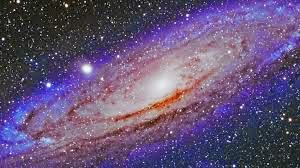
(The Andromeda with two satellite galaxies.)
Poul Anderson, Starfarers (New York, 1999).
Does any other author write texts that generate apparently endless discussion?
Yu and Sundaram discuss Tahirian society. Sundaram says:
"'...I do not think that we can properly call this a conservative society, like old China or old India. That is too weak a word. I think it is posthistoric. It has renounced change in favor of a stable order that apparently provides universal peace, plenty, and justice.'" (p. 258)
(Francis Fukuyama argued that history had ended because the Soviet Union had fallen? "Don't speak too soon because the wheel's still in spin and there's no tellin' who that it's namin'!" This seems like impressionistic history, thinking that the most recent significant change must also be the last such change or like thinking that the nearest telegraph pole is the biggest.)
In any case, surely Sundaram sets up a false dichotomy? I look forward to a human future of peace, plenty, justice and change. Change is fundamental to reality and humanity and is compatible with either peace or justice. Nor it is incompatible with plenty when the technology to produce plenty has been produced. Yu speculates that Tahirian society as described by Sundaram would not be tragic:
"'The riches and beauty of the world, the treasures of the past...'" (p. 259) are new to each generation;
one lifetime is never long enough to appreciate them all;
new artistic creations are always possible even if in "'Ancient, fixed modes...'" (ibid.)
But why should the modes be fixed? I accept that, within the fiction, the Tahirians have fixed them but why should we have to make the same choice as them? - which is the real issue here.
Poul Anderson, Starfarers (New York, 1999).
Does any other author write texts that generate apparently endless discussion?
Yu and Sundaram discuss Tahirian society. Sundaram says:
"'...I do not think that we can properly call this a conservative society, like old China or old India. That is too weak a word. I think it is posthistoric. It has renounced change in favor of a stable order that apparently provides universal peace, plenty, and justice.'" (p. 258)
(Francis Fukuyama argued that history had ended because the Soviet Union had fallen? "Don't speak too soon because the wheel's still in spin and there's no tellin' who that it's namin'!" This seems like impressionistic history, thinking that the most recent significant change must also be the last such change or like thinking that the nearest telegraph pole is the biggest.)
In any case, surely Sundaram sets up a false dichotomy? I look forward to a human future of peace, plenty, justice and change. Change is fundamental to reality and humanity and is compatible with either peace or justice. Nor it is incompatible with plenty when the technology to produce plenty has been produced. Yu speculates that Tahirian society as described by Sundaram would not be tragic:
"'The riches and beauty of the world, the treasures of the past...'" (p. 259) are new to each generation;
one lifetime is never long enough to appreciate them all;
new artistic creations are always possible even if in "'Ancient, fixed modes...'" (ibid.)
But why should the modes be fixed? I accept that, within the fiction, the Tahirians have fixed them but why should we have to make the same choice as them? - which is the real issue here.
Connotations
Poul Anderson, Starfarers (New York, 1999).
"...the vocabulary, both written and connotative." (p. 253)
I googled "connotative" but it turned out to be the adjective from the noun "connotation," which I do understand. The denotation of "Pope" is the present incumbent whereas the connotation is an entire institution and tradition in the Roman Church and that in turn has different connotations for each person who hears or reads the word. "Who or what is the Pope?" and "What does this phrase, 'the Pope' mean for you?" are entirely different questions.
It would surely be impossible, as Anderson's text suggests, to compile a dictionary not only of denotations but also of connotations? However, Anderson is to be commended because, in The Boat Of A Million Years and in Starfarers, he conveys the difficulty of establishing communication with alien intelligences. The Tahirians use body language so that, for them, vocable are mere signals, such as alarm cries, not words. A common language must be invented and articulated in symbols displayed on hand-held screens. The human explorers are with the Tahirians for over two years before we begin to be told some of the content of a halting conversation.
The Tahirians possibly see individual photons and think more naturally in quantum mechanics. Separate evolution and different kinds of experience generate qualitatively different minds.
"...the vocabulary, both written and connotative." (p. 253)
I googled "connotative" but it turned out to be the adjective from the noun "connotation," which I do understand. The denotation of "Pope" is the present incumbent whereas the connotation is an entire institution and tradition in the Roman Church and that in turn has different connotations for each person who hears or reads the word. "Who or what is the Pope?" and "What does this phrase, 'the Pope' mean for you?" are entirely different questions.
It would surely be impossible, as Anderson's text suggests, to compile a dictionary not only of denotations but also of connotations? However, Anderson is to be commended because, in The Boat Of A Million Years and in Starfarers, he conveys the difficulty of establishing communication with alien intelligences. The Tahirians use body language so that, for them, vocable are mere signals, such as alarm cries, not words. A common language must be invented and articulated in symbols displayed on hand-held screens. The human explorers are with the Tahirians for over two years before we begin to be told some of the content of a halting conversation.
The Tahirians possibly see individual photons and think more naturally in quantum mechanics. Separate evolution and different kinds of experience generate qualitatively different minds.
Sex And Gender
Poul Anderson, Starfarers (New York, 1999).
Tahirians copulate by kissing and both become pregnant. This is a genuinely different reproductive system, far more imaginative than the Jovian male/demi-male/female trisexuality in Anderson's Three Worlds To Conquer or the bi-species trisexuality of Larry Niven's Puppeteers.
Olaf Stapledon's Neptunian observer tells us, through Stapledon, that his species, the Last Men, have many sexes but does not elaborate. CS Lewis imagined immortal space-dwelling beings, the eldila, with no sex but seven genders. Thus, personality types or genders (masculine: active; feminine: passive; others:?) are separated from reproductive functions and then increased in number. I used to argue at school that God was not male but nevertheless masculine (active, creative) but other pupils did not understand this distinction. I still understand it but am no longer sure that I buy into it.
Lewis mysteriously refers only once to these seven genders. However, this author created something entirely unique, two very different and equally imaginative fictional restatements of Christianity: Narnia and Ransom. Although Lewis' anti-Wellsian theological sf is unique, Anderson touches on the same themes in "The Problem of Pain" and The Game Of Empire. Thus, this line of thought has taken us from Starfarers via Three Worlds To Conquer, Niven, Stapledon and Lewis to Anderson's Technic History.
Tahirians copulate by kissing and both become pregnant. This is a genuinely different reproductive system, far more imaginative than the Jovian male/demi-male/female trisexuality in Anderson's Three Worlds To Conquer or the bi-species trisexuality of Larry Niven's Puppeteers.
Olaf Stapledon's Neptunian observer tells us, through Stapledon, that his species, the Last Men, have many sexes but does not elaborate. CS Lewis imagined immortal space-dwelling beings, the eldila, with no sex but seven genders. Thus, personality types or genders (masculine: active; feminine: passive; others:?) are separated from reproductive functions and then increased in number. I used to argue at school that God was not male but nevertheless masculine (active, creative) but other pupils did not understand this distinction. I still understand it but am no longer sure that I buy into it.
Lewis mysteriously refers only once to these seven genders. However, this author created something entirely unique, two very different and equally imaginative fictional restatements of Christianity: Narnia and Ransom. Although Lewis' anti-Wellsian theological sf is unique, Anderson touches on the same themes in "The Problem of Pain" and The Game Of Empire. Thus, this line of thought has taken us from Starfarers via Three Worlds To Conquer, Niven, Stapledon and Lewis to Anderson's Technic History.
Basic Motivations
Poul Anderson, Starfarers (New York, 1999).
Sundaram discusses the basic motivations for human activities. The activities that he cites are science and exploration although, of course, everyday activities must be accounted for first. The most fundamental activity is survival, staying alive, earning a living. Americans call this "making a buck" - although there was a long period before "bucks"/money existed. Further, technology promises, and Anderson in several works shows that there can be, an even longer post-money period.
The two basic motivations identified by Sundaram are "...hope of gain..." and "...to make sense of the universe..." (p. 241). Here, Sundaram makes the common mistake of assuming that his own social situation is the most fundamental. Only when people have filled their bellies are they able to look around them for either gain or sense. How we earn a living continues to affect everything else. When hunting and gathering were replaced by herding and growing, it then became possible for some men to own not only herds but also slaves to tend the herds. Social relationships and consequently also ideas and values had changed. Slavery, previously inconceivable, now seemed natural.
Sundaram's examples of gain are wealth, power, fame, freedom and security. He observes that making sense was originally expressed in myth and religion. To these have been added art, philosophy and science. The Tahirians have the same motivations but in different degrees and more for the group. The aliens in Anderson's The Byworlder practiced science and exploration more for aesthetics than for curiosity.
Sundaram discusses the basic motivations for human activities. The activities that he cites are science and exploration although, of course, everyday activities must be accounted for first. The most fundamental activity is survival, staying alive, earning a living. Americans call this "making a buck" - although there was a long period before "bucks"/money existed. Further, technology promises, and Anderson in several works shows that there can be, an even longer post-money period.
The two basic motivations identified by Sundaram are "...hope of gain..." and "...to make sense of the universe..." (p. 241). Here, Sundaram makes the common mistake of assuming that his own social situation is the most fundamental. Only when people have filled their bellies are they able to look around them for either gain or sense. How we earn a living continues to affect everything else. When hunting and gathering were replaced by herding and growing, it then became possible for some men to own not only herds but also slaves to tend the herds. Social relationships and consequently also ideas and values had changed. Slavery, previously inconceivable, now seemed natural.
Sundaram's examples of gain are wealth, power, fame, freedom and security. He observes that making sense was originally expressed in myth and religion. To these have been added art, philosophy and science. The Tahirians have the same motivations but in different degrees and more for the group. The aliens in Anderson's The Byworlder practiced science and exploration more for aesthetics than for curiosity.
Subscribe to:
Posts (Atom)