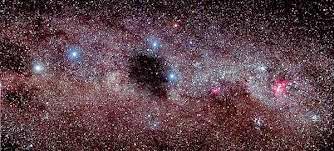
(The (spherical) Black Nebula is not the Horsehead Nebula but the latter comes up in google searches for "dark nebulae" so let's appreciate it here.)
Takahashi theorizes that Arzunian life can control mass-energy because it is linked to atomic probabilities but does not discuss the source of the energy for this control. However, Donovan, who has had more contact with the Arzunians, suggests that:
Arzunian metabolisms cannot generate enough energy, e.g., to project the Arzunians themselves out into space;
so they must instinctively tap into "'...some unknown cosmic energy source...'" (Rise Of The Terran Empire, p. 425);
but they do use nervous energy to direct the flow;
so they have to rest after strenuous efforts, as he can testify.
(Everything has limits, even the fantastic feats of the Arzunians.)
This helps to explain why the Terrans can fight and win, even with the kind of primitive weapons that are more familiar to the psychokinetic Arzunians:
as stated, the Arzunians also tire after exertion;
they are a dying race, their population confined to a single city;
most will flee when attacked, unused to victims who resist;
those who do fight have a superiority complex that prevents them from taking due care in combat;
they are undisciplined, without any plan of action;
the Earthmen need not defeat the entire planet but merely fight their way to the captured spaceships and escape in one.
With all this rationale to fall back on, Anderson writes some good fight scenes. In particular, the quadrupedal Donarrian, ridden by the Terran commander, wreaks havoc but succumbs to a spear wound and stays to finish the fight while the spaceship leaves.
After resisting the Arzunian allure, Donovan cannot maintain his hostility to Sol.
Showing posts with label "Sargasso of Lost Starships" by Poul Anderson. Show all posts
Wednesday, 5 November 2014
Psychic Powers
Arzunian animals also have telekinetic and hyperspatial powers. (Is hyperspatial teleportation auto-telekinesis?) Intelligent Arzunians have more highly developed powers. There must be some reason why evolution took this course on Arzun and nowhere else. Perhaps a very improbable mutation was so successful that every surviving organism is descended from it?
Takahashi's theory of the powers is that Arzunian life is linked to the primary atomic probabilities or psi functions determining the spatiotemporal continuous-field distribution of matter-energy. Thus, conscious control of matter-energy through the unified field of space-time, just as some human beings can control dice. So an Arzunian controls probability? By conscious will, he increases the probability that:
an object will rise from the ground;
a missile aimed towards him will swerve away from him;
he himself will make a series of quantum jumps onto a planet at the edge of the nebula or into an approaching spaceship?
A Marvel Comics superheroine, the Scarlet Witch, has some such power. If Washington is under attack, then she increases the probability that the molecules of the incoming missiles will be transformed into those of harmless objects like flowers. Or something. It sounds improbable - but then it is meant to be.
Swords And Spaceships
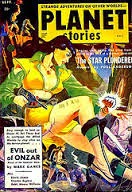
Pulp magazines had spacemen with swords on their covers. Poul Anderson rationalized that. Dominic Flandry of the Terran Empire can use a sword because his decadent civilization cultivates deliberate archaisms like scientific fencing. In a sword fight, Flandry's telepathic opponent, Aycharaych, has no advantage because fencing moves are drilled reflexes.
The Arzunians carry swords and spears because their telekinesis prevented them from developing mechanics and they are simply uninterested in science. Guns against swords sounds like an easy fight. However, telekinesis enables the Arzunians to deflect missiles or blaster shots unless they are distracted. They have caused a spaceship to crash on their planet and should now be able to dispose of its crew. However, knowing all this, the Earthmen use their blaster flames to forge swords, axes and spears from the scattered plastic and metal of their wrecked ship.
Thus, some of those old pulp covers can make sense after all!
Tuesday, 4 November 2014
Jansky, Valduma And Morzach
In a story originally published in Planet Stories, Poul Anderson describes characters who belong on the cover of that magazine. Commander Helena Jansky is young and tall in blue uniform and red cloak with shoulder-length black hair and one hand near her sidearm.
"She swept on, her cloak a scarlet wing flapping behind her."
-Poul Anderson, Rise Of The Terran Empire (New York, 2011), p. 390.
Because she serves the Solar Empire, her family has recently been ennobled so that she is the Lady Jansky of Torgandale on Valor. When an Ansan earl taunts her that her grandfather was a dirt farmer, she replies proudly that he was an atomjack. Aristocracy is a social symbol but it is technology that counts.
Valduma the alien is tall with long red hair, black cape, ivory-white skin and oblique green eyes. Her male companion, Morzach, is tall, gaunt, black-caped, classically beautiful and armed with a sword. Does the sword make sense on a spaceship? Yes, since he is using psychic powers to intimidate the crew, an archaic weapon is an important part of his image.
(There was a Star Trek like this. The Enterprise crew found a Halloween castle on a planet just outside the galaxy?)
When Poul Anderson wrote for pulp magazines, he carefully created appropriate prose.
Addendum, 5 Nov 2014: For a discussion of "Anderson's PLANET STORIES Tales by Sean M Brooks," see here.
Deductions About A Planet
The Imperial Solar spaceship, HM Ganymede, remotely controlled by aliens, crashes on a planet in the Black Nebula. Approaching the planet, it is possible to see that its star is an old, burnt-out dwarf. Since planets form at an early stage of stellar evolution, it follows that the planet also is old. On the surface, rocks, vitrified when the star exploded before its collapse, are almost completely eroded, a process that takes millions of years. It follows that rotation has slowed, therefore that the night will be long and cold.
However, there is still a breathable albeit thin atmosphere, frozen water and vegetation. These can have survived only with artificial help. Therefore, the planet is inhabited - by the aliens that wrecked the ship.
Additional information provided by Donovan, who has had previous contact with the aliens:
the star is near the center of the nebula in a hollow where the dust is too thin to force the planet into the star. Further, the star shares the nebula's velocity and therefore remains in the hollow.
Quite an exotic setting, like many others imagined by Poul Anderson, such as the Sky Cave and the Cloud Universe, both encountered in later periods of the Technic History.
Where Is The Black Nebula?
In Poul Anderson's History of Technic Civilization, the author writes the introductions that are fictitiously written by:
Francis L Minamoto;
Hloch of the Stormgate Choth;
Vance Hall;
Noah Arkwright;
Le Matelot;
Urwain the Wide-Faring;
Donvar Ayeghen, President of the Galactic Archaeological Society.
(Have I missed any?)
In Baen Books' The Technic Civilization Saga, the first complete uniform edition of the Technic History, editor/compiler Hank Davis writes the one new introduction that is fictitiously written by Michael Karageorge, a contemporary of Donvar Ayeghen.
Karageorge writes that the few clues as to the location of the Black Nebula use names of stars that fell into disuse centuries previously. The story, "Sargasso of Lost Starships," informs us that the nebula is a spherical dust cloud a light year in diameter ten parsecs beyond Ansa towards Sagittari. This sounds clear enough. And Ansa, a colony planet, is still inhabited a few centuries later in Dominic Flandry's time.
However, "Ansa" is the Anglic name of a planet. We are not told the name of its star. Further, Ayeghen and Karageorge live a very long time after Flandry. Ayeghen refers to the Empire founded by Manuel Argos as "...the First Empire..." (Rise Of The Terran Empire, p.325). We know of no subsequent Empires although we do know that human beings spread further during the four or more millennia after Flandry. Daven Laure, a Ranger of the service organization called the Commonalty, reflects that:
humanity has thinly occupied parts of two or three spiral arms;
the Commonalty operates in only one civilization, where it has members on ten million planets;
other branches of humanity have distinctive ways;
there are rumors of even stranger ways.
Thus, although the Commonalty has no wars or imperialism, there could well be empires elsewhere and Ayeghen's phraseology confirms this. Sol and Old Earth are fifty light years from Ansa but two spiral arms away from Daven Laure so Karageorge, wherever/whenever he is, is probably right when he says that the Black Nebula will be difficult to locate, especially if the name of their organization, the Galactic Archaeological Society, means that Ayeghen and Karageorge belong to a civilization that is not confined to part of one spiral arm but spans the galaxy.
Monday, 3 November 2014
Sargasso Of Lost Starships, Continued
(This Planet Stories cover advertises "Sargasso of Lost Starships" (see here) as "a Black Nebula story by Poul Anderson" as though there were a series of this name.)
The Imperials are called "Terrans" more often than "Solarians." Perhaps both English words translate an Anglic term that can be used in either sense?
Helena Jansky, commanding HM Ganymede, is from Valor, one of several inhabited planets that are mentioned only once in Anderson's Technic History. Valor is Sirius A IV, the fourth planet of the brightest star in a binary or multiple system. Exercise: google Sirius.
Ansans:
"'...fought Shalmu when the greenies wanted to take what we'd built, and then we made friends with them.'"
-Poul Anderson, Rise Of The Terran Empire (New York, 2011), p. 383.
Shalmuans as aggressively acquisitive does not fit with what we know of them from a perhaps more reliable source later in the Technic History. However, the Ansans might be more than capable of misrepresenting the cause of a past war?
A nebula thought to be haunted? A whole nebula? But then the whole universe is haunted to those who perceive it as indwelt by a mysterious and awesome presence.
This nebula is a spherical dust cloud a light year in diameter ten parsecs from Ansa towards Sagittari, the least and outermost of the clouds concealing the Galactic Center. Natives of planets on the edge of the Nebula either worship it or regard it as the home of the gods. Natives of Heim sacrifice food, fur, tools etc which their gods come and take...
Terra And Sol
Two stories by Poul Anderson about Dominic Flandry defending the Terran Empire were published in 1951. Two prequels were published in 1952:
"Sargasso of Lost Starships" (Jan '52) is set in the earlier Empire;
"The Star Plunderer" (Sept '52) is set just before the founding of the Empire.
Three of these four stories were published in Planet Stories. Thus, here already is a four part future history.
Because they were published so early and so close together, "...Plunderer" and "Sargasso..." share some distinctive features not common to the rest of what became the Technic History. Terminological differences do not matter since we must understand that the dialogue read by us in English was spoken in Anglic.
In "...Plunderer," Manuel Argos says that he will proclaim "...the Empire of Sol."
-Poul Anderson, Rise Of The Terran Empire (New York, 2011), p. 357.
He addresses his followers as "'...men of Sol.'" (p. 358)
In this space opera, men no longer identify themselves as citizens of a nation or even of Earth but of the Solar System. The former government of the System is referred to as the Commonwealth and we know from other installments of the History that its full name was the Solar Commonwealth.
"Sargasso..." refers to "...blue-uniformed Solarian [not Terran] marines..." (p. 370).
Basil Donovan refers to the "'...upstart Solar Empire...'" (p. 376) and "'...the almighty Empire of Sol...'" (p. 389) and Tetsuo Takahashi, an Imperial ship's exec says:
"'Old Manuel I had the guts to proclaim himself Emperor of Sol...'" (p. 384).
Manuel did that "'...two hundred years ago...'" (ibid.), when the Commonwealth had broken up.
Thus, these two stories are already a well-integrated future history. At some stage between Takahashi and Flandry, there is a shift of emphasis so that the Empire comes to be seen as centered not on the entire Solar System but more specifically on Terra.
Sunday, 2 November 2014
Sargasso Of Lost Starships
(This does not look like the cover of a Technic History story!)
Basil Donovan is drunk in the Golden Planet - yet another colorful inn visited by a Poul Anderson character.
Donovan is an earl on the planet Ansa.
"In Mirkheim, we learn that Nicholas van Rijn likes onion soup a la Ansa, in "Sargasso of Lost Starships," we see the planet Ansa just after it had been forcibly annexed by the recently founded Terran Empire and, in The People Of The Wind, we learn that an Imperial cruiser is called Ansa."
-copied from Faces Of War.
He sees a well-dressed Terran bossing Ansan workmen clearing wreckage after a space bombardment - a clear sign that Ansa has just been incorporated by the Terran Empire. See also here.
The customers of the inn include some Shalmuans - neighbors as interstellar distances go.
Donovan's companion, Wocha, is a Donarrian.
I hope to demonstrate that this early story is well integrated into Poul Anderson's History of Technic Civilization.
The Ansa were gods.
Subscribe to:
Posts (Atom)