Showing posts sorted by relevance for query Philippe Rochefort. Sort by date Show all posts

Tuesday, 22 April 2025

Philippe Rochefort

The People Of The Wind.

Maybe Philippe Rochefort is our main man in this novel.

Rochefort successively interacts with:

his crew, both killed in battle;
Eve Davisson on Esperance;
Hrill, Draun, Arinnian and Eyath on Avalon;
Admiral Cajal in the superdreadnaught, Valenderay -

- so he could be regarded as a unifying character.

Rochefort is like Dominic Flandry except that he does not save the day for Terra. But everyone cannot do everything.

A Philippe Rochefort series is one of many hypothetical extensions of Poul Anderson's Technic History. Where does Rochefort go and what does he do after Avalon? Hloch might have told us. He writes after the Terran War but does not incorporate The People Of The Wind into his Earth Book compilation. We would have welcomed another such Editor for the second half of the Technic History.

Thursday, 6 June 2019

Philippe Rochefort II

The People Of The Wind, IV.

See:

Philippe Rochefort
A Falkayn And A Rochefort
A Mixed Colony

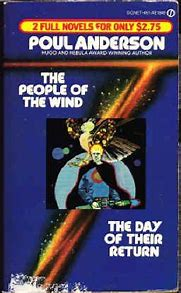
This cover image correctly shows Rochefort as brown-skinned.

Eve Davisson: "'I get an impression you disapprove of a mixed colony.'"

Rochefort: "'Well...in a way, yes... I believe in being what you are and standing by your own.'" (p.488)

How does living on the same planet as Ythrians or on the same street as immigrants contravene being what you are? Standing by your own means what? Arguing for community resources to be channeled into parts of town where there are no immigrants? (That is what some of my fellow countrymen mean by it.) I stand by own as long as my own means everyone. 

Saturday, 22 June 2019

Last Words Or Thoughts

The People Of The Wind.

Philippe Rochefort
"He recalled a girl in Fleurville and hoped he would be transferred to an Esperancian hospital when or if the cease-fire became a peace." (XVIII, p. 646)

Peace will come. A Philippe Rochefort series, if it had been written, would have told us where Rochefort went next.

Admiral Cajal
"'The peace treaty remains to be formulated,' said the drained voice. 'I can tell you in strict confidence, Governor Saracoglu has sent to the Imperium his strongest recommendation that Avalon not be annexed.'" (XVIII, p. 651)

Cajal will resign and return to Nuevo Mexico, accompanied by Luisa.

Daniel Holm
"His immediate happiness, quiet and deep, was at knowing that tonight he could go home to Rowena." (XVIII, p. 652)

Luisa Cajal to Ekrem Saracoglu
"'No doubt I'll be getting married. I think, if you don't mind, I think I'd like to name a boy for you.'" (XIX, p. 658)

Ekrem Saracoglu
"Tomorrow I must investigate the local possibilities with respect to bouncy and obliging ladies. After all, we are only middle-aged once." (XIX, p. 659)

Arinnian and Hrill
"'And we do have peace for a while,' she whispered.
"'Can't we be happy in that?' he asked.
"Then she smiled through moonlit tears and said, 'Yes, Arinnian, Chris, dearest of all,' and sought him." (XIX, p. 662)

They will marry. He will contribute "A Little Knowledge," "Day of Burning" and "Lodestar" to The Earth Book Of Stormgate.

Eyath
"Snowpeaks flamed. The sun stood up in a shout of light.
"High is heaven and holy." (XIX, p. 662)

That is the end of the novel.

Sunday, 16 June 2019

On St. Li II

The People Of The Wind, XIV.

Blog posts on Poul Anderson Appreciation are down because, between other activities, I am doing other reading but this generates (I hope) interesting comparative posts like the preceding one.

Meanwhile, we continue to notice interesting details when Arinnian/Chris and Eyath visit Tabitha Falkayn/Hrill and Draun on the island of St. Li in the Oronesian archipelago on Avalon.

Avalonians are bilingual. Thus, when the Terran prisoner of war, Rochefort, asks Arinnian a question, Eyath replies, "'Oh, yes,'" (p. 594) in Anglic. Rochefort declares that he loves not only Tabitha but also "'...your whole people.'" (ibid.) But will human beings and other species ever become bilingual in each other's languages? It will not be as easy as speaking English and French or even English and Mandarin. (For a start, will other languages even be spoken?)

A whistling noise is a giggle but only in Avalonian Planha. I have never remembered that before no matter how often I have reread The People Of The Wind. "'Phee-Leep Hroash For'" (p. 595) is Eyath's attempt to pronounce "Philippe Rochefort." When necessary, e.g., in diplomacy, "vocalizers" are used "...for total clarity of pronunciation." (XII, p. 573) In a later period of Technic civilization, the Starkadian Dragoika's attempt to pronounce "Dominic Flandry" will be:

"'Dommaneek Falandaree!'"
-Poul Anderson, Ensign Flandry IN Anderson, Young Flandry (Riverdale, NY, 2010), pp. 1-192 AT CHAPTER FOUR, p. 34.

Home guard leaders, Arinnnian, Hrill and Draun, will discuss a military secret. Rochefort, who must not hear the secret, and Eyath who, as Arinnian's assistant, already knows it, withdraw. Draun resents Rochefort as a Terran. Arinnian resents him because he is with Tabitha. Thus, the atmosphere is charged and, as often before, the wind seems to comment:

"Silence lingered behind [Rochefort and Eyath], save for a soughing in the trees outside." (p. 595)

The wind (really different winds) is in the background of a lot of scenes in a lot of books.

Wednesday, 23 April 2025

Philippe Rochefort II

The People Of The Wind, XVI.

If the Terrans do land on Avalon, then Rochefort wants to:

"'...be in the first assault group...'" (p. 624)

Cajal points out that:

"'That's the most dangerous...'" (ibid.)

- and suggests that Rochefort has:

"'...earned better.'" (ibid.)

I would go further. Surely Rochefort has proved himself to be such an asset that his superiors would not want to risk him in a first assault? In any case, he seems to lead a charmed life which, of course, has something to do with the fact that Poul Anderson wants Rochefort to survive for a last conversation with Tabitha Falkayn before the end of the novel.

Rochefort will go on his way, Tabitha will marry Arinnian and, unfortunately, we will see no more of any of them.

Fair winds forever.

Saturday, 12 December 2020

Philippe And Eve

The People Of The Wind, IV.

Philippe Rochefort, who is confident of a date on Esperance, wants to contemplate "God's temple, the universe" but instead watches a taped talk on Ythrian evolution.

When on Esperance, he dates Eve Davisson, reminding regular readers of Poul Anderson's Technic History that Nicholas van Rijn met Joyce Davisson from Esperance. (Certain families live on certain planets over the generations but we have been through this before.) Blonde Eve and deep-brown Philippe are described as "...a pleasing contrast..." (p. 487) This reminds me of two work colleagues in Merseyside. She had fair skin and long blonde hair whereas he looked as if no gene in his body had ever been outside Africa. Since she thought that he was "beautiful," I wondered what their hypothetical children might look like. A character's physical appearance might be mentioned just once in a novel but is always before us in a film, a major difference between the two media.

Philippe and Eve also contrast in garb. Apparently, simple clothing is an old-fashioned Esperancian style whereas Philippe overdoes his dress uniform: tilted bonnet, blue tunic with gold trim, scarlet sash and cloak, white trousers and leather boots from Terra. Writing that out, I realize that it is over the top.

Eve mourns the loss of Esperancian pacifism but will not join the demonstrations. I would have liked to have read an account of a demonstration, including one of the speeches, with warcraft passing overhead. There are entire aspects of Technic civilization that we are not shown. However, Philippe tells us something about the Solar System by summarizing his biography. (This post continues the story after Philippe's conversation with Eve.) See also other posts about Philippe here.

Monday, 23 November 2015

A Change Of Scene

"'Phil!' she shouted. Ah, Arinnian thought. Indeed. The next betrayal.


"'At ease, Lieutenant. Sit down.'"
 -Poul Anderson, Rise Of The Terran Empire (New York, 2011), p. 618.

What a marvelous device in drama and prose fiction is the change of scene. Hrill shouts "Phil!" and Arinnian thinks, "...betrayal," because they have just heard Philippe Rochefort escaping from Avalon in a stolen spaceship. Admiral Cajal says, "At ease..." because, hours later, Rochefort stands before him. A double space between paragraphs informs the reader that there has been what we have come to know and recognize as "a change of scene."

There is no such phenomenon in reality. I cannot start to walk towards Lancaster railway station, then, by virtue of an instant "change of scene," be greeted by a friend as I arrive at Birmingham railway station. But Rochefort does not experience any instantaneous transportation either. Between departing Avalon and meeting Cajal, he has:

traveled through space;
rejoined the Terran fleet;
been identified, interrogated and hypnoprobed;
made statements that, we learn, have been recorded, transcribed and read by the Admiral;
maybe eaten, slept and waited;
received an unexpected invitation to meet the Admiral.

Cajal refers to statements and hypnoprobing and Rochefort refers to interrogators. Thus, we know some of what has happened. Thus also, the "change of scene" exists neither in our world nor in Rochefort's but only at the narrative interface. The reader alone enjoys this privileged perspective. We skip the tedium, proceeding directly from a dramatic escape to its strategic consequences. And we take this for granted, rarely reflecting that narrative techniques like point of view and change of scene have had to be refined by generations of fiction writers.

Friday, 11 April 2025

Some Technic History Women

In Poul Anderson's The People Of The Wind, Philippe Rochefort almost meets Vodan and does meet the planet-based Avalonians, including Tabitha Falkayn.

Some Technic History Women
Coya Conyon, granddaughter of Nicholas van Rijn, wife of David Falkayn and ancestress of Tabitha Falkayn.

Tabitha Falkayn, lover of Philippe Rochefort and, later, wife of Christopher Holm.

Persis d'Io, mistress of Lord Hauksberg, lover of Dominic Flandry and mother of Dominic Hazeltine.

Kathryn McCormac, wife of Admiral Hugh McCormac, rescued by Dominic Flandry.

Kossara Vymezal, niece of the Gospodar of Dennitza and fiancee of Dominic Flandry.

Miriam Abrams, daughter of Max Abrams and wife of Dominic Flandry.

Diana Crowfeather, daughter of Dominic Flandry.

This neither is nor is meant to be a complete list but maybe covers the main names. Each of these women can be defined by her relationship to one or more men. The name Falkayn is succeeded by the name Flandry.

Saturday, 24 January 2026

Philippe Rochefort And The Ythrians

The People Of The Wind is an important novel by Poul Anderson. It is one volume of this sf author's main future history series, the History of Technic Civilization. However, The People Of The Wind belongs neither to the Polesotechnic League sub-series nor to the Dominic Flandry sub-series. Instead, it is one of only five instalments, and the only novel, to be set between these two main Technic historical periods. It has no characters in common with any other instalment but nevertheless presents a broad cast of newly introduced characters on both sides of an interstellar conflict.

Chapter IV introduces a sympathetic Terran character, Philippe Rochefort, who informs himself, and thus also us, by watching a training video about the enemy Ythrians. Because these beings are winged carnivores, their:

"Society remained divided into families or clans, which seldom fought wars but which, on the other hand, did not have much contact of any sort." (p. 45)

Ytrhians did not have any equivalent of the human need to cooperate in large numbers to dig pits for mammoths or to stand together against charging lions. When, eventually, herding generated a food surplus that did lead to leisure, culture and larger, more complicated social units, these were not based in anything corresponding to cities and that is all that we are told here. We expect to read something about "choths" but are disappointed.

Tuesday, 20 February 2018

Who Dies?

Which characters known to us die in the Lauran System during the Terran War?

Philippe Rochefort's Comrades
Wa Chaou, a Cynthian
Abdullah Helu from Huy Braseal
Ahmed Nasution from New Djawa

Ythrians
Ferune, succeeded as First Marchwarden by Daniel Holm
Draun, Tabitha Falkyan's business partner
Nyesslan, Draun's son
Vodan, Eyath's fiance
Quenna, who knew Vodan

Character Connections
Arinnian/Christopher Holm, son of Daniel Holm and life-long friend of Eyath, marries Tabitha Falkayn who had previously had a relationship with Philippe Rochefort.

The Ythrian New Faith
The rite for Ferune makes no reference to a hereafter. His successor as Wyvan of Mistwood Choth addresses what is left of Ferune:

"'...be water and leaves, arise in the wind; and spirit, be always remembered.'"
-Poul Anderson, The People Of The Wind IN Anderson, Rise Of The Terran Empire (Riverdale, NY, 2011), pp. 437-662 AT Chapter X, p. 559.

Sunday, 4 February 2024

The Peace Demonstration In Fleurville

The People Of The Wind, IV.

In this post, we revisit one of my combox contentions. Over dinner, Eve Davisson tells Philippe Rochefort:

"'I shan't join the demonstrators, whatever some of my friends may say when they learn I've been out with an Imperial officer.'" (p. 488)

In any film adaptation, between Rochefort in space and Rochefort in the restaurant, we should see brief highlights of a demonstration:

a large crowd gathers, comprising smaller groups unfurling banners and raising placards;

they march through Fleurville, flanked by stewards identified by arm bands or coloured jackets;

not military ranks but a crowd flowing like a river;

individuals with megaphones lead chants;

different sections of the march display and chant different slogans like "Peace Now!," "Down with the Empire!," "No to Terra!"; "All Beings are Brothers!," "Friendship with Ythri!";

some peel off to crowd into coffee shops, then re-join the march;

on-lookers include pro-Imperial counter-demonstrators with placards;

police separate opposed factions;

police challenge some slogans as illegal;

there are some arrests;

an equivalent of a TV crew interviews individuals;

marchers ignore a lone preacher on a soapbox;

the gathering and march are filmed with a hand held camera carried between the actors and extras so that the cinema audience gets a sense of what it is like to be surrounded by the demonstration, not just of viewing it from the outside;

the march ends with a rally in a square near Parliament with speakers on a platform;

speakers include well-known politicians and campaign leaders;

some marchers are still arriving during the speeches whereas large numbers are already leaving to rendezvous with their transport back to other parts of Esperance;

some individuals and groups are content to have marched and not to have heard any speeches;

leaflets are distributed;

most leaflets directly address current politics but there will be alternatives like "Find Peace Through Jesus" or "Support (some sectarian leader that no one has ever heard of)";

alternative newspapers are sold or handed out free;

some queue to sign a petition to the Emperor;

money is collected for march expenses and for related causes;

if there are Krishna Consciousness devotees on Esperance, then they hand out free vegetarian curries (atheists do not refuse free food; Muslims might refuse food that has been offered to an idol);

an individual following a banner tries to move forward through the crowd but is held up by a seemingly endless line of people walking at right angles to his proposed path;

people use mobile phones to re-establish contact with groups from which they have been separated or to ask where their transport pick-up point is;

an ambulance has to be summoned to someone who has fainted;

the antigrav alternatives to helicopters hover overhead.

You might guess that I write from experience. A short scene in a film cannot possibly show everything that I have listed in any detail. However, an attempt to flicker very quickly through many such sub-scenes would generate a confusing impression of a large public event and would give some context to Eve's remark to Rochefort.
Thursday, 6 June 2019

Rochefort And The Milky Way

The People Of The Wind.

Philippe Rochefort starts out like Dominic Flandry. Hooting Star is his first command:

"...he having recently been promoted from ensign for audacity in a rescue operation..." (IV, p. 478)

Like Flandry, he loses his first command and must read a funeral service. Unlike Flandry, he:

loses his crew;
does not remain on the winning side;
is duped into carrying disastrous disinformation to his Fleet Admiral.

The following passage places Rochefort in Anderson's familiar cosmic setting but also displays two sides of his character, his capacity for awe and his conscientiousness:

"...space lay around the viewports in a glory of stars, diamond-keen, unwinking, many-colored, crowding an infinitely clear blackness till they merged in the argent torrent of the Milky Way or the dim mysterious cloudlets which were sister galaxies. Rochefort wanted to sit, look, let soul follow gaze outward into God's temple the universe. He could have done so, too; the boat was running on full automatic. But better demonstrate to the others that he was a conscientious as well as an easy-going officer. He turned the viewer back on which he had been using when the message came." (p. 479)

This is when we get the canned lecture on Ythrian evolution.

Friday, 2 February 2024

Tabitha Falkayn And Philippe Rochefort

The People Of The Wind.

Tabitha captures a Terran. We recognize him:

"He was tall, swarthy by Avalonian measure...people with such chromosomes generally settled between stronger suns than Laura...." (IX, p. 550)

( - like the sun of Nyanza.) 

We realize that Draun has killed Helu but Tabitha has rescued Rochefort. The latter reminds us of a later Terran:

Rochefort:

"...he stretched to the limit the tolerance granted officers regarding their dress uniforms - rakishly tilted bonnet bearing the sunburst of Empire, gold-trimmed blue tunic, scarlet sash and cloak, snowy trousers tucked into low boots of authentic Terran beef-leather." (IV, p. 487)

Flandry:

"...his bonnet was tilted more rakishly on his seal-brown hair than a strict interpretation of rules would have allowed; his frame was draped in a fantastic glittergold version of dress tunic and snowy trousers rucked into handsome beefleather halfboots; the cloak that fluttered behind him glowed with phosphorescent patterns through the chill dusk..."
-Poul Anderson, A Circus Of Hells IN Anderson, Young Flandry (Riverdale, NY, January 2010), pp. 193-365 AT CHAPTER TWO, p. 203.

Contrast Admiral Cajal:

"His uniform was as plain as his rank allowed." 
-The People Of The Wind, VII, p. 514.

We value human diversity.

On p. 667 of The People Of The Wind, Sandra Miesel's CHRONOLGY OF TECHNIC CIVILIZATION informs us that:

"A descendant of Falkayn and an ancestor of Flandry cross paths." 

Rochefort is a precursor of Flandry but is not known to be his ancestor.

Tuesday, 28 May 2013

Slavery?


Because Poul Anderson wanted the Terran Empire defended by Dominic Flandry to be like the Roman Empire, he even gave it slaves. Is this plausible? In any good future history, we are shown an unfamiliar aspect of a future society, then are shown the origin of that aspect in an installment written later but set earlier.

Thus, having learned about slavery among Ythrians, Philippe Rochefort reflects that the practice is being revived in the Empire, albeit limited by law, as a punishment and to get some social utility from criminals. Really? Current British law has a provision for "community service orders" which compel an offender to perform specified socially useful tasks or be returned to prison. But simply "selling" criminals to private individuals would, first, be unjust as a punishment because their treatment by their owners would be arbitrary and unpredictable and, secondly, it would in no way ensure that their owners made them do anything socially useful!

Rochefort asks himself how more moral Terrans are than Ythrians but then answers, "Man is my race." (Rise Of The Terran Empire, New York, 2011, p. 487)

Rochefort is a Jerusalem Catholic. Should his Church not condemn a revival of slavery? As I understand it, in the Roman Empire, St Paul, the founder of Gentile Christianity, did not condemn slavery but urged slaves to obey masters and taught that both master and slave were one in Christ but Paul was responding to an already existing institution, not to a practice revived after millennia of being morally condemned, and he thought that Christ would return soon so that everyone would be freed then.

Rochefort, preparing for war, is on Esperance, a planet that had been colonized by pacificists as we, the readers, were informed in a van Rijn story in the previous volume.

Friday, 11 December 2020

Narrative Beginnings

A novel can begin with a lead-in passage, e.g.:

"It is a truth universally acknowledged..."
-see here

- or in media res. Poul Anderson's The People Of The Wind begins in mid-conversation on the eve of war:

"'You can't leave now,' Daniel Holm told his son. 'Any day we may be at war. We may already be.'" (I, p. 437)

We understand that we are to learn who they are and why war is imminent.

The People Of The Wind is a comprehensive novel presenting many characters on both sides of a war and its chapters begin in different ways.

"Avalon rotates in 11 hours, 22 minutes, 12 seconds, on an axis tilted 21 degrees from the normal to the orbital plane." (II, p. 452)

"The car identified its destination and moved down." (III, p. 463)

This chapter presents over a page of information about Avalon's equatorial diameter, molten core, atmospheric pressure and Oronesian archipelago before the aircar lands and the characters converse.
 
"A campaign against Ythri would demand an enormous fleet, gathered from everywhere in the Empire." (IV, p. 477)
 
Beginning in such impersonal terms, this chapter soon adds three new characters to the eight already introduced. They are on the Terran side and of two species.

On Esperance, Lieutenant Philippe Rochefort:

"...knew enough girls that dates were a statistical certainty." (p. 479)
 
I wish that I had had Rochefort's confidence and assurance earlier in life but we each play the cards that we are dealt. Another difference between Rochefort and me is that he has stayed with the religion of his upbringing whereas I have thought and inquired my way to a different understanding. When he reflects that the Empire is reintroducing slavery whereas the Ythrians are phasing it out:
 
"He straightened in his chair. Man is my race." (IV, p. 487)
 
I would not find racial solidarity sufficient when contemplating such an issue.

This chapter ends with Rochefort dating Eve Davisson, a twelfth character although she appears just once.

Chapter V comprises a telephone conference between four Avalonian characters, two of them new to the reader.

Comprehensive indeed.

Thursday, 30 March 2023

Threads And Jerusalem Catholicism

As in past history, numerous narrative threads run through Poul Anderson's Technic History, weaving in and out of successive periods. I set out to trace one thread but have become entangled in several. The earliest reference to the Jerusalem Catholic Church is in the very first story, "The Saturn Game." The earliest references to Hermes, Woden and Cynthia - Falkayn's, Adzel's and Chee Lan's home planets - are in the second story - the first in the Earth Book, - "Wings of Victory." This story does more than refer to the Ythrians. It introduces them. The third story, "The Problem of Pain," features Ythrians, introduces the planet Avalon and refers to the planet Aeneas. The fourth story, "How To Be Ethnic In One Easy Lesson," introduces Adzel and the Polesotechnic League and refers to Cynthia and Ythri. This story is contemporaneous with "Margin of Profit" which introduces Nicholas van Rijn. The next story, "The Three-Cornered Wheel," introduces David Falkayn and the planet Ivanhoe. I had better stop there. A sound foundation for a Heinleinian pyramidal future history series is laid in these opening instalments which carry us half way through The Technic Civilization Saga, Volume I.

The single thread that I was looking for was the Jerusalem Catholic Church which, I think, makes three appearances

"'My family was well-to-do, but they were - are - Jerusalem Catholics. Strict about certain things; archaistic, you might say. She lifted her wine and sipped. 'Oh, yes, I've left the Church, but in several ways the Church will never leave me.'"
-Poul Anderson, "The Saturn Game" IN Anderson, The Van Rijn Method (Riverdale, NY, December 2009), III, p. 30.

Centuries later, Philippe Rochefort reflects that their reproductive pattern seems to determine the lives of intelligent beings but then thinks:

"But no, a Jerusalem can't believe that. Biological evolution inclines, it does not compel."
-Poul Anderson, The People of the Wind IN Anderson, Rise of the Terran Empire (Riverdale, NY, March 2011), IV, p. 481.

More centuries later, the Wodenite, Axor, is a Jerusalem Catholic priest. (Wodenites are another thread, of course, - even Wodenites converting to Terrestrial religions.)

I would like to discuss several issues with Rochefort. He disapproves of mixed colonies but Avalon is a fascinating success. On the eve of war with Ythri, he reflects that Ythrians are phasing out slavery whereas the Terran Empire is reviving it:

"How more moral are we than they? How much more right do we have?
"He straightened in his chair. Man is my race."
-The People of the Wind, IV, p. 487.

Get real, Rochefort. Wars are fought for economic and strategic advantage, not for morality.

Sunday, 9 November 2014

Appreciating Fiction

Art-forms are as diverse as sense-organs and physical and mental faculties. Static visual art is spatial in the sense that it can be permanently displayed and simultaneously viewed as a whole whereas a novel is temporal in the sense that its words and sentences are appreciated successively while reading them. However, the novel can be remembered, quoted and reread. Some works of literature become permanent parts of our mental landscape. For example, images derived from Alice in Wonderland are instantly recognizable even in new illustrations or dramatizations. I hope to demonstrate that Poul Anderson's History of Technic Civilization warrants lengthier aesthetic appreciation than is possible on the basis of a single reading such as is appropriate for lighter fictions. It is more like the Bayeux tapestry of an imaginary future.

In The People Of The Wind, although the Imperial and Avalonian characters wage war against each other, we care equally about (most of) them. Some, like the two Marchwardens, are religious unbelievers but we might notice how many different religions are practiced by some of the others.

(i) Philippe Rochefort is a Jerusalem Catholic.

(ii) Admiral Juan de Jesus Cajal y Palomares is an (unspecified) Catholic. Since he is from Nuevo Mexico, not, e.g., Dennitza, I infer that his practice of praying before a crucifix is Catholic, not Orthodox.

(iii) Abdullah Helu from Huy Braseal is a Muslim. He says, "'Ullah akbar, Ullah akbar.'" (Rise Of The Terran Empire, p. 538) and "'Hand of Fatima...'" (p. 539).

(iv) Do Cynthians have any religion? When Rochefort and Helu survive a crash landing, each gives thanks and adds a wish for the soul of their Cynthian comrade, Wa Chaou. When they bury "Watch Out," Rochefort reads the Naval service which is monotheist but acknowledges that the deity is imagined in different forms.

(v) Most of Highsky Choth keep to the Ythrian Old Faith, use drugs in sacred revels and practice "...slaughterous sacrifices." (p. 548) When Draun kills Helu, he says, "'Hell-winds blow you before my chothmates! Tell Illarian they are coming!'" (p. 549)

(vi) Ferune departs Mistwood according to the New Faith. His litter and its torches are dropped from as high as Ythrians can fly. He becomes water and leaves and rises in the wind. His spirit is not prayed for but remembered.

High is heaven and holy.

Saturday, 24 January 2026

Good And Empire

The People Of The Wind, IV.

Eve Davisson to Philippe Rochefort:

"'Do you believe the Terran Empire is a force for good?'"  (p. 47)

Rochefort replies:

"'On balance, yes. It commits evil. But nothing mortal can avoid that. Our duty is to correct the wrongs...and also to recognize the values that the Empire does, in fact, preserve.'" (ibid.)

This is not like any empire on a single planet. If a human colony or a non-human intelligent species practices communism or anarchism, it can be incorporated into the Terran Empire under the minimal conditions that:

it pays modest taxes;
it receives Imperial protection;
it is free to, although not compelled to, trade with other Imperial planets.

The human colony on Esperance tries to set an example of pacifism. Eventually, Esperance is used as a naval base in the war between Empire and Domain. But the Empire has made no attempt to suppress Esperancian pacifism.

Eventually, we see Dominic Flandry involved in the violent Imperial annexation of the non-human planet, Brae. At that stage, Rochefort, your Empire has not only committed evil. It has transgressed the conditions that I outlined above.

Monday, 21 April 2025

Blind Prejudice

The People Of The Wind, XIV.

"'What is honor to a Terran?' Draun snorted." (p. 594)

The Terran in question is the prisoner of war, Philippe Rochefort, who is supremely honorable. Anyone who deals with Rochefort, either as friend or as foe, has to start with that fact - just as it is also evident that Draun himself is blinded by prejudice.

The first casualty in any war is the truth. I once argued in a fanzine letter column that every state should be secular and was immediately denounced for advocating an Islamic state! That is an obvious contradiction/non sequitur but it fitted the context and the assumptions of my antagonist. The process is: "I strongly disagree with and dislike what someone has said. Therefore, I should denounce it in the strongest possible terms - even at the expense of completely misquoting it!"

Clearly, Draun cannot be trusted to quote accurately anything said by Rochefort. Later, Draun will get his wish. He will die killing Terrans. If he had survived the war, then he would have had to fight a duel with Arinnian. "They who live by the sword..."

I hang my observations on Poul Anderson's passages. Everyone else is welcome to do likewise.

Saturday, 17 February 2018

Space Battle

Ansa launches Hooting Star, a small Meteor-class spaceship crewed by Philippe Rochefort, Abdullah Helu and Wa Chaou;

during a launch, the negagrav screen for that part of the mother ship has to be turned off and, in this case, a torpedo approaches but one of Wa Chaou's guns destroys it;

Hooting Star pursues the boat that had launched the torpedo;

Ansa and Ganymede try to saturate the defenses of a light battleship;

an energy beam from the enemy boat touches Hooting Star which veers automatically;

any hole caused by the beam is small enough to self-seal;

Rochefort sees the enemy and drives his ship at it;

two beams hit Hooting Star but Wa Chaou destroys their sources before they do serious damage;

Rochefort sees the symbol on the side of the Ythrian boat;

Wa Chaou destroys an Ythrian torpedo and Hooting Star's torp hits the Ythrian;

a fragment of the exploded boat hits Hooting Star;

meanwhile, the enemy battleship is destroyed.